
A car’s last trip can keep valuable materials in use. Car recycling means removing reusable components and hazardous fluids, then separating metals and other materials for recovery. In Australia, the end-of-life vehicle industry currently recovers about 70% of vehicle material, and car recycling success depends on handling each part safely and directing it to the right recovery process.
It’s easy to think a written-off or unwanted car is simply crushed and discarded. In practice, recycling can recover parts for reuse, reclaim metals such as steel and aluminium, and remove fluids that could otherwise leak into the environment. This guide explains how the process works, which parts, metals and fluids are recovered, and how recycling can reduce waste and demand for newly mined materials. You’ll also learn what happens to materials that are harder to recycle, and what responsible vehicle recovery can achieve.
Key Takeaways
- See why removing harmful substances before crushing helps reduce the risk of pollution.
- Learn which vehicle materials can be separated for recovery, and what may be harder to recycle.
- Understand how usable components are assessed for possible reuse before the remaining vehicle is processed.
- Find out how recovering scrap metals can conserve resources and reduce the need for newly mined materials.
- Explore how the recycling process handles oils and other vehicle fluids, including which materials may be reclaimed.
Environmental benefits of vehicle recycling
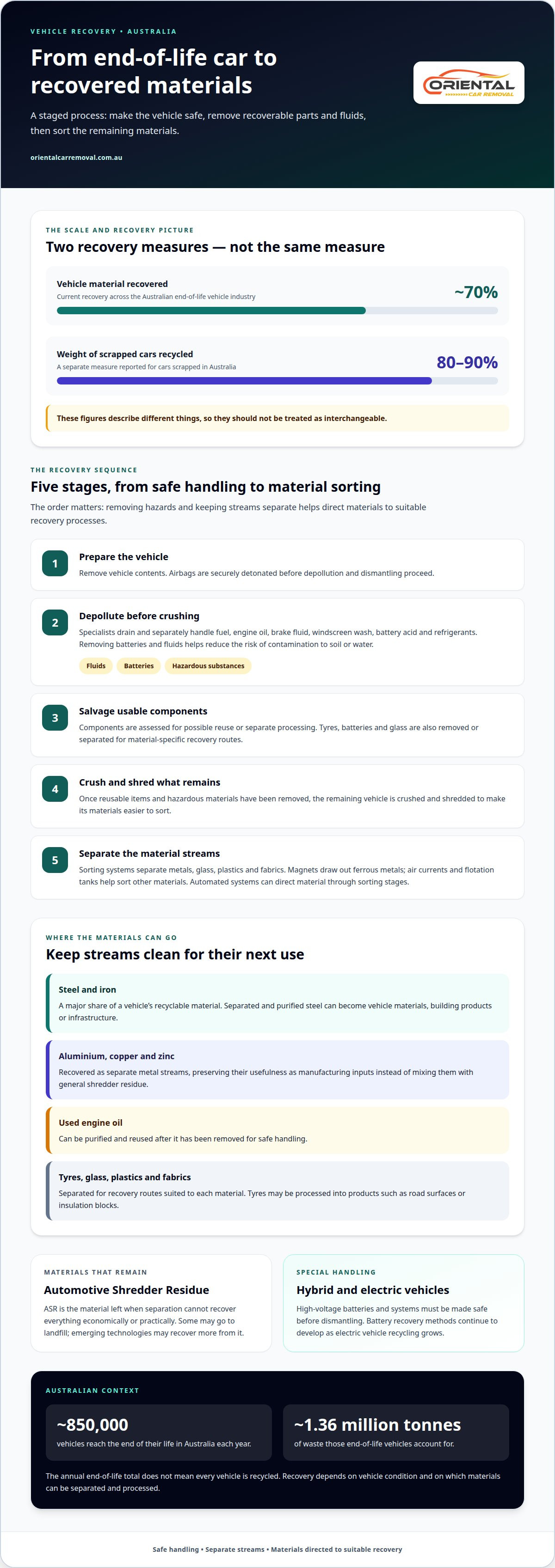
Car recycling keeps usable materials out of landfill and reduces the risks created by abandoned vehicles. In Australia, about 850,000 vehicles reach the end of their life each year, accounting for approximately 1.36 million tonnes of waste. Recovering metals, components and other materials can reduce demand for newly mined resources and limit waste that needs disposal.
The process involves removing reusable components and hazardous substances, then separating materials for recovery. Steel and aluminium can return to manufacturing, while tyres may be processed into products such as road surfaces or insulation blocks. Removing batteries and fluids before crushing helps prevent harmful substances from contaminating soil or water. Materials that cannot be recovered may still require disposal.
Australian policy also signals a broader focus on waste recovery. The 2019 Australian Government Waste Action Plan set a target to recover 80% of all waste by 2030, according to the Australian Government Department of Climate Change, Energy, the Environment and Water. A proposed Australian end-of-life vehicle scheme covers passenger vehicles and light commercial vehicles up to 3.5 tonnes. This proposal reflects attention to vehicle waste, but it should not be mistaken for a recycling rate or a rule requiring every vehicle to be recycled.
Hybrid and electric vehicles need a different safety approach during decommissioning. Their high-voltage battery and other high-voltage systems must be made safe before dismantling. Electric vehicle recycling is relatively new to the scrap industry, and battery recovery methods continue to develop. As more electric vehicles reach the end of their useful lives, safe handling and effective battery recovery will become increasingly important to the sector.
To choose a car recycler or auto wrecker in Australia, look for a licensed, transparent operator that uses safe, environmentally conscious methods. Clear information about fluid removal, battery handling and material recovery helps you understand how the vehicle will be processed.
Car recycling in Australia involves depolluting the vehicle, salvaging usable components, crushing what remains and separating materials for recovery. Around 80-90% of the weight of cars scrapped in Australia is recycled, while the end-of-life vehicle industry currently recovers about 70% of vehicle material. These figures describe different measures, so they should not be treated as interchangeable.
About 850,000 vehicles reach the end of their life in Australia each year, but that figure does not mean every one is recycled. The share recovered depends on the vehicle’s condition and the materials that can be separated and processed. For readers, the environmental benefit comes from keeping recoverable metals and parts in use, while safely managing materials that could cause pollution.
Materials recovered from end-of-life vehicles
Recovery starts by making the vehicle safe, then separating components and materials into usable streams. The order matters because fluids, mixed materials and contamination can affect what is recovered.
Dismantling and shredding vehicles
Dismantling removes contents, reusable components and hazardous materials before the remaining vehicle is crushed and shredded. This staged process keeps recoverable items separate and makes the remaining material easier to sort. Before depollution, vehicle contents are removed and airbags are securely detonated. Specialists then drain fluids and remove components for reuse or separate processing.
Sorting and separating recovered materials
Sorting separates shredded material into streams such as metals, glass, plastics and fabrics. Magnets draw out ferrous metals, while air currents and flotation tanks help separate other materials. Automated systems can direct material through sorting stages. Cleaner, distinct streams are easier to send to suitable recycling processes, while mixed material can be harder to recover.
Steel and iron make up a major share of a vehicle’s recyclable material. Once separated and purified, recovered steel can become vehicle materials, building products or infrastructure. Aluminium, copper and zinc can also be recovered as separate metal streams. Keeping these metals apart preserves their usefulness as manufacturing inputs instead of leaving them mixed with general shredder residue. A key measure of car recycling success is how well each stream is kept clean for its next use.
Depollution happens before crushing. Specialists remove fuel, engine oil, brake fluid, windscreen wash, battery acid and refrigerants for safe handling and storage. These materials need separate treatment because leaks can contaminate land or water. Used engine oil can be purified and reused. Tyres, batteries and glass are also removed or separated, with each following a recovery route suited to its material.
After shredding, the remaining mix can include plastics, glass, fabrics and small metal fragments. Magnets, air currents and flotation tanks help recover useful portions. Automotive Shredder Residue, or ASR, is material left when separation cannot recover everything economically or practically. Some residue may go to landfill, while emerging technologies may recover more from it. This sorting supports car recycling success by directing recovered materials to a suitable next stage.
The process works best when each material is directed to the right next stage. An unwanted vehicle can contain recoverable metal alongside fluids and residue that need separate handling. For a vehicle ready to leave the road, scrap car removal can be a practical starting point for its recovery journey.
More than 25 million tons of material are recycled from old vehicles each year. More than 14 million tons of recycled steel are derived from junk vehicles each year. Recovered car steel and aluminium can be reused in new vehicles and construction materials.
Car battery recycling can recover near 100% of materials for making new batteries. Car recycling specialists drain vehicle fluids and disassemble cars into recyclable sections before purifying metals for reuse. Automotive Shredder Residue contains materials difficult or expensive to recycle and may go to landfill or be processed with emerging technologies.
Dismantling and resale of reusable parts
Before a vehicle is crushed, dismantlers assess whether its components can be reused. This keeps serviceable parts in circulation and separates them from material destined for metal recycling. A damaged vehicle may still contain a working transmission, intact wheels or usable electronic components. The condition of each item matters more than the vehicle’s overall appearance.
Reusable parts commonly include engines, transmissions, tyres and catalytic converters. Dismantlers remove and clean these components, then test their function before resale. A part that works correctly and shows limited wear may suit another vehicle. An item that is cracked, badly corroded or damaged in a collision may instead be directed to material recovery.
Testing helps distinguish parts suitable for reuse from those that need further processing. For example, an engine can be inspected for visible damage and operational condition, while a transmission needs assessment as a separate component. Tyres are judged by their condition, and catalytic converters are removed for their recoverable materials. The inspection determines the next step for each part.
Compatibility also matters to the person buying a reused component. Vehicle make, model, year and part specifications can affect whether a component fits and functions as intended. Recyclers identify and sort parts so buyers can match them to their vehicles. Reuse can extend a component’s service life and avoid the energy and materials involved in producing a replacement from new resources.
Recycled auto parts can cost less than comparable new parts, but the difference varies with the component’s condition, demand and availability. A clean, tested component in strong demand may retain more value than a damaged or uncommon item. Buyers should also consider the part’s age, wear and suitability for the intended vehicle.
Scrap car prices in Australia depend on the vehicle’s condition, weight, recoverable materials and reusable components. Demand for those materials and the work needed to recover them also shape its value. A complete vehicle with components suitable for reuse can have a different recovery value from one with extensive damage or missing parts.
Salvaging parts before shredding also reduces the chance that usable components will be damaged in later processing. Once dismantlers remove selected items, the remaining shell can be prepared for metal recovery. Components that cannot be reused still contribute materials such as steel, aluminium or copper. The process therefore separates value by use: functioning parts may be resold, while unsuitable parts enter material recycling.
For vehicle owners, this process explains why a car’s condition and completeness matter during assessment. Age alone does not determine whether its parts can be reused. The most useful indicators are the condition of specific components and whether they can be identified, tested and matched to another vehicle.
Environmental benefits of scrap metal recycling
Recovering metal from end-of-life vehicles reduces the need to extract fresh ore. Steel, copper and aluminium can be recycled repeatedly without losing strength, making scrap a useful manufacturing input. In Australia, recovered metal is exported, while much advanced reprocessing takes place overseas. The environmental value depends on effective recovery and what happens in the next stages of processing.
Vehicle scrap is not just metal. Shredding and sorting can separate ferrous metals, non-ferrous metals, glass, plastics and rubber into different streams. Steel and iron are ferrous metals because they contain iron, and magnets help recover them from mixed fragments. Copper and aluminium need separate sorting, while glass and plastics require their own processing routes.
Recovered steel can return to vehicle manufacturing or become building materials and infrastructure. Aluminium can also be reused in manufacturing, while copper is valuable in electrical applications. Separating these metals matters because mixed scrap is harder to process into consistent material. Clean, distinct streams give manufacturers suitable feedstock and help keep useful resources in circulation.
Ferrous scrap from vehicles adds to the metal supply available for processing. Recyclers separate steel and iron from other materials, then send the recovered stream for further treatment. This supports manufacturing that uses recycled feedstock instead of relying entirely on newly extracted ore. The amount recovered from each vehicle depends on its material mix and how effectively the scrap is separated.
Recycling metals uses far less energy than producing them from newly mined materials. This advantage comes from avoiding some energy-intensive stages, including mining, transporting ore and processing it into usable metal. Recovered steel, for example, can be processed as scrap instead of starting with newly extracted iron ore. Energy demand still varies according to the metal and recycling process.
Non-metal recovery matters too. Glass can be separated for specialist recycling, while vehicle plastics may be sorted by material type. Tyres contain rubber that can be processed into products such as road surfaces or insulation blocks. These routes reduce the volume of vehicle material sent for disposal, although mixed shredder residue can still contain materials that are difficult or uneconomic to recover.
For Australian vehicle owners, metal recovery is part of a wider processing chain. A locally dismantled vehicle may produce scrap that is transported for further treatment before entering manufacturing. Transport and processing are part of that chain, alongside the resource savings from recovering metal. Effective separation helps direct each stream to a suitable next use and limits useful material left in mixed residue.
Hazardous fluids and oils reclaimed
Fluids are removed before an end-of-life vehicle is crushed because leaks can contaminate surrounding land and water. Fuel, engine oil, brake fluid and windscreen wash each need to be drained and kept separate. This depollution stage protects other vehicle materials from fluid contamination and prepares the shell for further processing.
Engine oil is one fluid with a potential recovery route. Dirty engine oil can be purified and reused rather than discarded with the vehicle. Keeping it separate from fuel, water and other fluids helps maintain its suitability for treatment. The oil’s condition and contamination affect the processing needed before reuse.
Fuel also needs careful removal. A damaged tank or vehicle can leave fuel where it shouldn’t be, creating a spill risk during dismantling and transport. Removing fuel before crushing helps prevent leaks and keeps it out of metal, plastics and other material streams. Fuel is stored separately for suitable handling rather than mixed with recoverable scrap.
Brake fluid and windscreen wash are removed as part of the same depollution work. Although they serve different purposes inside a vehicle, both can spread if containers or lines are damaged during dismantling. Separate collection prevents these fluids from soaking into the vehicle shell or mixing with oil. It also keeps liquid waste distinct from parts and scrap metal.
Battery acid needs separate attention because car batteries contain lead and sulphuric acid. If a battery goes to landfill or is damaged during processing, these substances can pollute land. Removing it before crushing helps control that risk and allows it to follow a battery recovery route. Hybrid and electric vehicles add another consideration: their high-voltage batteries and systems must be made safe before dismantling.
Refrigerants are also removed before the vehicle shell is processed. They are held in safe storage rather than released during dismantling. This matters because a damaged air-conditioning system can release refrigerant as the vehicle is taken apart. Separating it early keeps its removal distinct from crushing and metal recovery.
Effective fluid recovery depends on sequence and separation. First, specialists identify and drain the vehicle’s fuel, oils and other liquids. They keep each material separate, then direct it to appropriate storage, treatment or reuse. A spill or mixed collection can complicate processing and contaminate other recoverable materials, such as steel or plastics.
For an unwanted vehicle, proper depollution is a key part of responsible scrap car removal. It helps ensure fluids are managed before the vehicle moves on to crushing and material recovery.
Oriental Car Removal
Oriental Car Removal helps owners move unwanted vehicles on when keeping or repairing them no longer makes sense. It buys cars, trucks, 4WDs and vans, and offers Cash for Cars, Cash for Trucks, Cash for 4WDs and Vans, and Free Car Removal. The team handles towing, paperwork and disposal, helping simplify the handover before the vehicle enters its next stage.
This can be a practical option for an unroadworthy, damaged or end-of-life vehicle that you’re ready to part with. You don’t need to manage the removal yourself. Contact Oriental Car Removal to discuss your unwanted vehicle and the next step.
Take the next step with confidence
Choosing what happens to an unwanted vehicle is a practical decision with an environmental impact. If you’ve finished using yours, decide whether you’re ready to arrange its removal or need more time. A clear decision helps you move on without leaving an unused vehicle occupying space or delaying its next stage.
Car recycling success depends on each vehicle entering a suitable recovery process. Your next step can be straightforward: contact Oriental Car Removal to discuss your vehicle and the available way forward. You can raise whether it’s a car or truck and explain its current condition, so the conversation can focus on your situation.
There’s no need to overcomplicate the decision. Choose a next step that suits your plans, then put the vehicle behind you with confidence.
Frequently Asked Questions
What Is Car Recycling?
Car recycling is the recovery of usable components and materials from a vehicle that’s no longer wanted or roadworthy. For example, a dismantler may remove a working engine or transmission before sending the remaining shell for metal recovery. Fluids and batteries are handled separately. The aim is to keep suitable parts and materials in use rather than treating the entire vehicle as rubbish.
What percentage of a car can be recycled or recovered?
Around 80-90% of the weight of cars scrapped in Australia is recycled. This figure describes vehicle weight, not the proportion of every individual car that will be recovered. The outcome depends on what can be separated and processed, including metals, tyres, glass and reusable components. Materials that are difficult to recover may remain as shredder residue and require disposal or further processing.
How much can you get for a scrap car in Australia?
There’s no single amount for every scrap car. Its value depends on factors such as the vehicle’s weight, condition, recoverable metals and components that can be salvaged. A complete vehicle with reusable parts may be assessed differently from one that’s badly damaged or missing components. Oriental Car Removal offers cash for unwanted vehicles; the amount depends on the vehicle being assessed.
How do I recycle or dispose of an old car in Australia?
Start by deciding whether the vehicle is ready to leave your ownership, then arrange removal through a vehicle recycling service. Remove personal belongings and any items you need to keep before collection. The vehicle can then be assessed, depolluted and processed for reusable components and materials. In Perth, Oriental Car Removal provides free vehicle removal for owners ready to move on from an unwanted car.
What environmental benefits and risks are associated with car recycling?
Recycling can conserve resources by returning metals to manufacturing and reducing demand for newly mined ore. It also keeps some vehicle waste out of landfill. Risks arise if oil, fuel, battery acid or refrigerants leak during handling, or if tyres are dumped or burned. Proper depollution and separation help control these hazards, while unrecoverable shredder residue may still need disposal.