
How to lodge a WA vehicle notice of disposal on time

How to lodge a WA vehicle notice of disposal on time

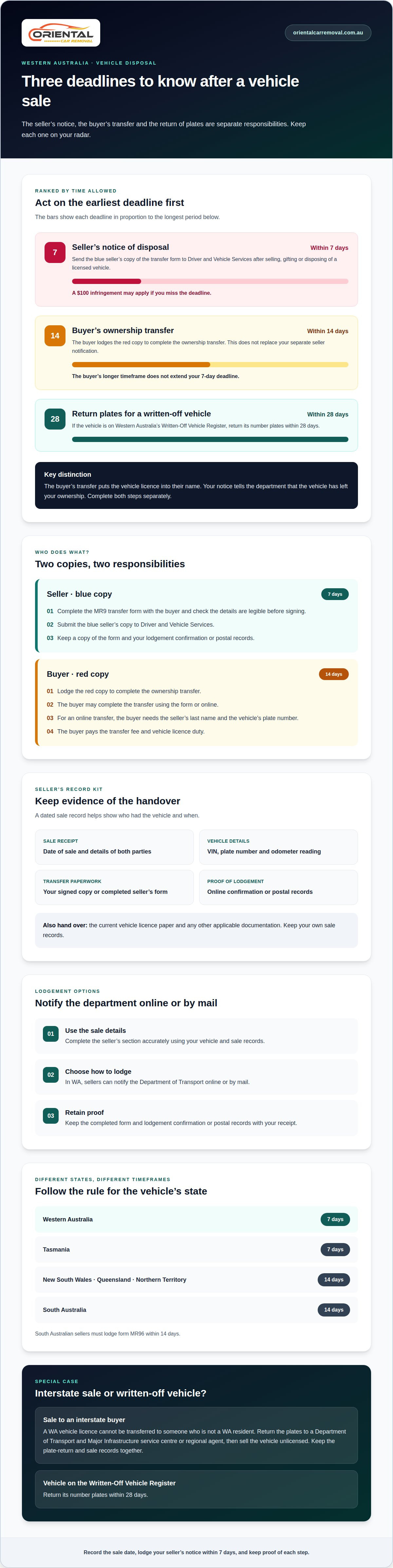
Selling a wrecked car to a wrecker doesn’t remove your reporting step. For a notice of disposal for a WA vehicle, send the blue seller’s copy of the transfer form to Driver and Vehicle Services within 7 days of selling, gifting or disposing of it. A $100 infringement may apply if you miss the deadline.

It’s easy to assume the buyer takes care of everything once the vehicle is gone. But the buyer’s ownership transfer and your notice of disposal are separate steps, so complete your part promptly.

This guide explains who lodges each part of the transfer, how to notify the Department of Transport online or by mail, and what to do with the plates when a vehicle is written off. You’ll also learn what sale records to keep so you can complete the paperwork with confidence.

Key Takeaways

  • The buyer handles the ownership transfer, but you must lodge your seller’s copy of the transfer form separately.
  • Keep a dated sale receipt with both parties’ details and the vehicle’s identifying information as a record of the handover.
  • You can notify the Department of Transport online or by mail. Choose the method that suits your sale and keep proof of lodgement.
  • If the vehicle is on Western Australia’s Written-Off Vehicle Register, return its number plates within 28 days.
  • Before disposing of a wrecked vehicle, understand what happens to its plates and any unused vehicle licence period.

Buyer responsibility for transferring vehicle ownership

If the buyer doesn’t transfer the vehicle into their name, lodge your blue seller’s copy with Driver and Vehicle Services within 7 days of the sale. Keep a dated receipt and your transfer records as evidence of the handover.

  1. Complete the MR9 transfer form with the buyer. In a Western Australian sale using form MR9, give the buyer the red copy and submit the blue copy yourself. Both copies record the change of ownership, but each party has a separate responsibility. Check that the vehicle and buyer details are legible before signing.
  2. Give the buyer the vehicle documents. Provide the current vehicle licence paper and any other applicable documentation. The buyer uses the transfer details to put the vehicle licence into their name. Keep your own record of the sale, including a dated receipt naming both parties and recording the vehicle’s VIN and odometer reading.
  3. Make sure the buyer completes their transfer. The buyer must lodge the red copy within 14 days after the sale. They can complete the transfer using the form or online. For an online transfer, they need your last name and the vehicle’s plate number. The buyer submits the Notice of Change of Ownership to complete the transfer.
  4. Understand the buyer’s costs and registration task. The buyer must pay the transfer fee and vehicle licence duty. The transfer updates the vehicle licence record; it does not replace your separate seller notification. Submit your blue copy within 7 days, even if the buyer says they will handle the paperwork.
  5. Keep the records that show when the vehicle left your possession. Retain your signed copy or sale receipt, the buyer’s details, the sale date, and the vehicle identifiers. These records help establish who held the vehicle and when if ownership records remain unchanged after the sale.
  6. Handle an interstate sale differently. A Western Australian vehicle licence cannot be transferred to someone who is not a WA resident. For a sale to an interstate buyer, return the plates to a Department of Transport and Major Infrastructure service centre or regional agent, then sell the vehicle unlicensed. Keep the plate-return and sale records together.

Vehicle transfer paperwork has two parts: the buyer completes the ownership transfer, while you notify the department that you’ve sold or disposed of the vehicle. Lodging your notice promptly helps keep the records clear, even if the buyer has not yet submitted their copy.

How long to lodge a notice after selling my car?

  1. Start with Western Australia’s seven-day deadline. Send the blue seller’s copy of the vehicle transfer form to Driver and Vehicle Services within 7 days after selling, gifting or disposing of a licensed vehicle. The deadline applies to you as the seller, even if the buyer intends to lodge their copy promptly. Lodge it on the day of sale where possible, rather than waiting until the final day.
  2. Keep the buyer’s deadline separate. The buyer has 14 days after the sale to lodge the red copy and complete their ownership transfer. That period does not extend your seven-day seller notification deadline. For example, if you sell on Monday, organise your own paperwork immediately instead of waiting for the buyer’s transfer to appear in the records.
  3. Choose a lodgement method and retain evidence. In WA, sellers can notify the Department of Transport of a vehicle sale online or by mail. Complete the seller’s section accurately, using the sale details and vehicle information from your records. Keep a copy of the completed form and any lodgement confirmation or postal records. These help show when you notified the department.
  4. Act before the deadline to avoid an infringement. A $100 infringement may be issued if you miss WA’s seven-day deadline. Don’t assume that handing over the keys, registration papers or signed form completes your notification. The buyer’s transfer and your seller notice are different actions, so complete and lodge your part separately.
  5. Check the rule for the state where the vehicle is registered. Deadlines differ across Australia. Tasmania’s seller deadline is 7 days; New South Wales, Queensland and the Northern Territory each allow 14 days. South Australian sellers must lodge form MR96 within 14 days. These comparisons show why a WA seller should follow the local seven-day period, not another state’s timeframe.
  6. Use the sale date as your paperwork trigger. Write the handover date on your receipt, then prepare the seller’s notice straight away. If the buyer needs time to organise their transfer, that does not change your deadline. Keep the receipt, signed form and lodgement record together so you can confirm the sequence of events.
  7. Respond promptly if you discover a missed deadline. Lodge the seller’s copy as soon as possible and keep the completed paperwork and sale records. The seven-day period is the required timeframe, and a late lodgement does not erase the missed deadline. Clear records can help explain when the sale occurred and when you submitted your notice.

Notice of disposal versus transfer of ownership

Keep your seller notification separate from the buyer’s ownership transfer. Both steps update vehicle records, but they serve different purposes.

In Western Australia, a notice of disposal tells the Department of Transport that you’ve sold or disposed of a licensed vehicle. Keep the confirmation or receipt from your online or mailed lodgement. If you lodged by mail, retain a copy of your paperwork as evidence of submission.

  1. Distinguish Disposal Notice from Ownership Transfer

    Submit your seller notification, then make sure the buyer completes the ownership transfer. With form MR9, you give the buyer the red copy and submit the blue copy. The buyer’s transfer puts the vehicle licence into their name; your notice tells the department the vehicle has left your ownership. Don’t treat one step as a replacement for the other.

  2. Check Whether the WA Notice Has Been Processed

    Check the lodgement confirmation or receipt against your sale records. Keep the vehicle plate number, sale date and a copy of the submitted form together. For an online lodgement, retain the confirmation shown after submission. For a mailed form, keep your copy and postal records. These documents help show what you sent and when.

  3. Use the WA process that fits your sale.

    Buyers and sellers can transfer vehicle ownership online or by form. An online transfer requires the seller’s last name and the vehicle plate number. The buyer submits the Notice of Change of Ownership to complete the transfer. To transfer a vehicle licence online, the seller needs a DoTDirect account. Some transactions cannot be completed online, including those involving joint ownership, heavy vehicles, optional plates, companies or mismatched records.

  4. Keep optional number plates in the transfer plan.

    If optional plates are sold with the vehicle, the buyer must transfer them into their name and pay the transfer fee. If you’re keeping the plates, exchange them at a Department of Transport and Major Infrastructure service centre or regional agent before the sale. Standard state or district plates stay with a vehicle sold to another driver.

  5. Note the different Queensland sequence.

    Queensland’s online transfer has two steps, with the seller required to lodge the disposal notice before the buyer attempts their transfer. Don’t apply that seller-first sequence to WA. In WA, lodge your seller notification and ensure the buyer completes their separate transfer. Each step updates a different part of the vehicle’s ownership records.
How to lodge a WA vehicle notice of disposal on time

How long to lodge a Notice of Disposal in Western Australia?

Submit the seller’s copy within 7 days of selling, gifting or disposing of a vehicle. In Western Australia, you can notify the Department of Transport online or by mail.

  1. Start with the sale date. Count from the day you sell, gift or dispose of the vehicle. The seller’s blue copy must reach Driver and Vehicle Services within 7 days. Lodge your notice of disposal for a WA vehicle promptly, leaving time to correct any errors and retain evidence. Don’t wait for the buyer to finish their separate transfer.
  2. Choose online or mail lodgement. Western Australian sellers can notify the Department of Transport online or by mail. Follow the relevant submission process and provide the sale and vehicle details accurately. Keep a copy of the form and your lodgement record. If you mail the seller’s copy, retain evidence of posting with your sale paperwork.
  3. Use form MR9 for a sale that uses it. Complete the seller’s section and give the buyer the red copy. Submit the blue copy as your notification. Check that the buyer’s details, vehicle plate number and sale information are clear before sending it. This notice of disposal for a WA vehicle records the seller’s notification, not the buyer’s transfer.
  4. Know what an in-person visit is for. A Department of Transport service centre or regional agent is relevant if you need to return number plates, such as for an interstate sale. The listed notification methods are online and mail. Keep plate-return paperwork separate from your seller notice, because returning plates and notifying the department serve different purposes.
  5. Understand the fee distinction. Western Australia does not charge a vehicle transfer fee when selling a car. The buyer is responsible for the transfer fee and vehicle licence duty when completing the transfer. Your seller notification records that the vehicle has left your ownership; don’t confuse it with the buyer’s transfer transaction.
  6. Submit online through the Department’s vehicle services. The seller can notify the Department of Transport online. DoTDirect is required for an online vehicle licence transfer, which is the buyer’s transfer process, not the seller’s disposal notice. Keep these tasks separate and save the confirmation generated for your own submission.
  7. Keep proof with your sale records. Store the lodged form or online confirmation alongside the dated receipt and vehicle details. If you submit by mail, keep the posting record too. These records help you confirm when you notified the department if the vehicle’s ownership record does not update as expected.

Written-off and wrecked vehicle disposal

  1. Record the vehicle’s status before arranging disposal. If it appears on Western Australia’s Written-Off Vehicle Register, note that status in your records. A wrecked vehicle can still involve separate disposal, plate and licence tasks. Keep the sale or handover date, the vehicle details and any insurer correspondence together. These records help you track each step without confusing the vehicle’s physical removal with its registration paperwork.
  2. Lodge your seller notification after disposal. Selling or disposing of a wrecked vehicle does not remove your seller-notification responsibility. Submit the blue seller’s copy within 7 days of disposal. Keep the lodgement record with your receipt, even if the vehicle is no longer driveable. The notification records that the vehicle has left your ownership; plate return is a separate action.
  3. Return plates for a vehicle on the register. For a vehicle on Western Australia’s Written-Off Vehicle Register, return its number plates within 28 days. Arrange the return through the Department of Transport and Major Infrastructure, then keep the receipt or other record of the return. Don’t assume a wrecker’s collection or the vehicle’s damaged condition completes this step for you.
  4. Keep accident evidence if you’re seeking a licence refund. A refund of unused vehicle licence fees can be backdated to the accident date if you provide a crash report or an insurer’s letter confirming the accident. Keep that document with the vehicle licence details and plate-return receipt. Without the supporting accident documentation, the refund’s effective date is the date the plates are returned.
  5. Separate the refund process from the ownership paperwork. The plate-return date can affect the effective date used for a refund of the remaining licence period. It does not replace the seller’s notification. File the notice, the plate receipt and any crash report or insurer letter together, so each record supports its own part of the process.
  6. Make the handover details clear. Record who received the wrecked vehicle, when it left your possession and its identifying details. A dated receipt naming both parties and recording the VIN and odometer reading can help establish ownership and timing. If the odometer cannot be read, don’t guess; retain the other accurate details and paperwork.
  7. Choose a disposal option that suits the vehicle. If a damaged car, 4WD or truck is no longer wanted, a wrecker may be a practical route for disposal. Keep the collection or sale receipt, then complete your own notification and plate steps. The vehicle’s condition does not merge those administrative tasks into one.

Arrange car wrecking in Perth

Oriental Car Removal: Cash for Cars

Oriental Car Removal is a practical option if you’re ready to dispose of an unwanted, damaged or written-off vehicle. It buys cars, trucks, 4WDs and vans, and provides free vehicle removal. The team handles the removal and disposal paperwork, helping simplify the handover.

Keep your WA obligations separate: lodge your seller notification and, if the vehicle is on the Written-Off Vehicle Register, return its plates within the required timeframe. Keep your sale receipt and any plate-return record with your paperwork.

If your vehicle is no longer worth keeping, contact Oriental Car Removal or visit its website to discuss the next step.

Close the paperwork and move forward

Once the vehicle has changed hands, finish the remaining administration. Treat lodging a notice of disposal for your WA vehicle as part of closing the sale, not an afterthought. Keep your records together to avoid loose ends in the ownership paperwork.

If you’re also ready to dispose of another unwanted vehicle, Oriental Car Removal can help with the next step. Choose the option that suits your vehicle and arrange its removal when you’re ready.

Complete the handover, keep your paperwork organised and move ahead with confidence.

Frequently Asked Questions

Do I still need to lodge it if I sold the car to a wrecker?

Yes. Selling to a wrecker doesn’t remove your responsibility to notify the department that you’ve disposed of the vehicle. Keep the handover receipt, including the date and vehicle details, with your submitted notice. Contact your insurer about your policy too, because lodging the notice doesn’t automatically cancel your insurance. The vehicle’s destination doesn’t replace these separate administrative steps.

Is a Notice of Disposal the same as a Bill of Sale?

No. A Notice of Disposal tells the department that you’ve sold or disposed of a vehicle. A bill of sale or receipt records the agreement between you and the buyer, such as the parties, sale date and vehicle identifiers. Keep both records where available. For example, the department notice records the disposal, while your receipt can help show when the handover happened.

How do I lodge a notice of disposal for a vehicle in WA?

Submit the seller’s copy of the transfer paperwork to the Department of Transport online or by mail. For a sale using MR9, the seller submits the blue copy and gives the buyer the red copy. Check that the sale date and vehicle details are readable before lodging. Save your confirmation or a copy of the paperwork with the sale receipt for your records.

How long do I have to notify WA Transport of a vehicle sale or disposal?

You have 7 days after selling, gifting or disposing of the vehicle to send the seller’s copy to Driver and Vehicle Services. Treat the handover date as the start of your deadline, even if the buyer plans to complete their transfer later. For example, after a weekend sale, organise your notice promptly rather than waiting for the buyer’s paperwork or a reminder.

What details and documents are needed to lodge a WA notice of disposal?

Have the vehicle’s plate number and sale details ready, and use the seller’s copy of the transfer paperwork. For your records, retain a receipt naming both parties and noting the VIN and odometer reading. A vehicle transfer may require other identifying details, such as the make, model and engine number. Don’t guess; use the vehicle documents and your sale records.

What should the seller and buyer do after a vehicle sale in Western Australia?

The seller lodges the seller’s copy, while the buyer completes the ownership transfer using their copy. Keep the handover date and signed paperwork accessible in case either party needs to resolve a record mismatch. The buyer’s transfer fee and vehicle licence duty are separate from the seller’s notification. If the sale includes optional plates, the buyer must transfer them into their name.

How do I notify WA of a vehicle disposal if I sold it privately, traded it in, or scrapped it?

Use the same seller-notification process for a private sale, trade-in or scrap disposal: submit the seller’s copy and keep evidence of the handover. Record who received the vehicle and the disposal date, then retain a receipt or other sale record. If the vehicle is written off and appears on WA’s Written-Off Vehicle Register, treat returning the plates as a separate requirement.

What happens if I do not lodge a WA notice of disposal on time?

Missing the 7-day seller-notification deadline may result in a $100 infringement. Lodge the paperwork as soon as you realise it’s overdue, and keep your sale receipt and submission record together. These records can help establish the disposal date and show the steps you took. Don’t assume the buyer’s transfer, a trade-in or a wrecker’s collection has completed your notification.

Cash for Cars Success: Selling a Written-Off Vehicle

Cash for Cars Success: Selling a Written-Off Vehicle

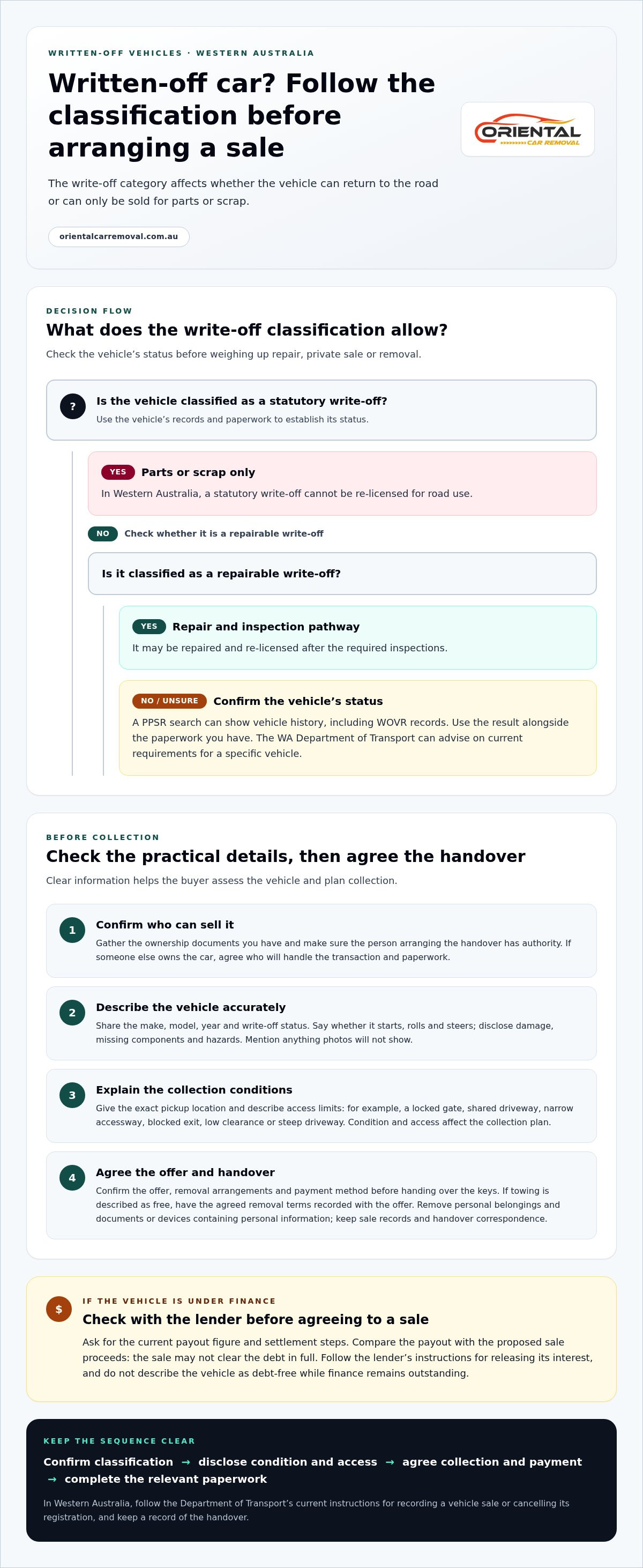
Cash for cars in Success can be an option for a written-off vehicle, but its classification affects what can happen next. In Western Australia, a statutory write-off can only be sold for parts or scrap and can’t be re-licensed for road use. A repairable write-off may be repaired and re-licensed after required inspections.

It’s understandable to want a clear answer before arranging a sale, especially if the car is damaged or hard to move. This guide explains what to prepare and how removal compares with a private sale, including paperwork and payment. If you’re considering cash for cars in Success, these practical steps can help you decide what to do next.

Key Takeaways

  • A written-off vehicle may be sold, but its classification affects whether it can return to the road or be sold only for parts or scrap.
  • Before arranging collection, gather available ownership documents and explain access issues such as a narrow entrance or blocked driveway.
  • Describe whether the vehicle starts, rolls or steers, and disclose known damage, missing parts and hazards when requesting an offer.
  • Before handover, remove personal belongings and information-bearing documents or devices, then confirm the offer, removal details and payment method.
  • Compare removal with a private sale by considering the vehicle’s condition, collection logistics and the paperwork involved.

1. Can I sell a written-off car for cash in Success?

Yes, a written-off car in Success may still be sold for cash, but its write-off classification affects what can happen next. In Western Australia, a statutory write-off can only be sold for parts or scrap and cannot be re-licensed for road use. A repairable write-off may be repaired and re-licensed after the required inspections. Identify the vehicle’s status before arranging a sale, as each category has a different outcome.

A PPSR search can show vehicle history, including WOVR records. Use the result alongside the paperwork you already have, rather than assuming a damaged car has a particular classification. The WA Department of Transport can advise on current requirements for a specific vehicle. This information matters when weighing a private sale against removal or deciding whether repairs are worth pursuing.

Before arranging collection, establish who is authorised to sell the vehicle. Gather the ownership documents you have and make sure the person arranging the handover has authority to do so. If someone else owns the car, agree on who will handle the transaction and paperwork. Clear ownership information helps the buyer arrange collection smoothly.

Access can shape the collection plan as much as visible damage. Tell the buyer if the car is behind a locked gate, in a shared driveway or on a narrow accessway. Mention a second vehicle blocking the exit, low clearance or a steep driveway. For example, a car that rolls but cannot turn through a tight entrance needs a different collection plan from one parked at the kerb.

Describe the vehicle’s condition plainly. Say whether it starts, rolls and steers, then disclose known damage, missing components and hazards. A flat tyre, broken steering or sharp body damage can affect loading arrangements. Don’t rely on photos alone if an important access obstacle or safety issue won’t be visible. Clear details help set practical expectations for collection.

Collection timing and coverage for a Success address depend on the vehicle’s condition, access and agreed arrangements. Set out the exact pickup location and any access limits when discussing timing. If towing is described as free, have the agreed removal terms recorded with the offer, so collection costs aren’t confused with the vehicle payment. The scrap car removal option is relevant when a written-off vehicle is destined for scrap rather than road use.

2. Selling a written-off vehicle for removal

Removal can be a practical option when damage makes a private sale difficult. In Western Australia, a statutory write-off can only be sold for parts or scrap and cannot be re-licensed for road use. A repairable write-off has a different pathway, subject to repairs and required inspections. The classification helps establish whether the vehicle is being sold for road use, parts or scrap.

A vehicle assessment does not guarantee an offer. Share the make, model, year and write-off status, then describe the damage accurately. Explain whether it starts, rolls and steers. Include missing components and any hazards that could affect loading. If the car is partly dismantled, describe what remains rather than relying on its original specifications.

Agree on the practical details before collection. Give the exact pickup location and explain access limits, such as a blocked driveway or restricted vehicle movement. Confirm the offer, removal arrangements and payment method with the buyer before handing over the keys. Remove personal belongings and documents or devices containing personal information. Keep your sale records and handover correspondence.

For a vehicle under finance, contact the lender before agreeing to a sale. Ask for the current payout figure and the steps for settling the loan. Compare that amount with the proposed sale proceeds, as the sale may not clear the debt in full. Follow the lender’s instructions for releasing its interest, and don’t describe the vehicle as debt-free while finance remains outstanding.

In Australia, transfer and registration procedures vary by state. In Western Australia, follow the Department of Transport’s current instructions for recording a vehicle sale or cancelling its registration, and keep a record of the handover. The WA Department of Transport is the relevant point of contact for advice about a specific vehicle’s requirements.

Keep the transaction in a clear sequence: disclose the vehicle’s status, provide accurate condition details, agree on collection and payment, then complete the relevant paperwork. A written-off vehicle may be assessed for removal, but its classification, condition and collection circumstances all matter. If the vehicle is destined for scrap, scrap car removal is one relevant option to consider for the next step.

Oriental Car Removal notes that statutory write-off vehicles cannot be re-registered once classified as statutory write-offs, so confirm the classification before discussing a removal or parts sale.

Vehicle makes, models and conditions accepted

Acceptance depends on the vehicle’s details, condition and intended use. Give the buyer the make, model, year and vehicle type. A small hatchback, commercial ute and four-wheel drive can have different parts, weight and recovery needs. Describe the exact vehicle rather than assuming every make or model will be accepted.

Condition matters just as much as the badge. Explain whether the vehicle starts, rolls and steers. Disclose accident damage, missing components, flat tyres and known hazards. For example, a car that won’t steer may need different loading arrangements from one that drives but has body damage. A clear description helps assess the vehicle and plan collection. Photos can show visible damage, but mention anything they don’t capture.

Buyers may assess vehicles beyond standard passenger cars. Describe whether you have a truck, 4WD, van or ute, and note its condition. If a vehicle is written off, explain its classification and whether it is being sold for parts or scrap. That classification affects the sale pathway.

How does a cash-for-cars buyer compare with a wrecker in Australia? The names alone don’t determine the outcome. Compare the proposed offer, accepted vehicle condition, collection arrangements and payment method. A wrecker may assess a vehicle for parts or scrap, while a buyer’s assessment can depend on its condition and intended destination. Provide the same vehicle details to each buyer for a clearer comparison.

Before accepting an offer, get clear answers about the transaction. Ask what vehicle details informed the offer, whether the amount depends on an inspection, and what happens if its condition differs from your description. Confirm who arranges collection, whether any removal cost applies, and how payment will be made. Agree on these points before handing over the vehicle.

  • Does the offer account for the disclosed damage and missing parts?
  • Is collection included in the agreed arrangement?
  • When and how will payment be made?

Is a particular buyer licensed, reputable and well reviewed? Those points are specific to each business, so a name or offer alone doesn’t establish them. Check relevant licence and insurance details, then read reviews for recurring comments about communication, collection and payment. Treat specific claims as things to verify, not assumptions.

Prepare the details once: vehicle identity, condition, write-off status and collection needs. That makes it easier to compare like with like, whether you’re selling a damaged hatchback or an unwanted work ute. Keep the agreed offer, removal plan and payment method clear before the handover.

Cash for Cars Success: Selling a Written-Off Vehicle

4. Digital sale paperwork and payment

For a car sale in Australia, gather available ownership documents and records showing who can sell the vehicle. In Western Australia, follow Department of Transport instructions for your circumstances. If finance remains, keep relevant lender correspondence with your sale records.

Digital copies can make records easier to organise. Photograph or scan the documents you already have, then check that names and vehicle details are readable. Keep the originals secure until handover. A digital copy helps you retrieve information, but don’t assume it replaces paperwork required for your transaction.

Match every record to the vehicle being sold. Compare the registration details and vehicle identification information on your documents with the car. If a name differs, or another person is arranging the sale, clarify who has authority to act. Share only the information needed to arrange the transaction, and avoid sending sensitive documents through an insecure channel.

Keep the sale terms in writing, whether they arrive by email, text or paper. Record the agreed offer, vehicle description, collection arrangements and payment method. If the buyer changes the offer after inspecting the car, ask for the revised amount and reason in writing before agreeing. This creates a clear record of what both sides accepted.

Confirm how payment will be made before collection. Ask whether it will be cash or an electronic transfer, and agree when payment is due. For a transfer, check your own account for the funds rather than relying only on a screenshot or payment notification. Keep the transaction record with the sale documents.

Before the vehicle leaves, remove personal items and documents or devices containing personal information. Check the glovebox, centre console, boot and storage compartments. Remove saved navigation addresses or paired-device details where possible. Keep your own copy of the agreed terms, payment record and collection confirmation.

A simple digital folder can hold the vehicle documents, written offer, messages and payment confirmation. Use a clear label, such as the vehicle registration, so you can find the record later. Don’t delete the conversation immediately after collection. If a question arises about the agreed amount or pickup, saved messages show the transaction details.

Make the handover a final check, not a rushed exchange. Confirm the vehicle being collected, the agreed payment method and that your personal belongings are out. Keep the records together after the sale. Clear documents and written terms help you track each step, from accepting the offer through payment and collection.

5. Cash offers for unwanted cars in Success

In Success, cash for cars gives owners a way to seek payment for an unwanted vehicle and arrange collection. You provide the car’s details, describe its condition and review the terms before handover. Start by giving a clear picture of the vehicle before comparing an offer.

An offer reflects more than the badge. Make, model, age, condition and usable components all help shape an assessment. A complete car differs from one missing its engine or wheels. Describe specific faults and missing items rather than calling the vehicle simply “old” or “damaged”.

For example, say whether the engine starts, the car rolls and it steers. Mention accident damage, flat tyres, missing keys or parts, and hazards. If it’s written off, state its classification. This information helps the buyer assess the vehicle’s likely destination, such as parts or scrap, and plan collection.

Compare the whole transaction, not just the cash amount. Ask whether the offer includes free collection, what could change it after inspection and how payment will be made. Confirm the terms before agreeing. A higher initial figure may not suit you if the final terms or collection arrangements don’t fit your situation.

A private sale and a removal sale involve different tasks. A private seller prepares an advert, handles enquiries and coordinates viewings. A removal sale centres on assessing the vehicle, agreeing on payment and arranging collection. If the car won’t start, has extensive damage or is difficult to move, compare how each option handles those practical needs.

What does cash for cars in Success involve? It gives owners a way to seek payment for an unwanted vehicle and arrange its removal. Review the offer and collection terms before handing over the car.

Use a short checklist before accepting: provide accurate vehicle details, disclose damage, confirm the amount, agree on collection and verify the payment method. Keep the written offer and transaction messages. If an inspection changes the offer, ask for revised terms before collection proceeds.

For a fair comparison, give each option the same make, model, condition and access details. Then weigh the proposed payment, removal arrangements and steps required from you. This makes it easier to decide whether cash for cars in Success suits an unwanted car that’s no longer practical to drive or sell privately.

Oriental Car Removal: Cash for Cars

Oriental Car Removal offers Cash for Cars and Free Car Removal for unwanted vehicles. If your written-off car is difficult to sell privately, these services offer a practical next step. Share its classification, condition and collection details so the transaction can be assessed clearly.

The business also offers Cash for Trucks and Cash for 4WDs and Vans. Describe the vehicle accurately, including damage or missing parts, before discussing an offer and removal arrangements. Keep the agreed payment method and collection details clear before handover.

For a written-off vehicle in Success, contact Oriental Car Removal to discuss the vehicle and arrange the next steps.

Choose your next step with confidence

Base your decision on what you need next, not just clearing the driveway. If the vehicle may return to road use, compare that pathway with selling it for removal. For a cash-for-cars sale in Success, start with a clear account of the vehicle and the outcome you want. That keeps the conversation focused on a practical choice, not a rushed handover.

Take time to review the terms and choose a route that suits your circumstances. A written-off car can feel like a complicated problem, but clear priorities make the next move easier to manage. You’re ready to proceed when you understand your options and feel comfortable with your decision.

Take it one step at a time. You can move forward with a choice that feels right for you.

Frequently Asked Questions

Can I sell a written-off car for cash in Success?

Yes, a written-off car in Success can be offered for sale, but its classification matters. A statutory write-off is limited to parts or scrap, while a repairable write-off may have a road-use pathway after repairs and required inspections. Share the classification and vehicle details upfront. If ownership is shared, make sure the person arranging the sale has authority to do so.

Can a statutory write-off be sold for removal in Western Australia?

Yes, a statutory write-off can be sold for parts or scrap in Western Australia, but it cannot be re-licensed for road use. Its classification determines the appropriate sale pathway. A PPSR search can show vehicle history, including WOVR records. Keep that result with your available vehicle documents, and describe the car as a statutory write-off when discussing a removal sale.

Can a written-off car be sold for removal in Success?

Yes, a written-off car in Success can be put forward for a removal assessment. Tell the buyer whether it is classified as statutory or repairable, and whether it has missing parts or major damage. For example, a car without wheels needs different loading arrangements from one that can roll. Give the pickup address and describe any access restrictions clearly.

Does a written-off car need to be running for collection?

A car can be assessed even if it won’t start. State whether it starts, rolls and steers, and mention issues such as a flat tyre or damaged steering. These details help determine how it can be loaded and moved. If the vehicle is stuck behind another car or inside a tight garage, explain that before agreeing on collection arrangements.

How do you decide what to pay?

An offer depends on the vehicle’s details and condition, rather than one standard amount. Make, model, year, damage, missing components and usable parts can all affect its assessment. A complete car and one missing key components present different salvage possibilities. Provide an accurate description and ask for the offer terms in writing before agreeing to collection.

How much is your salvage car worth?

Your salvage car’s value depends on its specific details, condition and what remains usable. For example, a damaged vehicle with intact components differs from one that has been partly dismantled. Share its make, model, year, write-off status and known faults when requesting an assessment. The price depends on the case and is provided after a quote request.

Is there a fee for the tow?

Oriental Car Removal provides Free Car Removal at no charge to the owner. Before collection, make sure the agreed arrangement covers the vehicle and pickup location you described. Tell the buyer about narrow access, blocked driveways or a car that cannot roll. Clear details help avoid confusion about the collection plan and payment at handover.

Private sale or a vehicle removal buyer?

A private sale means preparing an advert, handling enquiries and arranging viewings, while a removal buyer focuses on assessing the vehicle and collection arrangements. A private listing may suit a roadworthy car with time for prospective buyers to inspect it. For a damaged or immobile vehicle, compare the written offer, removal terms and payment method before choosing your preferred route.