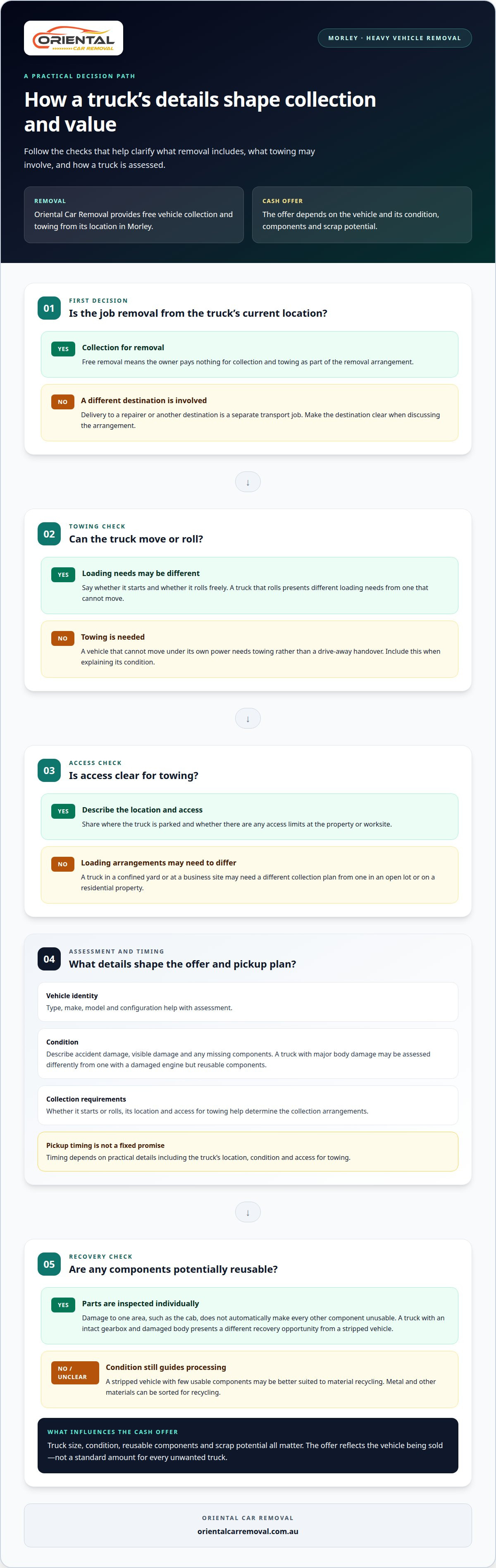
How to Transfer Vehicle Registration When Scrapping a Car in WA

How to Transfer Vehicle Registration When Scrapping a Car in WA

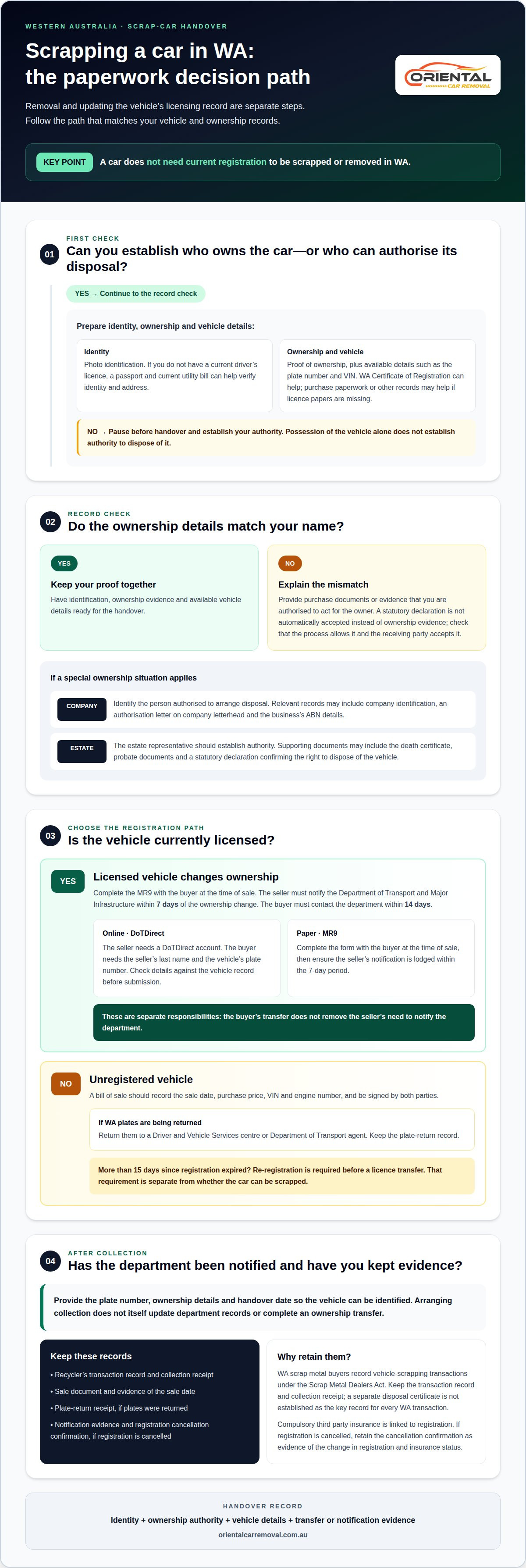
A scrap car doesn’t need current rego to be scrapped or removed in WA. If a licensed vehicle changes ownership, the seller must notify the Department of Transport and Major Infrastructure within 7 days, and complete the MR9 with the buyer at the time of sale. That’s the key distinction in how to transfer vehicle registration for a scrap car in WA: arranging removal and updating the vehicle’s licensing record are separate steps.

An expired licence doesn’t necessarily prevent you from scrapping a car in WA. The key is to document the handover and notify the Department of Transport so the vehicle’s ownership and registration records are clear.

This guide explains what documents to prepare, how the transfer paperwork works, how long you have to notify the department, and which records to keep after collection. You’ll also learn what to consider if the car is unregistered, the ownership details don’t match, or you need to return its number plates.

Key Takeaways

  • Learn which ownership and identity records can help a professional complete a scrap-car handover smoothly.
  • Understand why an expired licence doesn’t automatically prevent scrapping, and when a lapsed licence can affect transfer options.
  • See how the online and paper transfer routes differ, and what details help prevent delays in the paperwork.
  • Keep the right collection and plate-return records to document what happened after the vehicle leaves your hands.
  • Find out when a professional can help manage the removal and transfer paperwork for an unwanted vehicle.

How Long Do I Have To Transfer A Vehicle In WA?

In WA, the seller must notify the Department of Transport and Major Infrastructure within 7 days of the ownership change. The buyer must contact the Department of Transport within 14 days.

  1. Have a professional submit the buyer transfer

    Give the professional the vehicle details and the buyer’s name and address so they can prepare the transfer. The WA transfer can be handled online through DoTDirect or on the MR9 form. For an online transfer, the seller needs a DoTDirect account; the buyer needs the seller’s last name and the vehicle’s plate number. Confirm that the details match the vehicle record before submission.

  2. Have a professional notify the department after scrapping

    When a vehicle is scrapped, make sure the WA Department of Transport is notified. Provide the plate number, ownership details and handover date so the vehicle can be identified. Keep in mind that arranging collection does not itself update the department’s records or complete an ownership transfer.

    Compulsory third party insurance is linked to the vehicle’s registration. If the registration is cancelled, keep the cancellation confirmation with your records as evidence of the change in registration and insurance status.

  3. Meet both transfer deadlines

    Complete the MR9 with the buyer at the time of sale, then make sure the seller’s notification is lodged within 7 days. The buyer has 14 days to contact the Department of Transport. These are separate responsibilities, so the seller should not assume the buyer’s transfer removes the need to notify the department.

    For example, if a licensed vehicle changes hands on a Monday, the seller’s notification period starts from that ownership change. The buyer’s 14-day period is separate. Keep evidence of the sale date and submitted notification to help show when each step occurred.

  4. Handle an interstate sale before handover

    If the buyer lives interstate, return the WA plates to a Department of Transport and Major Infrastructure service centre or regional agent, then sell the vehicle as unlicensed. Returning the plates and selling the vehicle are separate steps. If the vehicle is relicensed in another state or territory, its WA licence is cancelled and no refund is payable.

    For a scrap handover, the professional can coordinate the vehicle details and notification steps with the seller. Keep the plate-return receipt and sale record, and don’t treat collection alone as proof that the department was notified.

Does a car need current rego before you can scrap it in WA?

No. A vehicle in WA does not need current registration to be scrapped or removed. Before handover, establish who owns it or who has authority to arrange its disposal.

  1. Provide identification and ownership evidence. Give the professional photo identification, proof of ownership and available vehicle details, such as the plate number and VIN. A WA Certificate of Registration can help establish ownership. If the vehicle licence papers are missing, purchase paperwork or other records can help show the ownership history. Possession of the vehicle alone does not establish authority to dispose of it.
  2. Explain any mismatch in the records. If the name on the vehicle documents differs from yours, provide purchase documents or evidence that you’re authorised to act for the owner. A statutory declaration isn’t automatically accepted instead of ownership evidence. Before relying on one, establish that the relevant process allows it and the receiving party accepts it. If you don’t have a current driver’s licence, a passport and current utility bill can help verify your identity and address.
  3. Gather company authorisation for a business vehicle. For a company-owned car, identify the person authorised to arrange disposal and provide relevant business records. These may include company identification, an authorisation letter on company letterhead and the business’s ABN details. This creates a clear record of who approved the handover, rather than relying only on the employee or driver presenting the vehicle.
  4. Prepare estate documents for an inherited vehicle. If the registered owner has died, the estate representative should establish their authority before arranging removal. Supporting documents may include the death certificate, probate documents and a statutory declaration confirming the right to dispose of the vehicle. Requirements depend on the estate circumstances, so gather records that show both the owner’s death and your authority to act.
  5. Record the sale and plan the plate return. For an unregistered vehicle, a bill of sale should record the sale date, purchase price, VIN and engine number, and be signed by both parties. A professional can include WA plate return in the handover plan; the plates must go to a Driver and Vehicle Services centre or Department of Transport agent. If registration expired more than 15 days ago, re-registration is required before a licence transfer, but that is separate from whether the vehicle can be scrapped.

For a straightforward handover, keep the identity, ownership and vehicle records together. If you need scrap car removal, provide those details so the professional can organise the paperwork around the vehicle’s circumstances.

Records to keep after vehicle collection

Keep a clear record of the handover, ownership change and registration updates. WA scrap metal buyers record vehicle-scrapping transactions under the Scrap Metal Dealers Act. A separate disposal certificate is not the key record established for every WA transaction, so retain the buyer’s transaction record and collection receipt.

  1. Save the transaction and collection records. Keep the recycler’s transaction record, receipt and any sale document together. The paperwork should identify the vehicle and show it was collected for scrapping. Store a digital copy as well as the original, using a clear file name with the plate number or VIN. If an ownership query arises later, these records can help connect the handover to the vehicle.
  2. Keep evidence of the registration updates. Save the seller notification confirmation, the completed MR9 copy or online transfer confirmation, and any message from the Department of Transport. These records show which notification was submitted and when. Keep them with the collection paperwork rather than relying on a verbal handover, because vehicle collection and a department update are separate events.
  3. File the number-plate return receipt. If you return the plates, retain the receipt issued by the Driver and Vehicle Services centre or Department of Transport agent. It helps show that the plates were handed back and supports your record of the vehicle’s licensing status. Keep it with the transaction record, especially if the vehicle’s licence or ownership details are queried later.
  4. Keep supporting ownership documents together. Retain purchase paperwork, the vehicle licence document, identification used for the handover, and any authority documents for company or estate vehicles. These records can explain why the person arranging disposal had the right to act. For example, an estate representative can keep probate paperwork with the vehicle’s collection receipt.
  5. Organise the file for later questions. Use one folder for the vehicle’s sale or disposal, collection date, buyer transaction record, plate return and Department of Transport updates. Note any outstanding registration issue, such as a notification awaiting confirmation. If the vehicle was sold interstate, include the sale paperwork and plate-return evidence so its WA licensing history is easy to follow.

Keep the records for as long as they may be needed to explain the vehicle’s disposal, ownership and registration in Western Australia. A complete file helps distinguish the scrap transaction from later licensing updates.
How to Transfer Vehicle Registration When Scrapping a Car in WA

Scrapping a registered or unregistered vehicle

In Western Australia, a car can be sold for scrap without current registration. If it’s written off or sold, arrange disposal only when you have authority, and keep records of the handover.

  1. Handle an unregistered vehicle

    Arrange the sale as an unregistered vehicle and provide identification and proof of ownership. A vehicle can be sold without registration, but it must not be driven on public roads without a special Temporary Movement Permit. Arrange transport rather than driving it to the buyer, and keep a sale record identifying the vehicle and both parties.

  2. Manage written-off or scrapped vehicles

    Confirm who has legal authority to dispose of a written-off vehicle before arranging collection. Its written-off status alone doesn’t establish who can sell or scrap it. If you’re the owner or authorised representative, keep supporting ownership or authority records with the sale paperwork. After handover, retain the buyer’s transaction record and any registration correspondence.

  3. Handle registration and number plates separately. For a registered vehicle, arrange the required registration cancellation with the Department of Transport WA after scrapping. Return the number plates to a Driver and Vehicle Services centre or Department of Transport agent. If registration has expired, plates must be returned within 14 days of expiry. Keep the return receipt as evidence that the plates are no longer with the vehicle.
  4. Consider whether a licence refund applies. A WA vehicle owner who returns the plates can apply for a refund of the remaining vehicle registration balance, less an administration fee. The refund takes effect from the date the plates are returned, unless an accident report or insurer letter confirms an earlier accident date. If selling to an interstate buyer and seeking a refund, return the plates before the sale.
  5. Keep the disposal file together. Save the sale record, collection receipt, plate-return receipt and Department of Transport updates. For an unregistered vehicle, record the sale date, price, VIN and engine number, with both parties’ signatures. For a registered vehicle, keep the vehicle licence details and cancellation correspondence in the same file. These records help explain the vehicle’s ownership and registration history if questions arise later.

Having a professional complete the vehicle transfer form

For a scrap vehicle with a WA licence, accurate paperwork connects the handover to the Department of Transport record. A professional can prepare an online transfer or MR9 form using details supplied by the seller and buyer. Understanding how to transfer vehicle registration for a scrap car in WA starts with choosing the right route for the transaction.

  1. Choose the transfer route. A WA vehicle licence transfer can be completed online or on paper. For an online submission, the seller needs a DoTDirect account. A paper transfer uses the MR9 form. The professional can use the details supplied by both parties and establish which route suits the transaction before submitting it.
  2. Provide the vehicle and applicant details. Supply the plate number, licence expiry date, odometer reading, make, model, body type, VIN or chassis number, and engine number. The applicant may need to provide identification details as part of the transfer paperwork. Vehicles from 2011 or newer require an odometer disclosure. Accurate identifiers help prevent mismatches between the form and the vehicle record.
  3. Complete the seller and buyer information. An online transfer needs the sale date, selling price, dutiable value, plate number, and buyer’s name and address. The buyer needs the seller’s last name and plate number to start an online transfer. Ensure these details match the transaction and vehicle records. This is a practical part of how to transfer vehicle registration when scrapping a car in WA.
  4. Sign and distribute the MR9 correctly. The MR9 has two halves, one for each party. For a paper transfer, make sure each party receives the appropriate copy. The professional can help complete the form with the buyer at the sale, then ensure each party receives the correct copy. Keep the seller’s copy with the disposal paperwork.
  5. Submit the form and retain proof. A paper MR9 can be lodged at a Driver and Vehicle Services Centre, a regional agent, or by post to Driver and Vehicle Services, GPO Box R1290, Perth WA 6844. Keep the completed form or online confirmation with the sale record. If the buyer receives no invoice or other communication within 21 days after lodgement, they should contact the Department of Transport and Major Infrastructure.

Oriental Car Removal: Scrap Car Removal

Oriental Car Removal provides scrap car removal when a vehicle is no longer worth keeping and you need help with its handover. The service includes towing, disposal and paperwork, helping bring the vehicle’s collection and records together. You’ll need to provide identification and ownership details so the handover can be properly documented.

Oriental Car Removal also offers Cash for Trucks for unwanted trucks. Free Car Removal takes care of transport, so you don’t have to arrange it yourself. Keep Department of Transport notifications and plate-return records with the collection paperwork, as these document separate parts of the process.

Contact Oriental Car Removal to discuss your scrap vehicle removal.

Make your vehicle handover the next step

Before arranging collection, decide who will manage each part of the handover and keep the paperwork connected. A clear plan for how to transfer vehicle registration for a scrap car in WA starts with sharing the vehicle details and ownership information with the professional handling its removal. That gives them the context to manage the collection and supporting paperwork without losing sight of the registration process.

Oriental Car Removal offers Cash for Cars for unwanted vehicles. Choose the removal service that suits your vehicle and keep a clear record of what has been arranged. To get started, contact Oriental Car Removal about your vehicle and its handover.

Frequently Asked Questions

What paperwork do you need to scrap a car in WA?

Prepare photo identification, proof of ownership or authority to act, and vehicle details such as the plate number and VIN. For a company vehicle, include business records showing who can authorise disposal. For an inherited car, estate documents can establish the representative’s authority. If names differ across the records, purchase paperwork can help explain the ownership history.

Can a professional complete the transfer online?

Yes. A professional can assist with an online WA transfer through DoTDirect when the transaction is eligible. The seller needs a DoTDirect account, and the buyer needs details such as the seller’s last name and the vehicle’s plate number. Some transfers, including certain company, joint ownership and deceased estate cases, cannot be completed online and require another process.

Can I sell my car without registration in Western Australia?

Yes. You can sell an unregistered vehicle in Western Australia, including for scrap. Establish ownership or authority to sell, and record the sale details in writing. Don’t drive the unregistered car on public roads without a special Temporary Movement Permit. If it cannot be legally driven, arrange collection instead.

Can you get a refund on remaining rego?

You may apply for a refund of the remaining WA vehicle licence balance after returning the number plates. For a sale to an interstate buyer, return the plates before the sale to be considered for a refund. The refund generally takes effect from the plate-return date. An accident report or insurer letter confirming the accident date can support an earlier date.

How do ownership and rego status change the WA paperwork checklist?

For a privately owned car, prepare identification and ownership evidence. A company vehicle also needs records showing who can authorise disposal, while an inherited car may need estate documents. Registration status affects the licensing paperwork, not whether the car can be scrapped. If the licence expired 15 or more days ago, the new owner needs an inspection and a new licence rather than a licence transfer.

What happens after you submit your documents?

After a vehicle transfer is lodged, the buyer should receive an invoice or other communication within 21 days. If nothing arrives in that period, the buyer should contact the Department of Transport and Major Infrastructure. The buyer must pay the invoiced transfer amount within 28 days. Keep the submission confirmation and transaction records together in case the paperwork needs follow-up.

How can a professional cancel vehicle registration in Western Australia when scrapping a car?

A professional can organise the disposal paperwork and notify the WA Department of Transport that the vehicle has been scrapped. Registration cancellation and vehicle collection are separate steps, so keep evidence of each. The owner should ensure the registration record is dealt with and return the number plates through the relevant WA process. Keep any department correspondence with the vehicle’s disposal records.

What documents are required to cancel WA vehicle registration?

Have the vehicle’s registration details, number plates and proof of ownership ready, along with identification for the person arranging cancellation. If someone is acting for a company or estate, include records showing their authority. Keep the plate-return receipt and any Department of Transport correspondence as evidence of the steps taken. Requirements can depend on who owns the vehicle and its circumstances.

Truck Wreckers in Fremantle for Cash Offers on Damaged Trucks

Truck Wreckers in Fremantle for Cash Offers on Damaged Trucks

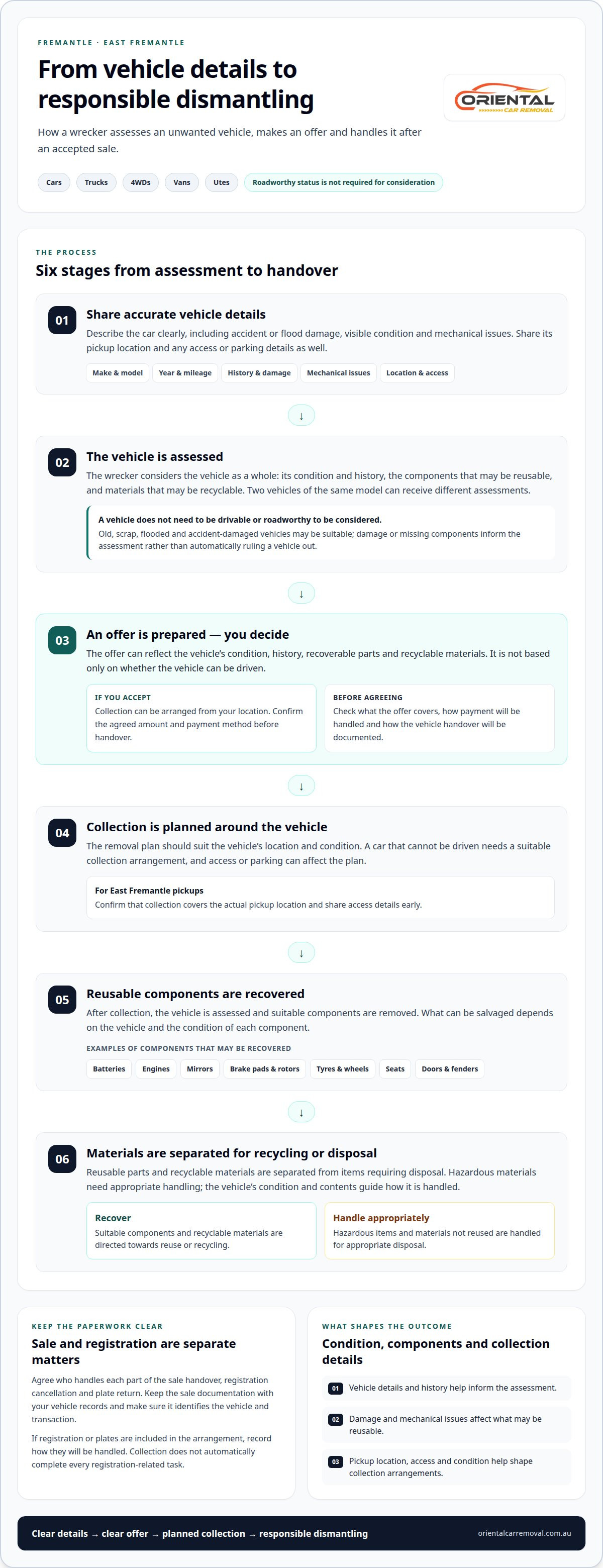
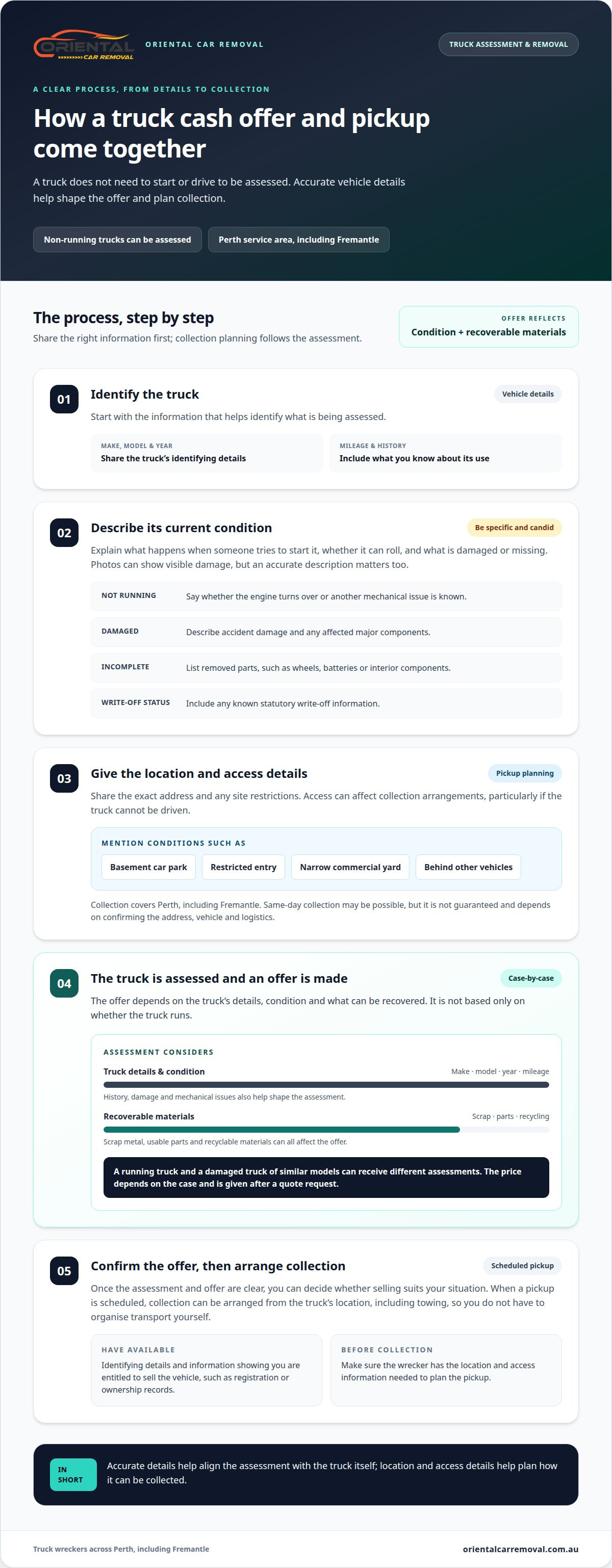
A truck that won’t start can still attract a cash offer. Truck wreckers in Fremantle assess details such as its make, model, year, condition, mileage, history, damage and mechanical issues. They consider the truck’s scrap metal, usable parts and recyclable materials when working out an offer, then arrange collection once a pickup is scheduled.

Before arranging truck wreckers in Fremantle, it helps to know the process. Share accurate details about the truck, receive an offer based on its condition and recoverable materials, then arrange removal without organising a tow yourself. The truck does not need to run for its condition and parts to be assessed.

This guide explains how wreckers assess trucks and make cash offers, what can affect the offer, and how removal works across Perth, including Fremantle. You’ll also learn what information helps with an assessment and how a professional truck-wrecking service can take care of collection when you’re ready to move on from the vehicle.

Key Takeaways

  • Truck removal services cover Perth, including Fremantle, but collection arrangements depend on the truck’s location and access.
  • Make, model, year, condition, mileage, damage and mechanical issues help shape a truck assessment.
  • Cash offers can reflect the truck’s scrap metal, usable parts and recyclable materials, not just whether it runs.
  • A scheduled pickup can include towing and collection from the truck’s location, helping avoid arranging transport yourself.
  • Oriental Car Removal buys trucks and provides free removal, giving you a straightforward next step for an unwanted vehicle.

Perth service areas, including Fremantle

Truck wreckers in Fremantle can assess trucks across Perth and arrange collection from the vehicle’s location. Access matters: a truck in a driveway presents different requirements from one behind a workshop or in a narrow commercial yard. Include the address and any site restrictions when describing the truck.

Perth truck wreckers can assess non-running, damaged and unwanted vehicles for a cash offer. The assessment can take the truck’s condition and recoverable materials into account, not just whether it starts. Share the make, model, year, location and known damage so the wrecker can understand the job before arranging collection.

Same-day collection may be possible in Perth, but it is not guaranteed and depends on confirming the address, vehicle and logistics. In Fremantle, mention details such as a basement car park, restricted entry or a truck positioned behind other vehicles. This helps plan a suitable pickup, especially if the truck cannot be driven.

Car wrecking services follow a similar practical process. A wrecker assesses the vehicle, considers usable components and recyclable materials, then arranges collection. Car parts may be salvageable, but that does not mean every part is suitable for reuse. Truck wreckers Perth and car wreckers Perth handle different vehicle types, so give an accurate description when arranging an assessment.

Fremantle is included in Perth-area vehicle removal information, including the local car removal service in Fremantle. For either truck or car collection, the vehicle’s exact location and access route are useful details to share. They help establish whether a standard pickup can reach the vehicle or whether site conditions need extra planning.

  • Share the truck’s make, model, year and condition.
  • Give the pickup location and describe access restrictions.
  • Explain whether the truck starts, rolls or has major damage.
  • Arrange collection after the assessment and offer.

For a truck sale or scrap collection, provide identifying details and information showing you’re entitled to sell the vehicle, such as registration or ownership records. Have available records ready for the sale process. Oriental Car Removal handles the transaction paperwork at no charge to the owner.

A Fremantle address alone does not establish whether a wrecker is licensed or follows environmental requirements. Check the specific business’s credentials and how it handles collection and disposal. Oriental Car Removal is licensed and insured, and recycles vehicles in an environmentally friendly way.

Before buying a used truck part, match the part number and fitment to the truck’s make, model and year. Check the part’s condition and return terms before purchase. Components that look similar may not suit different truck configurations, so accurate identification matters.

Buying non-running and damaged trucks

A truck does not need to start or drive to be assessed for a cash offer. The assessment considers its make, model, year and condition, along with damage, mileage, history and mechanical issues. A damaged truck may still have usable components or recyclable materials. An older truck with major engine trouble may be assessed differently from a newer vehicle with accident damage.

Clear details help the assessment reflect the truck you’re selling. Describe what happens when someone tries to start it, whether it can roll, and which parts are damaged or missing. Mention issues such as a failed engine, collision damage, a damaged gearbox or missing wheels. Photos can show visible damage, but an accurate description matters too.

The offer depends on the truck’s condition and what can be recovered from it. Scrap metal, usable parts and recyclable materials can all affect the assessment. The price depends on the case and is given after a quote request; the truck’s make, model, condition, damage and recoverable materials shape the offer.

  • Non-running: Explain whether the engine turns over or the truck has another mechanical issue.
  • Accident-damaged: Describe the affected areas and whether major components are missing.
  • Incomplete: List removed parts, such as wheels, batteries or interior components.
  • Hard to access: Explain where the truck is parked and whether it can be reached for collection.

A straightforward enquiry starts with the truck’s identifying details and a candid description. Share its make, model and year, then explain its history and current condition. If it has been in an accident or has a known mechanical fault, include that information before an offer is made. This helps avoid a mismatch between the description and the truck being assessed.

Some trucks are classified as statutory write-offs. According to the Department of Transport and Major Infrastructure, statutory write-off vehicles cannot be repaired or relicensed and may only be used for parts or scrap metal. That status affects whether a truck is considered for reuse or dismantling, so include any known write-off information when describing it.

Once the assessment and offer are clear, you can decide whether selling suits your situation. If the truck is no longer practical to keep, review the truck sale and removal options available and provide the vehicle details for an assessment.

Cash offers for trucks

A cash offer reflects the vehicle’s condition and what can be recovered from it. The assessment considers its make, model, year, mileage, history, damage and mechanical issues. Scrap metal, usable parts and recyclable materials also matter. A running truck and a damaged truck of similar models can therefore receive different assessments.

Give a clear account of the truck before accepting an offer. Explain whether the engine runs, describe accident damage and mention missing components. Include the vehicle’s location and access details too. This helps the wrecker assess the actual truck rather than relying on a broad description such as “old truck”.

The price depends on the case and is given after a quote request; the truck’s make, model, condition, damage and recoverable materials shape the offer. A truck with valuable reusable components may be assessed differently from one that is mainly suitable for scrap. No single condition label tells the whole story.

To compare truck wreckers in Fremantle, use the same vehicle details when requesting offers and ask what each assessment accounts for. Compare the full arrangement, including collection, rather than the cash amount alone. A clear explanation of how condition and recoverable materials affect an offer makes the comparison more useful.

  • Vehicle identity: Provide the make, model and year so the truck is assessed accurately.
  • Condition: Explain starting problems, mechanical faults and visible damage.
  • Completeness: Mention removed or damaged parts that could affect recoverable value.
  • Collection: Include the pickup location and any access restrictions when discussing the offer.

For example, a truck with a failed engine may still have components suitable for reuse, while severe damage can change what remains recoverable. A statutory write-off has a different status: according to the Department of Transport and Major Infrastructure, it cannot be repaired or relicensed and may only be used for parts or scrap metal. Share any known write-off information during the assessment.

Keep the comparison consistent. Use the same make, model, year, condition details and collection location for each assessment you review. Then consider whether the offer reflects the truck’s condition and whether the pickup arrangement suits your needs. Differences in the information supplied can make offers difficult to compare fairly.

If you’re ready to move from assessing the truck to discussing an offer, share your truck details for a cash assessment. Accurate vehicle information gives the assessment a practical starting point.

Truck Wreckers in Fremantle for Cash Offers on Damaged Trucks

Contact details

A useful truck enquiry connects your contact details with a clear description of the vehicle. Include your name, a phone number or email address, and the truck’s location in Fremantle or elsewhere in Perth. These details let the assessor discuss the vehicle and clarify points such as its condition or pickup access.

Start with the truck’s identifying information. Provide its make, model and year, then explain whether it starts, moves or has significant damage. For example, “a non-running truck with front-end accident damage” gives more context than “old truck”. If you do not know the exact model year, share what information you have rather than guessing.

Describe the pickup location precisely. A Fremantle street address, business name or nearby landmark can help distinguish one site from another. Add practical access details, such as a locked gate, narrow driveway, low clearance or a truck parked behind other vehicles. This explains the collection setting without assuming the vehicle can be driven.

  • Your details: Name and a reliable way to respond, such as your phone number or email address.
  • Truck identification: Make, model, year and registration details, if available.
  • Condition: Starting problems, mechanical faults, accident damage or missing parts.
  • Location: Street address, suburb and relevant access restrictions.
  • Preferred timing: Any collection constraints, such as site access hours or vehicle availability.

Keep the information consistent if you send photos with your description. A picture of a damaged cab can illustrate visible damage, while your written notes explain whether the engine runs. Do not rely on a photo to show mechanical faults or hidden damage. State those issues separately so the assessment has both visual and practical details.

Before sending an enquiry, review each detail for accuracy. A mistyped suburb can complicate location planning, while an incorrect model can affect how the vehicle is assessed. If several trucks are involved, describe each one separately and match its condition notes and photos to the correct vehicle. This avoids confusion between a damaged truck and another vehicle at the same site.

Use contact details you can access, and make sure your message identifies the truck clearly. If someone else manages the site or can provide access, include their role and relevant access information. For example, explain that a depot manager controls the gate without sharing unnecessary personal details. A concise, complete enquiry helps move the discussion to assessment and collection planning.

Do Fremantle truck wreckers offer truck removal and towing?

Yes. Truck wreckers commonly arrange towing and collect a vehicle after scheduling a pickup. This suits trucks that will not start, have accident damage or cannot be driven safely. Collection planning depends on the truck’s location, condition and access, so describe these details before agreeing on a pickup. Oriental Car Removal provides free vehicle removal.

For a Fremantle collection, give the street address and explain where the truck is parked. A vehicle inside a workshop yard may need different access arrangements from one on a residential driveway. Mention gates, narrow entrances, low clearance or other vehicles blocking the truck. These details help plan the collection.

Towing is especially relevant when a truck will not run or move under its own power. Describe whether it rolls, whether its wheels are intact and whether it has significant damage. A truck with missing wheels, for example, needs a different collection approach from a non-running truck that can still roll. Accurate details help plan suitable transport.

Truck removal follows a clear sequence. First, provide the truck’s details and pickup location. Next, discuss the assessment and collection arrangement. Once a pickup is scheduled, the vehicle is collected from the stated location. Keep the truck accessible and explain any site restrictions that could affect collection.

  • Location: Provide the Fremantle address and the truck’s exact position on site.
  • Access: Explain entry restrictions, gates, tight turns or limited clearance.
  • Condition: State whether the truck starts, rolls or has major damage.
  • Timing: Share any site access requirements that affect the pickup arrangement.

Same-day truck removal in Perth may be possible after the location, vehicle and logistics are confirmed, but it is not guaranteed. Share the address early, especially if the truck is at a commercial site with access requirements. The location and the truck’s condition both inform the collection arrangement.

Before the tow truck arrives, make sure the agreed pickup point is clear and explain how the operator can reach it. If the truck is behind a locked gate, identify who can provide access. If it is in a shared yard, point out the correct vehicle. These details can prevent confusion during collection.

Removal and towing are practical considerations when selling a damaged truck. Consider whether the collection plan suits the vehicle’s location and condition, not just the cash offer. With Oriental Car Removal, removal is free, so you can plan around the collection without arranging separate transport yourself.

Oriental Car Removal

Oriental Car Removal buys unwanted, damaged and non-running trucks in Perth, including Fremantle. Its cash-for-trucks service provides an offer based on the vehicle’s details, condition and recoverable materials. Free removal can simplify the next step when the truck cannot be driven or you do not want to arrange separate transport.

Share the truck’s make, model, year, condition and Fremantle pickup location to begin an assessment. Include known mechanical problems or damage so the offer and collection plan reflect the vehicle you’re selling. This is a practical option for owners who want to move on from a truck rather than keep storing it.

Contact Oriental Car Removal to discuss your truck.

Take the next step with confidence

Choosing truck wreckers in Fremantle is easier when you focus on a clear assessment and a collection plan suited to your vehicle. Before deciding, make sure the truck’s details and condition are described accurately. This gives you a practical basis for discussing its value and moving forward.

Oriental Car Removal offers Cash for Cars, free vehicle removal and Cash for Trucks across Perth and surrounding suburbs, including Fremantle. To discuss an unwanted truck, share its details and pickup location. You can then consider the offer and decide whether removal suits your needs.

Frequently Asked Questions

How Do Car Wreckers Work?

Car wreckers buy unwanted vehicles and handle their end-of-life processing. For an owner, this offers an alternative to keeping a vehicle that is no longer wanted or suitable for use. The wrecker takes responsibility for the agreed handover and subsequent vehicle handling. Truck owners can use the same type of service to sell a commercial vehicle instead of managing its disposal independently.

How It Works?

The sale proceeds from an enquiry to an assessment, offer and handover if you accept. Oriental Car Removal handles the paperwork at no charge to the owner. Have the truck’s keys and available vehicle documents ready for handover. If someone else is authorised to manage the vehicle or its site, arrange their involvement before collection so the handover can proceed smoothly.

Why Sell Your Truck to Us?

Oriental Car Removal buys cars, trucks, 4WDs, vans and utes, including vehicles in different conditions. That gives owners with mixed vehicle types a single business to approach about a sale. For example, a business replacing an old ute and an unwanted truck can enquire about both. The team also handles paperwork and disposal as part of its vehicle removal service.

Truck wreckers in Fremantle and nearby suburbs

Oriental Car Removal serves Perth and surrounding suburbs, including Fremantle, Joondalup, Mandurah, Rockingham, Morley, Osborne Park, Karrinyup, Subiaco, Bibra Lake, Success, Beeliar, Naval Base, Orelia, Warnbro, Secret Harbour and Golden Bay. Give the truck’s exact location when making an enquiry. For a business site or shared property, include the site name or relevant entry information so the vehicle can be identified correctly.

Truck wreckers Fremantle contact details and opening hours

Use the contact option on this page to reach Oriental Car Removal. Include your name and a suitable way to respond, along with the truck’s suburb. For opening hours, ask for the current operating times before planning a call or handover. This helps you choose a suitable time to discuss the vehicle and its sale.

Do Fremantle truck wreckers buy damaged or unwanted trucks?

Yes, Oriental Car Removal buys damaged and unwanted trucks, including rusty, flooded and non-running vehicles. The truck does not need to be roadworthy to make an enquiry. If it has flood damage, mention that clearly. This gives the team useful context about the vehicle’s condition.

How much do truck wreckers pay for scrap or used trucks in Fremantle?

There is no single offer for every truck. The amount is assessed for the particular vehicle, so a general scrap rate will not tell you what your truck may be worth. Request an offer for your specific truck and review it before accepting. If you compare options, make sure each offer refers to the same vehicle and sale arrangement.

What paperwork is needed to sell or scrap a truck in Western Australia?

Have the truck’s available records ready, such as registration or ownership records showing you’re entitled to sell it. The paperwork needed depends on the truck’s circumstances.

Cash for Unwanted Utes in Subiaco: What Your Ute Is Worth

Cash for Unwanted Utes in Subiaco: What Your Ute Is Worth

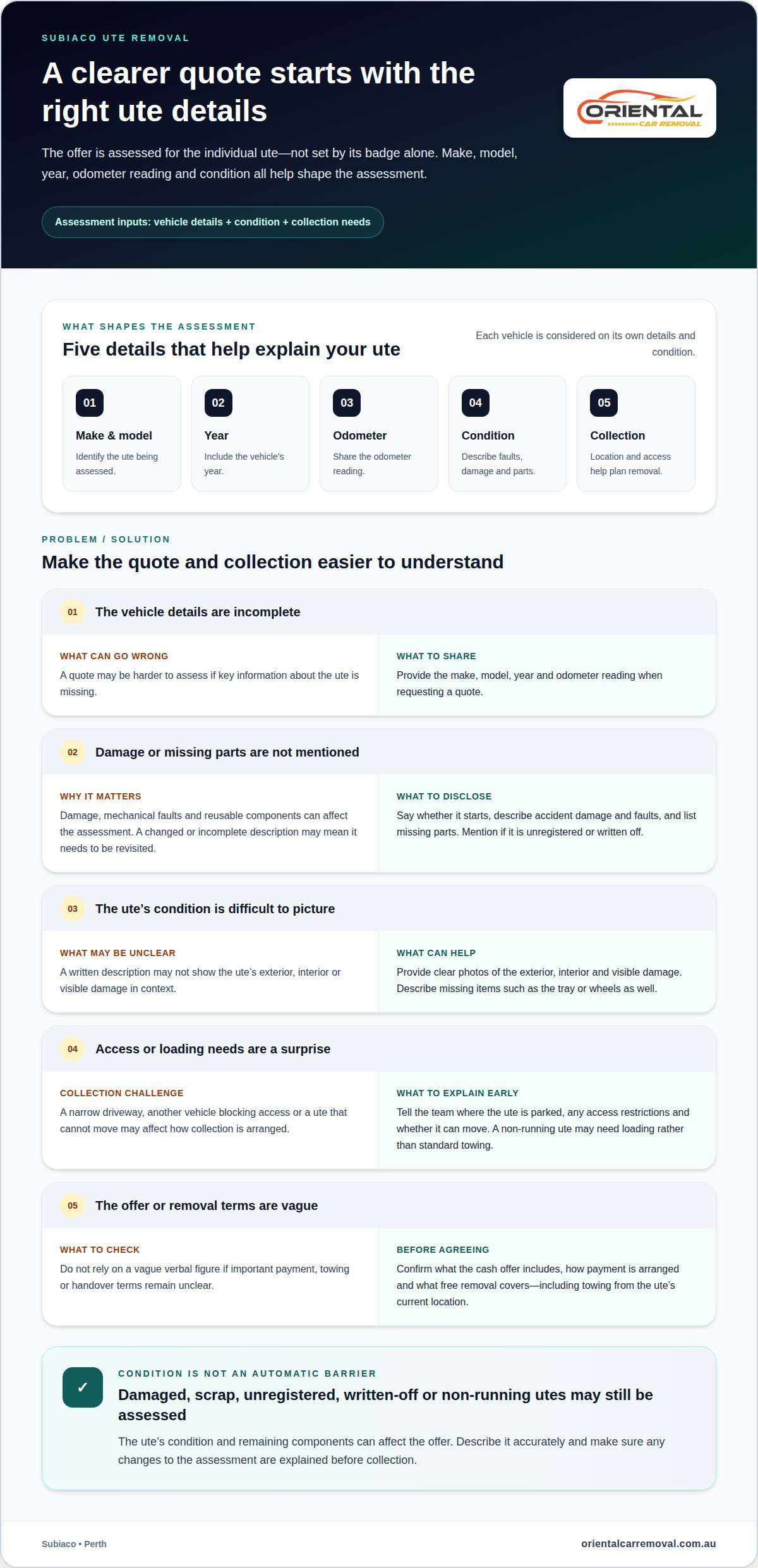
A ute’s value isn’t set by its badge alone. For cash for unwanted utes in Subiaco, the offer depends on the make, model, year, odometer reading and condition. The amount is assessed for the individual ute after you request a quote.

A damaged, ageing or non-running ute may still be worth selling, but its condition and reusable components can affect the assessment. To get a useful quote, share accurate vehicle details and explain what to expect from local removal. This guide covers the factors that influence your ute’s value, the details and photos to provide, and what to look for when arranging removal in Subiaco.

Key Takeaways

  • Your ute’s make, model, year, odometer reading and condition help shape its quote.
  • Clear photos and accurate details can help a wrecker assess the ute before arranging removal.
  • Damaged, scrap or unregistered vehicles may still be suitable for a cash offer.
  • Check what vehicle removal includes and how the quote is explained before you decide.
  • Choose a Subiaco wrecker whose service suits your ute’s condition and collection needs.

How a Car Wrecker Buys Your Ute in Perth

A Subiaco ute removal usually starts with a quote based on the vehicle’s details and condition. The next steps cover collection, towing and payment arrangements.

Free Ute Towing and Removal

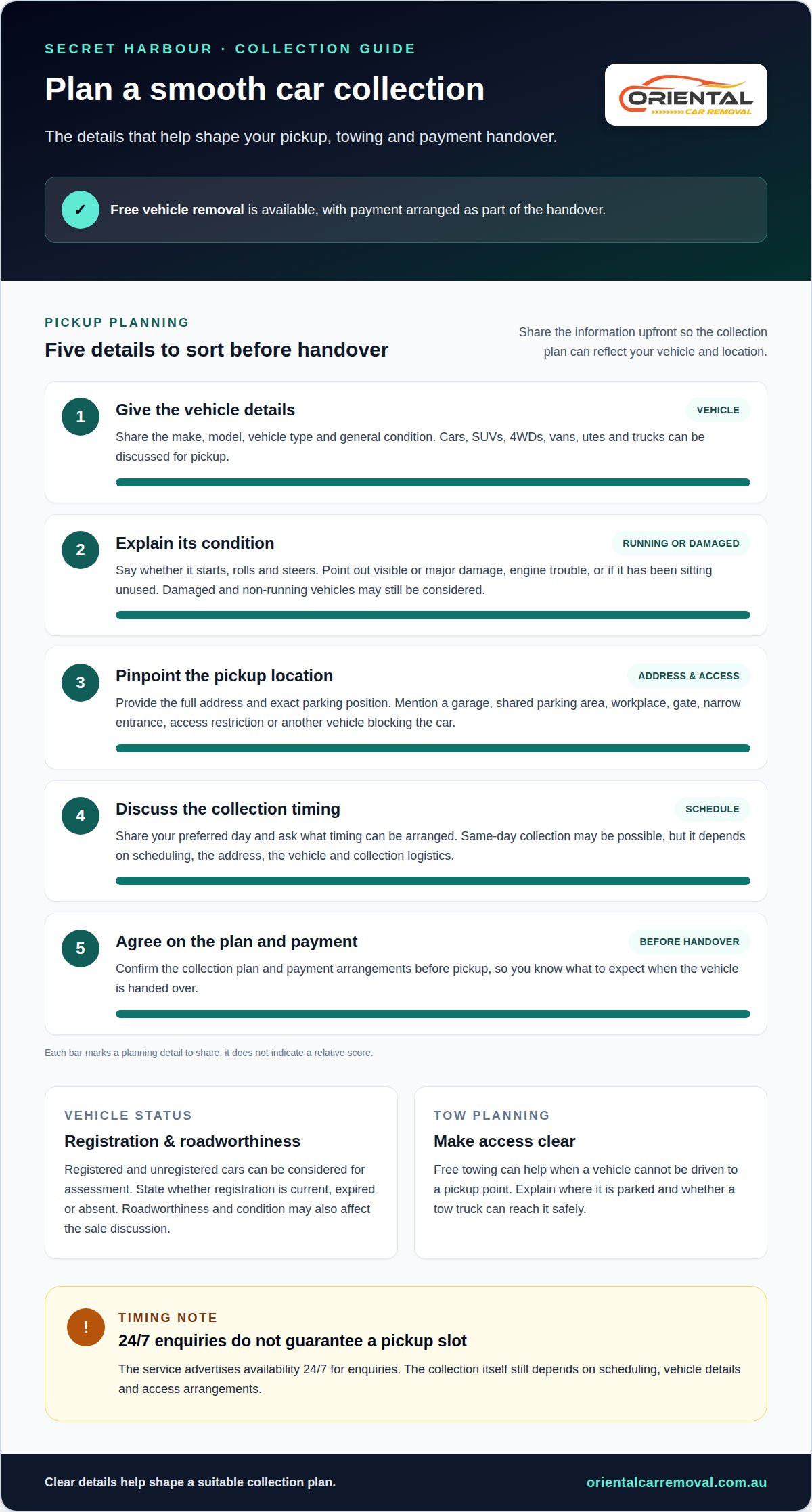
Free ute towing and removal means the collection cost isn’t charged separately to the owner. Before agreeing, check that the quote clearly explains what removal covers, including towing from the ute’s current location. A damaged ute parked at a Subiaco home, for example, may need a different loading approach from a vehicle that can still move.

Share access details early, such as a narrow driveway or a ute parked behind another vehicle. This helps the removal team plan collection and towing. Confirm how the handover and collection will be arranged before proceeding.

Provide the ute’s make, model, year, odometer reading and condition when requesting a quote. Mention whether it starts, has accident damage or is missing parts. These details help Oriental Car Removal assess the vehicle before arranging removal in Subiaco.

Photos can add useful context. Clear images of the ute’s exterior, interior and visible damage help show its condition. If the tray, wheels or other components are missing, describe that too. Accurate information gives the quote a sound basis and helps avoid confusion at collection.

  • Vehicle details: Share the make, model, year and odometer reading.
  • Condition: Describe damage, mechanical faults and missing components.
  • Collection access: Explain where the ute is parked and any access restrictions.
  • Quote terms: Confirm what the cash offer includes and how towing is handled.

A ute that needs repairs can still be assessed for removal. Its running condition, damage and reusable components may affect the offer. A non-running ute may need loading rather than standard towing, so mention this upfront to help the removal team prepare.

Transparent Vehicle Quotes

A clear quote explains what information shaped the cash offer and what happens next. Oriental Car Removal assesses each ute based on its details and condition, then provides an offer after a quote request. Confirm the payment and free removal arrangements so you understand the proposed offer before proceeding.

If the ute’s condition changes or the details differ from those provided, the assessment may need to be revisited. Newly reported accident damage or missing parts, for example, can affect its value. Share accurate details from the outset and make sure the final terms are clear before collection.

Keep the quote, collection timing and payment method aligned. A straightforward car removal process should make clear who is collecting the ute and what the owner needs to provide at handover. Don’t rely on a vague verbal figure if important terms remain unclear.

Free towing and removal can simplify selling an unwanted ute, particularly when it no longer runs. Understand the cash offer and collection arrangements together. When you explain the ute’s condition and access at your Subiaco address, the quote can account for its value and the practicalities of removal.

Why choose us for cash for ute removal?

A ute’s condition shapes the offer, but damage or registration status alone doesn’t decide its value. Oriental Car Removal assesses the vehicle’s details and condition before making a cash offer.

Yes, buyers may assess unregistered, damaged, written-off and non-running utes. To reduce risk, get the offer and removal terms clearly explained before agreeing, and be cautious of unexpected charges or pressure to accept.

Cash Offers for Different Ute Conditions

An unwanted ute can still have value as a vehicle, for parts or as scrap metal. A damaged tray, missing components or a non-running engine can affect the assessment, so describe each issue accurately. Oriental Car Removal also assesses written-off and unregistered utes, so disclose their status rather than assuming it rules out an offer.

For a scrap ute, the assessment considers its condition and the components that remain. An intact vehicle may be assessed differently from one with significant damage or missing parts. Share the ute’s make, model, year and odometer reading, then describe any faults or accident damage. These details help Oriental Car Removal assess the vehicle.

Offers Across Subiaco and Perth

Owners in Subiaco and across Perth can request cash offers for unwanted vehicles, including utes. The vehicle’s location helps plan collection, while its condition and details inform the assessment. Tell Oriental Car Removal where the ute is parked and whether it can move, especially if access is restricted or loading is needed.

Oriental Car Removal also assesses other vehicle types, including trucks. Each vehicle is assessed on its own details and condition. If you have a ute and another unwanted vehicle, describe each separately so the assessment reflects what you’re selling.

A ute’s value is not determined by its age or badge alone. Its make, model, year, odometer reading, damage, missing components and overall condition all contribute. For example, two utes of the same model may receive different offers if one runs and the other has major damage. A scrap car or ute may be assessed for its remaining parts and materials.

Clear terms matter as much as the amount offered. Before accepting, understand the cash offer, how payment is arranged and what the free removal service includes. Ask for any changes to the offer to be explained before collection. This helps avoid a mismatch between the initial assessment and the final handover.

  • Describe the condition: Include damage, faults and missing components.
  • Explain the status: Disclose if the ute is unregistered, written off or unable to run.
  • Clarify the terms: Understand the offer and removal arrangements before agreeing.

For an unwanted vehicle in Perth, the vehicle removal process can be a useful next step after you understand what shapes an offer. Share accurate details and consider the terms together, so the proposed payment and collection plan are clear before you decide.

Vehicles accepted regardless of make, model, age or condition

A ute’s make, model, age or condition doesn’t automatically prevent a cash assessment. Oriental Car Removal accepts all makes, models and conditions, and assesses each vehicle as presented, including whether it runs, has damage or is missing parts. For example, an older ute with a damaged tray can still be assessed, although its condition affects the offer. Share accurate details so the assessment reflects the ute you’re selling.

Disclose problems that could affect collection or value, such as accident damage, a flat tyre, missing keys or a non-running engine. Tell the buyer if the ute is unregistered or written off. This gives the removal team a clearer picture of the vehicle and helps avoid surprises at pickup. Government-issued photo identification and proof of ownership are useful documents to have ready when selling to a wrecker.

In Western Australia, owners can claim a pro-rata refund on remaining vehicle registration after cancelling the vehicle licence. The refund relates to the unused registration period, not the cash offer for the ute. Vehicle owners must notify the Department of Transport within 7 days. Keep the licence cancellation and sale paperwork organised, and treat each as a separate part of the process.

Completeness can make a substantial difference to an assessment. A ute with its major components intact presents differently from one missing critical parts. Vehicles missing critical components can lose 50% to 100% of their value compared with an intact vehicle. Report removed parts, such as the engine or wheels, before accepting an offer so the assessment accounts for the ute’s actual condition.

Pickup planning also depends on where the ute is located. A vehicle at a Subiaco home may have different access from one parked at a commercial site, such as a work yard. Explain the parking position, access route and any obstructions when arranging free removal. These details help the team plan towing and collection without assuming the ute can be driven or reached easily.

Environmental handling is another practical part of the handover. Don’t drain fuel or oil before collection; the removal team handles de-pollution at its yard. This matters for a damaged or scrap ute with fluids still present. Describe any leaks or visible damage accurately, then leave the handling to the removal process.

  • Share: Make, model, age, registration status and ownership documents.
  • Disclose: Damage, missing components, faults and access restrictions.
  • Separate: Manage any WA licence cancellation and registration refund paperwork alongside the sale.

Cash for Unwanted Utes in Subiaco: What Your Ute Is Worth

Information and photos needed for a quote

A useful ute quote starts with accurate vehicle details and a clear description of its condition. Share the make, model, year, odometer reading and whether it runs. Mention accident damage, mechanical faults, missing components or modifications. For example, explain if the engine starts but the ute has a damaged tray. These details help the buyer assess the vehicle being offered.

Photos can show details that are difficult to explain in a message. Include clear views of the front, rear and both sides, plus the cabin and tray. Photograph visible damage, such as a dented door or cracked bumper, and any missing parts. An odometer photo can support the reading you provide. Use good lighting and stand far enough back to show each relevant area.

Make the images useful. A close-up of accident damage shows its location, while a wider view provides context. If the ute won’t start, photograph its parking position and explain pickup access. Don’t hide damage with an angle or omit missing components. A clear account helps prevent differences between the initial assessment and the ute presented at collection.

The assessment considers all the information together. Make, model and year identify the vehicle, while its odometer reading and condition help show its use and state. A ute with mechanical damage may be assessed differently from a similar model that runs. Missing parts, accident damage and overall completeness also affect the assessment. Oriental Car Removal provides an offer for the individual ute after a quote request.

  • Vehicle details: Make, model, year and odometer reading.
  • Condition: Running status, faults, accident damage and missing parts.
  • Photos: Exterior, interior, tray, odometer and visible damage.
  • Pickup details: Location, access and whether the ute can move.

Clear information can help Oriental Car Removal assess the ute without repeated follow-up. If a detail is uncertain, describe what you can see rather than guessing. For example, say the ute has an engine fault if you know it won’t start, without trying to diagnose the cause. This keeps the assessment grounded in observable facts.

The time needed to respond depends on the information supplied and whether more details are needed. Complete vehicle details and photos can help move the quote process along; unclear damage or missing information may require follow-up. An instant cash offer should still reflect the ute’s actual details and condition, not a broad estimate.

Before accepting, make sure the quote reflects the ute described and that you understand the pickup arrangements. If the vehicle is accident-damaged or no longer wanted, request an assessment to establish the next step. Accurate photos, a straightforward condition report and complete vehicle details give the appraisal a practical starting point.

Choosing car wreckers near Subiaco

Choose a wrecker that assesses utes, explains its offer and sets out collection terms clearly. For Subiaco owners, both the quote and pickup arrangements matter.

Cash-for-cars businesses and car wreckers that assess unwanted vehicles are the relevant buyers to consider. Ask for an offer based on your ute’s details, condition and location, then compare what each quote includes.

Comparing Cash Offers

Compare offers on the same basis. Give each buyer consistent information about the ute, including damage, missing parts and whether it runs. Then consider the proposed payment alongside towing, removal and pickup arrangements. A higher figure may not be the clearest option if its terms leave collection costs or conditions unexplained.

Look for a quote that identifies the ute being assessed and explains any changes after inspection. For example, the buyer should clarify whether a missing component affects the offer. Clear terms make it easier to assess an offer fairly.

Ute Buyers in Subiaco

Ute owners in Subiaco can request an assessment from Oriental Car Removal, which buys unwanted utes and other vehicles. The assessment considers the vehicle’s condition, including whether it is damaged, incomplete or no longer running. A ute may also be assessed for reusable parts or scrap value.

Check that the collection arrangements suit the ute’s location and access needs. A vehicle in a tight residential driveway may need different pickup planning from one at a commercial site. Share access details when requesting an offer from Oriental Car Removal.

Use a consistent comparison process. Keep your vehicle description the same for each quote, and note what each buyer says about payment and removal. If an offer changes, ask which vehicle detail or condition factor affected the assessment. This helps clarify whether the change reflects a reassessment or terms that were unclear at the outset.

Location affects collection logistics as well as the offer. Subiaco streets, parking restrictions and worksite access can shape how the removal team plans towing. Explain whether the ute is on private property, at a business address or on a shared driveway. Include obstacles such as limited turning space or another vehicle blocking access.

Also consider whether the buyer assesses the type of ute you’re selling. A standard work ute, a heavily damaged vehicle and a modified ute may each need a different assessment. Describe modifications and missing components rather than assuming they add value. Accurate details help Oriental Car Removal assess the ute and plan suitable collection.

  • Compare like for like: Give each buyer the same vehicle details.
  • Read the terms: Understand payment, towing and removal arrangements.
  • Explain access: Describe the Subiaco pickup location and any restrictions.
  • Review changes: Ask what condition detail has changed a revised offer.

Choose based on a clear assessment and practical collection terms, not the headline offer alone. This gives you a more useful basis for deciding how to sell your unwanted ute.

Oriental Car Removal: Cash for Unwanted Cars

Oriental Car Removal buys unwanted vehicles, including utes, and arranges free removal. If your ute is damaged, ageing or no longer needed, its details and condition help shape the assessment. Oriental Car Removal also buys cars and trucks, making it a practical option if you have other unwanted vehicles.

Share the make, model, year, odometer reading and an honest description of its condition when requesting a quote. Include any damage or missing parts, plus the Subiaco pickup location. These details help establish an offer and plan the removal. If the vehicle suits your needs, contact Oriental Car Removal to discuss your unwanted ute.

Take the Next Step With Your Ute

Once you’ve decided to move on from your ute, focus on making the handover straightforward. Decide whether you want to sell one vehicle or arrange removal alongside another unwanted vehicle. A clear plan can help you avoid leaving an unused ute parked without a next step.

If you’re considering cash for an unwanted ute in Subiaco, Oriental Car Removal can help with cash for cars, free car removal and cash for trucks. Share your vehicle details to start an enquiry. You don’t need to have every decision worked out before taking the next step.

Contact Oriental Car Removal today

Take the process at your pace and choose an arrangement that works for you. A practical next step can turn an unwanted ute into one less thing to manage.

Frequently Asked Questions

How much is your junk ute worth?

A junk ute’s value depends on its make, model, year, condition and metal value. For cash for unwanted utes in Subiaco, Oriental Car Removal assesses the specific vehicle rather than applying one standard amount. A ute with reusable components may be assessed differently from one with major damage or missing parts. Share accurate details to receive an offer based on the vehicle’s condition.

What Defines the Best Car Wreckers Near Subiaco?

A suitable wrecker gives you a clear assessment, explains collection terms and can handle your ute’s condition. Check that the offer reflects the vehicle details you supplied, and understand how payment and pickup are arranged. For example, a non-running ute may need different loading arrangements from one that can be driven. Clear communication helps you decide whether the service suits your situation.

How much can I get for an unwanted ute in Subiaco?

The amount varies with the individual ute, so request a quote for a vehicle-specific offer. Oriental Car Removal considers details such as make, model, year, condition and metal value. A damaged ute and an intact ute of the same model may receive different assessments. Provide an accurate description, including faults and missing components, so the offer reflects the vehicle being evaluated.

What factors affect a ute’s cash offer, such as make, model, condition, and age?

Make, model, year and condition are key factors, alongside the vehicle’s metal value. The ute’s running state, accident damage and completeness can also influence its assessment. For example, a ute missing major components may be valued differently from one with those parts intact. Disclose modifications and visible damage so the buyer can assess the vehicle as it stands.

Do Subiaco ute buyers offer free vehicle removal and towing?

Oriental Car Removal provides free vehicle removal, including towing, for unwanted vehicles. This can help if a ute is damaged or can’t be driven from its current location. Share the pickup address and access arrangements when organising collection. If the ute is in a tight driveway or behind other vehicles, describe the situation so the removal team can plan the handover.

How quickly can a cash-for-utes buyer collect a vehicle in Subiaco?

Collection timing depends on the address, the ute and the arrangements needed for pickup. Same-day collection may be possible after the details and logistics are assessed, but it isn’t guaranteed. Share the vehicle’s location, whether it runs and any access limits when arranging collection. Agree on a suitable pickup time after the details have been considered.

What documents are needed to sell or scrap a ute in Western Australia?

Have the ute’s vehicle documents and keys ready for handover. Government-issued photo identification and proof of ownership can also help identify the vehicle and your connection to it. Oriental Car Removal handles the sale paperwork at no charge. Keep any registration or licence records available if you’re managing cancellation separately from the sale. The paperwork needed can depend on the vehicle and handover details.

Cash Offers for Fleet Vehicles in Golden Bay

Cash Offers for Fleet Vehicles in Golden Bay

Could a fleet vehicle still attract a cash offer if it’s no longer earning its keep? Cash for fleet vehicles in Golden Bay depends on the vehicle type and condition, and business vehicles can include trucks, vans, utes and 4WDs. A clear description of each vehicle helps establish what it may be worth.

When an unwanted vehicle is taking up space or adding to fleet administration, you need a clear way to assess its sale. This guide explains what affects cash for fleet vehicles in Golden Bay, which business vehicles Oriental Car Removal buys, and what details help with an assessment.

You’ll learn how offers for trucks and other commercial vehicles fit into fleet disposal, what information to prepare, and how free vehicle removal can help with the next step. Use these points to compare your options and plan the disposal of vehicles your business no longer needs.

Key Takeaways

  • Understand what makes a vehicle part of a business fleet and how disposal needs can vary between businesses.
  • See how vehicle type and condition can influence a cash offer, even when a vehicle is no longer in working order.
  • Learn what details about trucks and commercial vehicles help shape an offer.
  • Find out which types of trucks, buses and vans the article covers before arranging a disposal.
  • Get a clearer idea of the next step for unwanted fleet vehicles in Golden Bay.

Fleet and business vehicle disposals

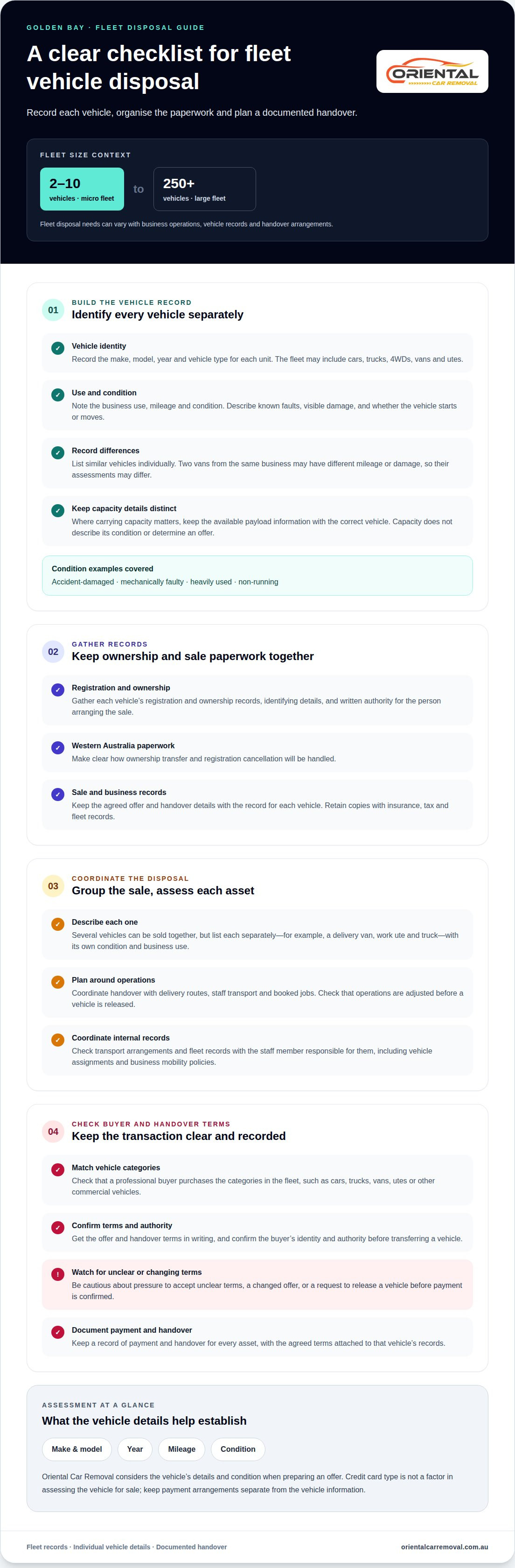
In Australia, a micro fleet can contain 2 to 10 vehicles, while a large fleet has 250 or more. Businesses seeking cash for fleet vehicles in Golden Bay can plan a disposal around their operating needs, vehicle records and handover arrangements.

Documents and ownership transfer

Gather each vehicle’s registration and ownership records, identifying details, and written authority for the person arranging the sale. An inventory can record each vehicle’s type, condition and business use. Keep the agreed offer and handover details with the record for each vehicle.

In Western Australia, the transaction paperwork should clarify how ownership transfer and registration cancellation will be handled. Keep copies with your business’s insurance, tax and fleet records. Clear documentation helps distinguish vehicles sold from those still assigned to daily work.

Selling multiple fleet vehicles

Golden Bay businesses can arrange the sale of several vehicles together. Describe each one separately, even if vehicles share a make or model. For example, list a delivery van, work ute and truck individually, with each vehicle’s condition and business use.

A grouped disposal can simplify coordination, while assessing vehicles individually accounts for differences between them. Plan handover around delivery routes, staff transport and booked jobs. This helps avoid releasing a vehicle before your business has adjusted its operations.

Choosing buyers and avoiding scams

Golden Bay businesses can approach professional buyers who purchase cars, trucks, vans, utes or other commercial vehicles. Match the buyer’s vehicle categories to the fleet being sold, and get the offer and handover terms in writing. Confirm the buyer’s identity and authority before transferring a vehicle.

Be cautious about pressure to accept unclear terms, a changed offer or a request to release a vehicle before payment is confirmed. Keep a record of payment and handover for every asset. Cash for fleet vehicles in Golden Bay can be organised more clearly when each vehicle and its agreed terms are documented.

Fleets help businesses deliver goods and complete jobs without relying on public transport. For manufacturers and distributors transporting fragile goods—who may rely on protective specialists such as Foam Packaging Direct to cushion products in transit—having the right commercial transport is essential. Catering, construction, hospitals, equipment dealing and public services can all depend on vehicles for daily operations. A business may decide to dispose of a vehicle when routes change or a particular job no longer requires it.

Fleet management also involves maintenance, insurance and tax filings. When adjusting commercial vehicle policies with a provider like SMI Insurance Agency, having clear records helps ensure coverage accurately reflects active assets. Business mobility policies can set who uses company vehicles and how they are assigned. Before disposal, coordinate with the staff member responsible for those records and transport arrangements. This helps keep deliveries and scheduled work moving while unwanted vehicles leave the fleet.

Vehicle condition and accepted makes

Make, model, year, mileage and condition can all affect a vehicle’s assessment. Oriental Car Removal considers the vehicle’s details and condition when preparing an offer.

Accepted makes and models

Fleet disposals can include cars, trucks, 4WDs, vans and utes. Give the buyer the make, model and vehicle type for each unit, so the assessment matches the actual vehicle rather than a broad fleet category.

There isn’t a verified list of individual makes or models to rely on here. Instead, describe each vehicle clearly, including its body type and business role. For example, identify a ute separately from a van, even if both supported the same work crew.

Accepted vehicle conditions

Vehicles can be assessed in different conditions, including accident-damaged, mechanically faulty, heavily used or non-running vehicles. Describe known faults accurately. A damaged truck and a running delivery van are different assets and should be listed separately.

Condition affects the vehicle’s potential use and value, but poor condition does not automatically make it irrelevant to a fleet disposal. Note visible damage, operating issues and whether the vehicle starts or moves. These details help the buyer assess what is being offered and plan its collection.

Valuation factors

Make and model identify the vehicle, while year and mileage indicate its age and use. Condition describes its present state. Together, these details help Oriental Car Removal assess each fleet vehicle individually.

For example, two vans from the same business may have different mileage or damage, so their offers may differ. Provide accurate details for every vehicle rather than relying on one fleet-wide description. A fleet vehicle assessment starts with identifying those differences.

Credit cards aren’t a factor in assessing a vehicle for sale. The offer is based on the vehicle’s details and condition, not the business’s card type. Keep payment arrangements separate from the information used to assess each vehicle.

Where carrying capacity matters, keep the available payload information with the records for that vehicle. In Australia, vehicles built to carry more than one tonne are outside the car-limit cap on GST credits and depreciable cost. This is separate from describing the vehicle’s condition: capacity does not indicate whether it starts, has damage or suits a particular job. Keep the specification connected to the correct vehicle rather than assuming the fleet’s vehicles share the same capacity. Clear records distinguish a vehicle’s physical characteristics from its working condition.

When preparing information for a disposal, separate facts about the vehicle from any tax-related consideration. A capacity description should be supported by the information available for that vehicle, and should not be used as a substitute for details about its make, type, mileage or known faults. Likewise, the fact that a vehicle is outside the car-limit cap does not describe its condition or determine what a buyer will offer. Keeping these details distinct makes it easier to provide an accurate account of each unit and to have the relevant vehicle information available when the fleet is assessed.

Cash offers for trucks and commercial vehicles

A cash offer gives a business a direct sale option for an unwanted truck or commercial vehicle. The amount depends on the individual vehicle, its condition and the details provided for assessment.

For a truck, the assessment can consider its make, model, year, mileage, condition and use. Body type and fit-out matter too: a tray truck, delivery truck and specialised work vehicle serve different roles. Clear information helps Oriental Car Removal assess the actual vehicle rather than treating every commercial vehicle alike.

Describe each truck separately, even when several share a make or model. Include its registration details, body type, known faults and whether it starts or moves. Mention accident damage or equipment fitted for a particular job. Accurate details help make the assessment and handover clearer.

The offer depends on the individual vehicle and is provided after you request a quote. Factors include vehicle type, year, mileage and condition. A business selling several commercial vehicles can have each assessed individually, accounting for differences between a well-used delivery truck and a specialised vehicle that has seen less use.

Cash offers differ from trade-ins and auctions. A trade-in connects the vehicle’s sale to a replacement purchase, while an auction puts the vehicle up for bids and the result depends on buyer interest. A direct cash sale focuses on the agreed vehicle transaction without tying disposal to buying another vehicle.

When comparing these options, consider timing, administration and whether your business needs a replacement vehicle. A trade-in may suit a fleet renewal when you’re already buying another vehicle. An auction may suit a seller prepared to wait for bids. A direct sale offers another route for disposing of a truck no longer needed.

Before agreeing to a sale, match the written offer to the correct vehicle and confirm the handover arrangements. For multiple trucks, keep each description and its agreed terms together. This record helps your business track the assets sold and manage their transfer from work use to disposal.

Businesses seeking a direct option for an unwanted truck can consider cash for trucks. The vehicle’s type, condition and use remain central to the assessment, whether it is a single truck or part of a wider fleet disposal.

Cash Offers for Fleet Vehicles in Golden Bay

Types of trucks, buses and vans bought

Fleet disposals can involve several commercial vehicle types, each built for a different role. Identify each vehicle’s body style and use clearly so the assessment reflects the actual asset.

A truck may be used for deliveries, equipment transport or construction work. Describe its body type and work-related fit-out, such as a tray or enclosed load space. A delivery truck and a site vehicle may have different configurations, even if they belong to the same business. These details distinguish one asset from another.

Vans commonly support home services, catering and delivery work. Record whether each van carried tools, goods or staff, and note fitted shelving or other business equipment. Similar vans can still differ in mileage, condition and fit-out, so give every vehicle its own description.

Buses serve a different transport role from trucks and vans. A business assessing a bus for disposal should describe its passenger-transport use, body type and condition. That information separates it from goods vehicles in the fleet inventory. It also helps a buyer understand the vehicle’s purpose without relying on a broad label such as “commercial vehicle”.

Business fleets can also include taxicabs, rental cars, bulldozers and tractors. Fleet disposal isn’t limited to standard road-going vans. Equipment dealers and construction businesses may operate specialised vehicles, while transport businesses may manage passenger vehicles. Grouping them under one fleet heading does not make their vehicle types interchangeable.

For a practical inventory, list each vehicle by category, make and model, then add its business use and known condition. Separate a truck from a bus, and a service van from a passenger vehicle. Note any distinctive equipment or damage that could affect the assessment. This gives the buyer a clear picture of the vehicles included in the disposal.

Golden Bay businesses with different vehicle types can organise information by category before requesting an assessment. For example, list delivery vans together, then describe trucks and passenger vehicles separately. This structure makes missing details easier to spot and keeps the fleet record useful for the sale.

Trucks are a clear fit for commercial vehicle disposal, while vans and utes may also form part of a business fleet. Oriental Car Removal buys trucks, vans and utes, including unwanted and damaged vehicles. Describe specialised use or equipment that distinguishes a vehicle from other fleet assets.

Which companies buy fleet vehicles in Golden Bay, Western Australia?

Golden Bay businesses can approach professional vehicle buyers that purchase commercial vehicles, truck buyers, or vehicle wreckers and salvage operators. The right fit depends on the fleet being sold. A business disposing of a working delivery truck has different needs from one clearing an accident-damaged van or an unwanted ute.

Oriental Car Removal buys commercial vehicles such as trucks, vans and utes, including vehicles in poor condition. Describe the vehicle and its state before requesting an offer. Details about damage, faults and whether it runs help make the assessment more accurate.

Golden Bay businesses can arrange assessment of a mixed fleet. A construction company, for example, may have a truck and a ute, while a home-services business may be disposing of several vans. Describe each vehicle individually because make, model, condition and business use can vary across the group.

Focus on clear sale terms. The written offer should identify the vehicle and state the agreed amount and handover arrangements. For a multi-vehicle sale, account for each truck, van or ute separately. This gives your business a usable record of the assets included and helps prevent confusion during handover.

Payment and collection arrangements also matter. Confirm how payment will be made and when the vehicle changes hands. Don’t release a vehicle based only on a verbal offer. Keep the sale record and payment confirmation with the fleet disposal paperwork, especially when several vehicles are being sold together.

A suitable buyer should match the vehicle type and the business’s disposal needs. A business selling a truck can focus on buyers handling commercial trucks, while a mixed fleet requires a buyer prepared to assess its different vehicle categories. For example, a truck and two service vans should be described separately, even if the business wants one organised disposal.

Start with an accurate vehicle list. Include the make, model, type, condition and known faults for each asset. A clear inventory helps Oriental Car Removal understand the fleet and prepare an offer based on the vehicles presented. It also gives your business a straightforward record of the disposal decision.

Oriental Car Removal

Oriental Car Removal helps businesses dispose of unwanted cars, trucks, 4WDs and vans. If a Golden Bay fleet includes several vehicle types, share each vehicle’s details so the sale can be considered clearly. Cash for Trucks and Free Car Removal may suit businesses handling a truck disposal, while Cash for Cars and Cash for 4WDs and Vans cover other unwanted fleet vehicles.

Free removal can make disposal simpler when a vehicle is no longer needed for deliveries, staff travel or daily work. Describe the fleet vehicles you want to sell and their condition to get the process moving.

Contact Oriental Car Removal to discuss your fleet vehicles.

Plan the next fleet move

A fleet disposal is also an opportunity to plan a clearer replacement cycle. Before removing a vehicle from active use, align its handover with the point when staff, routes and equipment can operate without it. This helps prevent disposal from becoming a last-minute operational task.

For businesses considering cash for fleet vehicles in Golden Bay, assess each surplus vehicle separately: retain, replace or release. This helps managers assign responsibility, approve the disposal and keep fleet records aligned with the next operating plan.

When your business is ready, bring the vehicle details and sale authority together. Oriental Car Removal buys unwanted fleet vehicles and provides free removal. A clear starting point helps move from a disposal decision to the next step.

Take the next step when it suits your fleet’s plans.

Frequently Asked Questions

Need Cash Today?

The offer depends on details such as the vehicle’s make, model, year and condition. If your business is selling several vehicles, prepare a separate description for each so the offer reflects the individual assets. Payment timing is discussed as part of arranging the sale and handover.

What types and sizes of fleet vehicles do Golden Bay buyers accept?

Oriental Car Removal buys cars, trucks, 4WDs, vans and utes. These categories can cover a mixed business fleet, such as a work ute, a delivery van and a commercial truck. Share the vehicle type and its details for each asset. Vehicle size categories aren’t stated as a separate limit, so describe larger commercial vehicles by their body type and business use.

Do Golden Bay fleet vehicle buyers offer free inspections and collection?

Oriental Car Removal provides free vehicle removal, including towing. The free service applies to removal; it shouldn’t be taken to mean a separate inspection service. For an assessment, provide vehicle details such as make, model, year and condition. For example, note whether a fleet car has accident damage or a truck is no longer running, so its circumstances are clear.

How quickly can fleet vehicles be collected and paid for in Golden Bay?

Collection timing depends on the address, vehicle and logistics. Same-day pickup may be possible after those details are assessed, but it isn’t guaranteed. Oriental Car Removal provides instant cash payment on the spot for accepted vehicles. For a fleet sale, organise the vehicle list and handover details together so collection arrangements can account for each vehicle’s location and condition.

Do Golden Bay vehicle buyers accept unregistered, damaged, or end-of-life fleet vehicles?

Damaged and end-of-life vehicles are accepted, including vehicles in poor condition. Oriental Car Removal buys unwanted, damaged and scrap vehicles, and accepts all makes, models and conditions. For an unregistered vehicle, include its registration status in the details provided for the sale. This helps make the vehicle’s paperwork and handover requirements clear alongside its condition and fleet role.

How do you transfer ownership and cancel registration when selling fleet vehicles in WA?

In Western Australia, make sure the transaction paperwork states how ownership transfer and registration cancellation will be handled. Keep the vehicle’s registration and ownership records, written authority, agreed handover details and copies with your business records.

Same Day Car Collection in Secret Harbour With Payment on Pickup

Same Day Car Collection in Secret Harbour With Payment on Pickup

Can you sell a car for cash with free collection and payment at pickup? Yes. Oriental Car Removal buys unwanted vehicles and provides free removal, with payment made as part of the handover. For same-day car collection in Secret Harbour, timing depends on the address, vehicle and collection logistics, so provide those details when arranging pickup.

Getting rid of an unwanted car should be straightforward, even if it’s damaged, old or no longer running. This guide explains what vehicle types and conditions may be accepted, how free collection and towing fit into the process, and what to expect when payment is made on pickup. You’ll also learn what affects collection timing, so you can make a clear plan without unnecessary back-and-forth.

Key Takeaways

  • Cars, trucks, 4WDs and vans may be considered, including vehicles with significant wear or damage.
  • Collection timing depends on scheduling and pickup details, so share the vehicle’s location and condition when arranging collection.
  • A car’s registration status and roadworthiness can affect the sale process, but an unregistered vehicle may still be worth discussing.
  • Free removal can cover the towing step, helping you arrange pickup without organising transport yourself.
  • Agree on payment arrangements before collection so you know what to expect when the vehicle is picked up.

Vehicle types and conditions accepted

Vehicle type and condition help determine whether a car removal pickup suits your unwanted vehicle. In Secret Harbour, accepted categories include cars, 4WDs, vans, utes and trucks, with condition considered alongside the vehicle type.

Accepted vehicle types

Cars range from everyday sedans to older models, while 4WDs, vans and utes cover different transport needs. Commercial vehicles such as trucks are another category to consider. An SUV’s size, configuration and condition help describe what needs collecting, so include those details when arranging a pickup rather than relying on the body shape alone.

For example, a Toyota Camry that has travelled 400,000 kilometres shows why age and odometer readings don’t tell the whole story. The vehicle’s overall condition and parts may still matter when a cash offer is assessed. Describe the make, model, body type and visible damage clearly. That gives the collection team a more useful picture of the vehicle before pickup.

Damaged and non-running vehicles

A damaged or non-running car can still be considered for removal. Explain whether it starts, rolls and steers, and point out any major damage. A collision-damaged car, a vehicle with engine trouble and one that has been sitting unused may each need a different towing approach. These details help the team plan collection. For drivers managing the aftermath of an accident, attending to personal recovery is just as vital as sorting transport logistics; local residents across Secret Harbour and neighbouring suburbs can visit goldenbaychiropracticworks.com.au for community-based musculoskeletal care.

For a non-running vehicle, give the team its exact parking position and explain whether access is clear. A car blocked behind another vehicle, for example, may need a different pickup plan from one in an open driveway. Sharing these details upfront helps the team account for the vehicle’s condition and access when arranging collection.

Free towing makes removal practical when a vehicle cannot be driven to a pickup point. Oriental Car Removal provides vehicle removal at no charge to the owner, including for damaged cars, vans and trucks. Describe the vehicle’s condition, location and access for the tow truck. Even a car parked on private property needs a suitable path for collection.

When describing an unwanted vehicle, focus on facts that affect its assessment and removal: its type, whether it runs, visible damage and where it is parked. A damaged ute, an immobile 4WD and a running sedan each have different collection considerations. Clear information helps shape a suitable pickup plan and gives the assessment a better basis for a cash offer.

Can I sell my car for cash with free collection?

Yes, you can sell an unwanted vehicle for cash and arrange free collection. Cars, SUVs, vans, utes, 4WDs and trucks can be discussed for pickup near Secret Harbour. Collection timing depends on scheduling and access, so provide the correct suburb and address when arranging it.

Same-day pickup availability

Same-day car collection in Secret Harbour may be possible, depending on logistics. Timing is confirmed after the address, vehicle and collection details are considered. Share your preferred day and whether the vehicle runs. A car in an accessible driveway may be simpler to collect than one blocked inside a crowded garage.

Vehicle type also helps shape the collection plan. Picking up a ute or commercial vehicle, for example, may involve different access needs from collecting a small sedan. When discussing a cash offer, include the make, model and general condition. This helps make the timing discussion specific to your vehicle.

Pickup scheduling

Arranging pickup starts with the address, preferred timing and vehicle details. Explain whether the car starts, where it is parked and whether a tow truck can reach it easily. A vehicle at a workplace, for example, may be subject to access restrictions. Sharing these details upfront helps avoid confusion on collection day.

Once the details are discussed, agree on the collection plan and payment arrangements before handover. If your plans change or the vehicle’s location differs from the address you provided, update the team promptly. This helps them plan the route and collection using the correct information.

Collection locations

Pickup can be arranged from an accessible location in Secret Harbour, such as a home driveway or workplace. Provide the full address and mention any gate, narrow entrance or parking restrictions. A car parked behind another vehicle, for instance, may need access arranged before the tow truck arrives.

For a vehicle that can’t be driven, its exact position is especially useful to know. Say whether it’s in a garage, at the kerb or in a shared parking area. Clear access information helps the team plan the tow, even if the vehicle isn’t running.

If you’re considering selling an unwanted vehicle, the cash for unwanted cars process lets you discuss the offer and collection details together. Provide the address and preferred pickup timing to get the conversation moving.

The service advertises availability 24/7, so you can make an enquiry outside daytime hours as well as during the day. This gives you an opportunity to raise the collection question when convenient, but it does not confirm that a particular pickup slot is available. Collection timing still needs to be discussed in light of the address, vehicle and access details.

When getting in touch, bring those details together: state where the car is parked, whether it runs, and when you would prefer collection. Ask what timing can be arranged and agree on the plan before handover. If the proposed timing does not suit, explain your preference so the collection arrangements can be discussed. The advertised 24/7 availability concerns the service, while the pickup itself depends on scheduling and access.

Buying cars with or without registration

Registration status is one detail to include when arranging an assessment. Both registered and unregistered cars can be considered for a cash-for-cars assessment. The vehicle’s age, condition and pickup needs also matter. Tell the assessor whether registration is current, expired or absent to give the discussion a clear starting point.

Roadworthiness can affect the decision to keep an older vehicle. The cost of keeping a 15-, 20-, or 25-year-old car roadworthy can exceed its value. For example, an older sedan that needs substantial work may no longer suit its owner’s plans. Selling it for cash may be worth considering instead of paying for repairs, especially if it is also difficult to drive or maintain.

For an offer, provide the car’s make, model, general condition and registration status. Explain whether it starts and where it’s parked. These details help the team assess the vehicle and plan any required towing. Give a complete description, including damage or missing parts, rather than relying on registration status alone.

Registration status doesn’t tell the whole story. A currently registered car may still have collision damage, mechanical problems or worn components. An unregistered car may be in better physical condition but unable to be driven. The assessor needs both the vehicle’s condition and collection details. If you’re unsure how to describe it, start with what works, what doesn’t and any visible damage.

In Secret Harbour, the pickup address matters too. Include the suburb and access details when arranging an assessment, particularly if the vehicle is parked away from the street. If it can’t be driven, explain its position and whether other vehicles block access. This helps connect the offer discussion with a workable collection plan.

A free quote gives you a chance to discuss the car before deciding whether to proceed. Share its registration status alongside its make, model, condition and location. You can also ask how the offer and pickup arrangements fit together before accepting. There’s no need to reduce the vehicle to one detail: registration, roadworthiness and condition each add context. For a local cash for cars assessment, clear details help keep the conversation focused on your vehicle and its collection needs.

Same Day Car Collection in Secret Harbour With Payment on Pickup

Free towing and car removal

Free towing means there’s no need to arrange separate transport for an unwanted vehicle. In Secret Harbour, it can make removal practical for a car that won’t run or can’t be driven safely. Oriental Car Removal provides towing and removal at no charge to the owner, simplifying collection.

Collection planning starts with the vehicle’s location and condition. A damaged car parked in a driveway, for example, needs a different plan from a running car beside the road. Say whether the vehicle can move, where it’s parked and what access is like. These details help the team plan the tow and avoid surprises at pickup.

Free car removal can cover more than a standard passenger car. A van, ute, 4WD or truck may also need towing if it is unwanted or no longer roadworthy. The vehicle type and its position help determine the practical collection approach. A truck in a yard, for instance, may have different access needs from a small car parked at home.

Selling a car involves assessment, collection, towing and disposal. Oriental Car Removal handles the towing, paperwork and disposal at no charge to the owner, which can simplify the process, especially for a damaged or immobile vehicle. Discuss the vehicle and pickup details as part of arranging removal.

Before pickup, make the vehicle accessible and confirm its location with the team. If a gate, narrow driveway or another parked vehicle affects access, explain that when arranging removal. A car behind a locked gate, for example, may need access coordinated before the tow truck arrives. Clear details help the planned pickup match the site.

Free towing is useful when a vehicle can’t be driven to a collection point. It avoids needing a friend to tow a damaged car or arranging separate transport. Once the collection details are agreed, Oriental Car Removal handles towing and disposal. This can make clearing an old car, damaged ute or unwanted van from a Secret Harbour property more straightforward.

Instant payment on collection

Payment at pickup connects the agreed offer with the vehicle handover. Before collection, discuss the car’s condition, the cash offer and payment arrangements. The vehicle is assessed against the details provided, so an accurate description helps align expectations about the offer and handover.

Describe whether the car starts, point out visible damage and provide its make and model. If its actual condition differs from your description, that may affect the assessment. Discuss any changes before accepting the offer. The cash amount depends on the vehicle, rather than being a fixed amount for every car.

The process is straightforward: provide vehicle details, receive an offer, agree on collection, then complete the handover and payment at pickup. The vehicle doesn’t need to be taken to a separate sale location. If it needs towing, include that in the collection discussion.

Paperwork is part of the handover. Oriental Car Removal handles the paperwork, towing and disposal at no charge to the owner. Make sure the vehicle and pickup details are clear before collection. If the car is at a different address from the one first discussed, update the location before the tow truck is dispatched.

Payment timing and method are separate details to agree on. Instant payment describes when payment is made; the method describes how it reaches you. Discuss both before the vehicle is loaded rather than assuming a particular method. A clear agreement helps prevent confusion at handover.

You don’t need to repair a vehicle just to arrange collection. Oriental Car Removal can assess a damaged or unwanted car in its current condition, with that condition reflected in the offer. Explain whether damage affects a door, engine or ability to start. Accurate details help the assessor make an informed offer before pickup.

For a smooth handover in Secret Harbour, keep the offer, vehicle description, pickup location and payment arrangements clear. Discuss any change to the offer before accepting it, and understand what paperwork is handled during collection. Then you can decide whether to accept the terms and proceed or decline before handing over the vehicle.

Oriental Car Removal

Oriental Car Removal buys unwanted vehicles for cash and provides free removal. If you’re planning same-day car collection in Secret Harbour, share the vehicle’s condition, location and access details when discussing pickup. This gives the team practical information to plan the next steps.

Cars, trucks, 4WDs and vans are among the vehicle types covered. You can discuss the vehicle, the cash offer, towing and payment arrangements before deciding whether to proceed. Collection timing depends on the agreed schedule, so make your preferred pickup timing clear from the outset.

Contact Oriental Car Removal to discuss your vehicle and collection arrangements.

Make your collection plans

For same-day car collection in Secret Harbour, discuss your vehicle and preferred pickup arrangements with the team. Start with a clear description: the vehicle type, condition and collection address. Review the offer and payment arrangements before deciding how to proceed.

Oriental Car Removal offers Cash for Cars, Free Car Removal and Cash for Trucks. These services can suit owners selling an unwanted car or arranging removal for a truck. Collection timing depends on scheduling, so share your preferred day when discussing pickup.

Choose the option that fits your vehicle and plans. Discussing the details can help you decide what happens next without committing before you’re ready.

Take the next step when you’re ready to clear the vehicle and move on.

Frequently Asked Questions

Do you handle collection even if the car isn’t running?

Yes, non-running cars can be collected. Tell the team whether the engine starts and where the car is positioned, such as inside a garage or at the kerb. For a damaged vehicle, describe the damage before arranging pickup. These details help plan collection and towing, so the car doesn’t need to be driven elsewhere.

How much is my car worth?

Your offer depends on the car’s make, model, year, condition and metal value. Registration status alone doesn’t determine its value. Share accurate details, including any damage or missing components, to help inform the assessment.

How quickly can you arrange free car collection?

Collection timing depends on the vehicle, address and pickup logistics. Same-day pickup may be possible, but it isn’t guaranteed. A car at an accessible residential address, for example, may involve different logistics from one in a restricted yard. Provide the suburb, vehicle details and access information so the team can assess timing.

Need Cash Today?

Oriental Car Removal offers instant cash payment when a vehicle is accepted. To discuss collection and payment on your preferred day, provide the vehicle details and pickup address. Timing depends on collection logistics, and payment is made as part of the handover. The offer depends on the vehicle assessment, so consider it before agreeing to proceed.

Need More Information?

For a clear answer about your vehicle, share its make, model, year, condition and location. Mention details that could affect collection, such as damage or restricted access. You can also ask how the offer, pickup and handover fit together before deciding. Contact Oriental Car Removal to discuss your situation and the next step.

What documents do I need to prepare for free car collection?

Have your vehicle documents and keys ready for handover. Oriental Car Removal handles the paperwork, and the exact items required are confirmed at booking. If you can’t locate the keys or documents, tell the team so they can clarify the handover requirements before arranging collection.

How can I book a car for same-day collection near Secret Harbour?

For same-day car collection in Secret Harbour, contact Oriental Car Removal with your vehicle details, pickup address and preferred timing. Include the make, model, condition and whether it runs. Same-day collection depends on the address, vehicle and logistics, so timing is confirmed after these details are considered. You can then review the offer and decide whether to proceed with collection.

Car Wreckers in Fremantle for Cash Offers and Free Removal

Car Wreckers in Fremantle for Cash Offers and Free Removal

A damaged car isn’t automatically without value. Car wreckers in Fremantle assess unwanted vehicles for reusable parts and recyclable materials, then make a cash offer and arrange removal if the offer is accepted. The vehicle’s condition, history and salvageable components all help shape its value.

It’s reasonable to want a clear offer and straightforward collection, especially when a car is old, damaged, flooded or no longer wanted. Wrecking involves more than towing: the vehicle is assessed, reusable components are recovered, and remaining materials are handled for recycling or disposal. Make, model, year, mileage, damage and mechanical issues can all affect the assessment.

This guide explains how offers are prepared, what dismantling can involve in East Fremantle, and which cars, trucks, 4WDs, vans and utes may be suitable. You’ll also learn what information helps shape an offer and what happens after you accept it, so you can decide whether wrecking is the practical next step for your vehicle.

Key Takeaways

  • A cash offer can reflect a vehicle’s condition, history, damage and reusable or recyclable materials.
  • Car dismantling can recover usable components before remaining materials are sorted for recycling or disposal.
  • Cars, trucks, 4WDs, vans and utes may be suitable, including vehicles that are old, damaged or unwanted.
  • Learn what documents may be relevant when selling a vehicle to a wrecker in Western Australia.
  • Collection is generally arranged after you accept the offer, with the vehicle’s location and condition helping shape the process.

Cash offers for unwanted vehicles

In Fremantle, an offer reflects the vehicle’s condition and the value of its reusable parts and recyclable materials. The same assessment factors apply in Fremantle and East Fremantle. Dismantling also involves separating materials for appropriate handling.

The offer process is separate from disposal rules. Vehicle dismantling and disposal involve handling recyclable materials and hazardous items appropriately, rather than treating every part as general waste.

Offers for Scrap and Unwanted Cars

A scrap car can still have value in its metal and components suitable for reuse. A wrecker may consider its make, model, year, mileage, history, damage and mechanical issues when preparing an offer. Start by providing accurate details, including whether the vehicle has been in an accident or sustained flood damage.

Those details help show how the vehicle’s condition affects its assessment. For example, a damaged car may have fewer reusable components, while other parts or recyclable materials can still contribute value. The offer reflects the vehicle as a whole, not just whether it can be driven.

Accepted Vehicle Conditions

Vehicles accepted for wrecking can include old, scrap, flooded and accident-damaged cars. A vehicle does not need to be roadworthy to be considered. Damage, missing or unusable components and mechanical problems inform the assessment, rather than automatically ruling the vehicle out.

Describe the car’s condition clearly. A vehicle that has been in a collision, for instance, may have damage to its bodywork, engine or other components. Accurate details help the wrecker assess what may be reusable and what needs recycling or disposal.

Assessment and Payment Process

Assessment starts with the vehicle’s identifying details and condition. Make, model, year, mileage, history, visible damage and mechanical issues can all affect the offer. The wrecker also considers recoverable parts and materials. These factors explain why two cars of the same model can receive different assessments.

Once the offer is made, you decide whether to accept it. If you do, collection can be arranged from your location. The Fremantle vehicle removal service covers the local collection step. Payment is then handled as part of the agreed transaction; clarify the amount and payment method before the vehicle is handed over.

Recycling and Safe Disposal

Wrecking is more than crushing a car. The vehicle is assessed for recoverable components, then reusable parts and recyclable materials are separated from items requiring disposal. This applies to cars with accident damage as well as old vehicles at the end of their useful life.

Hazardous materials need appropriate handling during dismantling and disposal. Their presence is one reason vehicle wrecking is different from treating a car as ordinary household waste. The vehicle’s condition and contents guide how it is handled, while suitable metal and materials can be directed towards recycling.

Car wrecking and dismantling in East Fremantle

Before choosing car wreckers in Fremantle, look for clear information about dismantling, collection and sale paperwork. For an East Fremantle vehicle, understand how reusable components are separated and how the handover is documented.

Vehicle Dismantling

Wrecking involves assessing a vehicle, removing suitable components and separating materials for recovery or disposal. What can be salvaged depends on the vehicle and its components. A car with body damage may still contain reusable components, while other materials can be directed towards recycling.

Ask for a plain explanation of what happens after collection. A clear account should cover assessment, component removal and handling materials that are not reused. This helps you understand the full process, not just the tow-away step.

Choosing a Car Wrecker

Compare practical service details, not just a headline cash offer. The quote should reflect the vehicle information supplied, and the collection plan should account for its location and condition. A car that cannot be driven, for example, needs a suitable removal plan.

Look for a clear explanation of the sale paperwork and vehicle handover. The wrecker should explain what the agreed offer covers, what happens during collection and how the vehicle proceeds to dismantling. Clear steps make the transaction easier to understand before you accept an offer.

For an East Fremantle vehicle, consider whether collection covers its actual pickup location. Access, parking and the car’s condition can affect arrangements. Share those details early so the removal plan fits the site, rather than relying on assumptions based only on the vehicle’s make or model.

Registration Cancellation and Plate Returns

Treat the sale handover, registration cancellation and plate return as separate administrative matters. Agree who will handle each part and what paperwork will record the vehicle’s sale. This keeps responsibilities clear without assuming collection automatically completes every registration-related task.

Keep the sale documentation with your vehicle records, and make sure the handover details identify the vehicle and transaction. If registration or plates are part of the arrangement, record how they will be handled. A clear paper trail distinguishes the wrecker’s dismantling work from the vehicle owner’s remaining administrative steps.

For a Fremantle collection, review local vehicle removal options alongside the dismantling and paperwork arrangements, so the service fits the vehicle and pickup location.

Car makes and models accepted

In Fremantle, a vehicle’s make and model help identify its likely reusable components and guide its assessment. Wreckers handle cars, trucks, 4WDs, vans and utes, but the badge alone does not determine an offer. Year, condition, mileage, history, damage and mechanical issues also matter.

Wreckers can assess vehicles from different manufacturers, though the parts available may vary by make and model. That does not mean every individual vehicle receives the same assessment. A particular model may have useful components, while damage or mechanical problems can affect what remains suitable for recovery.

Give the wrecker the vehicle’s make, model and year. Include the body type and any known model variant, such as sedan rather than hatchback. These details help distinguish vehicles that share a manufacturer’s badge but have different body styles or components.

  • Cars: identify the model and body style, then describe its condition and any accident damage.
  • 4WDs: include the model and drivetrain details if known, along with mechanical issues.
  • Vans and utes: state the vehicle type and explain any damage or missing components.
  • Trucks: provide the make, model and relevant condition details for assessment.

Use registration papers or vehicle identification details to avoid mixing up a model name, badge or variant. If paperwork is unavailable, share the identifying information you have and describe the vehicle clearly. A precise model description gives the assessor a more useful starting point than a broad label such as “old car”.

Condition still shapes the assessment. For example, two vehicles with the same model name can differ in mileage, service history, collision damage and mechanical state. Those differences affect the remaining components and materials. Be specific about whether the engine runs, panels are damaged or parts have already been removed.

Share any known changes to the vehicle, too. Aftermarket modifications, replaced components or missing items can make it different from its original configuration. An accurate description helps the wrecker assess the car, van, ute or truck being sold, rather than relying only on its make and model.

For East Fremantle sellers, a useful first step is to provide the vehicle’s identifying details and a concise condition summary. Include its location and whether it can be moved. This gives the wrecker a clearer picture and helps shape the assessment around its actual make, model and condition.

Car Wreckers in Fremantle for Cash Offers and Free Removal

Documents for selling a car to a wrecker in WA

For a Western Australian vehicle sale, prepare photo identification, vehicle details and any ownership or registration records you have. These documents help identify you, the car and your authority to sell it.

Identity and vehicle details

Have photo identification available for the person completing the sale. The name on it helps match the seller with the transaction paperwork. Also provide the car’s registration details, vehicle identification number or chassis number, make, model and year. These identifiers help distinguish your vehicle from another car of the same make.

If you have a registration certificate, purchase receipt or other ownership record, keep it with the vehicle information. Such records can help establish the car’s details and your connection to it. They are useful to provide, though every sale may not use an identical document set.

If you’re selling on someone else’s behalf

Clarify the ownership arrangement before handover. If the registered owner cannot attend, explain who owns the vehicle and who is authorised to complete the sale. Bring any written authority or ownership paperwork available for the situation. For example, don’t present a family member’s vehicle as your own.

For a company vehicle, gather business records identifying the organisation and the person handling the transaction. The paperwork should clarify the seller’s role and connect the vehicle to the business. This is especially useful when the person arranging collection is not named on the vehicle’s records.

Before the vehicle is collected

Keep the sale details together: seller identification, vehicle identifiers, available ownership records and agreed transaction information. Check that the paperwork describes the correct car, especially if your household has several vehicles or similar models. A mismatch in registration or vehicle identification details can complicate handover.

Tell the wrecker if registration papers are missing or the vehicle is registered to someone else. This helps establish what records are available and who needs to take part in the sale. Don’t guess at missing details. Share the vehicle’s known make, model and identifying numbers accurately.

At handover, keep a copy of the sale or transfer record provided for the transaction with your vehicle documents. Don’t rely on memory for the collection date or agreed terms. If plates or registration cancellation are also being handled, keep those arrangements distinct from proof of sale. Clear records help you track what was agreed and what steps remain for you.

How quickly can a wrecker collect a car in Fremantle?

In Fremantle, collection is generally arranged after you accept the quote. Oriental Car Removal provides free vehicle removal, with pickup timing agreed around access and vehicle condition. Same-day pickup may be requested where logistics allow, but it is not guaranteed.

The process starts with the vehicle details and pickup address. Share the make, model, condition and whether the car can move. Include the Fremantle street or property location, plus access limits such as a narrow driveway or restricted parking. These details help plan the right collection approach.

After accepting the quote, confirm the collection arrangement directly. Make sure the pickup location is accurate and explain where the vehicle is on the property. A car parked behind another vehicle, for example, may need a different removal plan from one with clear street access.

Vehicle condition matters, too. A car that starts and rolls differs from one with flat tyres, collision damage or locked wheels. Tell the wrecker about these issues before collection. That helps determine the equipment and handling needed, rather than leaving the towing team to discover obstacles on arrival.

Access in Fremantle can vary between a driveway, apartment parking area, workshop or roadside location. Mention gates, height restrictions and tight turns when arranging pickup. If the car is in a shared car park, explain how the tow vehicle can reach it and whether the car can be moved to an accessible spot.

Keep the handover practical. Have the vehicle’s identifying details and sale paperwork ready, and remove personal belongings before the agreed pickup. If keys are unavailable or the car is immobilised, say so when arranging collection. The wrecker can then plan for the actual vehicle, rather than assuming it can be driven onto a truck.

There isn’t one collection interval that fits every Fremantle vehicle. The steps are straightforward: provide accurate vehicle and location details, accept the quote, then agree on a pickup arrangement. Clear information about access and condition helps avoid preventable delays and makes the collection plan more precise.

For a Fremantle car removal arrangement, share the vehicle’s location and condition when requesting a quote.

Oriental Car Removal

Oriental Car Removal helps Fremantle vehicle owners sell unwanted cars and arrange removal. It also handles trucks, 4WDs and vans, so the vehicle type needn’t be a barrier to getting a quote. If you’ve reviewed how assessment, dismantling and collection work, the next step is to provide the vehicle details and location.

Its services include Cash for Cars, Free Car Removal, Cash for Trucks, and Cash for 4WDs and Vans. Share the make, model, condition and any damage or access issues so the vehicle can be assessed against the information provided. This is a practical option for an unwanted, damaged or end-of-life vehicle that you’re ready to sell and have removed.

Contact Oriental Car Removal to discuss your vehicle.

Make your next move with confidence

Choosing car wreckers in Fremantle is easier when you know what matters for your vehicle and handover. Before proceeding, consider whether you’re ready to sell, whether the vehicle details are accurate and whether collection arrangements suit your circumstances. A clear decision helps you move forward without unnecessary back-and-forth.

Oriental Car Removal offers Cash for Cars, Free Car Removal and Cash for Trucks in Perth and surrounding suburbs. These services suit people looking to sell an unwanted car or truck and arrange its removal. Choose the option that matches the vehicle you want to move on from, then take the next step when you’re ready.

Your next step is simple: decide what you need from the sale and contact Oriental Car Removal to discuss the vehicle. With a clear understanding of the process, you can move forward with confidence.

Frequently Asked Questions

How Do Car Wreckers Work?

Car wreckers assess unwanted vehicles, then recover suitable components and materials. To get started, provide the vehicle’s identifying details and explain its condition, including any missing parts. The wrecker uses that information to prepare an offer. If you accept, collection is arranged and the vehicle proceeds to dismantling. This suits cars that are no longer useful to their owners, not just vehicles with major damage.

How It Works?

The process moves from vehicle details to a quote, then an agreed handover. Share the make, model, year, location and any known damage or mechanical issues. Review the offer before accepting, then agree on collection arrangements. At handover, keep the transaction record with your vehicle documents. This sequence clarifies what happens next without requiring you to prepare the car for dismantling.

Which car wreckers operate in Fremantle and nearby suburbs?

Oriental Car Removal provides vehicle-buying and removal services in Fremantle and named surrounding areas. Nearby localities include Bibra Lake, Success, Beeliar and Naval Base, as well as Rockingham and Joondalup. If you’re considering car wreckers in Fremantle, give the pickup suburb and vehicle location when requesting an assessment. That helps establish whether the collection address is within the service area and informs the removal arrangement.

Which Fremantle car wreckers offer free vehicle removal or towing?

Oriental Car Removal provides free vehicle removal, with no charge for towing. If the car is in a locked car park or cannot roll, share those details so the collection arrangement reflects the actual access conditions. Free removal is a useful consideration when choosing how to move an unwanted vehicle from your property.

How much do car wreckers in Fremantle pay for scrap or unwanted cars?

The amount depends on the vehicle and is provided after a quote request. Wreckers consider details such as make, model, year, condition, mileage, damage and mechanical issues, alongside reusable parts and recyclable materials. For an accurate assessment, describe the car’s state plainly, including missing components or accident damage. Oriental Car Removal provides an instant cash offer after assessing the vehicle information, rather than using one amount for every car.

How can I get a car wrecking quote in Fremantle?

Request a quote by providing the vehicle’s make, model, year, condition and Fremantle pickup location. Mention whether it runs, has collision damage or is missing components. Clear details help the wrecker assess the vehicle and prepare an offer. You can also include access information, such as a narrow driveway, so the removal plan reflects where the car is parked. Review the offer before deciding whether to proceed.

Do Fremantle car wreckers buy damaged, unregistered, or non-running vehicles?

Damaged and non-running vehicles are accepted, including cars with accident damage or significant mechanical problems. Tell the wrecker if the vehicle is unregistered, and include that detail with its make, model and condition when requesting a quote. Registration status is useful for the sale and handover. A car does not need to be driveable to receive an assessment, but accurate details help plan collection.

Heavy Vehicle Wreckers in Morley for Free Removal and Cash Offers

Heavy Vehicle Wreckers in Morley for Free Removal and Cash Offers

A heavy vehicle doesn’t have to become a towing headache. Heavy vehicle wreckers in Morley can offer free removal for unwanted trucks, with a cash offer depending on the vehicle. The key is knowing what can be collected and what affects the offer.

Before arranging heavy vehicle wreckers in Morley, it’s reasonable to want clear answers: whether removal is free, when collection might happen and whether your vehicle can be accepted. This guide explains what affects the assessment and collection, and how trucks and other vehicles can be dismantled and recycled.

Oriental Car Removal buys unwanted trucks and other vehicles and provides free removal across Perth and surrounding suburbs, including Morley. Read the practical details, then share your vehicle information to get an instant cash offer and arrange removal.

Key Takeaways

  • Learn what free heavy-vehicle removal can involve and which details help establish whether a vehicle is suitable for collection.
  • Find out what can affect pickup timing in Morley, without relying on a fixed collection promise.
  • See how a truck’s condition and salvageable materials can shape a cash offer.
  • Explore which heavy vehicles and conditions may suit wrecking, dismantling and material recovery.
  • Understand when Oriental Car Removal’s truck buying and free removal services may be a practical next step.

Is scrap car removal really free in Morley?

When comparing heavy vehicle wreckers serving Morley and nearby Perth suburbs, check what the removal offer includes. Oriental Car Removal provides free removal of the vehicle from its location. This is different from delivery to a repairer, which is a separate transport job.

“Free removal” means the vehicle owner pays nothing for collection and towing as part of the removal arrangement. It does not mean free delivery to another destination, such as a workshop or repairer. When arranging collection, describe the vehicle and its location. A truck at a business site, for example, may need different loading arrangements from a car on a residential driveway.

For heavy vehicle wreckers in Perth and surrounding suburbs, “free removal” refers to collecting and towing the vehicle for removal, not delivering it to any destination. Collection for wrecking or recycling is different from towing a vehicle to a repairer. Make the vehicle’s location and intended removal clear when discussing the job.

Morley is in the City of Bayswater local government area, according to the City of Bayswater. For car removal and towing in Morley, the key distinction is whether the vehicle is being collected from its current location or transported somewhere else. A removal arrangement can cover collection without covering a separate delivery. State whether the vehicle is a car, truck or another heavy vehicle, and give its location so the collection can be assessed on the right basis.

Before arranging a Morley collection, prepare the basic vehicle and access details:

  • Give the vehicle’s type, such as a truck, car, van or 4WD.
  • Describe its condition, including whether it starts or has accident damage.
  • Explain where it is parked and whether access is clear for towing.
  • Say whether you need removal only or transport to another destination.

These details help distinguish a straightforward collection from a separate delivery request. A vehicle that cannot move under its own power, for example, needs towing rather than a drive-away handover. The location also matters: a vehicle at a business premises may have different access arrangements from one on a residential property. For a 4WD rather than a truck, the 4WD wrecking service covers that vehicle category. Clear details make it easier to understand what the removal includes before collection is arranged.

For Morley and nearby Perth suburbs, compare whether a wrecker’s offer covers collection and towing from the vehicle’s location or also includes a separate trip to a repairer. Check that the provider can handle the vehicle type and its condition, and confirm access and destination arrangements before booking.

How quickly can you pick up an unwanted car in Morley?

Heavy vehicle wreckers in Morley may buy scrap trucks and arrange vehicle removal, including for accident-damaged vehicles. Pickup timing depends on practical details such as the truck’s location, condition and access for towing, so a fixed collection window cannot be assumed.

An instant cash offer starts with the vehicle details. For a damaged truck, its accident damage, whether it can move and its overall condition help determine its value. A truck with major body damage may be assessed differently from one with a damaged engine but reusable components. The make, model and configuration also help assess its potential for dismantling or material recovery.

“Unwanted” can mean different things. A business might be clearing a truck that no longer suits its fleet, while a private owner may have an unregistered vehicle taking up space. Scrap and accident-damaged trucks can still be considered for an instant cash offer. Describe visible damage accurately and say whether the vehicle starts to help with the assessment.

Valuing a truck differs from valuing a car. A truck’s size, condition, reusable components and scrap potential all influence the instant cash offer. For example, a damaged work truck with recoverable components may be assessed differently from a burnt-out or stripped vehicle. The offer reflects the vehicle being sold, rather than a standard amount for every unwanted truck.

To help organise collection in Morley, provide clear details about:

  • The vehicle type, make and model.
  • Its condition, including accident damage or missing components.
  • Whether it starts, rolls or needs towing onto a removal vehicle.
  • Its location and any access limits at the property or worksite.

These details help determine both the offer and the towing arrangements. A truck in a confined yard, for instance, may need a different collection plan from one parked in an open lot. Free car removal may apply to eligible vehicles, but a cash offer and removal arrangement depend on the vehicle and collection details. State whether you’re asking about a car, truck or another vehicle so the assessment matches what you want removed.

Pickup speed is a separate question from vehicle value. Once the truck’s details and location are clear, the collection can be organised around access and towing requirements. A vehicle that rolls freely presents different loading needs from one that cannot move. For a truck-specific cash offer, explore cash for trucks and provide the vehicle information needed for an assessment.

Reusable parts and scrap metal recovery

Heavy vehicle wreckers in Morley assess trucks for reusable components and scrap metal. A vehicle’s condition helps determine whether parts can be recovered or whether it is better suited to material recycling.

During dismantling, a truck may contain components that remain usable despite damage elsewhere. For example, accident damage to a cab doesn’t automatically make every other component unusable. Parts are inspected individually, while metal and other materials can be sorted for recycling. The truck’s condition helps determine how it should be processed.

Condition affects potential reuse and the vehicle’s value. A truck with an intact gearbox but a damaged body presents a different recovery opportunity from a stripped vehicle with few usable components. Its make, model and visible condition help identify what may be suitable for reuse. Details about missing or damaged parts also prevent every unwanted truck from being assessed as though it offers the same recovery options.

Used auto parts and exchange warranties belong to a separate parts transaction. A recovered component may be sold for reuse, but warranty terms depend on the part and seller. Delivery across Australia is also separate from pickup of an unwanted vehicle in Morley. Vehicle removal and parts delivery have different destinations and purposes.

For a Morley vehicle owner, the practical steps are straightforward:

  • Describe the truck’s make, model and condition.
  • Identify obvious damage, missing components or parts that remain intact.
  • Explain whether the vehicle is complete or has already been dismantled.
  • Keep vehicle removal separate from any later purchase or delivery of parts.

These details help assess whether the truck has reusable components, scrap value or a mix of both. For example, an accident-damaged truck with intact assemblies may offer different recovery potential from a truck missing major components. The assessment can account for those differences without assuming every vehicle will yield the same parts or materials.

Recycling gives an unwanted truck a route beyond sitting unused on a property. Components suitable for reuse can be separated from materials intended for recovery, while the vehicle’s overall condition informs its processing. A used component’s suitability depends on its condition and whether it fits another vehicle, not simply on its original presence in a truck.

Heavy vehicle wreckers in Morley assess what a truck still contains before determining its recovery potential. Its make, any damage to the cab and the condition of mechanical components can all shape the assessment. Clear details help direct the vehicle towards suitable dismantling and recycling.

Heavy Vehicle Wreckers in Morley for Free Removal and Cash Offers

Do you buy heavy-duty trucks like Hino, Isuzu, or Volvo?

Truck buyers assess vehicle type, make and condition, rather than relying on the badge alone. Hino, Isuzu and Volvo are examples of truck makes. Oriental Car Removal accepts all makes and models, and the truck’s details help shape its instant cash assessment.

Oriental Car Removal is a fully licensed and insured WA-based company. Its vehicle wrecking and recycling process includes dismantling vehicles, inspecting parts and separating metal for recovery.

Oriental Car Removal buys trucks and other commercial vehicles for instant cash and provides free removal in Morley. The vehicle’s type, condition, completeness and collection requirements help shape its assessment.

Accepted Vehicle Types

Truck services can cover heavy-duty vehicles used for work or commercial transport, including makes such as Hino, Isuzu and Volvo. Oriental Car Removal accepts all makes and models. A truck’s body style, configuration and intended use also help describe it accurately for assessment.

Other vehicle categories, such as cars, 4WDs, vans and utes, are assessed as distinct types. Give the make and model, then describe the vehicle accurately. This helps avoid treating a rigid truck, a work ute and a passenger car as interchangeable.

Vehicle Condition Criteria

A truck’s condition can range from roadworthy to damaged, incomplete or no longer running. Accident damage, missing components and its general state all help determine its potential value and recovery options. A damaged cab, for example, may leave other parts intact, while a stripped vehicle presents a different assessment.

Include practical details such as whether the truck starts, rolls and can be accessed for collection. These points help distinguish a vehicle that can be moved easily from one requiring specific towing arrangements. Accurate information supports a clearer instant cash assessment before collection is planned.

Commercial Truck Wrecking

Commercial wrecking considers the vehicle as a whole, not just its brand. A Hino truck with significant damage and an Isuzu truck missing components may require different assessments, even if both are unwanted. Condition and possible recovery options help determine how each vehicle can be dismantled.

For fleet owners selling several vehicles, describe each truck separately. Different models, damage and completeness can affect the assessment for each one. A Volvo work truck that still has usable components, for example, should not be described simply as “scrap” without noting its condition.

Before arranging car removal services for a commercial vehicle, provide its make, model, condition and location. Those details help clarify whether the request concerns a truck purchase, wrecking or removal, and whether the collection needs special access arrangements.

Commercial vehicle wrecking and dismantling

Commercial vehicle wrecking assesses an unwanted truck for reusable components and scrap recovery. For a fleet operator in Morley, start by describing each vehicle accurately, including its model, condition and whether it is unregistered.

Dismantling is not the same as treating every truck as scrap. A commercial vehicle may have damaged bodywork but retain components suitable for recovery. Another may be incomplete or heavily damaged, changing how it can be assessed. The make and model identify the vehicle, while its actual condition determines what the assessment needs to consider.

Before arranging removal, separate the details for each unwanted vehicle. A Hino truck and an Isuzu truck in the same fleet may have different damage, missing parts or collection needs. Listing them together as one general “truck” can hide those differences. Provide the make, model, visible damage and whether each vehicle starts or rolls.

Paperwork is also part of an organised handover. Gather the vehicle details and any ownership information available, then keep records connected to the correct truck. For example, a fleet disposing of several models can label each vehicle’s details separately. This reduces confusion between vehicles and helps keep the removal and payment arrangements clear.

An unregistered vehicle can still be described for assessment as unwanted. Its registration status is one detail, not a substitute for explaining its condition. Note whether it has accident damage, is incomplete or cannot move under its own power. Those facts help distinguish an unregistered work truck from a complete truck that simply no longer suits the business.

For a more useful assessment, provide:

  • The make, model and vehicle type.
  • Whether the truck is complete, damaged or missing components.
  • Whether it starts, rolls or needs loading for removal.
  • Its location and any access limits for collection.
  • Available paperwork and ownership details for the vehicle.

A “top cash” offer cannot be judged by the model name alone. A complete vehicle and a stripped vehicle of the same model present different assessments. Condition, recoverable components and the details supplied all matter. Clear information also helps distinguish a truck being dismantled from an unwanted car being removed.

For fleet owners, the clear takeaway is simple: describe each vehicle separately and keep its paperwork with its details. That gives the assessment a practical starting point, whether the truck is damaged, unregistered or no longer needed for work.

Oriental Car Removal: CASH FOR CARS MORLEY

Oriental Car Removal offers Cash for Cars in Perth, including Morley, and buys unwanted vehicles for instant cash. If your vehicle is a truck, Cash for Trucks may suit; for an unwanted car, Cash for Cars and Free Car Removal are relevant options.

Share the vehicle type, condition and location to get started. These details help assess whether it’s a car or truck and organise the appropriate removal. Accident-damaged and unwanted vehicles in all conditions can be considered, with the instant cash offer shaped by the vehicle’s condition and recoverable value.

If you’re ready to discuss an unwanted car or truck in Morley, contact Oriental Car Removal.

Make the next move with confidence

Choosing heavy vehicle wreckers in Morley is the first step towards clearing space and moving an unwanted vehicle on. Decide whether you’re arranging removal for a car or seeking an instant cash offer for a truck, then share the vehicle details for an assessment. Clear information helps keep the handover focused on the vehicle you need removed.

Oriental Car Removal offers Cash for Cars in Perth, Free Car Removal and Cash for Trucks. Whether you’re dealing with an unwanted car or an old work truck, share the vehicle details to discuss the relevant option. Removal is free, and an instant cash offer can help you move on a vehicle that’s no longer needed.

Take the next step when it suits you and get the process moving.

Frequently Asked Questions

Can I sell a truck that has major mechanical or frame damage?

Yes. Oriental Car Removal buys unwanted and damaged vehicles, including trucks, and considers vehicles in all conditions. Describe the mechanical fault or frame damage accurately, such as a truck that won’t start or has a bent chassis. Include its make and model, and mention whether it can roll. These details help assess the vehicle for instant cash and plan its removal.

Do I need to be present for the car removal?

Plan for clear vehicle access and an organised handover. If you can’t attend, arrange access and handover with someone authorised to act for you, and keep relevant ownership information available. Oriental Car Removal handles towing and paperwork as part of its free removal process. For example, tell the person assisting you where the vehicle is parked and whether gates or site access need arranging.

Do you buy old cars that no longer run in Morley?

Yes. Oriental Car Removal buys old, unwanted and non-running cars in Perth, including Morley. A car doesn’t need to start to be considered for instant cash. Describe whether it rolls, has missing components or has been sitting unused. That information helps plan towing and loading for free removal.

Do you provide wrecking services for commercial truck fleets?

Oriental Car Removal buys unwanted trucks from commercial operators and provides Cash for Trucks. Each vehicle’s make, model and condition helps shape its instant cash assessment. For a fleet, keep details for each truck separate, especially where models or damage differ. This makes it easier to identify the vehicles being sold and organise the handover without mixing up their records.

How It Works?

Start by sharing the vehicle’s type, make, model, condition and location. Oriental Car Removal assesses the details and provides an instant cash offer for eligible unwanted vehicles. If you proceed, the team arranges removal and handles the associated paperwork and towing. For example, note whether a truck starts, rolls or has accident damage so its collection needs are clear from the outset.

How Much Cash Can I Get for My Scrap Car?

The amount for your car depends on its make, model, condition and recoverable value, so the maximum isn’t a standard payment for every vehicle. Share accurate details about damage and missing parts to support an assessment. Free removal is included with the vehicle removal service.

How do you handle the removal of oversized commercial trucks?

Oversized truck removal needs a collection plan based on the vehicle and its location. Provide the truck’s type, dimensions if known, condition and access details, such as a narrow entry or restricted yard. These practical details help plan towing before pickup. Clearly describe a truck that cannot move under its own power so its loading requirements can be considered.