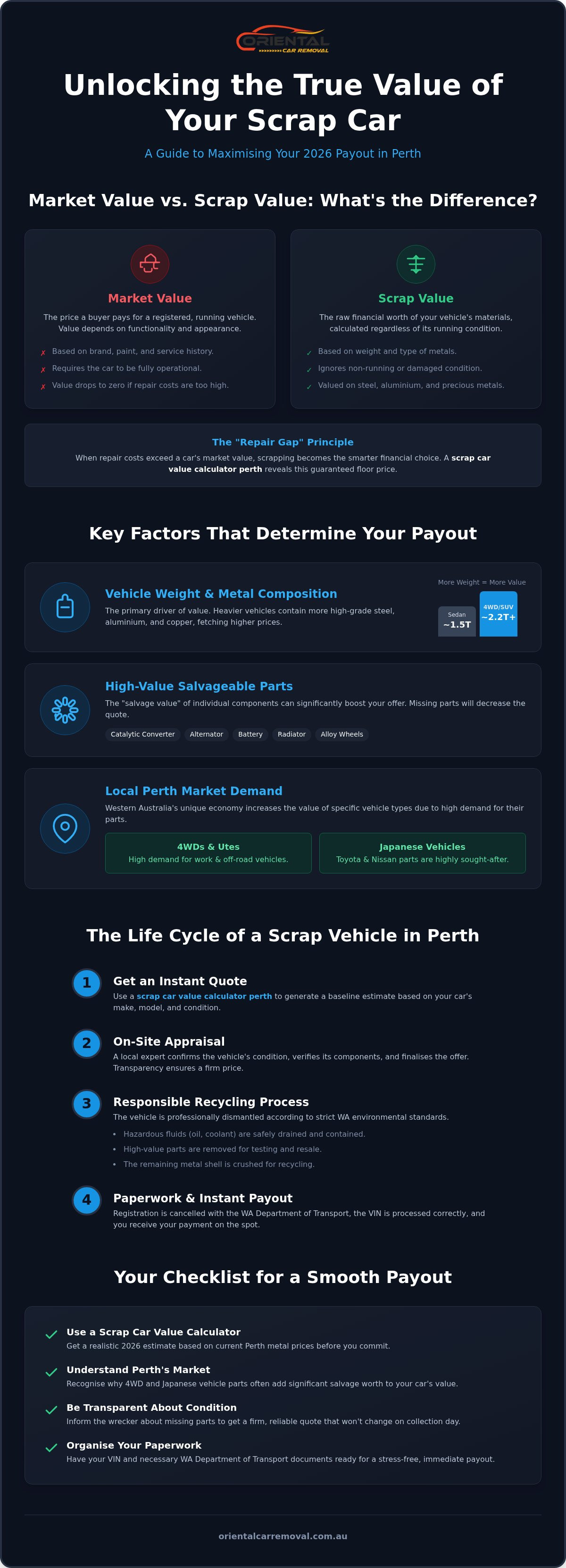
Cost of Scrapping a Car vs Selling: Choose Between Parts and Scrap

Cost of Scrapping a Car vs Selling: Choose Between Parts and Scrap

The higher offer isn’t always the better return. The cost of scrapping a car vs selling it has no single fixed figure: a private sale may bring in more, while a scrap or salvage offer reflects the car’s metal and reusable parts. Selling parts individually can add value, but it takes time and effort.

It’s reasonable to want a good return without spending weeks managing listings, buyer messages or dismantling work. The right choice depends on your car’s condition, demand for its parts and how much time you’re willing to spend. A damaged or non-running car can still have salvage value, even if selling it as a complete vehicle is impractical.

This guide compares selling a complete car, scrapping it and selling its parts, then explains what affects value and how each option works in Australia. You’ll see when a private sale may be worth the extra effort, when scrapping is more practical and what to consider before deciding.

Key Takeaways

  • Compare the likely return from selling the whole car with the time and work involved in removing and selling parts.
  • Assess how your car’s condition, weight, make and model, and demand for reusable parts can affect its value.
  • Understand why a written-off vehicle may still have salvage value beyond its scrap metal.
  • Weigh repair costs and sale effort against scrapping when a car is damaged, incomplete or no longer running.
  • Learn what information supports a useful quote and what steps are involved in arranging removal.

Is It Better to Sell Auto Parts or Scrap the Whole Car?

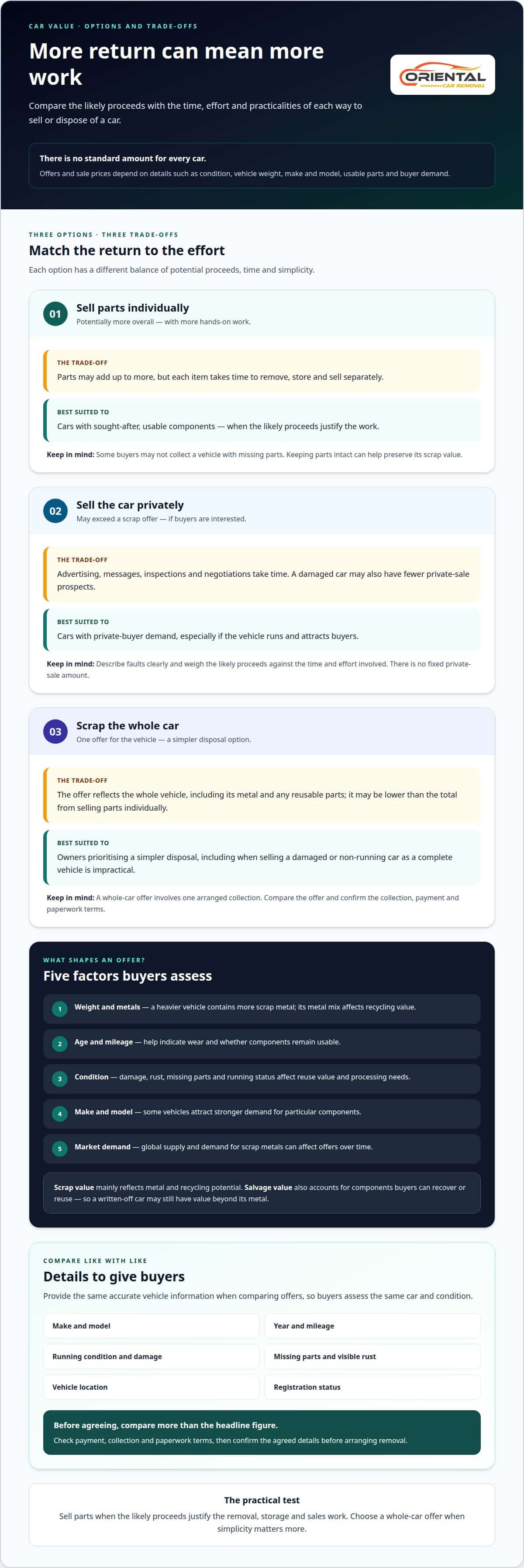
Selling parts can bring in more overall, but each item takes time to remove and sell. A whole-car scrap offer is simpler to assess because it covers the vehicle in one transaction.

There’s no standard amount Australian wreckers pay for every scrap car. An offer depends on details such as the vehicle’s weight, condition, make, model and usable parts. A used or damaged car also has no set private-sale price: its condition, demand and buyer interest all matter.

Scrap Quotes and Estimated Car Worth

An online estimate can provide a starting point, while a scrap quote reflects the specific vehicle and removal arrangements. Give buyers accurate details about the make, model, year, running condition, damage and missing parts. Compare payment, collection and paperwork terms, not just the headline figure, and confirm the agreed terms before arranging removal.

Scrap Proceeds Versus Private-Sale Proceeds

A private sale may bring in more than scrapping a complete car, especially if it runs and attracts buyers. But listings, messages, inspections and negotiations take time. For a damaged car, describe its faults clearly and weigh the likely proceeds against the work involved. Offers depend on condition and demand, so there’s no fixed Australian private-sale amount.

Scrap Value Versus Salvage Value

Scrap value mainly reflects the vehicle’s metal and recycling potential. Salvage value also accounts for usable components that buyers can recover or reuse. That total involved 18 hours of labour, plus storage and online listings.

Use this comparison to weigh money against effort:

Option Potential proceeds Time and work Best suited to
Sell parts individually Parts may add up to more Removal, storage and separate sales Cars with sought-after usable components
Scrap the whole car One offer for the vehicle One arranged collection Owners prioritising a simpler disposal
Sell privately May exceed a scrap offer Advertising and buyer negotiations Cars with private-buyer demand

Sell parts when the likely proceeds justify the work; choose a whole-car offer when simplicity matters more.

Keeping parts intact can preserve a car’s scrap value, and some buyers won’t collect vehicles with missing parts. Compare whole-car offers using the same vehicle details, then confirm collection, payment and paperwork before agreeing. A higher total from selling parts is worthwhile only if it outweighs the time, storage and work involved.

Factors affecting scrap car value

A scrap offer reflects the vehicle’s materials, condition and demand for reusable components. Several factors affect the amount, so two cars of similar age can attract different offers.

Vehicle Condition and Buyer Demand

Condition affects what buyers can reuse and how much processing the vehicle needs. A car with working electronics, intact panels and usable components may interest buyers looking for parts. Severe damage or missing components changes what can be recovered. Demand also shifts with market conditions and global supply and demand for scrap metals, so interest in the same vehicle can change over time.

Resale Options and Sale Value

Resale options depend on whether a vehicle appeals to private buyers, trade-in buyers or wreckers. A car in very good condition with few issues may attract a stronger trade-in offer, while a damaged vehicle may have fewer private-sale prospects. Make and model also influence interest. Weigh the expected sale value against the time, effort and repairs needed before choosing.

Key factors that shape scrap-car offers include:

  • Weight and metals: A heavier vehicle contains more scrap metal, while its metal mix affects recycling value.
  • Age and mileage: These help indicate wear and whether components remain usable.
  • Condition: Damage, rust, missing parts and running status affect the vehicle’s reusable value and processing needs.
  • Make and model: Some vehicles attract stronger demand for particular components.
  • Market demand: Scrap-metal values fluctuate with global supply and demand, affecting offers.

For example, a heavy 4WD with intact components presents different value factors from a small car with extensive damage. Weight can support its metal value, while the condition and demand for its parts influence salvage interest. Neither factor alone determines the final offer. Buyers assess the vehicle as a whole, including its metal and recoverable components.

Private sales carry different risks from scrapping. You may spend weeks or months arranging viewings and negotiating, and buyers may focus on faults or repairs. Scrapping avoids the need to find a private buyer, but the offer still depends on the car’s condition and demand for its metal and parts. Compare the likely return with the time and effort each option requires.

To estimate value, gather the vehicle’s make, model, year, mileage, running condition and damage details. Note missing parts and visible rust, then provide the same information when comparing offers. Accurate details help buyers assess the same vehicle, rather than different versions of its condition. Include its location and registration status, as these help identify the vehicle being assessed.

Market conditions can change the value of metals, while rust or broken components can reduce reuse potential if a car sits unused. Base your decision on the vehicle’s present condition, not a previous estimate. To consider the next step for an unwanted vehicle, review vehicle removal options alongside its resale prospects.

Scrap value vs salvage value: What’s the difference?

Scrap value reflects a vehicle’s metal, while salvage value also includes components that may be reused. A written-off car can still have either kind of value.

Salvage Value of Written-Off Vehicles

Salvage value comes from parts or repair potential, not just the vehicle’s metal weight. A written-off car with usable components, such as electronics or a catalytic converter, may interest buyers looking for specific parts. A repairable write-off may be repaired and re-registered under certain conditions; a statutory write-off generally cannot be re-registered. This distinction affects the car’s resale options.

Scrap Value of Damaged and Non-Running Cars

A damaged or non-running vehicle can still have scrap value through its metal and remaining components. Its condition affects what can be recovered, while weight and current demand influence the metal value. Cars are around 75% scrap metal, so metal content forms a substantial part of their scrap value. Missing or badly damaged components can reduce the vehicle’s appeal for parts recovery.

Vehicle Condition and Resale Value

Condition helps distinguish a car with repair potential from one valued mainly for recycling. A vehicle with intact, usable components may retain salvage value even if it cannot be driven. Extensive damage, by contrast, can leave metal as the main source of value. Private resale depends on whether buyers see a practical use for the car; scrap value centres on its materials and recoverable parts.

Payment speed is another factor to weigh. A car removal arrangement may combine collection with cash payment, but the amount and timing depend on the agreed terms. Treat “instant” payment as a specific term to confirm before agreeing, rather than assuming every offer works the same way. Compare the payment method alongside the vehicle’s condition and removal arrangements.

Environmental handling also differs by option. A private buyer may continue using the vehicle or recover selected parts; recycling separates reusable components and metals from material for disposal. Consider what happens to the whole vehicle under each option, especially if it’s written off and no longer suitable for road use. The process determines whether its remaining value comes from repair, parts or metal.

To compare offers, record the write-off type, running condition, damage and missing components. Note usable parts, including electronics or a catalytic converter, without assuming every component adds value. Then compare the vehicle’s salvage potential with its metal value and the payment terms. This gives you a clearer basis for deciding whether repair, resale or scrapping best suits its actual condition.
Cost of Scrapping a Car vs Selling: Choose Between Parts and Scrap

When damaged or non-running cars are better scrapped

A car that won’t start can still have value in its metal and usable components. Scrapping can be practical when repairs, missing parts or damage make a private sale difficult.

Start with the fault, not just the repair estimate. Engine failure, collision damage or an electrical problem can reduce buyer interest and make a roadworthy sale harder. Compare likely sale proceeds with repair costs, towing, advertising and the time spent arranging inspections. If the car needs substantial work before a buyer can use it, selling it as-is or scrapping it may make more sense.

Non-running and incomplete vehicles can still be scrapped. Their value depends on what remains, including body panels, wheels, electronics and metal. Missing parts can affect an offer, so describe them clearly when requesting a quote. Say whether the car starts, rolls, has collision damage or has had components removed. Accurate details help buyers assess its actual condition.

A damaged car may still attract a private buyer if its make, model or remaining components suit their needs. But the buyer must accept its faults, and you may need to answer questions, arrange viewings and negotiate. A car with substantial body damage and an engine that won’t run is a different sale proposition from one with a single repairable issue. List known faults plainly to avoid disputes about its condition.

Use this quick comparison before deciding:

  • Repair and sell: Consider this when the work is manageable and the repaired car has resale appeal.
  • Sell as-is: This suits a vehicle with faults that a buyer is willing to take on.
  • Scrap the car: Consider this when damage, an engine failure or missing parts leave few practical resale options.

Removal is another factor. A non-running car may need towing before a private buyer can inspect or collect it. Include that effort in your decision, alongside repairs and time spent handling enquiries. If you scrap your car, confirm collection arrangements before handover and remove personal belongings from the cabin and boot.

Registration is a separate task from deciding whether to sell or scrap a car. In Australia, owners are required to cancel registration when a car has been scrapped, and the process varies by state. Keep the sale or disposal details with your paperwork, then follow the registration process for the state where the vehicle is registered.

Make your choice using three factors: the car’s current condition, the repairs needed for resale and the effort involved in removal. If a repairable fault leaves useful resale value, selling may be worthwhile. If the car is damaged, incomplete or non-running and a private sale would involve substantial work, scrapping can offer a more direct way to dispose of it.

How scrapping and selling a car work

Scrapping transfers a vehicle for recovery, recycling or disposal; a private sale transfers it to a buyer. In Australia, private-sale expenses may include repairs, cleaning, advertising or transport, depending on your choices. The main difference is the process: a private sale involves finding and dealing with a buyer, while scrapping arranges removal and disposal.

Scrapping a Car

Start by gathering the vehicle’s make, model, year, location, registration status, running condition and damage details. Include any missing components. These details help a buyer assess the car as it stands. Be accurate: a vehicle that rolls but won’t start is different from one with major parts removed.

Before collection, remove personal belongings and have proof of ownership, such as registration papers or ID, available. Confirm the removal and payment terms before handover. Keep a record of the agreed arrangements and vehicle details with your paperwork.

  • Describe the vehicle, its condition and any missing parts.
  • Agree on collection, payment and paperwork arrangements.
  • Remove belongings before the vehicle is collected.

This option avoids preparing the car for a private buyer’s inspection or advertising. Oriental Car Removal buys vehicles without requiring engine or body repairs. The vehicle can then be assessed for reusable components and scrap metal, rather than prepared for continued road use.

Selling a Car Privately

A private sale starts with an accurate listing, an asking price and replies to buyer enquiries. Include the car’s condition and known faults. Buyers may request an inspection or negotiate after viewing it. A private sale can take weeks or months if you’re willing to wait for a higher price, so allow time for messages, viewings and ownership paperwork.

Possible out-of-pocket expenses depend on the vehicle and your choices. Repairs, cleaning, advertising and transport can all require money or effort. If the car needs work, weigh those costs against the likely sale proceeds. Describe its faults clearly before an inspection so buyers understand its condition and can decide whether it suits them.

Registration steps vary across Australia. Owners are required to cancel registration when a vehicle has been scrapped, with the process depending on the state. After a private sale, follow the relevant state or territory process to record the transfer. Keep the sale or disposal details together so you can complete the applicable paperwork.

Choose the route that fits the car and the time you can spend arranging its transfer. If you want a simpler option for an unwanted vehicle, arrange scrap car removal.

Oriental Car Removal: Scrap Car Removal

Oriental Car Removal provides Scrap Car Removal for owners who have decided that selling parts or arranging a private sale isn’t the right fit. It buys unwanted vehicles through Cash for Cars in Perth and provides free car removal, simplifying the next step when a car is no longer practical to keep.

If you’re weighing a whole-car option against dismantling and selling components, consider whether the extra time and effort suit your situation. Oriental Car Removal can also help if you want to sell a truck. Share the vehicle details and its condition to start the conversation about removal.

Choose the next step that suits your car

Your decision about the cost of scrapping a car vs selling it should account for more than the likely offer. Consider how much time you want to spend organising a sale and whether you’d rather keep managing the vehicle or move on from it. Once you’ve chosen, have the car’s details and condition ready to discuss.

Oriental Car Removal offers instant cash for cars in Perth, cash for trucks and free car removal. If you’re ready to discuss your vehicle, contact the team to get a quote and arrange the next step.

A clear decision can make moving on from an unwanted vehicle more straightforward.

Frequently Asked Questions

What is scrapping?

Scrapping takes a vehicle out of use so its materials or components can be recovered, recycled or disposed of. A car may be dismantled, with usable parts separated from scrap metal. For example, a vehicle with a damaged body may still have components that can be reused. Unlike a private sale, scrapping doesn’t transfer the car to someone intending to keep driving it.

Final Thoughts: Which Option is Right for You?

The cost of scrapping a car vs selling it depends on more than the amount offered. Consider the car’s condition, the work needed to prepare it and how much time you can spend dealing with buyers. A running vehicle with resale appeal may suit a private sale. If you value a more direct transfer and disposal process, scrapping may better match your priorities.

Can I scrap a car that isn’t running or is missing parts?

Yes, a car can still be scrapped if it doesn’t run or has missing parts. Describe its condition accurately, including whether it rolls, whether the engine starts and which components are gone. For instance, a car missing its battery differs from one stripped of major components. Clear information helps a buyer assess the vehicle as it stands and plan its removal.

Does a Broken or Non-Running Car Still Have Value?

Yes, a broken car may retain value through its metal or usable components. A failed engine doesn’t automatically make intact doors, wheels or electronics worthless. The vehicle’s weight, condition and demand for its parts all influence its value. If the car has been sitting unused, note visible rust or damage, as these can affect which remaining components are suitable for recovery.

How Much Is a Written-Off Car Worth?

A written-off car has no single value that applies to every vehicle. Its condition, metal content and recoverable components affect its worth. The write-off type also matters: a repairable write-off may be repaired and re-registered under certain conditions, while a statutory write-off generally cannot be re-registered. A vehicle with parts in demand may retain salvage value beyond what its scrap metal alone would suggest.

What is the average scrap metal value of a car in Australia?

There isn’t one fixed scrap-metal value for every Australian car. Weight, metal content and current market demand influence the amount, while reusable components can also affect a whole-vehicle offer. A heavier vehicle and a smaller car contain different amounts of metal. An individual assessment is more useful than relying on a general average because it can account for the specific vehicle’s condition and materials.

What fees apply when scrapping a car in Australia, including towing and disposal?

Costs depend on the vehicle and the arrangements. Before agreeing, make sure the terms explain collection, disposal, paperwork and payment. Private selling can also involve expenses, depending on whether you choose to repair, clean, advertise or transport the car. Compare any costs and effort with the likely proceeds, so your decision reflects what you may actually keep rather than the headline offer alone.

How do scrap car prices compare with private sale and dealer trade-in offers?

The cost of scrapping a car vs selling it privately comes down to likely proceeds, time and effort. A private buyer may pay more for a vehicle they can use, but the sale can involve listings, inspections and negotiation. Dealer trade-in offers may be lower than the vehicle’s full value because dealers plan to resell. Scrap offers reflect the vehicle’s metal and salvageable components, not its road-use value.

Unwanted Car Pickup in Warnbro for Cash Offers and Removal

Unwanted Car Pickup in Warnbro for Cash Offers and Removal

Pickup timing for an unwanted car in Warnbro depends on the collection schedule, your address and access to the vehicle. For unwanted car pickup in Warnbro, the vehicle’s type and condition also help shape the assessment and removal arrangements.

A car that won’t start, has accident damage or is taking up space can be difficult to move on your own. Before arranging pickup, it’s reasonable to want clear information about timing, payment and whether removal costs anything.

This guide explains how pickup timing works, what can affect an instant cash offer and how free removal fits into the process. You’ll also learn which vehicles can be collected, what to expect when selling a scrap car, and which nearby areas around Warnbro are covered. These details can help you plan a straightforward handover.

Key Takeaways

  • Learn how a vehicle’s type, condition and accessibility can shape its cash offer and pickup arrangements.
  • Find out what free vehicle removal means and how towing fits into the collection process.
  • See why cars, trucks, vans, utes and 4WDs can all be considered for removal, including vehicles that no longer run.
  • Understand how Warnbro fits into the Rockingham service area and which nearby suburbs may be covered.
  • Know that the City of Rockingham’s general waste verge collection does not accept car bodies, vehicle parts or tyres.

What Happens to the Cars and Scrap Metal?

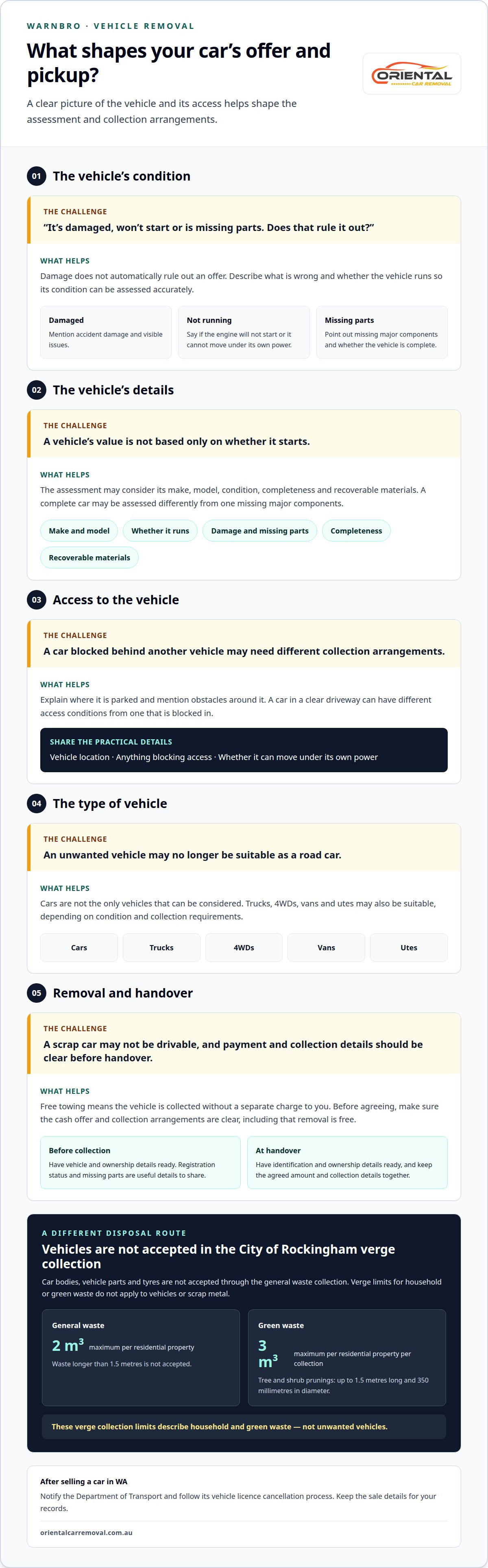
A vehicle’s condition helps shape its assessment for removal. A damaged car, a vehicle that won’t start and an older car with scrap value can each have different considerations. The make, model, completeness and condition of key components can affect its value. Access matters too: a car blocked behind another vehicle may need different collection arrangements from one parked in a clear driveway.

Cars aren’t the only vehicles considered. Trucks, 4WDs, vans and utes may also be suitable, depending on their condition and collection requirements. For example, a damaged van and an unwanted ute are different vehicle types, but both can be assessed for removal. Share the vehicle type, its condition and whether it runs when arranging a pickup. That gives the collection team practical details to plan around.

  • Damaged: Accident damage can affect the vehicle’s condition and assessment.
  • Not running: Tell the collector if the engine won’t start or the vehicle can’t move under its own power.
  • Scrap condition: Scrap car removal is an option to consider when a vehicle is no longer wanted as a road car.

No single condition describes every unwanted vehicle. A car may be damaged but complete, or it may be missing parts and unsuitable for driving. A truck, van, ute or 4WD may also have mechanical issues or body damage. Describe what’s wrong rather than assuming the vehicle’s condition rules it out. The vehicle’s details and access help shape the assessment and removal plan.

City of Rockingham verge collection is for household waste, not whole vehicles. Its general waste collection allows up to two cubic metres per residential property and won’t accept waste longer than 1.5 metres. Old furniture up to 1.5 metres may be accepted, with glass removed. Car bodies, vehicle parts and tyres aren’t accepted through that collection, so placing them on the verge isn’t a suitable disposal step.

Green waste has separate limits. The City of Rockingham accepts up to three cubic metres per residential property per collection. Tree and shrub prunings can be up to 1.5 metres long and 350 millimetres in diameter. Those rules apply to green waste, not vehicles or scrap metal. Keeping the categories separate helps avoid leaving an unwanted car where the verge service won’t collect it.

After selling a car in WA, notify the Department of Transport and follow its vehicle licence cancellation process. Keep the sale details for your records and check what steps may apply after selling a car.

Cash offers and factors affecting vehicle value

An instant cash offer reflects the vehicle’s details and condition, not just whether it starts. The information you provide helps assess its value as a usable vehicle or for scrap.

Offers for Scrap and Unwanted Cars

A scrap car can still have value even if it’s no longer suitable for driving. The offer depends on the vehicle’s make, model, condition and recoverable materials. A complete car may be assessed differently from one missing major components. Describe the vehicle accurately so the instant cash offer reflects what is being collected. This also helps distinguish scrap value from the value of a roadworthy vehicle.

Offers for Damaged Vehicles

Damage doesn’t automatically rule out an instant cash offer. Accident damage, a non-starting engine or worn components can affect the vehicle’s condition and assessment. For example, a car with body damage but intact components differs from one with extensive damage and missing parts. Describe the damage and say whether the vehicle runs. Clear details help the assessment reflect its actual condition.

Vehicle Assessment and Offer Factors

An assessment connects the vehicle’s details to the instant cash offer. Relevant details include its make and model, whether it starts, visible damage and missing components. Access can also affect collection arrangements, such as when a car is parked behind another vehicle. Give a clear description and mention anything that could affect the assessment. Accurate information makes it easier to discuss the offer before collection.

For a practical assessment, gather the vehicle’s identifying details and describe its condition. Note whether it starts, has accident damage or is missing major parts. If access is difficult, explain where it’s parked. These details help distinguish a scrap vehicle from an unwanted car that may retain usable value. They also help avoid surprises at collection.

  • Vehicle details: Provide the make and model.
  • Condition: Explain whether it runs and describe damage or missing parts.
  • Access: Mention obstacles around the vehicle’s parking spot.

A cash offer is the amount agreed for the vehicle, while payment arrangements should be clear before handover. Keep the agreed amount and collection details together so both are easy to refer to. Don’t assume every scrap car has the same value: condition, completeness and recoverable materials all matter. A cash offer for a scrap car starts with an accurate picture of the vehicle.

Is scrap car removal really free in Warnbro?

Vehicle removal can include free pickup and towing, so you aren’t charged to move the unwanted car. Before arranging a sale, prepare clear vehicle details and ownership information, and agree on the instant cash payment and collection arrangements.

Have identification and ownership details ready for the handover. Registration status and missing parts are also useful details to share during the quote process.

Free Pickup and Towing

Free towing means the vehicle is collected without a separate charge to you. Oriental Car Removal arranges removal, which is useful if a scrap car can’t be driven from your Warnbro property. Before agreeing, make sure the instant cash offer and collection arrangements are clear, including that removal is free.

Quote and Vehicle Assessment

A quote starts with the vehicle’s details and condition. Share its make and model, whether it runs, visible damage, missing components and where it’s parked. For example, an accident-damaged car that won’t start needs a different collection plan from a complete car in a driveway. These details help shape the assessment and instant cash offer. Agree on the offer and pickup arrangements before handover.

Unregistered Vehicles and Missing Parts

An unregistered vehicle can still be considered for removal. Registration status doesn’t describe the whole vehicle, so also explain its condition and whether it can move. Mention any parts already removed, such as a battery or wheels. Clear details help the assessment reflect the vehicle being collected. Have identification and ownership details ready for handover, and keep a record of the sale.

After collection, recycling can separate a vehicle’s metal and reusable components from material that needs disposal. A vehicle’s condition and completeness can influence which materials are suitable for recovery. A dismantled scrap vehicle may have fewer reusable components than a complete car, while damaged panels can affect the recoverable material. Recycling helps recover usable materials and process the remainder for disposal, rather than leaving an abandoned shell.

To sell your car without arranging a separate tow, follow a clear sequence:

  • Describe the vehicle, its condition and any missing parts.
  • Agree on the cash offer and collection arrangements.
  • Have ownership details ready, then complete the handover.

Free pickup takes the towing step off your hands, but it’s still important to agree on the instant cash offer. The offer should reflect the details supplied about the unwanted vehicle. Keep a sale record and confirm payment at handover. This gives you a clear transaction record and helps you complete your obligations as the seller.

Unwanted Car Pickup in Warnbro for Cash Offers and Removal

Rockingham service area and nearby suburbs

Warnbro is a named service location, and Rockingham is covered under postcode 6168. The wider service area extends within a 100 km radius of the Maddington wrecking yard, giving vehicle owners a clear reference point for nearby pickups.

Pickup Across Rockingham Suburbs

Rockingham postcode 6168 helps identify pickups within the Rockingham area. Provide the suburb and full address when arranging a car removal service, so the collection point is clear. Nearby named locations include Warnbro, Port Kennedy, Secret Harbour and Golden Bay. Giving the exact suburb helps distinguish a local pickup from a general request for the broader Rockingham area.

Address details help clarify vehicle access. A car in an open driveway presents a different collection situation from one behind a gate or in a shared complex. Include the pickup address and any practical access information when arranging collection. This helps Oriental Car Removal understand where the vehicle is parked and how it can be reached.

Nearby suburbs can be considered in relation to the stated service area. The wider coverage is measured within a 100 km radius of the Maddington wrecking yard. A suburb that appears close to Rockingham may sit at a different distance from Maddington. Providing the complete pickup address helps establish the location in relation to that radius.

Service Coverage Around Warnbro

Warnbro is specifically named as a service location, making it a useful reference for owners with unwanted cars or scrap cars. Rockingham postcode 6168 is another location marker. Other nearby named areas include Port Kennedy, Secret Harbour and Golden Bay. These place names help identify where a vehicle is located without relying on a broad description such as “near Rockingham”.

Give the suburb first, then the full pickup address. Add a practical access detail, such as whether the vehicle is in a driveway or behind a locked gate. For pickup in Warnbro, naming the suburb identifies the local area. If the vehicle is elsewhere, its address helps establish the collection location in relation to Rockingham and the Maddington wrecking yard.

Service-area descriptions are easier to use when the pickup point is specific. For example, Rockingham postcode 6168 identifies that locality, while a nearby suburb can be considered against the 100 km radius from Maddington. This gives owners a clearer way to describe where collection is needed before arranging it.

If you’re planning to sell an unwanted vehicle, start with its exact location. State whether it’s in Warnbro, Rockingham, Port Kennedy, Secret Harbour or Golden Bay, then provide the pickup address. Mention driveway access or obstacles around the vehicle too. These details clearly describe the collection point and help with local arrangements.

Removal of cars, trucks, vans, utes and 4WDs

Vehicle removal can cover more than a standard passenger car. Cars, trucks, vans, utes and 4WDs each have different sizes, conditions and collection needs. A damaged sedan and an unwanted work ute, for example, are different vehicles to assess. The key takeaway is simple: describe the vehicle accurately so its type and condition are clear.

A car may be unwanted because it’s old, damaged, no longer running or taking up space. A scrap car removal request may also involve a vehicle that’s incomplete or unsuitable to drive. These details matter because a car that starts differs from one that needs to be loaded for removal. Explain whether it runs and mention visible damage when arranging collection.

Trucks need clear identification too. Tell the removal team whether it’s a truck, rather than describing it only as a large vehicle. A van or ute may be used for work or personal transport, while a 4WD has a different body style and purpose. Naming the vehicle type helps keep the removal request specific. For example, state “van” or “4WD”, then describe its condition.

Vehicle condition varies within each category. One ute may be complete but no longer wanted, while another may have accident damage or missing parts. A truck may not start, and a van may be unregistered. Identify the vehicle clearly, including its make and model if known, whether it runs, and any damage or missing components.

Access is another practical detail for cars, trucks, vans, utes and 4WDs. A vehicle in an open driveway presents a different collection situation from one behind a gate or blocked by another car. Give the pickup address and explain the access issue. If a truck is parked in a tight area, say so. A clear description helps plan around the vehicle’s location and condition.

Use this short checklist when describing a vehicle for removal:

  • Type: Identify the car, truck, van, ute or 4WD.
  • Condition: Say whether it starts and describe damage or missing parts.
  • Location: Provide the pickup address and explain driveway or gate access.

A cash offer and removal plan depend on the vehicle details provided. “Top cash” alone doesn’t explain what a particular vehicle is worth. A complete, running van and a damaged, non-running 4WD need separate assessments. Share accurate details, discuss the offer, then agree on collection arrangements before handover. This straightforward process applies whether you want car removal or need an unwanted truck taken away.

Oriental Car Removal: Cash for Unwanted Cars

Oriental Car Removal can help when you’re ready to move on an unwanted vehicle. Its Cash for Unwanted Cars and Cash for Cars in Perth services provide a straightforward next step for cars you no longer need, while Free Car Removal includes collection and towing at no charge. Cash for Trucks is also available for unwanted trucks.

To get started, share the vehicle type, condition and pickup location. Details such as whether it runs, has damage or is difficult to access help shape the assessment and collection arrangements. Discuss the instant cash offer, then agree on a pickup plan for the handover.

Contact Oriental Car Removal to discuss your unwanted vehicle.

Make your next step straightforward

When you’re ready to move on from a vehicle, keep the handover simple. Gather its details, describe its condition clearly and arrange pickup for its location. A clear plan can help you arrange unwanted car pickup in Warnbro without leaving a vehicle sitting unused.

Oriental Car Removal offers Cash for Cars in Perth, Free Car Removal and Cash for Trucks. Whether you have a car you no longer need or a truck ready to go, share the vehicle details to discuss an instant cash offer and free collection arrangements.

Take the first step when you’re ready, and make space for what comes next.

Frequently Asked Questions

How quickly can you pick up my car in Warnbro?

Pickup timing depends on the collection schedule, your address and vehicle access. A car in an open driveway may be easier to reach than one behind a locked gate or blocked by another vehicle. Share your Warnbro address, the car’s condition and any access issues when arranging collection. This helps plan a suitable pickup time and avoid delays caused by unclear access arrangements. Same-day pickup may be possible where logistics allow, but timing isn’t guaranteed.

Do you buy old or non-running cars in Warnbro?

Yes. Older and non-running cars can be considered for removal in Warnbro. A vehicle doesn’t need to start to be assessed, and age alone doesn’t rule it out. Explain if the engine won’t turn over, the car has accident damage or parts are missing. Oriental Car Removal accepts vehicles across makes, models and conditions, including cars for scrap removal.

How and when do I get paid?

Payment is made as instant cash on the spot when the sale is completed. The agreed amount and handover arrangements should be clear before the vehicle is collected. Have the vehicle and ownership details ready so the transaction can be completed smoothly. If you’re selling a car that won’t run, mention this during the initial discussion so the offer reflects the vehicle being collected.

Is towing really free this far south?

Yes. Free Car Removal includes towing at no charge to the owner, and Warnbro is among the listed service locations. This can help if a scrap car can’t be driven or is parked away from central Perth. Include the pickup address and any driveway, gate or access restrictions when arranging collection, especially if a tow vehicle needs clear access.

What paperwork do I need to sell my car in Warnbro?

Have proof of ownership and identification ready for the sale. Registration isn’t always required when selling a car, but ownership details help establish that you can hand it over. Oriental Car Removal handles the sale paperwork as part of the process. Keep a record for your files, including the agreed amount and the date the vehicle changes hands.

Who offers unwanted car pickup in Warnbro, WA?

Oriental Car Removal offers unwanted car pickup in Warnbro, WA, as part of its service across Perth and surrounding suburbs. Its Cash for Cars in Perth service covers unwanted vehicles, while Free Car Removal includes collection and towing at no charge. Truck owners can also ask about Cash for Trucks. Share the pickup suburb and vehicle details to discuss an instant cash offer and collection arrangements.

How much can I get for an unwanted car in Warnbro?

The instant cash offer depends on details such as the car’s make, model, condition and completeness. A damaged vehicle with missing components may be assessed differently from a complete car. Share accurate details, including whether it runs, so the offer reflects the vehicle being sold.

Which unwanted vehicles do Warnbro car buyers accept?

Oriental Car Removal accepts cars, trucks, 4WDs, vans and utes, including unwanted, damaged, scrap and non-running vehicles. Make, model and condition don’t automatically exclude a vehicle. For instance, you can describe an unregistered van or an accident-damaged 4WD for assessment. Mention missing parts and access details too, so the vehicle’s condition and collection needs are understood from the outset.

Car Recycling in Australia: How Old Cars Become Materials

Car Recycling in Australia: How Old Cars Become Materials

An old car doesn’t go straight from the driveway to the scrap pile. In the car recycling process in Australia, a damaged or non-running vehicle is assessed, depolluted and stripped of reusable parts before its shell is crushed or shredded. Magnets and other sorting methods then separate metals from non-metal materials for further processing.

It’s natural to wonder what happens to the fuel, oil, battery and other materials inside a vehicle after collection. This guide explains how recyclers handle them, which parts may be reused, and how steel, aluminium and other materials are sorted and recovered.

You’ll also learn why depollution comes before crushing, what happens to materials that can’t be recycled, and how recycling can reduce waste and demand for raw materials. Each stage has a purpose, from making the vehicle safer to dismantle to directing recovered materials towards their next use.

Key Takeaways

  • Damaged and non-running vehicles can still enter the recycling process; condition, age and market value help determine how they’re assessed.
  • Depollution comes before crushing: fluids, batteries and other hazardous materials are removed for safe handling.
  • After shredding, magnets and other sorting methods separate metals from plastics, glass and other materials.
  • Recovered steel, aluminium and copper can be sent for further recycling, while some leftover material may require disposal.
  • The International Organization for Standardization identifies ISO 14001 as an environmental management system certification relevant to car recyclers.

Car recycling options for damaged and non-running vehicles

Damaged, unregistered and non-running vehicles can still be assessed for recycling. Australian disposal rules vary by state and territory, while the National Policy on the Disposal of End-of-Life Vehicles provides national guidelines for safe, responsible disposal.

Collecting and transporting vehicles

Collection is the step where an end-of-life vehicle is moved from its current location to a recycling facility. It matters because a car that won’t start, has accident damage or cannot be driven needs suitable transport rather than a road journey.

Before collection, describe the vehicle’s condition and location accurately, including whether it rolls and whether access is clear. This helps plan loading and transport. Cars, vans, trucks and commercial vehicles can be considered for recycling in any condition, so major damage or a failed engine doesn’t automatically rule them out.

At the facility, vehicles are logged and assessed for hazardous materials and reusable components. For a business fleet, record each vehicle’s identifying details and collection status. A separate record for every vehicle helps match transport, assessment and disposal paperwork across the fleet.

Assessing end-of-life vehicles

Assessment reviews a vehicle’s condition, age and market value to establish its recycling value. These factors matter because a damaged vehicle can still contain components or metals worth recovering.

Assessors review the vehicle as a whole, then identify reusable components and recoverable materials. For example, an accident-damaged vehicle may have a badly affected body but retain components suitable for reuse. A vehicle with extensive damage and fewer usable components may be valued mainly for its recyclable materials.

Some recycling services base payment on vehicle weight, while others consider condition, age and market value. That’s why two vehicles of similar size can receive different assessments. For fleet disposal, assess vehicles individually rather than treating them as identical, especially when their condition and models differ.

Preparing vehicles and paperwork for disposal

Preparation means gathering ownership records, clearing the vehicle and organising disposal documents before collection. Missing paperwork or personal belongings can complicate the handover.

Gather registration and ownership documents, along with records relating to any outstanding loan or lease. For fleet vehicles, organise paperwork by vehicle so each disposal can be matched to its records. Remove personal belongings, registration documents and insurance documents before collection.

Check for outstanding vehicle fees, such as parking tickets or tolls, and settle them where required. Notify the relevant transport authority about the disposal to avoid registration complications. Keep a record of the handover and vehicle details for your files. These steps create a clear trail from collection to disposal.

Rules for dismantling and recycling

Vehicle dismantling and recycling are shaped by state and territory rules, alongside national disposal guidance. Requirements can differ depending on where the vehicle is stored, treated and disposed of.

The National Policy on the Disposal of End-of-Life Vehicles sets guidelines for safe and responsible disposal in Australia. Each state and territory has its own regulations for vehicle disposal and recycling, which may cover waste storage, treatment and disposal. Don’t assume one state’s process applies everywhere.

Responsible handling also includes checking how a recycler manages environmental impacts. The International Organization for Standardization identifies ISO 14001 as an environmental management system certification relevant to car recyclers. It relates to environmental management, rather than replacing the applicable state or territory rules. Together, these considerations help frame a sound disposal process.

Separating shredded materials with magnets and other sorting methods

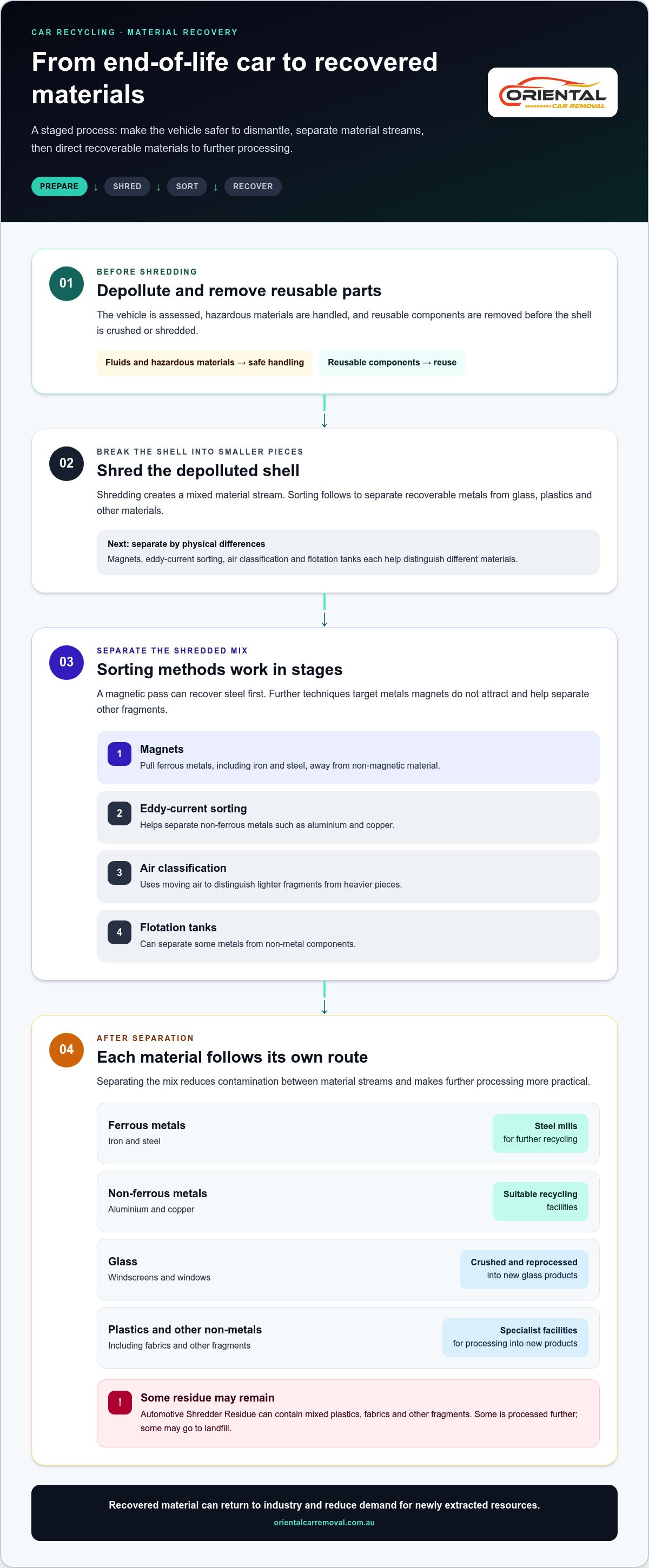
After reusable components are removed and the shell is depolluted, shredding breaks it into smaller pieces. Sorting then separates recoverable metals from glass, plastics and other materials.

Sorting shredded materials

Sorting separates the shredded mix by using physical differences between materials. This matters because steel, aluminium, copper and non-metal materials need different recovery and processing routes.

Magnets pull ferrous metals, including iron and steel, away from non-magnetic material. Eddy-current sorting helps separate non-ferrous metals such as aluminium and copper. Air classification uses moving air to distinguish lighter fragments from heavier pieces, while flotation tanks can separate some metals from non-metal components.

These methods work in stages. A magnetic pass can recover steel first, followed by techniques that target metals magnets don’t attract. The remaining mix may contain glass, plastics and fabrics. Separating it reduces contamination between material streams and makes further processing more practical.

Each recovered stream has a different next step. Ferrous metal can go to steel mills, while aluminium and copper are sent to suitable recycling facilities. Windscreens and windows can be crushed and reprocessed into new glass products. Plastics and other non-metal materials may go to specialist facilities for processing into new products.

Not all residue is easy or economical to recover. Automotive Shredder Residue can contain mixed plastics, fabrics and other fragments. Some residue is processed further, while some may go to landfill. Sorting helps recover usable materials before the remaining waste is handled.

Processing materials for reuse

Processing prepares recovered metal and non-metal materials for use in manufacturing. Recycling can return materials to industry and reduce demand for newly extracted resources.

Once separated, metal streams are prepared for their respective recycling facilities. Recovered steel can be used again, while aluminium and copper follow separate recovery routes. Glass and plastics also need suitable processing before they can become feedstock for new products.

Depollution supports material recovery by keeping hazardous substances out of the shredder and sorted streams. Fluids, batteries and other hazardous components are removed and handled separately before crushing. This helps prevent pollutants from entering the surrounding environment and keeps recoverable materials from becoming contaminated.

For example, drained oil should not mix with metal fragments intended for processing. A removed battery follows a separate recycling or disposal route, while cleaned steel can be directed towards metal recovery. Separating these items at the right stage makes later sorting clearer and reduces avoidable pollution.

Recovering metals also reduces reliance on virgin materials that require mining. Recycled metal can re-enter manufacturing, including vehicle production, while recovered glass and plastics may be processed into other products. Materials that are no longer suitable for recovery remain a disposal challenge, so careful separation matters from depollution through to final sorting.

Removal and handling of oils, fuels, batteries and coolants

Before a vehicle is crushed or dismantled, recyclers remove fluids and hazardous components. This depollution stage limits leaks and keeps substances such as oil, fuel and battery acid out of the processing area.

Oils, coolant, brake fluid and windscreen wash are drained and stored separately. Engine oil is collected for controlled disposal and further processing for reuse. Remaining petrol or diesel can be pumped from the tank and filtered to remove contaminants before further use. Keeping each fluid separate helps prevent spills and avoids mixing substances with different handling needs.

Batteries are removed for safe recycling or disposal, including recovery of lead from conventional car batteries. Airbags also need separate handling before dismantling because they contain explosive components. Refrigerants and battery acid are other hazardous materials that require careful removal and storage. Hybrid and electric vehicles need an additional stage: technicians safely disconnect and remove high-voltage batteries before dismantling continues.

Parts with reuse value are removed before the remaining vehicle shell is processed. Engines, transmissions, panels and lights may be cleaned and tested for resale or reuse. Functional components can serve another purpose and supply parts for consumer use instead of being treated as scrap metal. The vehicle’s condition and each component’s usability affect what can be recovered.

For car recyclers and vehicle recycling programs in each Australian state and territory, start with the relevant government environment or transport authority’s vehicle disposal guidance. State and territory rules differ, so use local guidance to understand disposal requirements and find suitable operators in your area.

In Australia, responsible vehicle disposal separates hazardous substances from reusable components and recyclable materials. Fluids are drained before crushing, batteries and airbags are handled separately, and salvageable parts are assessed for reuse. The order matters: removing contaminants first helps protect recovery and reduces the risk of pollution from leaks during processing.

As an owner, you don’t need to drain fluids or remove hazardous parts at home. Leave that work to the recycling process. Instead, remove personal belongings and paperwork, and give accurate details about the vehicle’s condition. A non-running car, damaged truck or unwanted van can still be collected for recycling, with suitable components recovered before its shell is processed.

These stages connect recycling with manufacturing. Reusable engines or panels may return to service, while recovered metals follow separate recycling routes. Materials that cannot be reused or recycled are handled as residual waste. The aim is to recover useful parts and materials while keeping hazardous fluids and components out of those streams.

Car Recycling in Australia: How Old Cars Become Materials

Environmental and economic benefits of car recycling

Recycling end-of-life vehicles recovers useful materials and reduces waste sent to landfill. In Australia, the benefit depends on what dismantlers recover and how they handle the remaining residue.

Environmental benefits and challenges

Vehicle recycling recovers usable materials from vehicles no longer suitable for the road. Responsible dismantling can reduce landfill waste and demand for natural resources.

End-of-life motor vehicles account for approximately 1.36 million tonnes of waste in Australia. The industry currently recovers approximately 70% of this waste. That recovery keeps valuable materials in use, but also leaves a substantial amount requiring further treatment or disposal.

Some materials are difficult or too expensive to separate after shredding. Automotive shredder residue can include mixed plastics and fabrics, and some of it goes to landfill. Thousands of tonnes of non-metal materials from end-of-life vehicles are sent to landfill in Australia annually. Better separation helps, but recycling does not eliminate every waste stream.

Resource and economic benefits

Resource benefits come from returning recovered materials to manufacturing rather than relying solely on newly extracted resources. Mining and processing virgin materials require energy and affect the environment.

Steel recovered from vehicles can be recycled repeatedly without losing strength. Aluminium and copper also have recovery routes, while reusable components can serve another purpose. These materials support manufacturing and consumer use, extending a vehicle’s value beyond its time on the road.

Recycling metal uses about 74% less energy than making metal. That energy saving supports more efficient production and reduces reliance on resource extraction. Recovered steel, for example, can feed into steel production rather than requiring all-new ore.

There are limits. Mixed materials can be costly to separate, and residue that cannot be recovered still needs responsible disposal. Environmental and economic value therefore depends on every stage: dismantling, sorting, material recovery and handling what remains. Effective recycling keeps more valuable resources circulating while recognising that some waste still reaches landfill.

Recycling ferrous and non-ferrous metals

After dismantling and sorting, metal streams are sent to suitable facilities for recovery. Ferrous metals contain iron, while non-ferrous metals include aluminium and copper. Separating them helps each material enter the right recycling process.

Reusable parts include engines, transmissions, lights and catalytic converters. Components in working condition may be cleaned, tested or refurbished for reuse. Steel, aluminium, copper, glass and plastics are processed as materials rather than resold as vehicle parts.

Steel is a major recovery stream. Around 80-90% of the weight of scrapped cars in Australia is recycled, and about 65% of a car’s weight is metal. Recovered steel can be recycled repeatedly without losing strength, making it valuable feedstock for steel mills and manufacturing.

Aluminium and copper follow separate routes because they are non-ferrous metals. Eddy-current sorting can separate them from shredded material, allowing each stream to go to an appropriate recycling facility. Australia exports recovered metal, particularly to Asia, connecting local vehicle recycling with wider manufacturing markets.

Glass and plastics also need separate processing. Windscreens and windows can be crushed and reprocessed into new glass products. Plastics and other non-metal materials can be sent to specialist facilities for processing. Mixed residue is harder to recover, so some material may still require disposal.

Scrap metal values can change as metal rates and market demand shift. The amount and type of material recovered, along with the vehicle’s make, model and condition, affect its potential value. This helps explain why two vehicles of similar size may yield different amounts of recoverable metal.

Recycling ferrous and non-ferrous metals reduces reliance on virgin materials that require mining. Producing steel from recycled metal uses less energy than mining and processing new ore. This can also reduce pollution associated with extracting and processing raw materials. However, the benefit depends on safe dismantling, effective separation and responsible handling of leftover material.

For an unwanted vehicle, arrange scrap car removal

Oriental Car Removal: Cash for Cars

Oriental Car Removal helps Perth owners move on from unwanted vehicles with Cash for Cars and Free Car Removal. It’s a practical next step when a car is damaged, no longer running or ready for recycling, and arranging collection is the main hurdle.

The service also covers Cash for Trucks and Cash for 4WDs and Vans. Oriental Car Removal handles towing and disposal at no charge to the owner, helping simplify the handover. Have your vehicle details and ownership paperwork ready so the disposal can be organised clearly.

If you’re ready to discuss an unwanted vehicle, contact Oriental Car Removal.

Make your next vehicle decision easier

Understanding the car recycling process in Australia can help you decide what to do with a vehicle that’s reached the end of its road life. Turn that decision into a clear handover plan: gather the ownership paperwork, remove personal belongings and arrange collection for a vehicle that can no longer serve you.

Oriental Car Removal offers Cash for Cars, Free Car Removal and Cash for Trucks. These services suit owners ready to move on from an unwanted car or truck without managing the removal themselves. Having the vehicle details and paperwork ready helps make the conversation straightforward.

A vehicle’s final journey can be the start of its materials being recovered for another use. When you’re ready, take the next step and arrange a simple handover with Oriental Car Removal.

You’re ready to move forward with a practical plan for your vehicle.

Frequently Asked Questions

The Process of Car Recycling: What Happens to Your Old Car?

Your old car is assessed, made safe for dismantling, then separated into reusable components and recyclable materials. For example, a working engine may be removed for reuse, while the remaining shell is processed for metal recovery. The exact route depends on the vehicle’s condition and which components remain usable. Materials that cannot be recovered are handled as residual waste.

What are the steps in the car recycling process in Australia?

Australia’s car recycling process generally moves through collection, facility assessment, depollution, parts recovery, shell processing and material sorting. A recycler first records the vehicle and examines its condition. Fluids and hazardous components are removed before dismantling or crushing. Reusable components are separated, then the shell is shredded and its materials sorted. The order matters: depollution must happen before crushing to limit leaks and contamination.

How are end-of-life vehicles collected and transported in Australia?

Vehicles are collected and transported to a recycling facility for logging and assessment. A car that won’t start or has accident damage can still be collected, but its condition affects how it can be loaded and moved. Tell the recycler whether it rolls, where it is parked and whether access is restricted. For fleet vehicles, keep a separate collection record for each one.

How are fluids, batteries, airbags and other hazardous materials removed safely?

Recyclers depollute a vehicle before crushing by draining fluids and removing hazardous components. Oil, fuel, coolant and brake fluid are kept separate for controlled handling, recycling or disposal. Batteries and airbags are removed separately, and hybrid or electric vehicles need high-voltage systems made safe before dismantling. Don’t attempt to drain fluids or remove airbags yourself; leaving these tasks to trained dismantlers helps prevent spills and injury.

Do vehicle owners need to cancel registration or return number plates when scrapping a car in Australia?

Notify the relevant transport authority when disposing of a vehicle, and follow your state or territory’s instructions for registration cancellation and number plates. The process differs across Australia, so don’t assume the same plate-return steps apply everywhere. Keep the handover details and vehicle identification information together when lodging disposal paperwork. This helps you maintain a clear record and avoid later registration complications.

How much can you get for a scrap car in Australia, and what affects the price?

A scrap car’s value depends on its condition, age, market value, weight and recoverable components. The make and model can also affect the value of reusable parts and metal. A complete vehicle with usable components may be assessed differently from a stripped or heavily damaged shell. The price depends on the case and is given after a quote request, based on the vehicle and its recoverable value.

How can I choose a licensed and reputable car recycler in Australia?

Choose a licensed operator and look for clear information about vehicle assessment, depollution and disposal records. Ask how the operator handles hazardous materials and what paperwork records the handover. ISO 14001 is an environmental management system certification relevant to car recyclers, according to the International Organization for Standardization. It can inform your assessment of environmental management, but it does not replace checking the applicable state or territory requirements.

What documents and proof of ownership are needed to recycle a car in Australia?

Have proof of ownership ready, along with the vehicle’s registration and title documents. If the vehicle is subject to an outstanding loan or lease, gather the related paperwork too. For a company fleet, organise documents by vehicle and keep each vehicle’s identification details with its disposal record. Remove registration and insurance documents from the car before collection, and retain your handover records for reference.

Sell a Car for Parts in Mandurah and Get a Valuation

Sell a Car for Parts in Mandurah and Get a Valuation

Yes, you can sell a non-running, damaged or scrap car for parts in Mandurah. Western Australia does not require a roadworthy certificate when selling a car, so the vehicle can be sold without one. Its condition, usable components and salvage value help determine its worth.

A car that will not start can still have value, but figuring out what to do with it can feel like another task when it is already taking up space. This guide explains how to sell a car for parts in Mandurah, what affects its valuation, how payment and free removal work, and what to know about registration and roadworthiness. You will have a clearer picture of the process before deciding what to do next.

Key Takeaways

  • A car that won’t start, is damaged or is unregistered may still have salvage value. Its condition and reusable components help shape the assessment.
  • Find out whether removal is free and whether towing costs are deducted from the offer before agreeing to a sale.
  • Western Australia doesn’t require a roadworthy check when selling a car, so a roadworthy certificate isn’t required for the sale.
  • Share the car’s make, model, year, condition and suburb to support a valuation, and understand how payment will be made.
  • Before the car is collected, learn what to do with its number plates and registration, and keep hazardous items such as batteries and used oil out of household bins.

Is scrap car removal really free in Mandurah?

Yes, free vehicle collection is available in Mandurah through Oriental Car Removal. Scrap, damaged and non-running vehicles can be collected without a towing charge. Confirm the offer and collection arrangements together so you know the agreed payment and what is included.

Free car removal means your vehicle is picked up without a removal charge. Oriental Car Removal offers free towing in Mandurah and across its Perth service area, including suburbs such as Rockingham, Joondalup, Morley and Fremantle. Ask for the offer and collection terms together so you know exactly what to expect.

Same-day pickup may be available, subject to the address, vehicle and logistics, but it is not guaranteed. Agree on a pickup time, provide the correct address and make sure the car is accessible for loading. If it is behind a gate or blocked by other vehicles, explain that when arranging collection.

A removal service transports the vehicle from your property to its next destination. This is useful if the car will not start or is not suitable to drive. Before collection, check the vehicle for personal belongings, including items in the boot and glovebox. Keep the keys and ownership documents ready, and remove the number plates before pickup.

Do Mandurah car wreckers offer free vehicle collection? Yes, free collection is available through Mandurah car removal services, including services that collect scrap vehicles. Check that the agreed offer includes towing and that no removal charge will be deducted from your payment.

Where can I sell a car for parts in Mandurah, WA? Oriental Car Removal buys unwanted, damaged and non-running vehicles in Mandurah. Share the vehicle’s condition and location to request a valuation and arrange free collection.

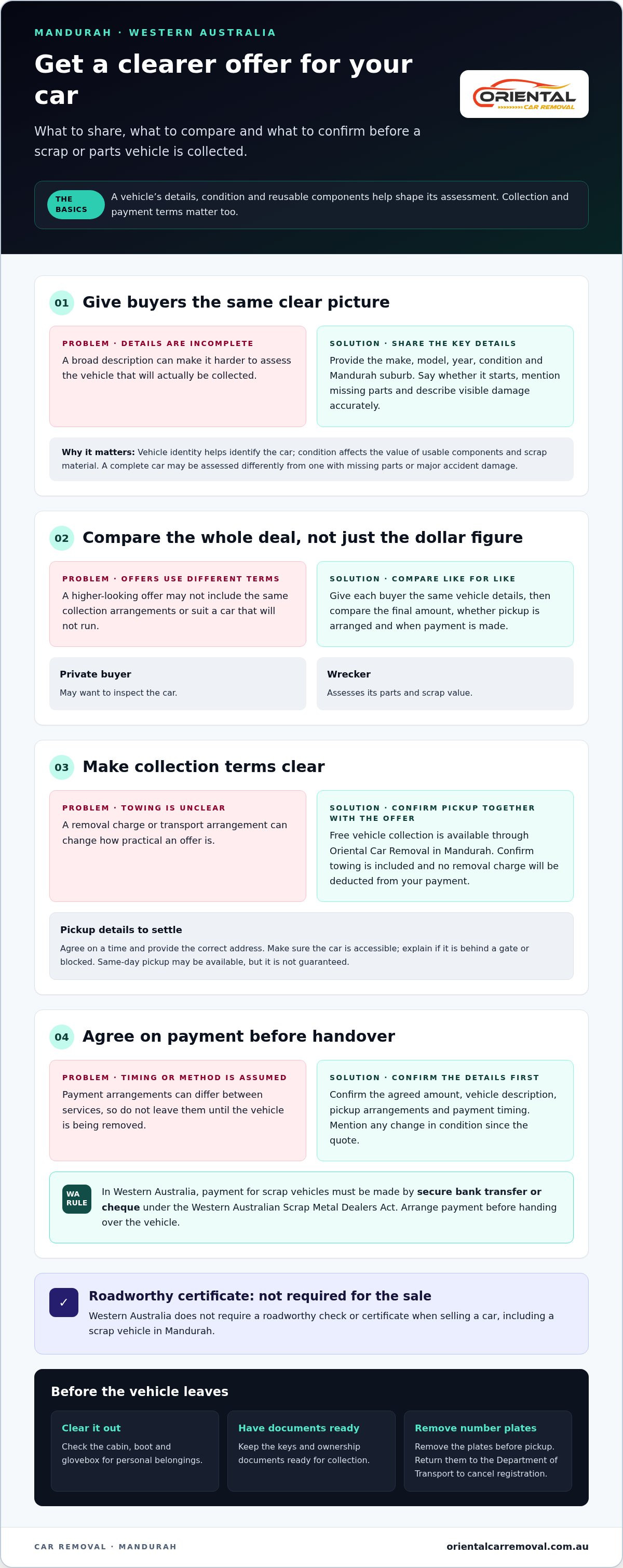
Payment timing and method matter as much as collection. Some services advertise payment when they remove the vehicle, while others describe instant payment. Agree on the payment method and timing before the vehicle leaves your property. For scrap vehicle payments in Western Australia, payment must be made by secure bank transfer or cheque under the Western Australian Scrap Metal Dealers Act.

How do I cancel vehicle registration and get a refund in Western Australia? Return the number plates to the Department of Transport (DoT), then submit the registration cancellation paperwork through DoTDirect or at a service centre. You can apply for a refund for any full months of registration remaining after returning the plates.

After collection, a scrap vehicle can be recycled rather than left unused on your property. Car recycling facilities remove engine fluids when vehicles arrive and recycle them wherever possible. Keep hazardous items, such as used batteries and motor oil, out of household bins. They need responsible recycling or designated collection.

Do you buy old cars that no longer run in Mandurah?

Yes, non-running, damaged, unwanted and scrap vehicles can attract offers in Mandurah. The vehicle’s details and condition help determine its value and collection arrangements.

Cash Offers for Unwanted Cars

A Cash for Cars offer can cover an unwanted vehicle even if it will not start, has accident damage or is no longer registered. Oriental Car Removal buys vehicles for dismantling, recycling and scrap processing. Share the make, model, year, condition and suburb to request a quote. Describe major damage accurately, such as a missing engine or crushed panels, so the valuation reflects the vehicle being collected.

Which Mandurah auto wreckers buy cars for parts or scrap? Oriental Car Removal buys unwanted vehicles in Mandurah, including cars with damage or missing components. Explain whether the car runs and describe any damage or parts that have been removed.

Factors Affecting Car Offers

The make, model and year help identify the vehicle, while its condition affects the value of usable components and scrap material. A complete vehicle may be assessed differently from one with missing parts or major accident damage. Include your Mandurah suburb when requesting a quote, as location affects pickup arrangements. A clear description helps match the offer to the vehicle that will be collected.

Comparing Wreckers and Private Buyers

How can I compare offers from car wreckers and private buyers in Mandurah? Give each buyer the same make, model, year, condition and suburb, then compare the final amount and collection terms. Check whether the offer covers a non-running car, who arranges pickup and when payment is made. A private buyer may want to inspect the car, while a wrecker assesses its parts and scrap value.

Compare the whole transaction, not just the dollar figure. For example, free collection may be more practical than an offer that requires you to arrange transport. Record each offer and its conditions so you can compare them on equal terms.

Accepting an Offer and Getting Paid

Before accepting an offer, confirm the agreed amount, vehicle description, pickup arrangements and payment timing. Mention any change in condition, such as new damage or a part removed since the quote. In Western Australia, payments for scrap vehicles must be made by secure bank transfer or cheque under the Western Australian Scrap Metal Dealers Act. Arrange payment before handing over the vehicle.

When a wrecker pays at removal, have the agreed payment method ready and keep a record of the transaction. You can use a unwanted car removal assessment as a next step for considering a vehicle that no longer runs.

Selling without a roadworthy certificate in WA

Western Australia does not require a roadworthy check or certificate when a car is sold. This applies to sales in Mandurah, including scrap vehicles.

Selling Process and Preparation

Start by recording the car’s make, model, year and condition. Note whether it starts, which parts are missing and any visible accident damage. These details help a buyer assess the vehicle and prepare a valuation. Be clear if it is an unwanted car that cannot be driven, rather than a roadworthy vehicle ready for ordinary use.

Before collection, remove personal belongings and gather proof of ownership and photo identification. Remove the number plates before pickup, then arrange registration cancellation through the Western Australian Department of Transport. In Mandurah, an individual is typically allowed to sell up to four cars within a twelve-month period, although the limit may vary. If you are approaching that number, factor it in before arranging another sale.

Unregistered or Financed Cars

An unregistered car can still be sold in Mandurah. Tell the buyer it is unregistered when requesting a valuation, and explain whether it is damaged, incomplete or unable to start. This helps establish how it will be valued and collected as a scrap vehicle, without assuming it can be driven to the buyer.

If finance remains on the car, contact the lender to establish the outstanding balance and settlement steps before accepting an offer. Compare the sale amount with the payout figure, and address the lender’s requirements before transferring the vehicle. Keep any written settlement details with your sale records. Do not describe the car as debt-free while a loan remains unpaid.

Risks When Selling for Parts

What risks should I watch for when selling a car for parts? Confirm the agreed amount, payment method, pickup arrangements and vehicle details before handing over the keys. Get the terms in writing, and keep a record of payment and collection. This helps prevent disputes if the offer changes or the collection plan differs from what you agreed.

Be accurate about missing parts and damage. For example, disclose if the engine or catalytic converter has already been removed, as this can affect the valuation. Do not let the vehicle go before receiving the agreed payment. In Western Australia, scrap vehicle payments must be made by secure bank transfer or cheque under the Western Australian Scrap Metal Dealers Act.

Keep the sale and registration tasks separate. Remove the plates and complete the registration cancellation process with the Department of Transport. A clear record of the sale, payment and collection is useful if questions arise later. If selling several cars, remember the Mandurah annual limit when planning each transaction.

Sell a Car for Parts in Mandurah and Get a Valuation

Car valuation and payment

A valuation starts with accurate details about the car and its condition. Agree on the payment method and timing before collection.

Car Valuation

To request a quote, provide the vehicle’s make, model, year, condition and Mandurah suburb. Explain whether it starts, and describe any rust, accident damage or missing parts. These details help the buyer assess the car as it is, rather than assuming it is roadworthy or complete.

The offer depends on the vehicle’s condition, usable components and scrap value. Request a valuation with accurate details to find out what your car may be worth.

Be specific. “Rusted” is less useful than describing rust on the doors, wheel arches or underbody. Likewise, say whether the engine is present and whether the car can roll. Clear information helps the buyer prepare a quote and plan collection. If the condition changes after the quote, update the buyer before agreeing to the sale.

Keep your details consistent when comparing valuations. Give each buyer the same make, model, year, condition and suburb, then compare the offer alongside collection and payment terms. A figure alone does not show whether each buyer assessed the same vehicle details or included pickup arrangements.

On-the-Spot Cash Payment

“Cash offer” can describe payment for a vehicle, but scrap vehicle payments in Western Australia must be made by secure bank transfer or cheque under the Western Australian Scrap Metal Dealers Act. Payment for a scrap car is not handed over as physical notes. Agree on the method and timing before collection.

Some services describe payment as instant or made when the vehicle is removed. Confirm when the transfer or cheque will be provided, and keep a record of the agreed amount. Don’t release the car based only on a verbal promise of instant cash.

Before pickup, have your proof of ownership and photo identification ready. Match the vehicle details in the paperwork to the car being collected, then check that the payment reflects the agreed offer. If a change in condition affects the quote, settle the revised amount before the vehicle leaves.

For a smooth handover, use this short checklist:

  • Confirm the final offer and the collection arrangements.
  • Agree on secure bank transfer or cheque for a scrap vehicle.
  • Prepare ownership documents and valid photo identification.
  • Keep a record of payment and the completed handover.

These steps make the valuation, paperwork and payment easier to follow, whether the vehicle is rusted, damaged or no longer roadworthy.

Selling scrap, damaged and non-running cars

A damaged or non-running car can still be assessed for reusable components and recyclable material. Oriental Car Removal accepts unregistered vehicles for removal in Mandurah. Describe the car accurately, including whether it starts or rolls and whether major parts are missing.

Start with a practical summary of the car’s condition. Note accident damage, rust, water damage, missing wheels or a seized engine. For example, a car with body damage but an intact engine presents a different assessment from a stripped shell. Share its make, model, year and Mandurah suburb so the quote reflects the actual vehicle and pickup location.

Parts value depends on what remains usable, while the vehicle body may have scrap value. A complete car can be assessed differently from one missing its engine, wheels or other major components. Do not remove parts after receiving an offer without telling the buyer. A change in condition can affect the agreed valuation and collection plan.

Tell the removal service where the scrap car is parked and whether access is clear. A car in a driveway may be straightforward to collect, while one behind a locked gate or blocked by another vehicle needs different arrangements. Mention if it cannot roll or steer. This helps prepare for loading and avoid surprises on collection day.

Recycling is part of responsible disposal. Car recycling facilities remove engine fluids when vehicles arrive and recycle them wherever possible. Professional wreckers also manage brake fluid, coolant and old oil to help prevent contamination of the local water table. This matters if a damaged vehicle is leaking fluid.

Before handover, remove personal belongings and check the boot, glovebox and under the seats. Keep your ownership documents and identification ready, and confirm the agreed payment method before the vehicle leaves. In Western Australia, scrap vehicle payments must be made by secure bank transfer or cheque under the Western Australian Scrap Metal Dealers Act.

Do not put car parts in household recycling bins. Used batteries and motor oil also need responsible recycling, not household rubbish. Take them to a designated collection point, and keep them separate from household waste while arranging the vehicle’s removal.

The practical takeaway is simple: disclose the car’s condition, access needs and missing components before agreeing to collection. This gives the buyer useful details for valuation, payment and pickup, whether the vehicle is a damaged sedan, an unregistered hatchback or a non-running ute.

Arrange scrap car removal

Oriental Car Removal: Cash for Cars

Oriental Car Removal offers Cash for Cars and Free Car Removal for unwanted vehicles in Mandurah and the wider Perth area. If your car is damaged, scrap or no longer running, share its make, model, year, condition and suburb to request a valuation. Removal is provided at no charge.

The service also covers Cash for Trucks and Cash for 4WDs and Vans. It’s a practical next step if you’re ready to sell an unwanted vehicle rather than keep it sitting unused. Free removal can help simplify the handover alongside the vehicle sale.

To discuss your vehicle, contact Oriental Car Removal or visit the website.

Choose the next step for your Mandurah car

If you are ready to sell a car for parts in Mandurah, decide what matters most: clearing the vehicle from your property, receiving an offer or arranging a straightforward handover. A clear priority helps you move forward instead of leaving an unwanted car unused.

Oriental Car Removal offers Cash for Cars, Free Car Removal and Cash for Trucks. These services suit owners looking to sell an unwanted vehicle and include removal in the process. Share accurate vehicle details to get a valuation based on its condition and discuss the next steps.

Taking action can turn a stalled vehicle problem into a practical plan. Start by sharing your vehicle details with Oriental Car Removal to request a valuation and arrange the handover.

You’re ready to take the next step with confidence.

Frequently Asked Questions

What happens to them?

After collection, an old vehicle can be assessed for dismantling and recycling. Usable components may be separated, while recyclable materials such as steel can enter scrap processing. Fluids are removed and recycled wherever possible. What can be recovered depends on the vehicle’s condition and which parts remain intact. A stripped or badly damaged car may be processed differently from one with more reusable components.

Why sell your unwanted car to us?

Selling to Oriental Car Removal lets you arrange the vehicle’s purchase, removal and disposal through one business. The company handles towing and sale paperwork at no charge to the owner, reducing the tasks you need to organise yourself. This can suit owners who do not want to advertise a damaged car privately or arrange transport separately. Share accurate vehicle details to request a valuation.

Wondering how to sell a car in Mandurah?

Prepare the car’s make, model, year, condition and Mandurah suburb. Describe any missing parts or damage, then review the valuation and agree on collection and payment terms before handover. Keep your proof of ownership and identification ready. Remove personal belongings and check less obvious places, such as the centre console and door pockets, before collection.

Do I need to be present for the car removal?

Plan to be present for the handover so you can identify the vehicle and address any final paperwork or payment questions. Before pickup, make sure the car is accessible and personal items have been removed. If you cannot attend, arrange access and handover details in advance with the person managing the vehicle. Keep a record of the agreed collection details.

Do you accept flood-damaged cars?

Oriental Car Removal buys flood-damaged vehicles. Describe how much of the car was affected, including whether water reached the cabin or engine area, and mention any known damage. Flood exposure can affect a vehicle beyond visible marks, so give a clear account rather than presenting it as ordinary accident damage. Accurate details help ensure the assessment reflects the car being collected.

How much of a car can be recycled?

There is no single recycling percentage for every vehicle. The outcome depends on its materials, condition and which components remain suitable for recovery. Steel can be recycled without losing material quality, while some plastics, such as bumpers, need specialist recycling and may not be accepted by general car recyclers. A complete vehicle and a stripped shell can therefore have different recycling outcomes.

How quickly can you pick up a car in Mandurah?

Pickup timing depends on the Mandurah address, the vehicle’s condition and collection logistics. When arranging removal, give the exact suburb and explain whether the car rolls or steers, or sits behind an access barrier. These details help plan collection. If the vehicle is in a tight driveway or shared parking area, describe the access clearly so arrangements suit the location.

Is same-day car removal available?

Same-day pickup may be available, subject to the address, vehicle and logistics, but it is not guaranteed. Provide the vehicle details and location when arranging collection, then confirm whether same-day timing is available for your booking. If it is not, agree on another collection time before making plans around removal. Keep the pickup details handy for handover.

Cash for Cars Morley: Get Up to $10,000 for Your Vehicle

Cash for Cars Morley: Get Up to $10,000 for Your Vehicle

Who pays for scrap cars in Morley, and will they tow yours away for free? If you’re tired of tyre-kickers, hidden towing fees or a car blocking your driveway, cash for cars Morley can make the next step simpler.

Oriental Car Removal buys unwanted cars, utes, trucks, 4WDs and vans in any condition, with offers of up to $10,000. The offer depends on your vehicle, so share accurate details to help us assess it. If you accept, you get instant cash, free towing and help with the removal paperwork. With more than 10 years of experience in Perth, our licensed and insured team can help you clear space without the runaround.

We also recover usable parts where possible, giving vehicles a useful next step beyond scrap. This guide explains what can affect your vehicle’s value, how collection works and what to know about paperwork when disposing of a vehicle in WA. Whether your car is damaged, unregistered or simply no longer worth keeping, you can turn it into cash and get your Morley driveway back.

Key Takeaways

  • Learn why cash for cars morley can be a simpler option than managing private-sale listings and enquiries.
  • Find out which vehicle details can influence your offer, including condition, completeness and potential for parts recovery.
  • Compare direct vehicle removal with a private sale, including the time involved in arranging viewings and collection.
  • Use a short preparation checklist to make pickup smoother, from clearing personal belongings to gathering paperwork.
  • See how dismantling and recycling can give an unwanted vehicle a useful next step.

Why Morley Residents Choose Professional Cash for Cars Services

A car that won’t start can be difficult to sell privately. You may need to arrange transport just to get it inspected, and a vehicle parked in a narrow driveway or at a commercial property can quickly become a nuisance. With cash for cars Morley, you can arrange an assessment and free towing without trying to make an unwanted car road-ready for a buyer.

Professional removal also gives you a direct path to payment. Oriental Car Removal buys unwanted vehicles and offers up to $10,000, depending on the vehicle. Knowing that towing and paperwork handling are included can make the process easier to plan.

The Problem with Private Sales in Morley

Private listings can bring messages that go nowhere, missed inspections and buyers who change their offer after seeing the car. Even near familiar spots such as Galleria or Wellington Road, coordinating viewings takes time. You also need to decide whether you’re comfortable having prospective buyers visit your home or workplace.

There’s work to do before the first inspection, too. Cleaning, photographing and advertising a vehicle takes time, and may not make sense if it’s only suitable for dismantling or recycling. A direct offer lets you focus on the vehicle’s condition and collection instead of managing a stream of enquiries.

The Convenience of Local Morley Car Removal

With more than 10 years of experience in Perth, our team arranges vehicle removal across residential and commercial locations, including Morley. Free towing means you don’t need to organise a separate tow for a non-running car. Tell us about tight access or the vehicle’s position so collection can be planned around the site.

Removing an unwanted vehicle can clear space in a driveway, yard or work area. You can arrange cash for scrap cars and have the collection and paperwork handled as part of the process.

Responsible disposal matters beyond your property line. Suitable parts and materials can be recovered through recycling instead of being treated as waste. The vehicle recycling process explains how vehicles can be dismantled and materials directed towards reuse or recycling. Choosing a licensed and insured wrecker connects removal with a more responsible next step.

Oriental Car Removal serves Morley and other Perth-area locations, including Joondalup, Mandurah, Rockingham, Osborne Park, Karrinyup, Subiaco, Fremantle, Bibra Lake, Success, Beeliar, Naval Base, Orelia, Warnbro, Secret Harbour and Golden Bay.

For Morley sellers, the practical benefit is straightforward: fewer private-sale hassles, no towing charge and cash for an unwanted vehicle. Once you accept the offer and arrange collection, you can move on with a clear driveway.

Our Morley Valuation Guide: How We Calculate Your $10,000 Payout

An offer of up to $10,000 is a maximum, not a set payment for every vehicle. We assess each car, ute, 4WD, van or truck on its details. The assessment considers more than scrap metal alone: the vehicle’s parts, condition and potential for recycling can all contribute to its value.

For cash for cars morley, share accurate details about the vehicle, including damage, missing components and whether it runs. Clear information helps us assess it fairly and avoid surprises at collection.

Factors Influencing Your Vehicle’s Worth

Make, model and year help indicate which components may be reusable. Toyota and Nissan vehicles, for example, may interest wreckers because their parts can have ongoing demand, but the value still depends on the specific vehicle. Condition matters too: a car with accident damage may retain useful components, while a heavily damaged or incomplete wreck is assessed differently.

The odometer reading can help show how much use the vehicle has had. It’s considered alongside the condition and salvage potential of its components, rather than used as a standalone price guide.

Why Commercial Vehicles and 4WDs Pay More

Utes and 4WDs can contain components suited to a range of uses. A work ute’s configuration, completeness and condition can all affect its assessment. Demand for specific components also changes, so no vehicle type automatically guarantees a higher offer. Our used 4WD parts in Perth service reflects our focus on assessing 4WDs for reusable value.

We also buy trucks. A commercial vehicle is assessed on its own condition, parts and material value. If you’re selling a truck, our cash for trucks in Perth service covers that vehicle category.

Metal Value, Reusable Parts and Your Offer

Scrap metal prices change with market conditions and can influence the value of a vehicle sent for recycling. But metal is only one part of the assessment. Where components can be recovered, their potential reuse may contribute to an offer too. A complete vehicle can therefore be assessed differently from one missing key parts, even if neither is roadworthy.

The Motor Trades Association of Australia provides industry context for automotive businesses, including parts dismantlers and recyclers. Our licensed and insured wrecking team considers a vehicle’s overall salvage potential, then arranges free towing and paperwork handling if you accept the offer.

To help us assess your vehicle, have the make, model, year, odometer reading and a straightforward description of any damage ready. If you’re weighing up an unwanted vehicle in Morley, request an offer from Oriental Car Removal based on its individual details.

Oriental Car Removal vs. Traditional Selling Methods

Selling privately can suit a roadworthy car that’s in demand and easy to show. But for a damaged, unwanted or non-running vehicle, the asking price is only part of the equation. You’ll also need to account for preparing the car, responding to enquiries, arranging inspections and getting it to a buyer.

With cash for cars Morley, the process is more direct. Tell us about the vehicle, receive an offer based on the details provided, then arrange free towing if you accept. We buy unwanted vehicles in any condition, so you don’t need to get yours cleaned up or running before removal.

The Hidden Costs of Selling Yourself

A free online listing still takes effort. You may spend time taking photos, writing the ad and answering messages, as well as travelling to meet buyers or completing inspections. Cleaning and preparing a car also costs time and supplies. If you’re considering paying for a roadworthy certificate or other preparation, weigh that expense against the likely return first.

Private sales can fall through, too. A buyer might not show up, negotiate after inspecting the car or change their mind. You’ll also need to manage the sale and relevant WA paperwork yourself. Check current Department of Transport guidance for your situation rather than relying on assumptions.

The Oriental Advantage: A More Direct Process

Our service focuses on vehicle removal, not a private sale. Share accurate details about the vehicle’s condition and location so the offer reflects what you’ve told us. If you accept, our team arranges free towing and handles the paperwork. We’re a licensed and insured local wrecking business with more than 10 years of experience in the Perth region, including Morley.

Here’s how the options compare for a vehicle that’s no longer convenient to keep:

  • Time: A private sale can involve repeated enquiries and viewings. A removal service focuses on arranging collection after you accept an offer.
  • Preparation: Private buyers may expect a clean, presentable car. We buy vehicles in any condition, so you can describe their actual state instead of preparing them for display.
  • Collection: A private buyer may not be able to move a non-running vehicle. Our towing is free, including from residential or commercial premises.
  • Payment: A private sale depends on completing a transaction with an individual buyer. Our service includes instant cash when your vehicle is collected.

No selling option suits every vehicle. A desirable car may be worth listing privately if you’re happy to invest the time. If yours is damaged, unwanted or taking up space, removal can reduce the admin and give you a clear next step. Describe its condition accurately from the outset so the offer is based on the right details.

For a straightforward option, request a cash offer and free vehicle removal from Oriental Car Removal. You can stay home while our team handles collection, rather than organising transport or hosting a series of inspections.

Cash for Cars Morley: Get Up to $10,000 for Your Vehicle

3 Steps to Prepare for Your Morley Car Removal

A little preparation can help your pickup run smoothly. Before collection, gather your documents, remove personal belongings and make sure the vehicle is accessible. These steps help our team confirm the details and plan removal, whether your car is parked at home, in a tight driveway or at a commercial property.

Step 1: Gather your documents and check the WA process

Have proof of ownership and valid photo identification ready for the team. Check that the vehicle details you provide match your documents, and let us know if anything needs explaining, such as a name difference or missing paperwork. Our team handles removal paperwork, and having your documents ready helps keep the handover organised.

Registration and number plate requirements can depend on your circumstances. Before pickup, check the latest Western Australian Department of Transport instructions for what to do with the plates and how to notify the department about the disposal or sale. Don’t assume the steps are identical for every vehicle. Keep relevant records together so they’re easy to refer to during the handover.

Step 2: Check the cabin, boot and storage spots

Take a final look through the car before it leaves. Personal items are easy to miss, especially in a vehicle that hasn’t been driven for a while. Check the glovebox, centre console, door pockets, boot and under the seats. Remember to remove anything you want to keep, such as sunglasses, paperwork, toll tags, loose change and child seats.

  • Remove personal documents and anything with your address or contact details.
  • Check under floor mats and in any storage compartments.
  • Take off accessories or equipment you intend to keep.
  • Keep the keys, identification and ownership documents handy.

Once the vehicle is collected, retrieving a forgotten item may not be straightforward. A quick final sweep can save you the hassle.

Step 3: Make the vehicle easy to reach

Confirm the pickup location and tell us about access issues before collection. Mention a narrow driveway, locked gate, limited clearance or a vehicle parked behind other cars. Clear the approach where possible, and make sure the agreed collection spot is available. If the car is at a workplace or shared property, arrange access with the relevant person in advance.

These details help the team plan the towing process. Be ready to point out the vehicle and share useful information about its condition or position. With documents prepared, belongings removed and access sorted, your cash for cars Morley pickup is set up for a straightforward handover.

Maximise Your Return with Morley’s Leading Car Wreckers

An unwanted vehicle can be worth more than its scrap metal. Reusable components may also contribute to its overall value, depending on their condition and potential for reuse. A proper assessment looks at the vehicle as a whole, rather than treating every car as a pile of metal. For Morley drivers, this can mean turning an unused vehicle into cash while giving suitable materials another use.

Oriental Car Removal buys cars, trucks, 4WDs and vans in any condition, with offers of up to $10,000. This is a maximum, not a guaranteed payout. Your offer depends on the vehicle’s details and salvage potential, so be upfront about its condition and any missing parts.

The Value of Recycled Vehicle Components

Engines, gearboxes, panels and other components may retain value if they’re suitable for recovery and reuse. Their condition, completeness and demand can all affect how they contribute to an offer. A vehicle with salvageable components may therefore be assessed differently from one with extensive damage or missing parts. Reuse also helps keep materials in circulation and can reduce reliance on newly manufactured components.

Responsible wrecking involves more than removing a vehicle from your driveway. Suitable components and materials can be separated for reuse or recycling, while the remaining vehicle is handled for recovery. As a licensed and insured car wrecker in Perth, our team assesses vehicles with their recovery potential in mind. The valuation considers what may be reclaimed, not just the vehicle’s weight as scrap.

Choose a Responsible Local Removal Service

Choosing a licensed wrecker means your vehicle is handled by a specialist instead of being left to deteriorate. Oriental Car Removal has more than 10 years of experience in the Perth region, including Morley. Our team arranges free towing and handles paperwork, making it easier to move from an accepted offer to a cleared driveway.

Once collected, your vehicle can enter the wrecking and recycling process. Reusable components may be recovered, and recyclable materials can be directed for further processing. This gives an unwanted car a practical next step and supports resource recovery in the local automotive industry. The vehicle’s salvage potential also contributes to its offer, with the final amount based on its condition and details.

Ready to Clear Your Driveway?

If you’re considering cash for cars Morley, have your vehicle details ready and describe its condition clearly. Oriental Car Removal offers instant cash of up to $10,000, with free towing. The maximum payout isn’t guaranteed for every vehicle, and the offer is based on an individual assessment. Our team handles the removal paperwork, so you can focus on getting your space back.

Take the Next Step Towards a Clearer Driveway

An unwanted vehicle doesn’t need to stay on your property while you weigh up your options. With cash for cars morley, you can clear space and move forward. Oriental Car Removal offers instant cash of up to $10,000 and free removal in Morley. The amount offered depends on your vehicle’s details.

Share accurate information about your car, ute, 4WD or van, then decide whether the offer suits you. There’s no need to organise a private viewing or arrange separate towing. When you’re ready, get an offer and let our team help make your unwanted vehicle one less thing to manage.

Your driveway could soon be clear, and your old vehicle on its way to a useful next chapter.

Frequently Asked Questions

How much cash can I get for my car in Morley?

You could receive an offer of up to $10,000, depending on your vehicle. The amount is assessed individually, so there’s no fixed payout for every make or model. Details such as the year, overall condition, completeness and potential for parts recovery can affect the offer. Give us an accurate description, including significant damage or missing components, so we can assess your car based on its actual condition.

Do I need to clean the car before you pick it up?

No, you don’t need to detail or wash your car before collection. We buy vehicles in any condition. Do remove your personal belongings, though. Check the glovebox, boot, door pockets and under the seats for paperwork, keys, toll tags and anything else you want to keep. If the car contains loose rubbish or unusual items, mention them when describing the vehicle.

What happens if my car is unregistered or has no rego?

You can sell an unregistered vehicle in WA, and a roadworthy certificate isn’t required just to sell it. Oriental Car Removal buys unwanted and damaged cars, including vehicles that aren’t currently registered. Tell us it has no rego and whether it can move under its own power. Before collection, check the latest WA Department of Transport instructions about number plates and notifying the department about the disposal.

Can you remove a car from a tight driveway in Morley?

Tell us about restricted access before collection is arranged. Useful details include a narrow entrance, low clearance, a steep driveway, a locked gate or another vehicle blocking the car. If possible, share the exact pickup location and explain whether the car rolls or steers. This helps the removal team plan for the site and identify access issues before arriving.

Do you buy trucks, vans and utes as well as cars?

Yes. Oriental Car Removal buys trucks, vans and utes, as well as cars and 4WDs. Share the vehicle type, make, model, year and condition so the team can assess it accurately. For example, mention whether a ute has a tray, whether a van is complete or whether a truck has sustained damage. Clear details help avoid confusion about the vehicle being collected.

How quickly can you complete a car removal in Morley?

Pickup timing is arranged with you. The collection plan depends on the agreed arrangements and the vehicle’s location and access. When describing your car, include any access restrictions and say if it’s in a shared car park or commercial yard. Having that information ready helps the team organise the handover and towing without unnecessary back-and-forth.

What documents do I need to sell my scrap car in WA?

Have proof of ownership and valid photo identification ready. These documents help establish that you’re entitled to sell the vehicle and support an orderly handover. Keep them together with the vehicle details, such as its registration information if available. If you’re unsure what to do with the plates or how to notify the WA Department of Transport, use the department’s current guidance for your situation.

Are there any hidden towing or admin fees?

No. Towing and paperwork handling are provided at no charge to the owner. You won’t need to organise or pay for a separate tow when your vehicle is collected through Oriental Car Removal. Before agreeing to the sale, make sure you understand the offer for your specific vehicle and the collection arrangements. That way, you know what to expect from the handover and payment.

Damaged Car Removal Morley: Get Cash and Free Vehicle Removal

Damaged Car Removal Morley: Get Cash and Free Vehicle Removal

A damaged car doesn’t automatically need another repair bill. If it’s unsafe or impractical to drive, and repair costs or private-sale negotiations feel uncertain, damaged car removal morley can offer a simpler way forward. The right next step depends on your car’s condition, not just its age.

You’ll learn how the process works, what can affect the offer for your vehicle and what to expect from quote to collection. Oriental Car Removal buys damaged vehicles in Morley, provides complimentary removal and towing, and handles title documentation at no charge to the owner. Before committing, you can share details about your car and receive an offer based on its make, model and condition. We’ll also cover the practical steps to prepare for collection, including the paperwork and personal items to sort out. With the key details clear, you can decide whether removal is a more straightforward option than arranging repairs or negotiating a private sale.

Key Takeaways

  • Learn when damaged car removal morley may be a practical option for a vehicle that’s unsafe, costly to repair or difficult to sell privately.
  • Compare repair, private sale and removal to weigh the effort, collection needs and payment uncertainty involved in each choice.
  • Understand which vehicle details can shape an offer, including its make, model, year, condition and completeness.
  • Prepare for collection by removing personal belongings and gathering your vehicle ownership documents.
  • See how Oriental Car Removal makes the process simpler, with complimentary removal and towing and title documentation handled at no charge to the owner.

Damaged Car Removal in Morley: When Is Removal a Practical Option?

Damaged car removal in Morley is arranging collection of an unwanted vehicle so it can be assessed for salvage, recycling or disposal. It can be worth considering when accident damage, mechanical failure or a non-running condition makes keeping or selling the car difficult.

The key question is how the damage affects the car. A dented door or scratched bumper may be cosmetic, while steering, engine or structural damage can affect whether it’s safe or practical to drive. A vehicle that still runs may suit one option; a car that won’t start may need collection rather than a drive to an inspection. Neither condition guarantees a particular offer.

Oriental Car Removal buys damaged vehicles across Perth, including Morley, and provides complimentary removal. Some vehicles may be dismantled for salvageable components or processed through the vehicle recycling process. For details about the broader service, see car removal in Perth.

What types of damaged cars can owners consider removing?

Owners can consider removal for accident-damaged cars, mechanically faulty vehicles, scrap cars and cars that no longer run. The car doesn’t need to be in driving condition to discuss an offer. Its make, model, year, condition and completeness can all affect its salvage value.

Describe the damage clearly when requesting an offer. Mention where the damage is, whether the car starts or drives, and whether major components are missing. For example, a car with body damage but an intact engine is different from one with extensive damage and missing parts. Accurate details help establish an offer based on the vehicle’s actual condition.

When is removal worth comparing with repairs?

Repair decisions can involve arranging an assessment, understanding the work required and weighing the expense against the car’s value. A newer vehicle with limited damage may justify that effort. For an older car with major damage, persistent mechanical faults or several missing components, removal may be a more straightforward option to compare.

Look at the whole picture: the car’s age, damage, condition and whether it can be driven safely. If it’s been in a collision, the guide to accident car removal in Perth can help you explore the collection option. Comparing removal with repairs or a private sale gives you a clearer basis for deciding what to do next.

Repair, Private Sale or Damaged Car Removal in Morley: Compare Your Options

There’s no single right answer for every damaged car. Compare what each option asks of you, whether it suits the vehicle’s condition and how predictable the next steps feel. A car that still drives and has limited damage presents different choices from one that won’t start or has extensive accident damage.

Option Effort Condition suitability Collection needs Payment uncertainty
Repair Arrange an assessment and decide whether to proceed with the work. May suit a vehicle whose damage can be addressed and that remains useful to you. The vehicle may need to reach an assessment or repair location. Repair requirements and the car’s value need to be weighed up for that vehicle.
Private sale Prepare a listing, respond to enquiries and coordinate with potential buyers. Can be harder to present if the car is damaged, incomplete or undriveable. Buyer inspection and transport arrangements may need coordination. Interest and the final agreed sale depend on the buyer and vehicle.
Damaged-car removal Share the vehicle details, consider an offer and arrange collection. Can be considered for damaged, faulty or non-running vehicles. Collection is arranged rather than requiring you to drive the car. An offer depends on the vehicle and its condition.

Repairing a damaged vehicle: what should owners weigh up?

Start with the extent of the damage and whether you still need the car. A repair decision depends on an assessment of that specific vehicle, not age alone. Consider what’s damaged, how the car performs and whether it remains practical for your needs. You can then compare keeping it with selling or arranging removal, without assuming one choice will always make better financial sense.

Selling privately versus arranging vehicle removal

A private listing takes time: you’ll need to describe the damage, manage enquiries and coordinate viewing or collection. An undriveable car can be harder to show and may limit who can buy it. With damaged car removal morley, you can share its condition and discuss an arranged collection instead. Salvageable components may also give a vehicle value beyond what a private buyer might offer for it as a complete car. Explore the vehicle removal service as one option, and read more about recycled car parts and salvage.

What Affects a Damaged Car Removal Offer in Morley?

An offer reflects the vehicle as a whole, not just the fact that it’s damaged. Make, model, year, condition and completeness can all influence its salvage value. Damage to a major component, missing parts or a car that no longer runs may affect its value differently from cosmetic damage on a complete vehicle.

For a relevant vehicle offer, provide the car’s make, model, year, damage location, running condition and details of any missing components. Clear, accurate information gives Oriental Car Removal a better picture of the vehicle before discussing an offer. Oriental Car Removal offers cash payments up to A$10,000, but the amount depends on the individual vehicle and its condition. The maximum isn’t guaranteed for every car.

What vehicle details should you provide for an offer?

Have the make, model and year ready, along with registration details if available. Describe where the damage is and whether the car starts or runs. Mention components that have been removed or are missing, such as wheels or major engine parts. Share clear photos if requested as part of discussing the vehicle. Don’t try to make the car seem to be in better condition than it is; accurate details help keep the conversation relevant.

How to compare an offer with your other options

Consider the offer alongside the car’s condition and the time and coordination involved in another sale route. A private buyer may want to inspect or transport a damaged, non-running vehicle, while removal is arranged around collection. Compare the overall practicality, not just the amount offered.

Before collection, make sure the payment, towing and handover arrangements are clear. Oriental Car Removal provides complimentary removal and towing, and handles title documentation at no charge to the owner. For broader information about selling a vehicle, read the guide to cash for cars in Perth. This can help you weigh the offer against your circumstances before deciding how to proceed.

Damaged Car Removal Morley: Get Cash and Free Vehicle Removal

How to Prepare a Damaged Car for Collection in Morley

Getting a damaged car ready for collection doesn’t mean repairing it or trying to drive it. A few practical steps can help the handover go smoothly and make sure important belongings and documents aren’t left behind. Oriental Car Removal provides towing and handles title documentation at no charge to the owner.

What to do before the tow truck arrives

Use this checklist to prepare without moving an unsafe vehicle:

  • Remove personal items. Check the cabin, boot, glove box and other storage compartments.
  • Share access details. Explain where the vehicle is parked and mention tight access, gates or other obstacles that could affect collection.
  • Flag known safety concerns. Tell the team about hazards such as sharp damage, leaking fluids or unstable parts.
  • Leave an undriveable vehicle where it is. Don’t attempt to start or move it if doing so could be unsafe. Collection can be arranged without you driving it.

Clear information about the vehicle’s location and condition helps the collection team plan the pickup. If access has changed since you arranged it, pass on the update before collection.

Which paperwork should you have ready?

Gather any available documents that show your ownership of the vehicle, along with relevant vehicle details. Having them ready can make it easier to work through the handover. Oriental Car Removal handles title documentation as part of its service, but keep your own records and make sure you understand the handover before it’s completed.

Western Australian requirements for registration cancellation, number plates and vehicle disposal can change. Check the latest guidance from the WA Department of Transport before taking any registration-related steps, rather than relying on old advice. The car removal service can handle title documentation, but that doesn’t replace checking your own responsibilities under current state guidance.

Before the vehicle is collected, do one final check for belongings and confirm the agreed access arrangements. These simple steps can reduce last-minute confusion without requiring you to prepare the car mechanically.

Arrange Damaged Car Removal in Morley with Oriental Car Removal

Oriental Car Removal buys damaged vehicles across Perth, including Morley. The process is straightforward: share the vehicle details, discuss an offer, agree on collection arrangements and complete the handover. You don’t need to drive a damaged or non-running car to arrange its removal.

What happens after you request a quote?

Start with the make, model and year, then describe the damage, whether the car runs and any missing components. Accurate details help the team understand the vehicle and discuss an appropriate offer. You can also explain where it’s located and any access issues that could affect collection.

Once you’ve considered the offer, agree on collection arrangements before the vehicle is removed. Oriental Car Removal provides complimentary removal and towing, and handles title documentation at no charge to the owner. This keeps the key steps together, from the initial discussion through to handover.

Why Morley owners choose an experienced removal service

Arranging damaged car removal morley is easier when the process and responsibilities are clear. Oriental Car Removal has more than ten years of experience and is a licensed and insured business. These credentials offer reassurance while you organise removal for a damaged, unwanted or non-running vehicle.

Before collection, make sure you understand the offer and the agreed arrangements. Have available ownership documents ready, remove personal belongings and share any access or safety details. The team handles towing and title documentation, helping reduce the tasks involved in clearing the vehicle.

Ready to take the next step? Arrange car removal.

Make Your Next Step Simple

Choosing what to do with a damaged car comes down to its condition, your repair or resale options, and how much effort you want to take on. For damaged car removal morley, sharing accurate vehicle details helps you understand an offer before deciding. Clearing personal belongings and gathering ownership documents can also make collection and handover easier.

Oriental Car Removal buys damaged vehicles across Perth, including Morley. With more than ten years of experience, the business is licensed and insured, and provides complimentary vehicle removal and towing. Title documentation is handled at no charge to the owner, reducing the paperwork involved in the process.

Take the next step when you’re ready. Share your car’s details, discuss an offer and decide whether removal suits your situation. You can move forward with a clearer plan and less hassle.

Your damaged vehicle doesn’t have to remain a problem. A straightforward collection can help you clear the space and move on.

Frequently Asked Questions

Can I get damaged car removal in Morley if my car does not run?

Yes, Oriental Car Removal buys damaged and unwanted vehicles, including cars that don’t run, across Perth and in Morley. You don’t need to drive it to arrange removal. Share the make, model, year and known condition, including whether it starts and what damage it has. These details help the team discuss an offer and plan collection for the vehicle.

How much cash can I get for a damaged car in Morley?

Oriental Car Removal offers cash payments up to A$10,000, but the amount depends on the individual vehicle and its condition. Make, model, year, completeness and the type and location of damage can all influence its salvage value. Provide accurate details, including any missing components and whether the car runs, so the team can discuss an offer relevant to your vehicle.

Is damaged car removal in Morley free?

Yes, Oriental Car Removal provides complimentary vehicle removal and towing for damaged cars in Morley. There’s no charge to the owner for the towing, removal or title documentation handled as part of the service. Before collection, discuss the offer and arrangements so you understand the handover process. Share any access restrictions or safety concerns that could affect collecting the vehicle.

What types of damaged cars can be removed from Morley?

Oriental Car Removal buys damaged and unwanted vehicles, including accident-damaged, mechanically faulty, scrap and non-running cars. The vehicle’s condition doesn’t need to be hidden or dressed up. Describe it as it is, including damage location, whether it starts or drives, and any parts that are missing. Make, model, year and completeness can affect the offer discussed.

Do I need to arrange towing for a damaged car in Morley?

No, you don’t need to arrange towing separately. Oriental Car Removal provides complimentary towing and vehicle removal in Morley, including for cars that aren’t practical or safe to drive. When discussing collection, explain where the vehicle is parked, how the site can be accessed and any known hazards. Don’t try to move an unsafe or undriveable car yourself.

What paperwork do I need for damaged car removal in WA?

Have available vehicle ownership documents and photo identification ready to support the handover. Oriental Car Removal handles title documentation at no charge to the owner. WA registration and number plate requirements can depend on your circumstances, so check current instructions from the Department of Transport before taking registration-related steps. Keep any paperwork you need for your own records.

Can I sell a damaged car in Morley without repairing it first?

Yes, you can discuss selling your damaged car without repairing it first. Oriental Car Removal buys damaged vehicles in Morley, including cars affected by accident damage, mechanical faults or a non-running condition. Describe the vehicle accurately so the team can discuss an offer based on its condition. You can then weigh removal against repair or a private sale before deciding.

Scrap Car Value Calculator Perth: Estimate Your Payout in 2026

Scrap Car Value Calculator Perth: Estimate Your Payout in 2026

That rusted sedan taking up space in your driveway isn’t just a pile of metal. It’s a financial asset that could be worth hundreds more than you think. You likely feel the frustration of watching a vehicle sit idle while worrying that local wreckers will low-ball you because the engine won’t turn over. It is common to feel confused by the difference between a car’s market value and its actual weight in steel.

This guide helps you clear the fog and secure the best possible payout. By using a scrap car value calculator perth, you can generate a realistic estimate based on current 2026 market conditions in Western Australia. We will show you exactly what factors impact your car’s worth, from catalytic converter precious metals to the weight of the chassis. You’ll also learn how to navigate WA Department of Transport requirements and find a service that handles the heavy lifting for you. Stop guessing what your unwanted vehicle is worth and start planning your next move with confidence.

Key Takeaways

  • Learn why vehicle weight and metal composition are the primary drivers of your final cash offer in Western Australia.
  • Use a scrap car value calculator perth to get a realistic 2026 estimate based on current local metal prices.
  • Discover why Perth’s high demand for 4WD and Japanese vehicle parts can significantly increase your car’s salvage worth.
  • Evaluate the “repair gap” to determine if a private sale is worth the time or if scrapping provides better financial value.
  • Organise your VIN and WA Department of Transport paperwork early to ensure a stress-free and immediate payout.

Understanding Scrap Car Value in Western Australia

Scrap car value is the raw financial worth of your vehicle’s materials. It ignores the brand, the paint colour, or the service history. Instead, it focuses on the weight of the steel and the value of specific components that can be recycled. When a car reaches the end of its functional life, it transitions from a “transportation asset” to a “commodity asset.” In the 2026 Perth economy, this value is driven by global metal markets and the local demand for recycled auto parts.

The WA Department of Transport plays a critical role in this transition. They manage the vehicle’s “end-of-life” status by overseeing the cancellation of registration and ensuring the VIN is handled correctly. This prevents fraud and ensures that the vehicle is legally removed from the WA road network. Understanding this process helps you move from a cluttered driveway to a clean payout without administrative headaches.

Market Value vs. Scrap Value: The Key Differences

Market value is what a buyer pays for a registered, running vehicle. If your car has a blown engine or a transmission failure, its market value often drops to zero because the repair costs exceed the car’s worth. This is where a scrap car value calculator perth becomes essential. These tools don’t care if the car starts. They calculate value based on the heavy steel chassis, the aluminium engine block, and precious metals found in the catalytic converter. While a used car buyer sees a “non-runner,” a wrecker sees high-value salvageable components like the alternator, starter motor, and battery. Using a scrap car value calculator perth ensures you get a floor price based on weight rather than a subjective assessment of the car’s condition. To properly value your vehicle beyond just the scrap baseline, it helps to understand both the market and salvage components driving your final offer.

The Life Cycle of a Scrap Vehicle in Perth

The journey of a scrap vehicle usually begins with a simple phone call and ends at a specialised facility in suburbs like Kenwick or Rockingham. The process involves professional vehicle recycling, which is a methodical dismantling of the car. First, all hazardous fluids like oil, coolant, and brake fluid are drained to meet Western Australian environmental standards. Next, high-value parts are removed for testing and resale. Finally, the remaining metal shell is crushed and sent to a foundry. This process keeps toxic materials out of our local landfills and provides raw materials for new manufacturing. For a stress-free experience, choosing a professional service for Scrap Car Removal Perth ensures that every step of this cycle is handled responsibly and legally.

How a Scrap Car Value Calculator Works

A scrap car value calculator perth operates on a logic of weight and material recovery. Unlike a standard used car valuation, which looks at service history and paint condition, a scrap calculator prioritises the Gross Vehicle Mass (GVM). Heavier vehicles like 4WDs and SUVs naturally fetch higher prices. This is because they contain more high-grade steel. Beyond steel, calculators account for aluminium engine blocks and copper wiring. These non-ferrous metals are more valuable per kilogram than iron.

Global scrap metal prices fluctuate daily based on international demand. A national report on vehicle recycling highlights how these market shifts impact the Australian automotive industry. When steel prices rise in Asia, your payout in Perth often follows suit. While age and odometer readings matter for resale, they rarely affect the raw scrap price. A 20-year-old car with 400,000 kilometres still has the same amount of metal as a low-kilometre wreck.

The Algorithm Behind the Quote

Wreckers use databases to estimate the curb weight of your specific make and model. This allows them to provide an accurate baseline. However, there is a distinction between “scrap value” and “salvage value.” Scrap value is the price of the crushed metal; salvage value is the worth of the individual parts. Japanese brands like Toyota and Nissan often trigger higher valuations. Their parts are in high demand across WA, allowing wreckers to offer more than just the metal weight. If your vehicle is missing key components like the battery, radiator, or alloy wheels, the quote will decrease. You can get a better idea of these variables by looking at our car wreckers perth options.

Why “Instant” Quotes Can Sometimes Change

An online estimate is a starting point. It relies on the information you provide. A physical appraisal is the only way to confirm the final figure. If you are honest about the condition, such as whether the catalytic converter is still attached, the price remains firm. Missing high-value parts are the most common reason for a quote adjustment. A calculator provides a baseline, but a local expert provides the final figure. Being transparent about the car’s state ensures you receive a stress-free payout on the day of collection.

Local Perth Factors That Influence Your Scrap Payout

Perth isn’t like other Australian cities. Our unique geography and economy create specific demands that directly impact the results of a scrap car value calculator perth. While global metal prices provide the floor for your valuation, local market trends in Western Australia determine the ceiling. From the salt air of the coast to the high-kilometre reality of FIFO life, several factors dictate what a wrecker is willing to pay for your vehicle today.

High-kilometre vehicles are the norm in WA. The “FIFO effect” means many cars have spent years commuting to regional hubs or sitting in airport car parks. While a high odometer reading usually kills market value, it doesn’t necessarily ruin scrap value. If the heavy-duty components are still intact, the car remains a valuable asset for recycling. However, coastal corrosion is a significant factor for Perth locals. Vehicles from Fremantle, Rockingham, or Scarborough often suffer from salt-induced rust. If the chassis is severely corroded, the vehicle is valued strictly for its weight in raw steel rather than for salvageable body panels.

The High Demand for 4WD and Commercial Parts

Perth is often called the 4WD capital of Australia. Models like the Toyota Hilux and Nissan Patrol are incredibly popular for both trade work and weekend adventures. This creates a massive local market for second-hand parts. If you are scrapping a 4×4, your payout is often higher because 4WD Wreckers can resell mechanical components like differentials, gearboxes, and suspension kits. Commercial vans and utes used in the WA trade sector also fetch a premium. A scrap car value calculator perth that accounts for this “4WD premium” will always provide a more accurate estimate than a generic national tool.

Logistics and Towing in the Perth Metro Area

Geography plays a major role in your final cash offer. Moving a non-running vehicle from Mandurah to a northern suburbs wrecking yard can cost hundreds in private towing fees. Reputable local operators include free removal as part of their service to remain competitive. This ensures you keep the full amount of the quote without deductions for transport. Whether you are in Joondalup or require Car Removal Armadale, choosing a service with a wide local reach is essential. Efficient logistics allow wreckers to offer better prices because they can manage their fleet costs across the entire metro area.

Scrap Car Value Calculator Perth: Estimate Your Payout in 2026

Scrap Value vs. Private Sale: Which Path Should You Take?

Deciding whether to list your car on the private market or sell it to a wrecker involves a simple mathematical calculation. This is often called the “Repair Gap.” If the cost of getting your vehicle roadworthy and registered exceeds its potential sale price, you are losing money. A scrap car value calculator perth helps you identify this threshold quickly. For many older vehicles, the financial benefit of a private sale is wiped out by the mechanical work required to make the car safe for a new owner.

Choosing a professional service for Cash for Cars Perth offers an immediate resolution. You avoid the weeks of waiting for a serious buyer and the uncertainty of a fluctuating market. While a private sale might theoretically offer a higher figure, it rarely accounts for the “Tyre-Kicker” tax. This is the value of your own time spent answering messages, arranging viewings, and dealing with people who never show up. Wreckers provide a same-day transaction, turning a liability into liquid cash within hours.

When to Stop Fixing and Start Scrapping

Major mechanical failures are the primary deal-breakers. A blown head gasket, a failed transmission, or significant structural rust can cost thousands to fix. Use our vehicle market value calculator to compare your car’s current state against its potential running value. For vehicle owners looking for similar resources in other major Australian cities, you can learn more about the digital appraisal services offered by My Car Value. If the repair bill is more than 50% of the car’s worth, scrapping is usually the smarter move. By consulting a scrap car value calculator perth, you can see that the metal weight and salvageable parts might net you more than a low-ball private offer for a broken car. In Western Australia, selling an unregistered car privately is also a logistical nightmare. Scrapping removes this burden entirely as the wrecker handles the transport and the plate return process through the Department of Transport.

Selling privately isn’t free. Advertising fees on major platforms eat into your profit before you even find a buyer. There is also the inherent risk of uninsured test drives or strangers visiting your home. If your vehicle is over 15 years old or has high kilometres, a “Scrap my car” service is often the most financially sound choice. It provides a guaranteed payout without the liability of a private transaction. You get a clean break from the vehicle and immediate cash in hand. This avoids the stress of a buyer returning weeks later with complaints about mechanical issues you weren’t aware of.

Get an immediate cash offer for your car today

How to Get a Precise Quote and Finalise the Sale in WA

Finalising your car sale in Perth is a straightforward process when you follow a methodical plan. While a scrap car value calculator perth provides the initial estimate, the final payout depends on the accuracy of your information. Speed and transparency are the keys to a successful transaction. Follow these four steps to ensure a smooth transition from your driveway to the wrecking yard.

  • Gather your vehicle information: Have your VIN, make, model, and a brief description of the condition ready. This allows for a firm quote rather than a vague estimate.
  • Clear the cabin: Remove all personal belongings, including sunglasses, spare change, and house keys. Don’t forget to remove your E-Tag from the windscreen.
  • Prepare for plate removal: You’ll need to remove your number plates before the tow truck arrives. This is a legal requirement in Western Australia.
  • Schedule the removal: Pick a time that suits you. Most professional wreckers offer immediate payment on the spot once the vehicle is loaded.

Paperwork and Legal Requirements in Western Australia

In WA, you must return your number plates to a Driver and Vehicle Services (DVS) centre or a regional DoT office. This officially cancels the registration and protects you from future liabilities. When you return the plates, you can apply for a pro-rata rego refund for any remaining full months of registration. This extra cash goes straight into your pocket, separate from the scrap payout. You will also need to provide a valid photo ID, such as a WA driver’s licence, to comply with state scrap metal regulations. For a complete breakdown of the rules, check out our How to Scrap a Car in WA checklist.

Maximising Your Payout with Oriental Car Removal

While a scrap car value calculator perth gives you a baseline, a physical inspection by an experienced team often uncovers more value. We look for high-demand components that generic tools might miss. We specialise in Japanese models and 4WDs, often paying more for these sought-after parts. Our team handles the heavy lifting, including the towing and the title transfer paperwork. We aim to provide relief and peace of mind by making the process as efficient as possible. Don’t let an old vehicle rust away when it could be turned into immediate cash. If you want to value your vehicle accurately before committing to a scrap quote, our 2026 step-by-step guide walks you through every factor that influences your final offer in the Perth market.

Secure the Best Cash Offer for Your Perth Vehicle Today

You now understand that your unwanted vehicle is a valuable resource of recycled steel and high-demand parts. A scrap car value calculator perth provides a vital baseline, but the final payout comes from choosing a licensed local expert who understands the WA market. We’ve explored how Perth’s specific demand for 4WD components and the Department of Transport plate return process influence your final return.

Our team brings over 10 years of experience as licensed WA wreckers. We provide free towing from Joondalup to Mandurah, ensuring you keep every cent of your payout. You can secure immediate cash payments up to $10,000 without the stress of private listings or expensive mechanical repairs. We handle the heavy lifting and the administrative details, providing you with a clean break and total peace of mind.

Get Your Instant Scrap Car Quote in Perth Now

Frequently Asked Questions

Is a scrap car calculator accurate for cars with missing parts?

A scrap car value calculator perth provides a baseline estimate assuming the vehicle is complete. If your car is missing the engine, gearbox, or catalytic converter, the final payout will be lower. These components represent a significant portion of the vehicle’s salvage and weight value. You should always disclose missing parts during the initial quote phase to ensure the final cash offer remains accurate when the tow truck arrives at your property.

What is the current scrap metal price per tonne in Perth?

Scrap metal prices in Western Australia are influenced by global steel demand and current 2026 market trends. While the national average for a complete vehicle sits around $170 per tonne, local rates in Perth can vary based on the specific metal composition of your car. Heavy iron and steel fetch the most weight; meanwhile, non-ferrous metals like copper and aluminium provide higher value per kilogram. Contacting a local specialist is the best way to confirm today’s rate.

Do I need to clean my car before scrapping it?

You don’t need to wash or detail your vehicle before the removal team arrives. Wreckers are interested in the recyclable materials and salvageable mechanical components rather than the cosmetic appearance. Your only responsibility is to remove all personal belongings from the cabin and boot. Ensure you check under the seats and in the glovebox for important documents, house keys, or your E-Tag before the vehicle is loaded onto the tow truck.

Can I sell my scrap car if I have lost the keys?

You can definitely sell your vehicle even if you have lost the keys. Professional wreckers in Perth use specialised towing equipment to recover vehicles with locked steering columns or missing keys. As long as you can provide proof of ownership and a valid photo ID, the lack of keys won’t prevent the sale. This is a common situation for old or abandoned cars found on rural properties or in long-term storage across WA.

What paperwork do I need to scrap a car in Western Australia?

To scrap a car in Western Australia, you must provide a valid photo ID, such as a WA driver’s licence or passport. This is a legal requirement under state scrap metal regulations to prevent the trade of stolen goods. You also need to provide proof of ownership for the vehicle. Once the sale is finalised, you must return your number plates to a Department of Transport office to cancel the registration and protect yourself from liability.

How long does the scrap car removal process take in Perth?

The removal process is designed for speed and efficiency. Most bookings in the Perth metro area are completed within 24 hours, with many handled on the same day you call. Once the tow truck arrives at your location in suburbs like Morley or Osborne Park, the actual loading and payment process usually takes less than 30 minutes. This methodical approach ensures you get your cash and your space back without any unnecessary delays.

Will a wrecker buy my car if it has major accident damage?

Yes, we purchase vehicles with major accident damage, including those that are considered a total write-off. Structural damage doesn’t eliminate the value of the car’s raw materials or the mechanical parts that survived the impact. Whether the car has been rolled, flooded, or involved in a heavy collision, it still contains valuable steel and aluminium. A scrap car value calculator perth can still provide a quote based on the vehicle’s remaining weight and salvageable components.

Can I get a refund on my WA car registration after scrapping?

You are entitled to a pro-rata refund on any remaining full months of registration in Western Australia. After the wrecker collects your car, you must take the number plates to a Driver and Vehicle Services (DVS) centre. The Department of Transport will cancel the registration and issue a refund for the unused portion. This is an excellent way to get extra cash back into your pocket alongside the immediate payment you receive for the scrap vehicle.