Cash Offers for Fleet Vehicles in Golden Bay

Cash Offers for Fleet Vehicles in Golden Bay

Could a fleet vehicle still attract a cash offer if it’s no longer earning its keep? Cash for fleet vehicles in Golden Bay depends on the vehicle type and condition, and business vehicles can include trucks, vans, utes and 4WDs. A clear description of each vehicle helps establish what it may be worth.

When an unwanted vehicle is taking up space or adding to fleet administration, you need a clear way to assess its sale. This guide explains what affects cash for fleet vehicles in Golden Bay, which business vehicles Oriental Car Removal buys, and what details help with an assessment.

You’ll learn how offers for trucks and other commercial vehicles fit into fleet disposal, what information to prepare, and how free vehicle removal can help with the next step. Use these points to compare your options and plan the disposal of vehicles your business no longer needs.

Key Takeaways

  • Understand what makes a vehicle part of a business fleet and how disposal needs can vary between businesses.
  • See how vehicle type and condition can influence a cash offer, even when a vehicle is no longer in working order.
  • Learn what details about trucks and commercial vehicles help shape an offer.
  • Find out which types of trucks, buses and vans the article covers before arranging a disposal.
  • Get a clearer idea of the next step for unwanted fleet vehicles in Golden Bay.

Fleet and business vehicle disposals

In Australia, a micro fleet can contain 2 to 10 vehicles, while a large fleet has 250 or more. Businesses seeking cash for fleet vehicles in Golden Bay can plan a disposal around their operating needs, vehicle records and handover arrangements.

Documents and ownership transfer

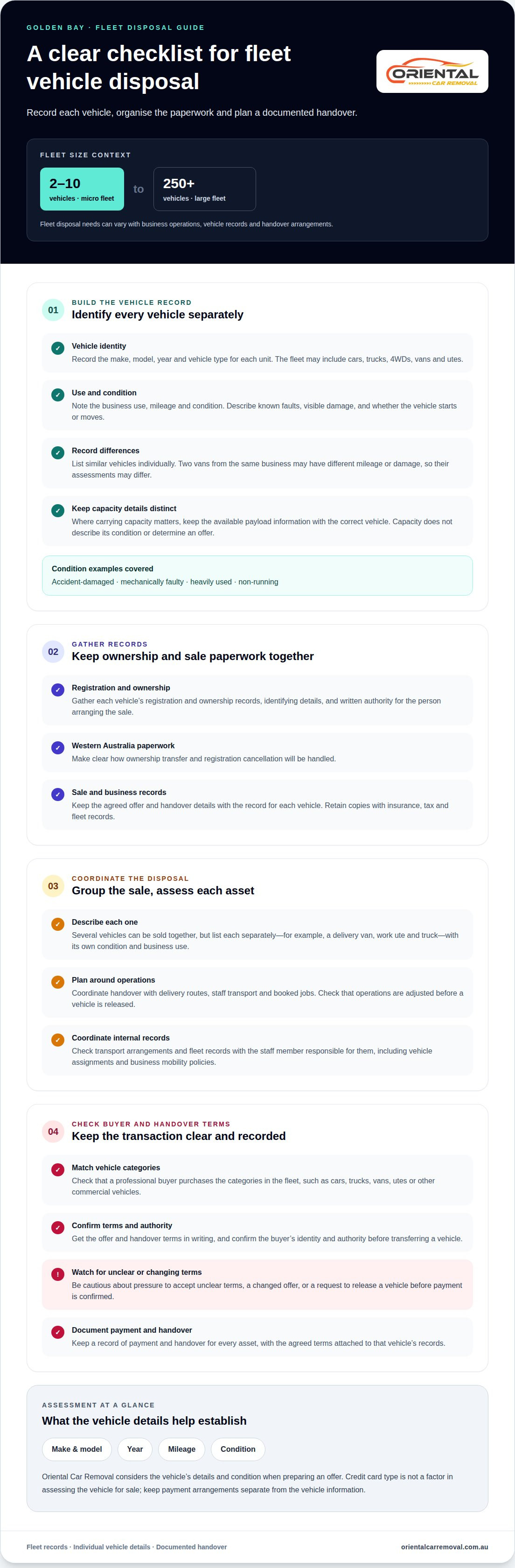
Gather each vehicle’s registration and ownership records, identifying details, and written authority for the person arranging the sale. An inventory can record each vehicle’s type, condition and business use. Keep the agreed offer and handover details with the record for each vehicle.

In Western Australia, the transaction paperwork should clarify how ownership transfer and registration cancellation will be handled. Keep copies with your business’s insurance, tax and fleet records. Clear documentation helps distinguish vehicles sold from those still assigned to daily work.

Selling multiple fleet vehicles

Golden Bay businesses can arrange the sale of several vehicles together. Describe each one separately, even if vehicles share a make or model. For example, list a delivery van, work ute and truck individually, with each vehicle’s condition and business use.

A grouped disposal can simplify coordination, while assessing vehicles individually accounts for differences between them. Plan handover around delivery routes, staff transport and booked jobs. This helps avoid releasing a vehicle before your business has adjusted its operations.

Choosing buyers and avoiding scams

Golden Bay businesses can approach professional buyers who purchase cars, trucks, vans, utes or other commercial vehicles. Match the buyer’s vehicle categories to the fleet being sold, and get the offer and handover terms in writing. Confirm the buyer’s identity and authority before transferring a vehicle.

Be cautious about pressure to accept unclear terms, a changed offer or a request to release a vehicle before payment is confirmed. Keep a record of payment and handover for every asset. Cash for fleet vehicles in Golden Bay can be organised more clearly when each vehicle and its agreed terms are documented.

Fleets help businesses deliver goods and complete jobs without relying on public transport. For manufacturers and distributors transporting fragile goods—who may rely on protective specialists such as Foam Packaging Direct to cushion products in transit—having the right commercial transport is essential. Catering, construction, hospitals, equipment dealing and public services can all depend on vehicles for daily operations. A business may decide to dispose of a vehicle when routes change or a particular job no longer requires it.

Fleet management also involves maintenance, insurance and tax filings. When adjusting commercial vehicle policies with a provider like SMI Insurance Agency, having clear records helps ensure coverage accurately reflects active assets. Business mobility policies can set who uses company vehicles and how they are assigned. Before disposal, coordinate with the staff member responsible for those records and transport arrangements. This helps keep deliveries and scheduled work moving while unwanted vehicles leave the fleet.

Vehicle condition and accepted makes

Make, model, year, mileage and condition can all affect a vehicle’s assessment. Oriental Car Removal considers the vehicle’s details and condition when preparing an offer.

Accepted makes and models

Fleet disposals can include cars, trucks, 4WDs, vans and utes. Give the buyer the make, model and vehicle type for each unit, so the assessment matches the actual vehicle rather than a broad fleet category.

There isn’t a verified list of individual makes or models to rely on here. Instead, describe each vehicle clearly, including its body type and business role. For example, identify a ute separately from a van, even if both supported the same work crew.

Accepted vehicle conditions

Vehicles can be assessed in different conditions, including accident-damaged, mechanically faulty, heavily used or non-running vehicles. Describe known faults accurately. A damaged truck and a running delivery van are different assets and should be listed separately.

Condition affects the vehicle’s potential use and value, but poor condition does not automatically make it irrelevant to a fleet disposal. Note visible damage, operating issues and whether the vehicle starts or moves. These details help the buyer assess what is being offered and plan its collection.

Valuation factors

Make and model identify the vehicle, while year and mileage indicate its age and use. Condition describes its present state. Together, these details help Oriental Car Removal assess each fleet vehicle individually.

For example, two vans from the same business may have different mileage or damage, so their offers may differ. Provide accurate details for every vehicle rather than relying on one fleet-wide description. A fleet vehicle assessment starts with identifying those differences.

Credit cards aren’t a factor in assessing a vehicle for sale. The offer is based on the vehicle’s details and condition, not the business’s card type. Keep payment arrangements separate from the information used to assess each vehicle.

Where carrying capacity matters, keep the available payload information with the records for that vehicle. In Australia, vehicles built to carry more than one tonne are outside the car-limit cap on GST credits and depreciable cost. This is separate from describing the vehicle’s condition: capacity does not indicate whether it starts, has damage or suits a particular job. Keep the specification connected to the correct vehicle rather than assuming the fleet’s vehicles share the same capacity. Clear records distinguish a vehicle’s physical characteristics from its working condition.

When preparing information for a disposal, separate facts about the vehicle from any tax-related consideration. A capacity description should be supported by the information available for that vehicle, and should not be used as a substitute for details about its make, type, mileage or known faults. Likewise, the fact that a vehicle is outside the car-limit cap does not describe its condition or determine what a buyer will offer. Keeping these details distinct makes it easier to provide an accurate account of each unit and to have the relevant vehicle information available when the fleet is assessed.

Cash offers for trucks and commercial vehicles

A cash offer gives a business a direct sale option for an unwanted truck or commercial vehicle. The amount depends on the individual vehicle, its condition and the details provided for assessment.

For a truck, the assessment can consider its make, model, year, mileage, condition and use. Body type and fit-out matter too: a tray truck, delivery truck and specialised work vehicle serve different roles. Clear information helps Oriental Car Removal assess the actual vehicle rather than treating every commercial vehicle alike.

Describe each truck separately, even when several share a make or model. Include its registration details, body type, known faults and whether it starts or moves. Mention accident damage or equipment fitted for a particular job. Accurate details help make the assessment and handover clearer.

The offer depends on the individual vehicle and is provided after you request a quote. Factors include vehicle type, year, mileage and condition. A business selling several commercial vehicles can have each assessed individually, accounting for differences between a well-used delivery truck and a specialised vehicle that has seen less use.

Cash offers differ from trade-ins and auctions. A trade-in connects the vehicle’s sale to a replacement purchase, while an auction puts the vehicle up for bids and the result depends on buyer interest. A direct cash sale focuses on the agreed vehicle transaction without tying disposal to buying another vehicle.

When comparing these options, consider timing, administration and whether your business needs a replacement vehicle. A trade-in may suit a fleet renewal when you’re already buying another vehicle. An auction may suit a seller prepared to wait for bids. A direct sale offers another route for disposing of a truck no longer needed.

Before agreeing to a sale, match the written offer to the correct vehicle and confirm the handover arrangements. For multiple trucks, keep each description and its agreed terms together. This record helps your business track the assets sold and manage their transfer from work use to disposal.

Businesses seeking a direct option for an unwanted truck can consider cash for trucks. The vehicle’s type, condition and use remain central to the assessment, whether it is a single truck or part of a wider fleet disposal.
Cash Offers for Fleet Vehicles in Golden Bay

Types of trucks, buses and vans bought

Fleet disposals can involve several commercial vehicle types, each built for a different role. Identify each vehicle’s body style and use clearly so the assessment reflects the actual asset.

A truck may be used for deliveries, equipment transport or construction work. Describe its body type and work-related fit-out, such as a tray or enclosed load space. A delivery truck and a site vehicle may have different configurations, even if they belong to the same business. These details distinguish one asset from another.

Vans commonly support home services, catering and delivery work. Record whether each van carried tools, goods or staff, and note fitted shelving or other business equipment. Similar vans can still differ in mileage, condition and fit-out, so give every vehicle its own description.

Buses serve a different transport role from trucks and vans. A business assessing a bus for disposal should describe its passenger-transport use, body type and condition. That information separates it from goods vehicles in the fleet inventory. It also helps a buyer understand the vehicle’s purpose without relying on a broad label such as “commercial vehicle”.

Business fleets can also include taxicabs, rental cars, bulldozers and tractors. Fleet disposal isn’t limited to standard road-going vans. Equipment dealers and construction businesses may operate specialised vehicles, while transport businesses may manage passenger vehicles. Grouping them under one fleet heading does not make their vehicle types interchangeable.

For a practical inventory, list each vehicle by category, make and model, then add its business use and known condition. Separate a truck from a bus, and a service van from a passenger vehicle. Note any distinctive equipment or damage that could affect the assessment. This gives the buyer a clear picture of the vehicles included in the disposal.

Golden Bay businesses with different vehicle types can organise information by category before requesting an assessment. For example, list delivery vans together, then describe trucks and passenger vehicles separately. This structure makes missing details easier to spot and keeps the fleet record useful for the sale.

Trucks are a clear fit for commercial vehicle disposal, while vans and utes may also form part of a business fleet. Oriental Car Removal buys trucks, vans and utes, including unwanted and damaged vehicles. Describe specialised use or equipment that distinguishes a vehicle from other fleet assets.

Which companies buy fleet vehicles in Golden Bay, Western Australia?

Golden Bay businesses can approach professional vehicle buyers that purchase commercial vehicles, truck buyers, or vehicle wreckers and salvage operators. The right fit depends on the fleet being sold. A business disposing of a working delivery truck has different needs from one clearing an accident-damaged van or an unwanted ute.

Oriental Car Removal buys commercial vehicles such as trucks, vans and utes, including vehicles in poor condition. Describe the vehicle and its state before requesting an offer. Details about damage, faults and whether it runs help make the assessment more accurate.

Golden Bay businesses can arrange assessment of a mixed fleet. A construction company, for example, may have a truck and a ute, while a home-services business may be disposing of several vans. Describe each vehicle individually because make, model, condition and business use can vary across the group.

Focus on clear sale terms. The written offer should identify the vehicle and state the agreed amount and handover arrangements. For a multi-vehicle sale, account for each truck, van or ute separately. This gives your business a usable record of the assets included and helps prevent confusion during handover.

Payment and collection arrangements also matter. Confirm how payment will be made and when the vehicle changes hands. Don’t release a vehicle based only on a verbal offer. Keep the sale record and payment confirmation with the fleet disposal paperwork, especially when several vehicles are being sold together.

A suitable buyer should match the vehicle type and the business’s disposal needs. A business selling a truck can focus on buyers handling commercial trucks, while a mixed fleet requires a buyer prepared to assess its different vehicle categories. For example, a truck and two service vans should be described separately, even if the business wants one organised disposal.

Start with an accurate vehicle list. Include the make, model, type, condition and known faults for each asset. A clear inventory helps Oriental Car Removal understand the fleet and prepare an offer based on the vehicles presented. It also gives your business a straightforward record of the disposal decision.

Oriental Car Removal

Oriental Car Removal helps businesses dispose of unwanted cars, trucks, 4WDs and vans. If a Golden Bay fleet includes several vehicle types, share each vehicle’s details so the sale can be considered clearly. Cash for Trucks and Free Car Removal may suit businesses handling a truck disposal, while Cash for Cars and Cash for 4WDs and Vans cover other unwanted fleet vehicles.

Free removal can make disposal simpler when a vehicle is no longer needed for deliveries, staff travel or daily work. Describe the fleet vehicles you want to sell and their condition to get the process moving.

Contact Oriental Car Removal to discuss your fleet vehicles.

Plan the next fleet move

A fleet disposal is also an opportunity to plan a clearer replacement cycle. Before removing a vehicle from active use, align its handover with the point when staff, routes and equipment can operate without it. This helps prevent disposal from becoming a last-minute operational task.

For businesses considering cash for fleet vehicles in Golden Bay, assess each surplus vehicle separately: retain, replace or release. This helps managers assign responsibility, approve the disposal and keep fleet records aligned with the next operating plan.

When your business is ready, bring the vehicle details and sale authority together. Oriental Car Removal buys unwanted fleet vehicles and provides free removal. A clear starting point helps move from a disposal decision to the next step.

Take the next step when it suits your fleet’s plans.

Frequently Asked Questions

Need Cash Today?

The offer depends on details such as the vehicle’s make, model, year and condition. If your business is selling several vehicles, prepare a separate description for each so the offer reflects the individual assets. Payment timing is discussed as part of arranging the sale and handover.

What types and sizes of fleet vehicles do Golden Bay buyers accept?

Oriental Car Removal buys cars, trucks, 4WDs, vans and utes. These categories can cover a mixed business fleet, such as a work ute, a delivery van and a commercial truck. Share the vehicle type and its details for each asset. Vehicle size categories aren’t stated as a separate limit, so describe larger commercial vehicles by their body type and business use.

Do Golden Bay fleet vehicle buyers offer free inspections and collection?

Oriental Car Removal provides free vehicle removal, including towing. The free service applies to removal; it shouldn’t be taken to mean a separate inspection service. For an assessment, provide vehicle details such as make, model, year and condition. For example, note whether a fleet car has accident damage or a truck is no longer running, so its circumstances are clear.

How quickly can fleet vehicles be collected and paid for in Golden Bay?

Collection timing depends on the address, vehicle and logistics. Same-day pickup may be possible after those details are assessed, but it isn’t guaranteed. Oriental Car Removal provides instant cash payment on the spot for accepted vehicles. For a fleet sale, organise the vehicle list and handover details together so collection arrangements can account for each vehicle’s location and condition.

Do Golden Bay vehicle buyers accept unregistered, damaged, or end-of-life fleet vehicles?

Damaged and end-of-life vehicles are accepted, including vehicles in poor condition. Oriental Car Removal buys unwanted, damaged and scrap vehicles, and accepts all makes, models and conditions. For an unregistered vehicle, include its registration status in the details provided for the sale. This helps make the vehicle’s paperwork and handover requirements clear alongside its condition and fleet role.

How do you transfer ownership and cancel registration when selling fleet vehicles in WA?

In Western Australia, make sure the transaction paperwork states how ownership transfer and registration cancellation will be handled. Keep the vehicle’s registration and ownership records, written authority, agreed handover details and copies with your business records.

Heavy Vehicle Wreckers in Naval Base for Business Removal

Heavy Vehicle Wreckers in Naval Base for Business Removal

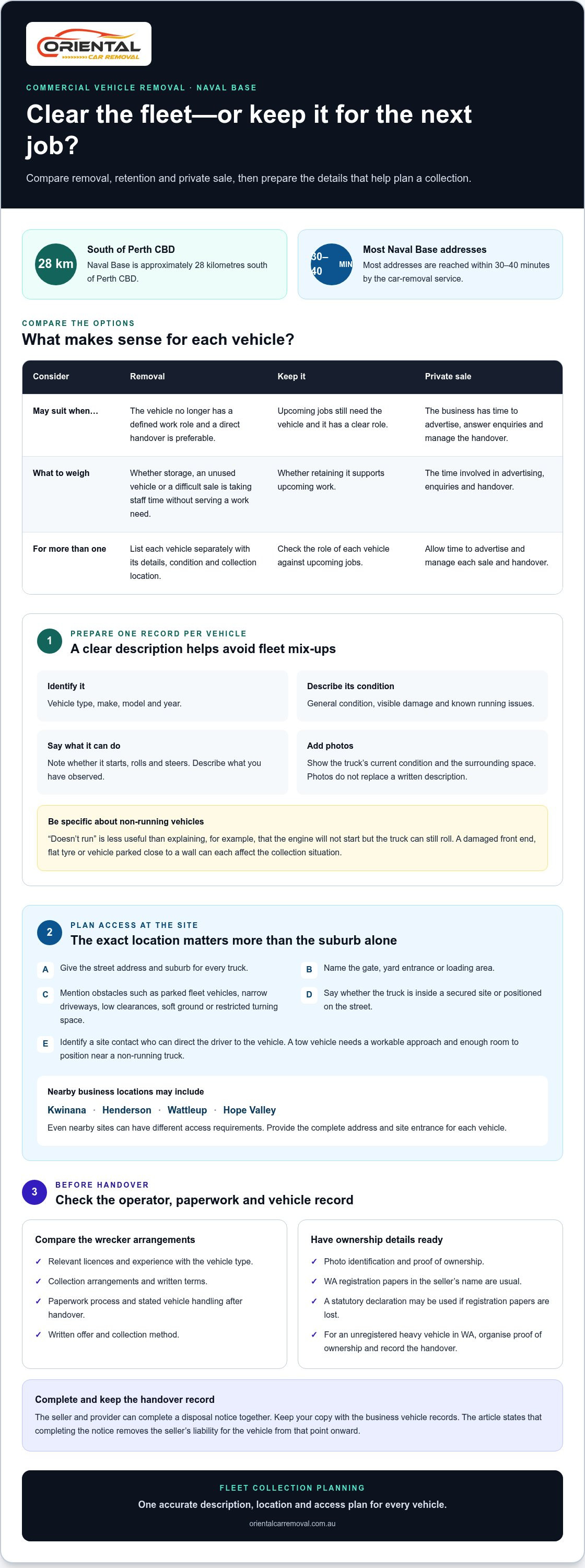
Yes, a business can arrange removal for more than one unwanted work vehicle by listing each vehicle’s type, make, model, year and condition, along with the collection location and access details. Heavy vehicle wreckers in Naval Base may suit when the vehicles no longer have a defined job and the business wants a direct handover.

It’s practical to weigh removal against keeping a vehicle for upcoming work or managing a private sale. A private sale takes time for advertising, enquiries and handover, while a vehicle that still has a clear role may be worth keeping. Naval Base is about 28 kilometres south of Perth CBD, so location and access matter when planning a collection.

This guide explains when heavy vehicle wreckers in Naval Base may be useful, what details to prepare for a damaged or non-running truck, and how to plan collection. It also covers nearby areas and the next step for Perth businesses ready to clear unwanted vehicles.

Key Takeaways

  • Removal may suit when a work vehicle no longer has a defined role; keeping it can make sense if upcoming jobs still need it.
  • For each truck, note its type, make, model, year, general condition, visible damage and running issues.
  • Share the collection location and access details so the pickup can be planned around the vehicle and site.
  • Naval Base is approximately 28 kilometres south of Perth CBD, and most addresses are reached within 30-40 minutes.
  • For a business clearing more than one vehicle, organise the details for each one before arranging collection.

When commercial vehicle removal may suit a Naval Base business

Removal may suit a Naval Base business when a truck, bus or other commercial vehicle is no longer needed and a direct handover is preferable. Keeping it may make more sense if upcoming work still requires it.

Heavy commercial vehicle removal

Heavy vehicle removal means arranging collection for trucks and buses a business no longer needs. List each vehicle separately, including its type, make, model, year and condition. Note visible damage, whether it runs and the collection location. For a fleet, this gives the enquiry a clear record of each vehicle instead of one general description.

Commercial vehicle wrecking

Truck wrecking means the vehicle is assessed for removal and dismantling rather than kept in service. Compare operators by looking at their relevant licences, experience with the vehicle type, collection arrangements, written terms and paperwork process. Ask for the agreed scope in writing, including what happens to the vehicle after handover. For mixed fleets that include 4WDs, the 4WD wreckers information covers that separate vehicle category.

Selling a truck or bus for wrecking

To sell a truck or bus for wrecking in Naval Base, prepare its make, model, year, condition and location, and describe damage or running issues accurately. Have photo identification and proof of ownership ready. WA registration papers in the seller’s name are usual, and a statutory declaration may be used if the papers are lost. Agree on the handover and complete the disposal notice together.

For an unregistered heavy vehicle in WA, organise proof of ownership and record the handover with the receiving operator. The seller and provider can complete a disposal notice together, removing the seller’s liability for the vehicle from that point onward. Keep your copy of the paperwork with the business vehicle records.

Before choosing a wrecker, compare the written offer, collection method, paperwork and stated vehicle handling. Check that the operator can manage the specific truck or bus, especially if it is damaged or cannot move under its own power. Parts availability varies, so ask about a specific component using the vehicle’s make, model and year.

Removal is worth considering when storage, an unused vehicle or a difficult private sale is taking staff time without serving a work need. A private sale may suit a business with time to advertise, answer enquiries and manage the handover. If the vehicle still has a clear role in upcoming jobs, retaining it may be more practical.

Arranging removal for non-running or damaged trucks

A truck does not need to start or move under its own power for a removal enquiry. Describe its condition clearly so the collection team understands what vehicle is involved and what access arrangements may matter.

Start with details that identify the truck: vehicle type, make, model and year. Then describe whether it starts, moves or steers, and note any obvious damage. “Doesn’t run” is less useful than explaining, for example, that the engine will not start but the truck can still roll. State what you have observed.

For visible damage, describe the affected area and whether it affects the truck’s position or access. A damaged front end, flat tyre or truck parked close to a wall each presents a different collection situation. Photos can show the vehicle’s current condition and surrounding space, but do not replace a clear written description.

Include the exact collection location and practical access details. Note whether the truck is in a yard, behind a gate or among other fleet vehicles. Mention narrow driveways, low clearances, soft ground or other site features that could affect access. At a workplace, identify the entrance and the person who can direct the driver.

Use this enquiry checklist for each damaged or non-running truck:

  • Vehicle type, make, model and year.
  • General condition, visible damage and known running issues.
  • Whether it can start, roll and be steered.
  • Collection address and site access details.
  • Photos showing the truck and its surroundings.

For more than one vehicle, prepare a separate description for each. A fleet list can match each truck to its condition, location and images. This helps avoid confusion when one truck runs and another is immobile, or when vehicles are in different parts of a site.

Before agreeing to collection, make sure the description matches the truck on site. If its condition changes, such as a tyre issue or additional damage, update the details. Keep vehicle records and handover paperwork together so the business can track which truck was collected and when.

If you’re arranging removal for a truck that won’t run, the truck wreckers information can help you take the next step.

Service coverage around Naval Base and nearby suburbs

Collection planning starts with the vehicle’s exact location, not just the suburb name. Naval Base is approximately 28 kilometres south of Perth CBD, and most Naval Base addresses are reached within 30-40 minutes by the car-removal service. For a truck or business fleet, the site address and access conditions help shape practical arrangements.

Nearby business locations may include Kwinana, Henderson, Wattleup and Hope Valley. Give the complete street address, suburb and site entrance for each vehicle. A Naval Base warehouse, an industrial yard in Kwinana and a roadside location near Henderson can have very different access requirements, even when they are close to one another.

Use this location checklist when preparing a collection enquiry:

  • Write the street address and suburb for every truck.
  • Name the gate, yard entrance or loading area used for vehicle access.
  • Describe nearby obstacles, such as parked fleet vehicles or restricted turning space.
  • Explain whether the truck is inside a secured site or positioned on the street.
  • Identify a site contact who can direct the driver to the vehicle.

Access details are especially important for non-running trucks. A tow vehicle needs a workable approach and enough room to position near the truck. A vehicle parked behind other equipment may need a different collection plan from one beside an open entrance. State the truck’s condition and location together so both can be considered.

For businesses operating across Naval Base and Kwinana, group vehicles by suburb before arranging collection. A list showing each truck’s address, condition and access notes makes separate locations easier to distinguish. It also helps prevent a driver being directed to the wrong depot or gate.

Do not treat a nearby suburb as interchangeable with Naval Base. A business in Rockingham or Port Kennedy should provide its own address rather than relying on a Naval Base travel estimate. That estimate applies to most Naval Base addresses, not every location across the wider region.

Before the agreed collection time, prepare the site for the access route. Move equipment only where safe and practical, and make sure the named contact knows which truck is being collected. For a multi-site fleet, keep each location’s vehicle details together. Clear addresses and access notes help match the right truck to the right site.

Heavy Vehicle Wreckers in Naval Base for Business Removal

Collection arrangements

Plan a truck collection around three details: the address, the vehicle’s condition and safe access. For a Naval Base business, clear instructions help identify the correct vehicle and site and prepare for collection without confusion.

Start with the full street address and suburb, then identify the entrance the driver should use. A large industrial site may have separate staff, delivery and loading gates. Name the correct gate and give a simple direction from there, such as “turn left after the warehouse”. If the truck is parked in a yard, describe where it is among nearby vehicles or equipment.

Access information should be specific to the truck, not just the property. Explain whether it is parked on firm ground, inside a shed or behind other fleet vehicles. Note tight turns, low overhead structures, locked gates or narrow driveways. These details help identify possible obstacles before collection is organised.

Make a concise collection record for each vehicle. Include:

  • The vehicle’s type, make, model and year.
  • Whether it starts, rolls or can be steered.
  • Visible damage that could affect access or movement.
  • The exact collection address and entry point.
  • A site contact who can identify the truck on arrival.

For several vehicles at one depot, label each record clearly. For example, “truck beside the eastern workshop” is more useful than “truck in the yard” when a site holds multiple vehicles. If vehicles are at different Naval Base locations, keep a separate address and access note for each. This reduces the chance of a driver being directed to the wrong vehicle.

Prepare the collection area before the agreed time. Move loose equipment only where safe, and keep the route to the truck clear. If the vehicle is blocked in, explain what is preventing access instead of describing it only as non-running. A truck that cannot start may still be accessible; one boxed in by machinery presents a different issue.

Keep the handover straightforward. Have the relevant vehicle and ownership documents ready, identify the person authorised to represent the business, and record which vehicle leaves the site. If the condition or access changes after arrangements are made, update the collection details. Accurate notes help keep the address, truck and handover aligned.

A commercial vehicle removal enquiry should include the collection location and relevant access details. Keep them with the vehicle record so the collection team understands where the truck is and how to reach it. If access instructions change, provide the updated information before collection.

Oriental Car Removal ensures its driver arrives promptly with a heavy-duty tow truck and all necessary paperwork for vehicle collection. Having the site contact ready to identify the truck and provide the prepared ownership documents can support a smooth and clear handover at the collection point when dealing with heavy vehicle wreckers Naval Base services.

Truck wreckers and dismantlers serving Naval Base and Kwinana

For a business in Naval Base or Kwinana, the right truck wrecker depends on the vehicle and collection site. A damaged rigid truck, bus and prime mover each have different dimensions, conditions and access needs. Describe the vehicle accurately before comparing removal arrangements.

Truck dismantling involves assessing a vehicle for reusable components and materials, then separating it for disposal or recovery. This differs from repairing a truck for continued use, where heavy-duty towing and repair services like JTT Towing and Storage focus on restoring viable commercial vehicles. If the vehicle no longer suits business needs, consider whether a direct handover is preferable to advertising it privately and managing buyer enquiries.

Use these points to compare written removal arrangements for a truck or bus:

  • Does the operator handle the vehicle type and its stated condition?
  • Are the collection location and access instructions recorded clearly?
  • Does the written offer describe the handover and vehicle destination?
  • Are ownership documents and disposal paperwork addressed?
  • Is the agreed collection process clear for every vehicle in a fleet?

Ask for the proposed process in writing. This lets a business compare what each arrangement covers, including collection, handover and paperwork. Keep the vehicle description consistent in the enquiry and written terms. For example, distinguish a bus that starts from a truck that cannot move instead of describing both simply as unwanted vehicles.

Parts availability is separate from vehicle removal. A dismantler’s stock depends on the vehicles processed and the components retained. If you need a particular item, identify the truck’s make, model, year and component. Do not assume a nearby dismantler has a matching part simply because it handles trucks.

For a fleet across Naval Base and Kwinana, prepare a separate record for each truck. Include its location, condition and intended handover. A truck at a Kwinana depot may have different access constraints from a bus at a Naval Base site. Separate records help prevent mix-ups during collection and paperwork.

Before proceeding, make sure the person arranging the handover can represent the business and provide ownership documents. Record which vehicle was collected and retain the completed paperwork with business records. These steps create a clear record from the initial enquiry through to handover.

If you’re ready to arrange truck removal, start your vehicle removal enquiry.

Treat that advertised amount as a point to clarify, not as confirmed payment for a particular truck or bus. Ask whether the offer applies to the vehicle described and request the terms in writing. Keep the vehicle details and collection location consistent when seeking or comparing offers.

Before accepting, check the payment offered for the specific vehicle and how it relates to the proposed handover. Confirm that collection arrangements, vehicle identification and paperwork are clear, and keep the written offer with the completed handover records. For a vehicle at a Naval Base site, state its condition and access details accurately. A clear written comparison helps distinguish an advertised maximum from the amount and arrangements offered for your vehicle.

Oriental Car Removal: Cash for Cars

Oriental Car Removal is a practical next step when a business wants to clear an unwanted truck, car, 4WD or van. Its Cash for Trucks service suits businesses considering a handover, while Free Car Removal helps with unwanted vehicles that need collection.

Prepare the vehicle’s type, make, model, year, condition and collection address before making an enquiry. For a truck that will not run, include visible damage and access details so collection can be planned around its condition. Keep ownership documents ready for handover.

Contact Oriental Car Removal to discuss removing an unwanted business vehicle.

Make your next vehicle handover straightforward

Choosing heavy vehicle wreckers in Naval Base is one part of clearing an unwanted work vehicle. Next, decide who will manage the handover and what details your business needs on record. A clear decision can help your team move on from a vehicle that no longer fits its work plans.

Oriental Car Removal offers Cash for Cars, Free Car Removal and Cash for Trucks. These services may suit businesses looking to remove an unwanted vehicle rather than keep it on site. Share the vehicle details and collection address to begin.

Choose the option that fits the vehicle and your business needs. A practical handover can free up space and help keep your next steps organised.

Take the next step when you are ready and make room for what your business needs next.

Frequently Asked Questions

Can a business arrange removal for more than one unwanted work vehicle?

Yes, a business can arrange removal for multiple unwanted vehicles. Keep a separate record for each one, including its fleet number or another internal identifier. This helps match handover documents to the correct vehicle, particularly when several trucks share a depot. If vehicles belong to different business entities, have the relevant representative manage each handover and file the records with that entity’s documents.

Commercial vehicle removal in Naval Base: when is it the practical option?

Removal can be practical when a commercial vehicle no longer supports current or upcoming work and has no clear business purpose. For example, a damaged truck taking up space at a Naval Base depot may be ready for handover rather than a private sale. Compare the time needed to advertise and manage buyer enquiries with the value of keeping the vehicle for planned jobs.

Where can I find heavy vehicle wreckers near Naval Base WA?

Oriental Car Removal serves Naval Base as part of its Perth-area vehicle removal service. Businesses looking for heavy vehicle wreckers in Naval Base can enquire about removing an unwanted truck and provide its location, condition and vehicle details. The business also serves nearby areas such as Kwinana and Rockingham. Share the suburb and site address so the collection can be considered for the correct location.

What heavy vehicles do wreckers near Naval Base accept?

Oriental Car Removal buys trucks, including unwanted, damaged and non-running vehicles. Its vehicle purchases also cover cars, 4WDs, vans and utes. A business should describe the truck accurately, including its make, model, year and condition, so the enquiry concerns the actual vehicle. Don’t assume a bus or a specialised heavy vehicle is included in the same category as trucks; identify it clearly in your enquiry.

Do truck wreckers offer free vehicle collection near Naval Base?

Yes, Oriental Car Removal provides free removal for vehicles, including trucks. Oriental Car Removal offers a complimentary free removal service. For a business arranging a truck handover near Naval Base, include the collection address and the vehicle’s condition in the enquiry. This helps make the arrangements specific to the truck and site, rather than relying on a general fleet description.

Truck Wreckers Perth: The 2026 Ultimate Guide to Selling Your Commercial Vehicle

Truck Wreckers Perth: The 2026 Ultimate Guide to Selling Your Commercial Vehicle

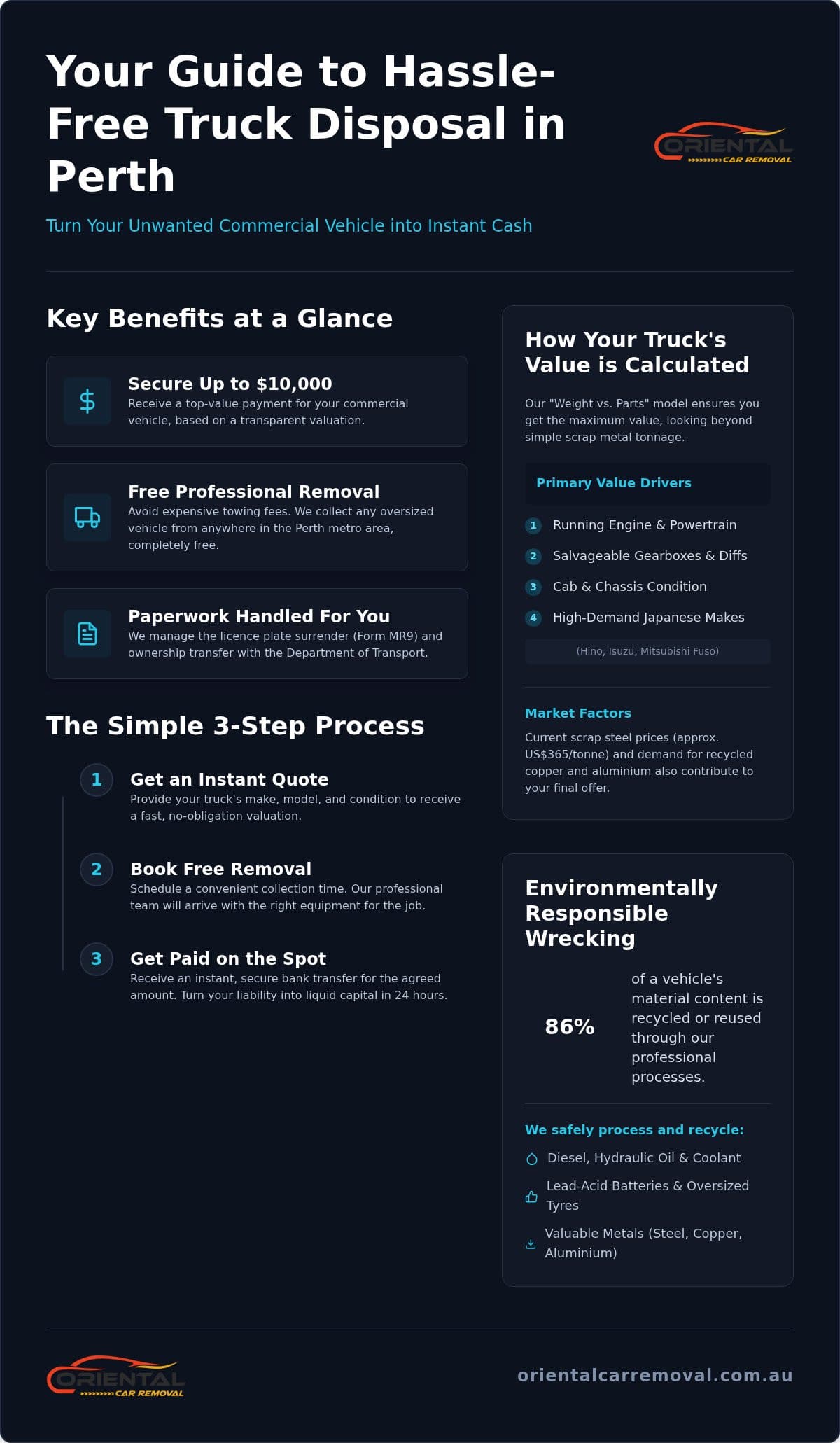
Why should a retired commercial vehicle cost you more in towing fees than it’s worth sitting in your yard? Most Perth business owners find that offloading a heavy vehicle is a logistical nightmare filled with unreliable buyers and expensive transport quotes. It’s a common struggle; you want the asset gone, but the Department of Transport paperwork and the sheer size of the machine make it feel impossible. If you’re looking for the most efficient truck wreckers perth has to offer, you need a solution that prioritises your time and your bottom line.

We understand you need this sorted without the usual stress. This guide explains how to secure a high-value payment of up to $10,000 for your unwanted vehicle while enjoying a completely free professional removal anywhere in the metro area. We’ll walk you through the 2026 requirements for surrendering licence plates and lodging your Form MR9 correctly. You’ll discover how to bypass the tyre-kickers and get an instant, secure bank transfer for your truck today. It’s time to clear your yard and get paid without the headache.

Key Takeaways

  • Secure up to $10,000 for your unwanted commercial vehicle through a transparent valuation process that considers both metal weight and salvageable parts.
  • Avoid expensive towing fees by choosing the most reliable truck wreckers perth residents trust for free, professional removal of oversized vehicles.
  • Navigate Western Australian Department of Transport requirements with ease as experts handle the plate returns and ownership transfer paperwork on your behalf.
  • Maximise your return on Japanese and commercial makes by dealing with licensed, local experts who provide instant payment via secure bank transfer.
  • Simplify your disposal process with a straightforward three-step method that turns a non-running truck into liquid capital within 24 hours.

Why Truck Wreckers Perth Are Your Best Bet for Heavy Vehicle Disposal

Selling a non-running commercial vehicle privately in Western Australia is often a losing battle. You’ll likely deal with endless phone calls from people who can’t actually transport a vehicle of that size. Most private buyers want a working asset, not a project that requires a low-loader to move. This is where professional truck wreckers perth specialists provide immediate relief. We turn your “dead weight” into liquid capital without the weeks of waiting. While national car-buying chains often struggle with the specific logistics of oversized vehicles, a local expert has the equipment and knowledge ready to go right now.

The Logistics of Disposing of a Heavy Asset

Standard tow trucks simply aren’t built for prime movers or heavy rigids. If you try to organise private heavy-duty towing, you’ll likely face a massive bill before you’ve even sold the vehicle. We eliminate this financial hurdle entirely. A professional truck wreckers perth service uses specialised recovery vehicles designed specifically for heavy commercial assets. This means we can clear your site in hours, not days. It’s a transactional process designed for speed. You get the cash, and we handle every aspect of the physical removal. Don’t let a retired truck sit and rust when it could be converted into a bank transfer today.

Environmental Responsibility in WA

Disposing of a truck isn’t just about moving metal; it’s about managing hazardous waste. A professional Wrecking yard plays a vital role in Perth’s circular economy. We safely drain and recycle diesel, hydraulic oil, and engine coolant to prevent soil contamination. Our team also ensures that oversized tyres and lead-acid batteries are processed through the correct channels rather than ending up in WA landfills. This methodical approach protects our local environment while recovering valuable materials for future use. Approximately 86% of a vehicle’s material content can be recycled or reused when handled by experts. It’s a responsible, no-hassle way to offload an asset that has reached the end of its life. We take the environmental burden off your shoulders so you can focus on your next business move.

Choosing a local specialist also ensures your money stays in the Perth economy. We understand the specific makes and models common in the WA transport industry, particularly Japanese commercial brands. This local expertise allows us to offer more competitive prices than generic national buyers who don’t understand the local parts market. Stop paying for storage or registration on a vehicle you no longer use. Get a quote, book a removal, and settle the matter once and for all.

Calculating Your Truck’s Scrap Value: More Than Just Metal Weight

Many owners assume a scrap quote is based solely on the weight of the metal. While tonnage is a factor, professional truck wreckers perth specialists use a more sophisticated “Weight vs. Parts” valuation model. We look at your vehicle as a collection of high-value components rather than just a block of steel. If your truck has a running engine, your instant cash quote will increase significantly. A functional powertrain allows us to recover and repurpose parts, which is always more valuable than melting down raw materials. We also consider the current international benchmark for heavy melting scrap steel, which sat at approximately US$365 per tonne in mid-2026.

The Value of Salvageable Parts

High-demand components like gearboxes, differentials, and diesel engines are the primary drivers of a premium offer. We specifically look for parts from reliable Japanese commercial brands such as Hino, Isuzu, and Mitsubishi Fuso. Because we specialise in providing used Japanese car parts Perth businesses rely on, we can often pay more for these specific makes. The physical condition of the cab and chassis also matters. A straight, rust-free cab can be a lifesaver for another operator looking to repair an accident-damaged vehicle. If your truck is complete and has its major mechanical parts intact, you’ll always secure a better result than if it’s been stripped of its “good bits” before we arrive.

Market Factors in 2026

External market forces in Western Australia play a huge role in your final payout. The demand for recycled aluminium and copper remains strong in 2026, which supports higher pricing for trucks with large radiators or extensive wiring looms. We also factor in your location. While we service all areas from Mandurah to Morley, the logistics of moving an oversized asset influence the net offer. As members of the broader automotive industry, we follow the professional standards promoted by the Motor Trade Association of Western Australia to ensure our valuations are fair and transparent. In the 2026 market, salvage value represents the total projected resale price of recovered mechanical components minus the professional labour costs required for dismantling and hazardous fluid disposal. You can get a fast quote for your truck based on these real-time market variables to see exactly what your asset is worth today.

Don’t settle for a generic scrap metal price that ignores the mechanical value of your vehicle. A specialised wrecker understands the secondary market for commercial spares. By choosing a partner who knows the worth of a Hino gearbox or an Isuzu diff, you ensure that no money is left on the table. It’s the most efficient way to turn a retired workhorse into immediate capital for your next fleet upgrade. If you also operate commercial vans as part of your fleet, you can explore how to get the best cash for vans Perth deals using the same transparent valuation principles. If your fleet also includes 4×4 work vehicles, find out how to get top cash for Toyota 4WD Perth owners rely on for a fast, fair payout.

How to Choose a Reliable Perth Wrecking Yard (And Avoid the Cowboys)

Choosing the right truck wreckers perth operator is the difference between a smooth 24-hour transaction and a week-long headache. Many “cowboy” operators promise high prices but lack the legal credentials to operate in Western Australia. Always verify that a yard holds a valid Motor Vehicle Repairer (MVR) licence. This isn’t just a formality; it’s your guarantee that the business follows state regulations and environmental standards. If a buyer refuses to provide a firm, transparent quote over the phone, it’s a major red flag. They might be planning to negotiate you down once they arrive with the tow truck.

Don’t overlook insurance coverage. Heavy vehicle removals involve significant weight and complex machinery. If an uninsured wrecker damages your property or a public road during the removal, you could be held liable. A reputable yard carries full public liability insurance to protect both parties. Check online reviews from local Perth customers to see if the business actually shows up on time and pays the agreed amount. Reliability is everything when you’re trying to clear a commercial site.

Verification Checklist for Truck Sellers

Before you agree to a pickup, ask these specific questions to vet the service. A professional outfit will have no trouble answering them immediately:

  • Does the wrecker own their own heavy-duty tilt tray or low-loader suitable for your specific truck size?
  • Will they provide a detailed receipt for the payment on the spot for your business records?
  • Are they familiar with navigating heavy industrial hubs like Bibra Lake or Naval Base?

Reliable operators understand the logistics of moving heavy rigids and prime movers across the metro area. They don’t hire third-party contractors who might not have the right experience for oversized recoveries. If they don’t have the right gear, they’ll likely waste your time or cause a safety risk on your property.

The Benefit of Local Expertise

Having 10+ years of local experience makes a massive difference for complex removals. A seasoned team knows exactly how to handle the “heavy lifting,” from winching a seized chassis to managing the Department of Transport paperwork. While generic car wreckers perth services might struggle with a 10-tonne asset, a commercial specialist has the right gear for the job. We act as your proactive partner, stripping away the complexities so you can move on with your day. We’ve spent over a decade refining our process to ensure every client gets a fair deal and a fast exit. We know the Perth suburbs, the local regulations, and the most efficient routes to get your truck off-site and into our yard today.

Truck Wreckers Perth: The 2026 Ultimate Guide to Selling Your Commercial Vehicle

Handling the legal side of heavy vehicle disposal in Western Australia doesn’t have to be a headache. When you deal with professional truck wreckers perth, you’re choosing a partner that understands the Department of Transport (DoT) requirements. The most critical step is ensuring you aren’t held liable for the vehicle after it leaves your property. This means you must lodge a Notification of Change of Ownership (Form MR9) within seven days of the transaction. You can do this easily through your DoTDirect account or at a local service centre. We help you navigate these administrative hurdles so the transition is permanent and legally sound.

Department of Transport (DoT) Compliance

To officially cancel your registration and potentially receive a refund, you must remove the licence plates and return them to a DoT service centre. This prevents any future tolls or fines from being linked to your name. Once the plates are surrendered, you can lodge the Notice of Disposal to finalise the process. In 2026, Western Australian vehicle owners can claim a pro-rata refund for any remaining full months of registration once the licence plates have been successfully returned to the Department of Transport. We assist with this process by ensuring the vehicle is correctly identified and the transaction is recorded accurately.

Selling Without Rego or Keys

Many clients ask if they can sell a truck that is currently written-off or unregistered. The answer is yes. Even if your asset has been sitting in a paddock for years and the paperwork is long gone, we can still facilitate the sale. We use the vehicle’s VIN or chassis number to verify ownership through official channels. If you’ve lost the keys to a heavy rigid or prime mover, don’t worry. Our recovery teams are equipped to move locked or non-steering vehicles safely. For a more detailed breakdown of the legalities, refer to our guide on how to scrap a car in WA to ensure you’re fully covered.

Oriental Car Removal takes the lead on managing the official disposal documentation. We provide you with a clear receipt and ensure the VIN is correctly logged in our system. This protects you from any post-sale liability. We’ve spent over a decade as licensed truck wreckers perth, so we know exactly what the DoT expects. You don’t need to spend hours researching regulations or waiting in queues. We handle the heavy administrative lifting on your behalf.

Get an instant quote and handle your paperwork today

Get Top Cash for Trucks with Oriental Car Removal’s 3-Step Process

Selling a heavy vehicle shouldn’t be a long-term project. We’ve designed a streamlined process that prioritises your time and gets the asset off your property within 24 hours. As the truck wreckers perth businesses rely on for speed, we’ve stripped away the usual delays of private sales and complex negotiations. Our system is built on transparency and efficiency. You provide the details, we provide the quote, and our recovery team handles the rest. It’s a straightforward path to clearing your yard and boosting your bank balance.

  • Step 1: Request Your Quote. Call us or use our online form to share your truck’s make, model, and current condition. We provide a firm offer based on real-time 2026 market values.
  • Step 2: Schedule Free Removal. Pick a time that suits your business schedule. We’ll send a heavy-duty recovery team to your location at no cost to you.
  • Step 3: Receive Instant Payment. Once the final check is complete, you’ll receive a secure payment of up to $10,000. We’ll winch the truck and move it out immediately.

Our service area is extensive. We cover the entire metro region, from the northern reaches of Joondalup down to Rockingham and Mandurah. Distance is never a barrier to a fair deal. We bring the equipment and the cash to you, ensuring you don’t have to worry about the logistics of moving a non-running prime mover or heavy rigid. The same hassle-free approach applies whether you’re disposing of a large truck or looking for the best cash for vans Perth offer for a smaller commercial vehicle in your fleet.

Why We Are Perth’s Preferred Truck Wreckers

Local operators choose us because we deliver on our promises. We specialise in high-value payouts for commercial brands like Isuzu, Hino, and Mitsubishi Fuso. Because we understand the specific parts market for these Japanese makes, we can offer more competitive rates than generic scrap yards. Our commitment to “No-Hassle” transactions means we show up when we say we will. If you need an urgent removal to clear space for new fleet arrivals, we often facilitate same-day pickups across Perth. We act as a proactive partner, managing the heavy lifting so you can stay focused on your daily operations. If your business also runs Toyota LandCruisers or other 4×4 work vehicles, our same transparent process applies when you need cash for Toyota 4WD Perth businesses depend on for fast fleet turnover.

Ready to Clear Your Space?

Preparation is the key to a fast exit. Before our tow truck arrives, ensure you’ve removed all personal items and business equipment from the cab. Make sure our heavy-duty recovery vehicle has clear access to the truck to avoid delays. Have your identification and any available ownership documents ready for a final check. Once the paperwork is signed and the cash is in hand, your responsibility ends. We’ll handle the hazardous fluid drainage and recycling at our authorised facility. It’s the cleanest, fastest way to dispose of a commercial asset in WA.

Contact Oriental Car Removal for your free truck quote today!

Clear Your Yard and Boost Your Cash Flow Today

Selling a retired commercial vehicle doesn’t have to be a logistical burden that drains your business resources. You’ve seen how a professional truck wreckers perth service turns “dead weight” into liquid capital while managing every legal requirement on your behalf. From securing a fair valuation based on high-demand parts to ensuring your Department of Transport paperwork is 100% compliant, the process is designed for your total peace of mind. You get the space back in your yard and the money in your bank account without the stress of private listings or expensive towing fees.

Oriental Car Removal provides the ultimate “hassle-fixer” solution across the entire metro area. We offer instant payouts up to $10,000 and provide free heavy vehicle towing regardless of your location. We handle all the heavy lifting and official documentation so you can stay focused on your next project. It’s the most efficient way to settle your vehicle disposal once and for all.

Get an Instant Cash Quote for Your Truck Now

Take the first step toward a cleaner site and a better bottom line. Our team is ready to provide a transparent, no-nonsense quote today.

Frequently Asked Questions

How much cash can I get for my truck in Perth?

Oriental Car Removal pays instant cash up to $10,000 for commercial vehicles in any condition. The final offer depends on the make, model, age, and mechanical state of the asset. We use a transparent valuation model that considers the salvage value of parts and current scrap metal prices. You’ll receive a firm quote over the phone, ensuring there are no surprises or hidden fees when our team arrives for the pickup.

Do you provide free truck removal for oversized commercial vehicles?

Yes, we provide completely free truck removal for all oversized commercial vehicles across the Perth metro area. Our fleet includes heavy-duty tilt trays and low-loaders specifically designed to handle prime movers and heavy rigids. You don’t have to worry about the high costs of private heavy towing. We coordinate the entire recovery process at no charge to you, regardless of the vehicle’s size, weight, or current location.

What paperwork do I need to sell my truck to a wrecker in WA?

You primarily need a valid WA Driver’s Licence for identification and proof of ownership. If you’ve lost the original registration papers, we can often verify the vehicle’s status using the VIN or chassis number. As experienced truck wreckers perth specialists, we handle the official disposal documentation on-site. We’ll guide you through the Notification of Change of Ownership (Form MR9) to ensure you have no post-sale liability.

Can I sell a truck that is not running or has a blown engine?

You can certainly sell a truck that is not running or has a blown engine. We specialise in buying damaged, accident-affected, and mechanically failed commercial assets. While a running engine can increase the final payout, we still provide competitive offers for vehicles that are only fit for scrap or parts. Our recovery teams use specialised winching equipment to move non-steering or seized vehicles from your property safely.

Do you buy trucks in regional areas like Mandurah and Rockingham?

We buy trucks across all surrounding suburbs, including Mandurah, Rockingham, and Joondalup. Our service area covers major industrial hubs like Bibra Lake, Naval Base, and Osborne Park. Whether your vehicle is located in Fremantle or Secret Harbour, we provide the same free removal and instant cash payment. We are a local Perth business committed to serving the entire metropolitan region with fast, reliable commercial vehicle salvage and disposal services.

How long does the truck removal process take?

The entire process is designed to be completed within 24 hours. Once you accept our quote, we can often arrange for the removal on the same day. The physical pickup and payment usually take less than an hour, depending on the accessibility of the vehicle. We prioritise efficiency to ensure your yard is cleared and your cash is in hand without any unnecessary delays to your business operations or daily schedule.

Do I need to return my number plates to the Department of Transport?

Yes, you should remove and return your licence plates to a Department of Transport service centre. This is a crucial step to officially cancel your registration and stop any future liability. Returning the plates also allows you to claim a pro-rata refund for any remaining full months of registration. We can assist you by removing the plates on-site during the collection process if you don’t have the tools handy.

What happens to my truck after it is wrecked?

Your truck undergoes a methodical recycling process at our authorised facility. We first drain all hazardous fluids, such as diesel and hydraulic oil, to prevent environmental contamination. Our team then dismantles the vehicle to salvage high-quality mechanical components for our truck wreckers perth inventory. Finally, the remaining metal chassis is crushed and recycled as scrap steel, contributing to the circular economy and reducing landfill waste in Western Australia.