
A scrap car doesn’t need current rego to be scrapped or removed in WA. If a licensed vehicle changes ownership, the seller must notify the Department of Transport and Major Infrastructure within 7 days, and complete the MR9 with the buyer at the time of sale. That’s the key distinction in how to transfer vehicle registration for a scrap car in WA: arranging removal and updating the vehicle’s licensing record are separate steps.
An expired licence doesn’t necessarily prevent you from scrapping a car in WA. The key is to document the handover and notify the Department of Transport so the vehicle’s ownership and registration records are clear.
This guide explains what documents to prepare, how the transfer paperwork works, how long you have to notify the department, and which records to keep after collection. You’ll also learn what to consider if the car is unregistered, the ownership details don’t match, or you need to return its number plates.
Key Takeaways
- Learn which ownership and identity records can help a professional complete a scrap-car handover smoothly.
- Understand why an expired licence doesn’t automatically prevent scrapping, and when a lapsed licence can affect transfer options.
- See how the online and paper transfer routes differ, and what details help prevent delays in the paperwork.
- Keep the right collection and plate-return records to document what happened after the vehicle leaves your hands.
- Find out when a professional can help manage the removal and transfer paperwork for an unwanted vehicle.
How Long Do I Have To Transfer A Vehicle In WA?
In WA, the seller must notify the Department of Transport and Major Infrastructure within 7 days of the ownership change. The buyer must contact the Department of Transport within 14 days.
-
Have a professional submit the buyer transfer
Give the professional the vehicle details and the buyer’s name and address so they can prepare the transfer. The WA transfer can be handled online through DoTDirect or on the MR9 form. For an online transfer, the seller needs a DoTDirect account; the buyer needs the seller’s last name and the vehicle’s plate number. Confirm that the details match the vehicle record before submission.
-
Have a professional notify the department after scrapping
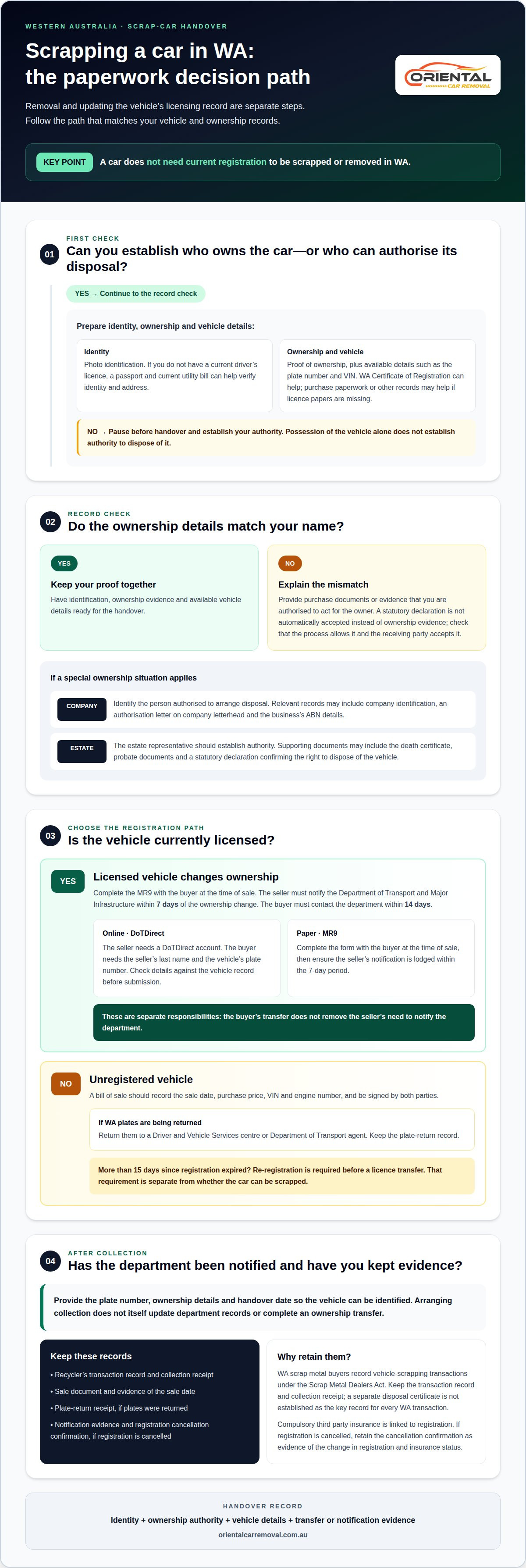
When a vehicle is scrapped, make sure the WA Department of Transport is notified. Provide the plate number, ownership details and handover date so the vehicle can be identified. Keep in mind that arranging collection does not itself update the department’s records or complete an ownership transfer.
Compulsory third party insurance is linked to the vehicle’s registration. If the registration is cancelled, keep the cancellation confirmation with your records as evidence of the change in registration and insurance status.
-
Meet both transfer deadlines
Complete the MR9 with the buyer at the time of sale, then make sure the seller’s notification is lodged within 7 days. The buyer has 14 days to contact the Department of Transport. These are separate responsibilities, so the seller should not assume the buyer’s transfer removes the need to notify the department.
For example, if a licensed vehicle changes hands on a Monday, the seller’s notification period starts from that ownership change. The buyer’s 14-day period is separate. Keep evidence of the sale date and submitted notification to help show when each step occurred.
-
Handle an interstate sale before handover
If the buyer lives interstate, return the WA plates to a Department of Transport and Major Infrastructure service centre or regional agent, then sell the vehicle as unlicensed. Returning the plates and selling the vehicle are separate steps. If the vehicle is relicensed in another state or territory, its WA licence is cancelled and no refund is payable.
For a scrap handover, the professional can coordinate the vehicle details and notification steps with the seller. Keep the plate-return receipt and sale record, and don’t treat collection alone as proof that the department was notified.
Does a car need current rego before you can scrap it in WA?
No. A vehicle in WA does not need current registration to be scrapped or removed. Before handover, establish who owns it or who has authority to arrange its disposal.
- Provide identification and ownership evidence. Give the professional photo identification, proof of ownership and available vehicle details, such as the plate number and VIN. A WA Certificate of Registration can help establish ownership. If the vehicle licence papers are missing, purchase paperwork or other records can help show the ownership history. Possession of the vehicle alone does not establish authority to dispose of it.
- Explain any mismatch in the records. If the name on the vehicle documents differs from yours, provide purchase documents or evidence that you’re authorised to act for the owner. A statutory declaration isn’t automatically accepted instead of ownership evidence. Before relying on one, establish that the relevant process allows it and the receiving party accepts it. If you don’t have a current driver’s licence, a passport and current utility bill can help verify your identity and address.
- Gather company authorisation for a business vehicle. For a company-owned car, identify the person authorised to arrange disposal and provide relevant business records. These may include company identification, an authorisation letter on company letterhead and the business’s ABN details. This creates a clear record of who approved the handover, rather than relying only on the employee or driver presenting the vehicle.
- Prepare estate documents for an inherited vehicle. If the registered owner has died, the estate representative should establish their authority before arranging removal. Supporting documents may include the death certificate, probate documents and a statutory declaration confirming the right to dispose of the vehicle. Requirements depend on the estate circumstances, so gather records that show both the owner’s death and your authority to act.
- Record the sale and plan the plate return. For an unregistered vehicle, a bill of sale should record the sale date, purchase price, VIN and engine number, and be signed by both parties. A professional can include WA plate return in the handover plan; the plates must go to a Driver and Vehicle Services centre or Department of Transport agent. If registration expired more than 15 days ago, re-registration is required before a licence transfer, but that is separate from whether the vehicle can be scrapped.
For a straightforward handover, keep the identity, ownership and vehicle records together. If you need scrap car removal, provide those details so the professional can organise the paperwork around the vehicle’s circumstances.
Records to keep after vehicle collection
Keep a clear record of the handover, ownership change and registration updates. WA scrap metal buyers record vehicle-scrapping transactions under the Scrap Metal Dealers Act. A separate disposal certificate is not the key record established for every WA transaction, so retain the buyer’s transaction record and collection receipt.
- Save the transaction and collection records. Keep the recycler’s transaction record, receipt and any sale document together. The paperwork should identify the vehicle and show it was collected for scrapping. Store a digital copy as well as the original, using a clear file name with the plate number or VIN. If an ownership query arises later, these records can help connect the handover to the vehicle.
- Keep evidence of the registration updates. Save the seller notification confirmation, the completed MR9 copy or online transfer confirmation, and any message from the Department of Transport. These records show which notification was submitted and when. Keep them with the collection paperwork rather than relying on a verbal handover, because vehicle collection and a department update are separate events.
- File the number-plate return receipt. If you return the plates, retain the receipt issued by the Driver and Vehicle Services centre or Department of Transport agent. It helps show that the plates were handed back and supports your record of the vehicle’s licensing status. Keep it with the transaction record, especially if the vehicle’s licence or ownership details are queried later.
- Keep supporting ownership documents together. Retain purchase paperwork, the vehicle licence document, identification used for the handover, and any authority documents for company or estate vehicles. These records can explain why the person arranging disposal had the right to act. For example, an estate representative can keep probate paperwork with the vehicle’s collection receipt.
- Organise the file for later questions. Use one folder for the vehicle’s sale or disposal, collection date, buyer transaction record, plate return and Department of Transport updates. Note any outstanding registration issue, such as a notification awaiting confirmation. If the vehicle was sold interstate, include the sale paperwork and plate-return evidence so its WA licensing history is easy to follow.
Keep the records for as long as they may be needed to explain the vehicle’s disposal, ownership and registration in Western Australia. A complete file helps distinguish the scrap transaction from later licensing updates.
Scrapping a registered or unregistered vehicle
In Western Australia, a car can be sold for scrap without current registration. If it’s written off or sold, arrange disposal only when you have authority, and keep records of the handover.
-
Handle an unregistered vehicle
Arrange the sale as an unregistered vehicle and provide identification and proof of ownership. A vehicle can be sold without registration, but it must not be driven on public roads without a special Temporary Movement Permit. Arrange transport rather than driving it to the buyer, and keep a sale record identifying the vehicle and both parties.
-
Manage written-off or scrapped vehicles
Confirm who has legal authority to dispose of a written-off vehicle before arranging collection. Its written-off status alone doesn’t establish who can sell or scrap it. If you’re the owner or authorised representative, keep supporting ownership or authority records with the sale paperwork. After handover, retain the buyer’s transaction record and any registration correspondence.
- Handle registration and number plates separately. For a registered vehicle, arrange the required registration cancellation with the Department of Transport WA after scrapping. Return the number plates to a Driver and Vehicle Services centre or Department of Transport agent. If registration has expired, plates must be returned within 14 days of expiry. Keep the return receipt as evidence that the plates are no longer with the vehicle.
- Consider whether a licence refund applies. A WA vehicle owner who returns the plates can apply for a refund of the remaining vehicle registration balance, less an administration fee. The refund takes effect from the date the plates are returned, unless an accident report or insurer letter confirms an earlier accident date. If selling to an interstate buyer and seeking a refund, return the plates before the sale.
- Keep the disposal file together. Save the sale record, collection receipt, plate-return receipt and Department of Transport updates. For an unregistered vehicle, record the sale date, price, VIN and engine number, with both parties’ signatures. For a registered vehicle, keep the vehicle licence details and cancellation correspondence in the same file. These records help explain the vehicle’s ownership and registration history if questions arise later.
Having a professional complete the vehicle transfer form
For a scrap vehicle with a WA licence, accurate paperwork connects the handover to the Department of Transport record. A professional can prepare an online transfer or MR9 form using details supplied by the seller and buyer. Understanding how to transfer vehicle registration for a scrap car in WA starts with choosing the right route for the transaction.
- Choose the transfer route. A WA vehicle licence transfer can be completed online or on paper. For an online submission, the seller needs a DoTDirect account. A paper transfer uses the MR9 form. The professional can use the details supplied by both parties and establish which route suits the transaction before submitting it.
- Provide the vehicle and applicant details. Supply the plate number, licence expiry date, odometer reading, make, model, body type, VIN or chassis number, and engine number. The applicant may need to provide identification details as part of the transfer paperwork. Vehicles from 2011 or newer require an odometer disclosure. Accurate identifiers help prevent mismatches between the form and the vehicle record.
- Complete the seller and buyer information. An online transfer needs the sale date, selling price, dutiable value, plate number, and buyer’s name and address. The buyer needs the seller’s last name and plate number to start an online transfer. Ensure these details match the transaction and vehicle records. This is a practical part of how to transfer vehicle registration when scrapping a car in WA.
- Sign and distribute the MR9 correctly. The MR9 has two halves, one for each party. For a paper transfer, make sure each party receives the appropriate copy. The professional can help complete the form with the buyer at the sale, then ensure each party receives the correct copy. Keep the seller’s copy with the disposal paperwork.
- Submit the form and retain proof. A paper MR9 can be lodged at a Driver and Vehicle Services Centre, a regional agent, or by post to Driver and Vehicle Services, GPO Box R1290, Perth WA 6844. Keep the completed form or online confirmation with the sale record. If the buyer receives no invoice or other communication within 21 days after lodgement, they should contact the Department of Transport and Major Infrastructure.
Oriental Car Removal: Scrap Car Removal
Oriental Car Removal provides scrap car removal when a vehicle is no longer worth keeping and you need help with its handover. The service includes towing, disposal and paperwork, helping bring the vehicle’s collection and records together. You’ll need to provide identification and ownership details so the handover can be properly documented.
Oriental Car Removal also offers Cash for Trucks for unwanted trucks. Free Car Removal takes care of transport, so you don’t have to arrange it yourself. Keep Department of Transport notifications and plate-return records with the collection paperwork, as these document separate parts of the process.
Contact Oriental Car Removal to discuss your scrap vehicle removal.
Make your vehicle handover the next step
Before arranging collection, decide who will manage each part of the handover and keep the paperwork connected. A clear plan for how to transfer vehicle registration for a scrap car in WA starts with sharing the vehicle details and ownership information with the professional handling its removal. That gives them the context to manage the collection and supporting paperwork without losing sight of the registration process.
Oriental Car Removal offers Cash for Cars for unwanted vehicles. Choose the removal service that suits your vehicle and keep a clear record of what has been arranged. To get started, contact Oriental Car Removal about your vehicle and its handover.
Frequently Asked Questions
What paperwork do you need to scrap a car in WA?
Prepare photo identification, proof of ownership or authority to act, and vehicle details such as the plate number and VIN. For a company vehicle, include business records showing who can authorise disposal. For an inherited car, estate documents can establish the representative’s authority. If names differ across the records, purchase paperwork can help explain the ownership history.
Can a professional complete the transfer online?
Yes. A professional can assist with an online WA transfer through DoTDirect when the transaction is eligible. The seller needs a DoTDirect account, and the buyer needs details such as the seller’s last name and the vehicle’s plate number. Some transfers, including certain company, joint ownership and deceased estate cases, cannot be completed online and require another process.
Can I sell my car without registration in Western Australia?
Yes. You can sell an unregistered vehicle in Western Australia, including for scrap. Establish ownership or authority to sell, and record the sale details in writing. Don’t drive the unregistered car on public roads without a special Temporary Movement Permit. If it cannot be legally driven, arrange collection instead.
Can you get a refund on remaining rego?
You may apply for a refund of the remaining WA vehicle licence balance after returning the number plates. For a sale to an interstate buyer, return the plates before the sale to be considered for a refund. The refund generally takes effect from the plate-return date. An accident report or insurer letter confirming the accident date can support an earlier date.
How do ownership and rego status change the WA paperwork checklist?
For a privately owned car, prepare identification and ownership evidence. A company vehicle also needs records showing who can authorise disposal, while an inherited car may need estate documents. Registration status affects the licensing paperwork, not whether the car can be scrapped. If the licence expired 15 or more days ago, the new owner needs an inspection and a new licence rather than a licence transfer.
What happens after you submit your documents?
After a vehicle transfer is lodged, the buyer should receive an invoice or other communication within 21 days. If nothing arrives in that period, the buyer should contact the Department of Transport and Major Infrastructure. The buyer must pay the invoiced transfer amount within 28 days. Keep the submission confirmation and transaction records together in case the paperwork needs follow-up.
How can a professional cancel vehicle registration in Western Australia when scrapping a car?
A professional can organise the disposal paperwork and notify the WA Department of Transport that the vehicle has been scrapped. Registration cancellation and vehicle collection are separate steps, so keep evidence of each. The owner should ensure the registration record is dealt with and return the number plates through the relevant WA process. Keep any department correspondence with the vehicle’s disposal records.
What documents are required to cancel WA vehicle registration?
Have the vehicle’s registration details, number plates and proof of ownership ready, along with identification for the person arranging cancellation. If someone is acting for a company or estate, include records showing their authority. Keep the plate-return receipt and any Department of Transport correspondence as evidence of the steps taken. Requirements can depend on who owns the vehicle and its circumstances.