How to Sell a Car With Finance Owing and Settle the Loan

How to Sell a Car With Finance Owing and Settle the Loan

Selling a car with finance owing in WA isn’t illegal. To understand how to sell a car with finance owing in WA, get the lender’s payout figure, arrange to clear the loan from the sale proceeds and cover any shortfall before transferring ownership. The lender’s security interest should then be discharged.

It’s understandable to worry that finance will prevent a sale or leave a buyer exposed. The key is to confirm the lender’s payout and ensure the security interest is cleared, rather than assuming the sale alone will settle everything.

You’ll also learn what confirmation to keep after the lender receives payment, helping you complete the process with fewer surprises.

Why Choose Oriental Car Removal

  • You can sell a car with finance owing in WA, but the loan payout and lender’s security interest need to be dealt with.
  • Compare the lender’s payout figure with the sale offer so you know whether you’ll have money left over or need to cover a shortfall.
  • For a private sale, arrange how the buyer’s payment will reach the lender and how any remaining proceeds will be paid to you.
  • A PPSR search using the car’s VIN can show a registered security interest, but it won’t tell you the loan balance.
  • Keep written confirmation that the loan is settled, then check that the lender’s security interest has been discharged.

Is it illegal to sell a car under finance?

No. In WA, you can sell a car with finance owing if you arrange to pay out the loan or cover any shortfall. Compare the lender’s payout figure with the sale price before agreeing to the sale.

  1. Work out any negative equity

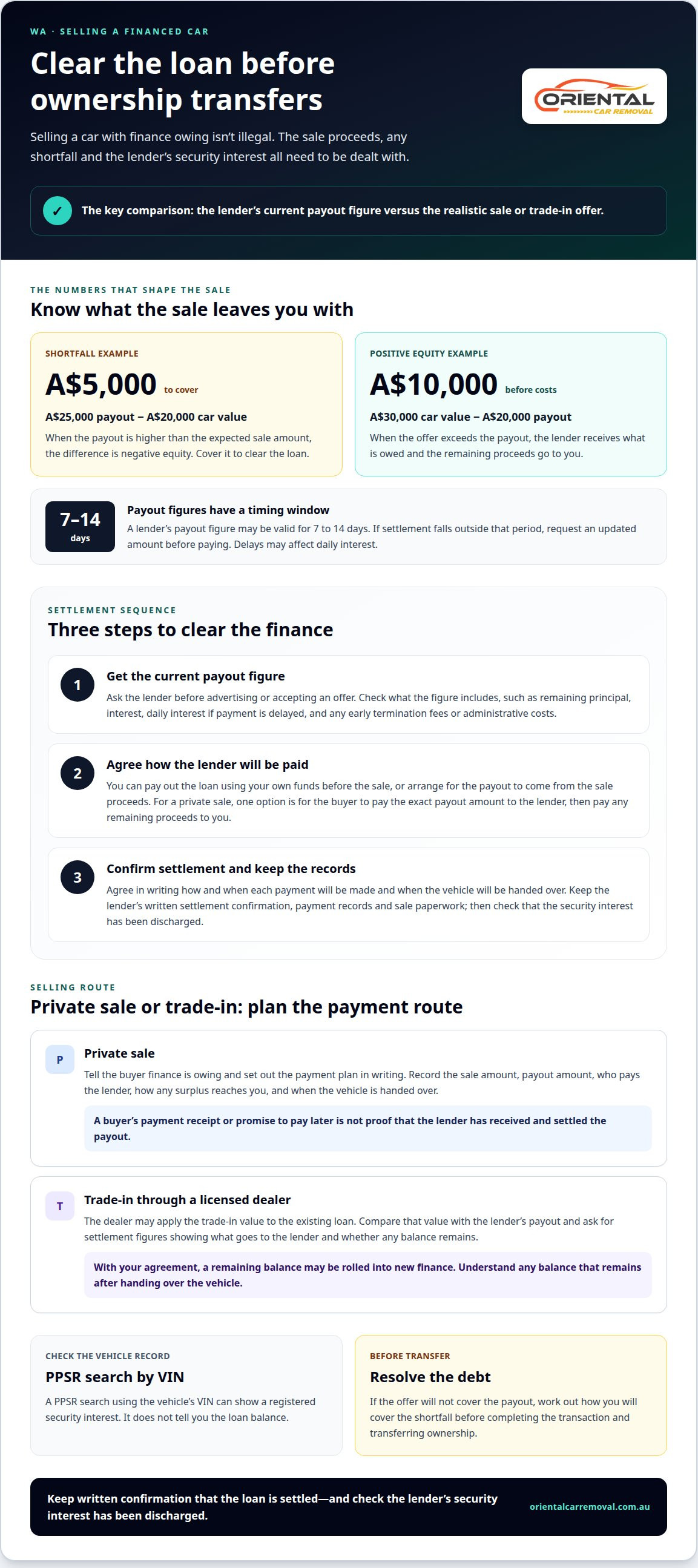
    Compare the lender’s current payout figure with the amount you expect buyers to pay. If the payout is higher, the difference is negative equity and must be covered to clear the loan. For example, a car worth A$20,000 with A$25,000 owing leaves a A$5,000 shortfall. A A$3,000 shortfall is another example of the extra money a seller may need to pay upfront.

    Use a realistic sale amount, not just an optimistic asking price, when doing the calculation. If the offer won’t cover the payout, speak with the lender about the shortfall before finalising the sale. Don’t assume the buyer’s payment alone will close the loan.

  2. Arrange the loan payout

    Ask your lender for a payout figure before you advertise or accept an offer. Check what it includes, such as remaining principal, interest, daily interest if payment is delayed, and any early termination fees or administrative costs. The figure may be valid for 7 to 14 days, so timing matters. If settlement falls outside that period, request an updated amount before paying.

    Then decide how the loan will be cleared. You can pay it out before the sale, using your own funds, or arrange for the payout to come from the sale proceeds. For example, a car worth A$30,000 with an A$20,000 payout figure has A$10,000 in positive equity before any applicable costs. Confirm the payment method and timing with the lender, and keep the payout details for settlement.

  3. Settle the finance from the sale

    For a private sale, arrange a clear payment process with the buyer and lender. One option is for the buyer to pay the lender the exact payout amount directly, then pay any remaining proceeds to you. Get the lender’s payout figure and payment instructions first. Agree in writing how and when each payment will be made, and when the vehicle will be handed over.

    If the offer exceeds the payout, the lender receives the amount owing and you receive the balance. Selling first and paying later still means the loan must be cleared. Don’t treat the buyer’s payment as proof of settlement until the lender confirms receipt of the payout.

Can you trade in a car with finance owing?

Yes. In Australia, you can sell or trade in a financed vehicle if the loan is paid out as part of the sale. Before deciding how to sell a car with finance owing in WA, plan how the lender will be paid and when ownership will transfer.

  1. Understand selling with finance owing

    Confirm whether the car loan is secured against the vehicle. With finance owing, the lender may have a security interest recorded on the Personal Property Securities Register. The sale can proceed legally when the loan payout is handled, but the debt must not be left unresolved.

    Keep the sale agreement separate from the ownership transfer. It is sensible for private sellers to be open with buyers about finance owing before agreeing the sale. Arrange the loan payout as part of the sale so the lender’s security interest can be cleared. A lender may require its payout from the sale proceeds, so agree on the payment route before handing over the vehicle or paperwork.

    Don’t treat a buyer’s promise to pay the loan later as a completed payout. The lender’s interest remains relevant until the debt is settled and the security interest discharged. This matters to buyers because an unpaid secured loan can expose the vehicle to the lender’s claim.

  2. Choose a selling option

    Decide whether to sell privately or trade in through a licensed dealer. For a private sale in WA, disclose the finance status and arrange the payout with the buyer and lender. A clear written agreement should record the sale amount, payout amount, who pays the lender, and how any remaining money will be paid to you.

    A trade-in can simplify payment handling. The dealer may apply the vehicle’s trade-in value to the existing car loan. With your agreement, any remaining balance may be rolled into new finance. Compare the trade-in value with the lender’s payout figure, and make sure you understand any balance that remains after handing over the vehicle.

    Some licensed dealers handle the payout directly, while a private buyer can pay the lender’s payout amount and send any surplus to you. If you’re deciding how to sell a car with finance owing in WA, compare the payment routes and any balance left after settlement. In WA, licensed car dealers can only sell cars with no money owing on them, so the existing finance needs to be resolved during the process.

  3. Use the sale proceeds to repay the loan

    Ask the lender for the current payout figure, then compare it with the sale or trade-in offer. Direct the payout portion to the lender and keep a record of any remaining payment.

    If the offer is lower than the payout, work out how you’ll cover the shortfall before completing the transaction. Don’t assume a trade-in automatically clears the debt. Ask for settlement figures showing how much goes to the lender and whether any balance will carry into new financing.

    After payment, keep the lender’s settlement confirmation and follow the agreed ownership-transfer steps. A buyer’s payment receipt alone doesn’t prove the loan has been settled. Keep the sale paperwork, payment records and lender correspondence together to maintain a clear paper trail.

What does ‘under finance’ mean?

A car is under finance when a loan remains unpaid. In a private sale, disclose this and plan how the buyer’s payment will clear the lender’s interest.

  1. Disclose the finance before setting the sale terms. Tell the buyer if money is owing on the vehicle and plan how the payment will clear the lender’s interest. Include the finance status in the advertisement, then repeat it in messages and the contract. This gives buyers a clear picture before they agree to pay or arrange collection.

    Explain whether the car loan is secured against the vehicle. Most car loans are secured, but a credit card or unsecured personal loan doesn’t encumber the car. If the loan is secured, the finance company’s interest may appear on the Personal Property Securities Register. Don’t describe a secured vehicle as clear of finance while that interest remains.

  2. Arrange a payment plan involving the buyer and finance company before signing final paperwork. Request the lender’s current payout figure and payment instructions. Give the buyer a copy of the payout information, then agree which amount goes directly to the lender and what balance, if any, goes to you.

    For example, if the agreed price exceeds the payout, the buyer pays the lender first and pays the remainder to you. If the price falls short, agree how you’ll pay the difference before settlement. Put both payment amounts, the payment method and the handover timing in the contract. This helps avoid confusion about who pays what.

    Ask the finance company how it will confirm receipt and loan settlement. Keep the lender’s instructions and the buyer’s payment records with your sale paperwork. Don’t hand over the vehicle based only on a promise to pay the loan later. The agreed payment plan should ensure the lender receives its payout.

  3. Reassure buyers with evidence, not just verbal assurances. Show the lender’s payout letter or written payment instructions, and explain how the buyer’s payment will clear the outstanding finance. A buyer can also request the lender’s payout letter and arrange to pay that amount directly to the finance company.

    Set out the transfer sequence in writing. Record when the buyer pays, when the lender receives the payout, how any surplus reaches you, and when you’ll provide the vehicle and transfer paperwork. A clear contract gives both parties a shared record of the sale terms.

    After payment, keep the lender’s settlement confirmation. The buyer can check the vehicle’s PPSR status again before completing the transfer. These records help show the steps taken to settle the finance, rather than leaving the buyer to rely on an informal assurance.
How to Sell a Car With Finance Owing and Settle the Loan

Understanding vehicle encumbrance and PPSR registration

Buying a car under finance carries a risk: if the secured loan remains unpaid, the lender could repossess the vehicle from its new owner. Sellers risk leaving the loan and security interest unresolved, so check the PPSR and arrange the payout before completing the transfer.

  1. Run a PPSR search using the vehicle’s 17-character VIN. It won’t show the amount owing, so contact the lender separately for the payout figure. A clean search result and a lender payout figure answer different questions.

    A car is encumbered when a security interest is registered against it. Paying off the secured loan clears the debt, while the lender’s interest must also be discharged. Don’t assume a PPSR search confirms the payout amount or proves the lender has removed its interest.

  2. Gather the sale paperwork before accepting an offer. For a private sale in WA, prepare proof of ownership, valid photo ID, and a receipt or contract of sale. Include the vehicle details, agreed price, finance disclosure and payment arrangement in the contract. Keep the lender’s payout instructions with those records so the buyer can see how the transaction will be handled.

    Use the vehicle’s VIN and registration details consistently across the documents. A mismatch can delay the buyer’s checks or create confusion during transfer. Keep copies of the signed contract, payment records and transfer paperwork together after the sale.

  3. Research the vehicle and seller before committing to payment. The buyer can match the VIN on the car with the VIN used for the PPSR search and compare it with the sale paperwork. Ask for the lender’s payout letter if finance is owing. This helps the buyer distinguish the exact payout from the total price and understand where each payment goes.

    As the seller, make the finance status clear in the advertisement and contract. Give buyers the payout information and agreed payment steps. Don’t describe the vehicle as unencumbered while the secured loan remains unsettled. Written details are more useful than verbal assurances.

  4. Prepare the vehicle for inspection and a realistic offer. Keep its service manual up to date and address major maintenance issues where possible. Scratches, chips and dents can affect resale value, so assess their condition before setting an asking price. Be ready to explain known issues during the inspection rather than surprising the buyer.

    Compare an offer with the lender’s payout, not just the advertised price. If the offer is lower, plan how to cover the shortfall. If it is higher, record how the lender will receive its payout and how the remaining proceeds will reach you. This makes payment and ownership transfer more straightforward.

Confirming discharge of the lender’s security interest

Paying the payout figure is a key step, but keep evidence that the lender’s security interest has been cleared. Follow the payment through to written confirmation and a PPSR status update.

  1. Get the lender’s agreement

    Contact the lender before selling a car secured by its loan. Ask what it requires to approve the sale, how the payout should be made, and what confirmation it will issue after payment. The lender’s agreement can help establish the right order for payment and handover.

    Request a payout figure and written payment instructions for the buyer, dealer or settlement arrangement. Check the figure’s expiry date and whether delayed payment changes the amount through daily interest. If the sale offer is lower than the outstanding balance, plan how you’ll cover the shortfall before completing the transaction.

    Keep the lender’s instructions with the sale contract and payment records. If a dealer is handling the transaction, ask for written confirmation showing the amount sent to the lender and any balance applied elsewhere. Don’t rely on a verbal statement that the finance has been dealt with.

  2. Arrange the sale through the lender

    Ask the lender how the buyer’s or dealer’s payment can be directed to the loan. In a WA sale, the lender may receive the payout directly during settlement. Agree who pays any remaining amount to you, or how you’ll cover a shortfall, and record the payment sequence before handing over the vehicle.

    After payment, obtain written confirmation that the loan is settled and the lender’s interest is cleared. Keep that letter with the settlement receipt and transfer paperwork. A PPSR status update can take a few days after the lender clears its interest, so retain the lender’s confirmation while the register updates.

    Check the PPSR again once the update has had time to appear. The search checks whether a security interest is still registered; it doesn’t replace the lender’s written settlement confirmation. If you trade in the car, keep proof that the old loan was settled, even if the dealer arranged the payout as part of the transaction.

    The title does not truly transfer to the new owner until the security interest is cleared. Match the lender’s confirmation to the vehicle and loan, then keep the records together. This gives you a clear trail from payment to discharge and helps resolve questions about the outstanding finance after you sell your car.

Explore cash for cars in Perth

Oriental Car Removal: Cash for Cars

Oriental Car Removal offers Cash for Cars when you’re ready to move on from an unwanted vehicle. It also provides Free Car Removal, plus Cash for Trucks and Cash for 4WDs and Vans. These options may suit you if you’ve decided not to keep the vehicle and have arranged how any outstanding finance will be paid and the lender’s security interest discharged.

Before the vehicle is collected, keep your lender’s payout and settlement records with your sale paperwork. This helps you track the finance separately from the vehicle sale and removal. For a car, truck, 4WD or van you no longer need, contact Oriental Car Removal to discuss the next step.

Take the next step with confidence

If you’re deciding how to sell a car with finance owing in WA, take a practical next step: choose a sale route that suits the vehicle and keep the lender’s settlement records organised. Once you’ve planned how the finance will be resolved, you can move on from a car, truck or other unwanted vehicle without losing track of the paperwork.

Oriental Car Removal offers Cash for Cars, Free Car Removal and Cash for Trucks. These services may suit you when you’re ready to part with a vehicle and want removal included in your next steps. Keep the finance settlement and vehicle sale as separate records so you can follow each part of the process clearly.

Take time to make your decision, then act when you’re ready. A clear plan puts you in control of the handover.

Your next step can be simple and well organised.

Frequently Asked Questions

What’s the process for selling a car that’s under finance?

Selling a car with finance owing in WA means coordinating the lender, buyer and ownership paperwork. Start with the vehicle’s VIN and loan account details, then get the current payout amount and decide how the sale payment will be allocated. Tell buyers about the finance status, document the agreed settlement steps, and keep the lender’s confirmation with your sale records.

Can the buyer pay off your car loan directly?

Yes, a buyer can pay the lender directly when the lender provides the correct payout amount and payment instructions. Ask the buyer to use those details rather than estimating the amount from your regular repayment. If the sale price is higher than the payout, agree how the balance will reach you. Keep the lender’s receipt or settlement confirmation.

How do you get a payout figure from your lender?

Contact the finance company that holds your car loan and request a payout figure for selling the vehicle. Ask for the amount in writing, its valid dates, payment instructions and any costs included in the calculation. Give the lender enough time to prepare the figure before settlement, then request an updated amount if the payment date changes.

Can you legally sell a car with finance owing in Western Australia?

Yes, selling a car with finance owing is legal in Western Australia if the payout is handled correctly. For a private sale, it can help to tell the buyer about any finance owing and agree how the loan will be paid off. If a secured loan remains unpaid, the lender may still have an interest in the vehicle, creating a serious issue for its new owner.

How do I check whether a car has finance owing using the PPSR in Australia?

Run a PPSR search using the vehicle’s 17-character VIN. It won’t show the amount owing, so use the lender’s payout figure to confirm the debt. Match the VIN to the car before searching.

How do I get a payout figure from my car lender in WA?

Ask your lender for a written payout figure tied to the date you expect payment in WA. Payout figures usually remain valid for 7 to 14 days, and the amount may change if payment is delayed. Ask whether daily interest or early repayment costs affect the total, and arrange an updated figure if settlement moves beyond its valid period.

How do I sell a financed car privately in WA and pay out the loan at settlement?

For a private sale in WA, put the payment plan and finance disclosure in the contract. Arrange for the buyer’s payment to cover the lender’s payout, then specify how any surplus or shortfall will be handled. Complete the vehicle transfer paperwork and notify the relevant authority using a Notice of Disposal. Keep copies of the contract and payment records.

Can a buyer pay the lender directly when buying a car with finance owing?

Yes. A buyer can request the lender’s payout letter and pay the stated amount directly to the finance company. The buyer should follow the lender’s payment instructions and keep proof of payment. Agree in writing how any remaining sale money will be paid to you. After settlement, a fresh PPSR search can help check whether the security interest remains recorded.

Sell My Car in Fremantle: Find Out How Much You Could Get

Sell My Car in Fremantle: Find Out How Much You Could Get

Your car’s value in Fremantle depends on the vehicle, not just its suburb. If you’re ready to sell your car in Fremantle, the amount you may receive depends on factors such as its make, model, age and condition. An accurate quote starts with clear details about the car.

It’s reasonable to want a clear answer before arranging a sale. This guide explains what affects your car’s value, what information helps you get a quote, and what to expect when organising removal and payment.

You’ll also learn how the process works for Fremantle sellers and why your exact location matters when arranging collection. The aim is to help you understand your options and take the next step with fewer surprises.

Why Choose Oriental Car Removal

  • Your car’s make, model, age and condition can all affect its value. Accurate details help you get a more useful quote.
  • Prepare key information about the vehicle before requesting a quote, then use it to organise collection.
  • Free vehicle removal can simplify the sale, especially when the car is no longer roadworthy or easy to move.
  • Payment timing and method are part of the sale process, so understand when payment is arranged alongside collection.
  • Allow for the 14-day period for buyer transfer noted in the seller steps, and check how it fits into your sale.

Free towing and vehicle removal

Free removal is useful when a car can’t be driven from a Fremantle property, and avoids arranging a separate tow. Before collection, identify where the vehicle is parked and whether access is clear. A car in a narrow driveway may need a different collection plan from one parked beside the kerb.

Start by describing the vehicle accurately. Share its make, model, registration details, condition and exact location. Mention flat tyres, accident damage or a blocked exit. These details help plan removal and avoid surprises when the tow truck arrives. For example, access to a car behind a locked gate needs to be arranged before collection.

Confirm what the free removal arrangement covers. Ask whether towing and loading are included, and whether the vehicle must be accessible from the street. Keep personal belongings out of the car, including items in the boot and glovebox. Remove any parking permits or personal documents before handing over the keys.

For a Fremantle collection, give clear directions to the pickup point. A street address alone may not identify a rear laneway, shared driveway or underground parking bay. Note any height restrictions, locked access or limited turning space, and have the keys and relevant sale paperwork ready.

For a smooth WA sale, prepare the vehicle details and a written record of the transaction. Ownership-transfer paperwork is separate from towing arrangements. The buyer transfer period is 14 days. Keep a copy of the sale record and note when the vehicle changes hands.

Any applicable transfer costs are separate from towing. In a private sale, agree who will handle them. Free towing covers vehicle removal, not government transfer costs; removal and ownership paperwork are separate parts of the transaction.

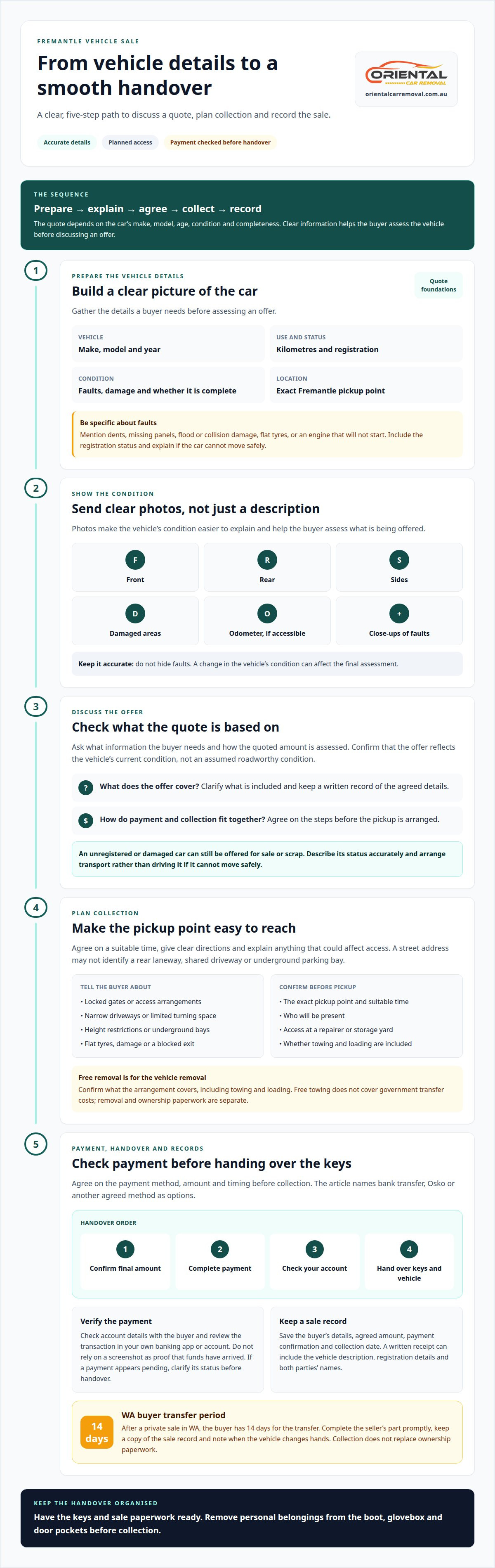
After a private sale in WA, the buyer has 14 days for the transfer. Keep the sale details and complete the seller’s part of the transfer process promptly. The collection itself does not replace ownership paperwork.

Free car removal is useful for an unwanted, damaged or non-running vehicle, but collection still needs planning. Clear access, accurate vehicle details and an agreed handover help the pickup run smoothly. For local collection information, see car removal in Fremantle.

How to get a quote and arrange collection

Start with the vehicle’s basic details: make, model, year, kilometres, registration status and location in Fremantle. Describe damage clearly, including dents, missing panels, flood damage or an engine that won’t start. Mention if the car is complete. Accurate information gives the buyer a clearer picture before discussing an offer.

Photos can make those details easier to explain. Take clear images of the front, rear, sides, dashboard and damaged areas. Include the odometer if it’s accessible. A close-up of a damaged door, for example, is more useful than describing it only as “bad condition”. Don’t hide faults, as changes in the vehicle’s condition can affect the final assessment.

When discussing a quote, ask what information the buyer needs and how the quoted amount is assessed. Clarify whether the offer reflects the vehicle’s current condition, rather than an assumed roadworthy condition. Ask how the payment and collection steps fit together, and keep a written record of the agreed details. The amount depends on the car’s make, model, age, condition and completeness; it’s provided after a quote request.

An unregistered or damaged car can still be offered for sale or scrap in Fremantle. Describe its condition and registration status accurately, then arrange transport rather than driving it. For example, explain if collision damage means it can’t move safely or if it won’t start.

Once you’ve discussed the quote, organise collection with the buyer. Give the pickup address and explain access, such as a shared driveway, locked gate or underground bay. Agree on a suitable time and who will be present. If the car is at a repairer or storage yard, arrange site access before setting the pickup.

  1. Gather the vehicle details and note any faults.
  2. Send clear photos, including close-ups of damage.
  3. Discuss the offer and clarify what it covers.
  4. Agree on a collection time and accessible pickup point.
  5. Have the keys and sale paperwork ready for handover.

Before collection, remove personal belongings and check the boot, glovebox and door pockets. Keep the keys, paperwork and any agreed sale record together. If you need local information for arranging a pickup, see Fremantle car removal details.

Payment method and timing

Agree on the payment method before handing over the vehicle. Confirm whether payment will be made by bank transfer, Osko or another agreed method. Check the amount, recipient details and when payment is due in the collection process. A written message recording these terms can prevent confusion at pickup.

For an electronic transfer, provide your account details directly and check each character before sending them. Confirm the account name and payment reference with the buyer. If a digit in your account number is wrong, for example, the transfer may not reach the intended account. Don’t rely on a screenshot as proof that funds have arrived.

Osko may be offered as a payment method. Before accepting it, confirm the payment amount and your account details with the buyer. Check the transaction status in your own banking app or account. If payment appears pending, clarify the status before handing over the keys or vehicle.

Timing depends on the agreed payment method and collection arrangements. Set a clear sequence: confirm the final amount, complete payment, check your account, then hand over the vehicle and keys. For a collection at your Fremantle home, have your phone and banking app ready to review the transaction at handover.

Keep a record of the sale. Save the buyer’s details, agreed amount, payment confirmation and collection date together. A written receipt can include the vehicle description, registration details and both parties’ names. Make sure it shows the amount actually agreed, not an earlier quote that changed after the vehicle was assessed.

  • Confirm the payment method and amount before collection.
  • Check account details directly with the buyer.
  • Review the transaction in your own banking app.
  • Keep the payment record and sale receipt.
  • Hand over the keys after payment is visible in your account.

If the vehicle’s condition differs from the details used for the quote, discuss any change before collection. Mention newly noticed damage or missing components, for example. Agree on the final amount and payment method again, then keep the updated terms in writing. Clear communication helps both parties follow the same steps.

In a private sale, treat payment and ownership paperwork as separate tasks. Keep the transfer record with the receipt and payment evidence. If the buyer says they’ve sent the funds, verify the status yourself before handover. A clear payment sequence records what was agreed and when the vehicle left your possession.

Sell My Car in Fremantle: Find Out How Much You Could Get

Selling cars in Fremantle for cash

A cash offer gives Fremantle sellers a direct way to sell without finding a private buyer. First decide whether you prefer a private sale, dealer trade-in or cash-for-cars sale. Each route involves different steps: with a private sale, you manage enquiries and handover; a dealer may assess the car as part of a trade-in; a cash buyer can quote based on the vehicle’s details and condition.

For a private sale, prepare an accurate description, set an asking price and organise inspections with potential buyers. For a dealer, provide the vehicle details and ask how its condition affects the offer. For a cash sale, describe the car honestly, including damage, missing parts or registration status. Compare the process and the final amount, not just the first offer.

Cash offers for cars in Fremantle depend on factors such as make, model, age, condition and completeness. A working hatchback and a damaged four-wheel drive have different assessment details. Share relevant information before accepting an offer. If the vehicle’s condition changes or an inspection reveals an issue, discuss the revised terms before proceeding. The price depends on the vehicle and is provided after a quote request.

For a private sale, clear photos and a precise description help buyers understand what’s being offered. For a dealer sale, bring the keys and available vehicle documents to the assessment. Either way, record the agreed amount and sale details. Don’t hand over the car based only on a verbal promise of payment.

A roadworthy inspection or service isn’t automatically needed before every WA sale. Weigh the vehicle’s condition and likely buyer expectations against the cost and effort of pre-sale work. For example, document a known fault accurately instead of paying for repairs without considering whether they could benefit the sale.

For a cash offer in Fremantle, ask how payment is made and whether pickup can be arranged for your preferred day. Instant payment and same-day collection are separate: confirm both before agreeing to handover. Same-day pickup is subject to address, vehicle and logistics, and is not guaranteed.

  • Choose the sale route that fits your time and vehicle.
  • Give buyers accurate details about condition and completeness.
  • Compare the final offer and the handover process.
  • Record the agreed terms before releasing the vehicle.

For a Fremantle seller, the clearest choice comes from matching the car’s condition to the sale method. A private listing suits someone ready to manage enquiries. A dealer assessment may suit someone considering a trade-in. A cash buyer offers another route for a vehicle that needs a direct sale.

Service areas around Fremantle

The pickup address matters as much as the suburb. Fremantle’s busy streets, residential blocks and industrial locations can all present different access conditions. Give the full street address, suburb, postcode and entry instructions when arranging collection. This helps distinguish a home pickup from a vehicle at a business or workshop.

Nearby suburbs also matter when planning collection. A vehicle in East Fremantle, North Fremantle, Beaconsfield or Hamilton Hill has a different pickup address from one in central Fremantle. State the suburb clearly rather than assuming “near Fremantle” is specific enough. A precise address helps identify the vehicle’s location and plan the route.

Access details are useful across Fremantle’s varied streets. Mention a narrow laneway, shared driveway, locked gate or underground car park before setting a time. A tow truck may need different instructions for a vehicle behind a gated apartment complex than for one in an open driveway. Include height limits and contact arrangements for secured sites.

If a car is outside Fremantle, provide its exact location before discussing collection. A vehicle in Cockburn or Rockingham shouldn’t be described simply as “nearby”. Distance and access conditions affect practical pickup planning. Clear details also distinguish the suburb where you live from the place where the car is waiting.

Use this checklist when giving a collection address:

  • Write the full street address and suburb.
  • Identify whether the vehicle is at a home, workshop or business.
  • Describe gates, access codes, parking levels or tight turns.
  • Explain if the car is behind another vehicle or obstructed.
  • Provide a contact name for access at the pickup point.

If you live in Fremantle but the car is at a repairer in Hamilton Hill, for example, give the repairer’s address as the collection point. For a vehicle in an apartment basement, include the entrance and clearance details. These facts help match the collection plan to the actual site.

A service area can cover a broad region, but collection planning depends on the exact pickup location. Treat Fremantle, East Fremantle and North Fremantle as distinct addresses when arranging handover. Share any change of location early, especially if the car moves from a home to a workshop before collection.

Arrange a Fremantle vehicle collection

Oriental Car Removal: Cash for Cars

Oriental Car Removal buys unwanted vehicles for cash from owners in Fremantle and arranges free removal. It purchases cars that are damaged, unregistered or no longer running. The vehicle’s details and condition help determine the quote.

It also buys trucks, 4WDs and vans. Share the vehicle’s make, model, condition and pickup location when requesting a quote, then discuss collection and payment arrangements.

This option suits you if you want to sell a car without organising a private listing or separate towing. It can also help when a vehicle is difficult to move. Contact Oriental Car Removal to discuss your car and arrange the next step.

Choose the next step that suits your plans

Before moving ahead, decide what matters most: a convenient handover, control over buyer discussions or time to manage a private sale. That priority can guide your choice and keep the process focused. If you’re ready to sell your car in Fremantle, prepare to describe the vehicle honestly and make a clear decision about the offer and arrangements.

You don’t need to settle every detail at once. Start with the option that feels practical, then take the next step when you’re ready. A direct conversation with Oriental Car Removal can help you understand how to proceed with your vehicle.

Take it one step at a time. With a clear decision, you can move forward with confidence and make space for what comes next.

Frequently Asked Questions

How much can you get for your car in Fremantle?

The amount depends on the vehicle’s make, model, age, condition and completeness. A car with missing components or significant damage may be assessed differently from a complete vehicle in working order. Share accurate details when requesting a quote, including faults that may not show in photos. This helps the buyer assess the actual vehicle rather than assume its condition.

Where can I sell my car in Fremantle, WA?

You can sell privately, approach a dealer or request a cash-for-cars quote from a buyer serving Fremantle. The right route depends on whether you want to manage enquiries, trade the car towards another vehicle or arrange a direct sale. If the car is away from home, use its actual location when discussing the sale and collection.

How much is my used car worth in Fremantle?

Your used car’s value is assessed from its specific details, not the suburb alone. Make, model, age, condition and whether key components are present all influence an offer. Two cars of the same model may be assessed differently if one has accident damage or missing parts. Provide an accurate description and request a quote for your vehicle.

What paperwork is required to sell a car in Western Australia?

Keep a written sale record and complete the seller’s part of the ownership-transfer process promptly. The buyer has 14 days for the transfer.

What fees or transfer costs apply when selling a car in WA?

Any applicable transfer charge is separate from towing. In a private sale, agree with the buyer who will handle it.

Cash for Cars Success: Selling a Written-Off Vehicle

Cash for Cars Success: Selling a Written-Off Vehicle

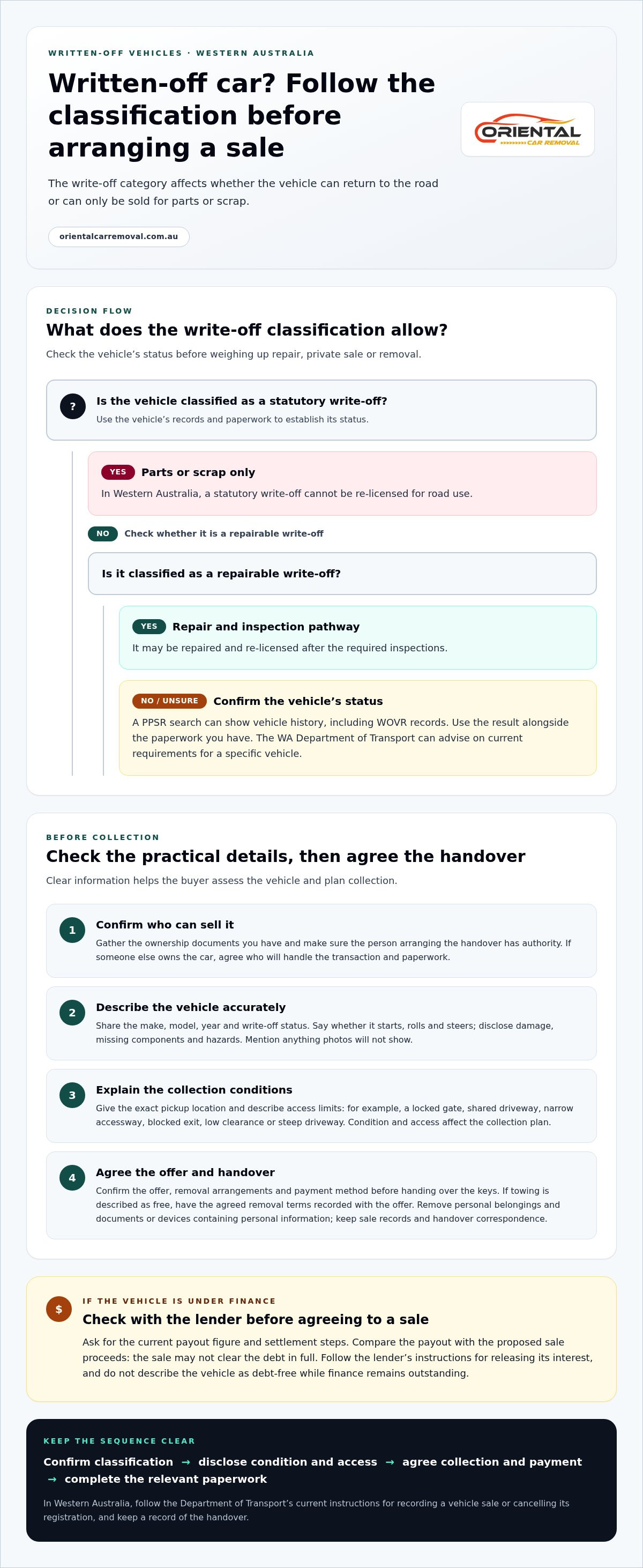
Cash for cars in Success can be an option for a written-off vehicle, but its classification affects what can happen next. In Western Australia, a statutory write-off can only be sold for parts or scrap and can’t be re-licensed for road use. A repairable write-off may be repaired and re-licensed after required inspections.

It’s understandable to want a clear answer before arranging a sale, especially if the car is damaged or hard to move. This guide explains what to prepare and how removal compares with a private sale, including paperwork and payment. If you’re considering cash for cars in Success, these practical steps can help you decide what to do next.

Why Choose Oriental Car Removal

  • A written-off vehicle may be sold, but its classification affects whether it can return to the road or be sold only for parts or scrap.
  • Before arranging collection, gather available ownership documents and explain access issues such as a narrow entrance or blocked driveway.
  • Describe whether the vehicle starts, rolls or steers, and disclose known damage, missing parts and hazards when requesting an offer.
  • Before handover, remove personal belongings and information-bearing documents or devices, then confirm the offer, removal details and payment method.
  • Compare removal with a private sale by considering the vehicle’s condition, collection logistics and the paperwork involved.

1. Can I sell a written-off car for cash in Success?

Yes, a written-off car in Success may still be sold for cash, but its write-off classification affects what can happen next. In Western Australia, a statutory write-off can only be sold for parts or scrap and cannot be re-licensed for road use. A repairable write-off may be repaired and re-licensed after the required inspections. Identify the vehicle’s status before arranging a sale, as each category has a different outcome.

A PPSR search can show vehicle history, including WOVR records. Use the result alongside the paperwork you already have, rather than assuming a damaged car has a particular classification. The WA Department of Transport can advise on current requirements for a specific vehicle. This information matters when weighing a private sale against removal or deciding whether repairs are worth pursuing.

Before arranging collection, establish who is authorised to sell the vehicle. Gather the ownership documents you have and make sure the person arranging the handover has authority to do so. If someone else owns the car, agree on who will handle the transaction and paperwork. Clear ownership information helps the buyer arrange collection smoothly.

Access can shape the collection plan as much as visible damage. Tell the buyer if the car is behind a locked gate, in a shared driveway or on a narrow accessway. Mention a second vehicle blocking the exit, low clearance or a steep driveway. For example, a car that rolls but cannot turn through a tight entrance needs a different collection plan from one parked at the kerb.

Describe the vehicle’s condition plainly. Say whether it starts, rolls and steers, then disclose known damage, missing components and hazards. A flat tyre, broken steering or sharp body damage can affect loading arrangements. Don’t rely on photos alone if an important access obstacle or safety issue won’t be visible. Clear details help set practical expectations for collection.

Collection timing and coverage for a Success address depend on the vehicle’s condition, access and agreed arrangements. Set out the exact pickup location and any access limits when discussing timing. If towing is described as free, have the agreed removal terms recorded with the offer, so collection costs aren’t confused with the vehicle payment. The scrap car removal option is relevant when a written-off vehicle is destined for scrap rather than road use.

2. Selling a written-off vehicle for removal

Removal can be a practical option when damage makes a private sale difficult. In Western Australia, a statutory write-off can only be sold for parts or scrap and cannot be re-licensed for road use. A repairable write-off has a different pathway, subject to repairs and required inspections. The classification helps establish whether the vehicle is being sold for road use, parts or scrap.

A vehicle assessment does not guarantee an offer. Share the make, model, year and write-off status, then describe the damage accurately. Explain whether it starts, rolls and steers. Include missing components and any hazards that could affect loading. If the car is partly dismantled, describe what remains rather than relying on its original specifications.

Agree on the practical details before collection. Give the exact pickup location and explain access limits, such as a blocked driveway or restricted vehicle movement. Confirm the offer, removal arrangements and payment method with the buyer before handing over the keys. Remove personal belongings and documents or devices containing personal information. Keep your sale records and handover correspondence.

For a vehicle under finance, contact the lender before agreeing to a sale. Ask for the current payout figure and the steps for settling the loan. Compare that amount with the proposed sale proceeds, as the sale may not clear the debt in full. Follow the lender’s instructions for releasing its interest, and don’t describe the vehicle as debt-free while finance remains outstanding.

In Australia, transfer and registration procedures vary by state. In Western Australia, follow the Department of Transport’s current instructions for recording a vehicle sale or cancelling its registration, and keep a record of the handover. The WA Department of Transport is the relevant point of contact for advice about a specific vehicle’s requirements.

Keep the transaction in a clear sequence: disclose the vehicle’s status, provide accurate condition details, agree on collection and payment, then complete the relevant paperwork. A written-off vehicle may be assessed for removal, but its classification, condition and collection circumstances all matter. If the vehicle is destined for scrap, scrap car removal is one relevant option to consider for the next step.

Oriental Car Removal notes that statutory write-off vehicles cannot be re-registered once classified as statutory write-offs, so confirm the classification before discussing a removal or parts sale.

Vehicle makes, models and conditions accepted

Acceptance depends on the vehicle’s details, condition and intended use. Give the buyer the make, model, year and vehicle type. A small hatchback, commercial ute and four-wheel drive can have different parts, weight and recovery needs. Describe the exact vehicle rather than assuming every make or model will be accepted.

Condition matters just as much as the badge. Explain whether the vehicle starts, rolls and steers. Disclose accident damage, missing components, flat tyres and known hazards. For example, a car that won’t steer may need different loading arrangements from one that drives but has body damage. A clear description helps assess the vehicle and plan collection. Photos can show visible damage, but mention anything they don’t capture.

Buyers may assess vehicles beyond standard passenger cars. Describe whether you have a truck, 4WD, van or ute, and note its condition. If a vehicle is written off, explain its classification and whether it is being sold for parts or scrap. That classification affects the sale pathway.

How does a cash-for-cars buyer compare with a wrecker in Australia? The names alone don’t determine the outcome. Compare the proposed offer, accepted vehicle condition, collection arrangements and payment method. A wrecker may assess a vehicle for parts or scrap, while a buyer’s assessment can depend on its condition and intended destination. Provide the same vehicle details to each buyer for a clearer comparison.

Before accepting an offer, get clear answers about the transaction. Ask what vehicle details informed the offer, whether the amount depends on an inspection, and what happens if its condition differs from your description. Confirm who arranges collection, whether any removal cost applies, and how payment will be made. Agree on these points before handing over the vehicle.

  • Does the offer account for the disclosed damage and missing parts?
  • Is collection included in the agreed arrangement?
  • When and how will payment be made?

Is a particular buyer licensed, reputable and well reviewed? Those points are specific to each business, so a name or offer alone doesn’t establish them. Check relevant licence and insurance details, then read reviews for recurring comments about communication, collection and payment. Treat specific claims as things to verify, not assumptions.

Prepare the details once: vehicle identity, condition, write-off status and collection needs. That makes it easier to compare like with like, whether you’re selling a damaged hatchback or an unwanted work ute. Keep the agreed offer, removal plan and payment method clear before the handover.

Cash for Cars Success: Selling a Written-Off Vehicle

4. Digital sale paperwork and payment

For a car sale in Australia, gather available ownership documents and records showing who can sell the vehicle. In Western Australia, follow Department of Transport instructions for your circumstances. If finance remains, keep relevant lender correspondence with your sale records.

Digital copies can make records easier to organise. Photograph or scan the documents you already have, then check that names and vehicle details are readable. Keep the originals secure until handover. A digital copy helps you retrieve information, but don’t assume it replaces paperwork required for your transaction.

Match every record to the vehicle being sold. Compare the registration details and vehicle identification information on your documents with the car. If a name differs, or another person is arranging the sale, clarify who has authority to act. Share only the information needed to arrange the transaction, and avoid sending sensitive documents through an insecure channel.

Keep the sale terms in writing, whether they arrive by email, text or paper. Record the agreed offer, vehicle description, collection arrangements and payment method. If the buyer changes the offer after inspecting the car, ask for the revised amount and reason in writing before agreeing. This creates a clear record of what both sides accepted.

Confirm how payment will be made before collection. Ask whether it will be cash or an electronic transfer, and agree when payment is due. For a transfer, check your own account for the funds rather than relying only on a screenshot or payment notification. Keep the transaction record with the sale documents.

Before the vehicle leaves, remove personal items and documents or devices containing personal information. Check the glovebox, centre console, boot and storage compartments. Remove saved navigation addresses or paired-device details where possible. Keep your own copy of the agreed terms, payment record and collection confirmation.

A simple digital folder can hold the vehicle documents, written offer, messages and payment confirmation. Use a clear label, such as the vehicle registration, so you can find the record later. Don’t delete the conversation immediately after collection. If a question arises about the agreed amount or pickup, saved messages show the transaction details.

Make the handover a final check, not a rushed exchange. Confirm the vehicle being collected, the agreed payment method and that your personal belongings are out. Keep the records together after the sale. Clear documents and written terms help you track each step, from accepting the offer through payment and collection.

5. Cash offers for unwanted cars in Success

In Success, cash for cars gives owners a way to seek payment for an unwanted vehicle and arrange collection. You provide the car’s details, describe its condition and review the terms before handover. Start by giving a clear picture of the vehicle before comparing an offer.

An offer reflects more than the badge. Make, model, age, condition and usable components all help shape an assessment. A complete car differs from one missing its engine or wheels. Describe specific faults and missing items rather than calling the vehicle simply “old” or “damaged”.

For example, say whether the engine starts, the car rolls and it steers. Mention accident damage, flat tyres, missing keys or parts, and hazards. If it’s written off, state its classification. This information helps the buyer assess the vehicle’s likely destination, such as parts or scrap, and plan collection.

Compare the whole transaction, not just the cash amount. Ask whether the offer includes free collection, what could change it after inspection and how payment will be made. Confirm the terms before agreeing. A higher initial figure may not suit you if the final terms or collection arrangements don’t fit your situation.

A private sale and a removal sale involve different tasks. A private seller prepares an advert, handles enquiries and coordinates viewings. A removal sale centres on assessing the vehicle, agreeing on payment and arranging collection. If the car won’t start, has extensive damage or is difficult to move, compare how each option handles those practical needs.

What does cash for cars in Success involve? It gives owners a way to seek payment for an unwanted vehicle and arrange its removal. Review the offer and collection terms before handing over the car.

Use a short checklist before accepting: provide accurate vehicle details, disclose damage, confirm the amount, agree on collection and verify the payment method. Keep the written offer and transaction messages. If an inspection changes the offer, ask for revised terms before collection proceeds.

For a fair comparison, give each option the same make, model, condition and access details. Then weigh the proposed payment, removal arrangements and steps required from you. This makes it easier to decide whether cash for cars in Success suits an unwanted car that’s no longer practical to drive or sell privately.

Oriental Car Removal: Cash for Cars

Oriental Car Removal offers Cash for Cars and Free Car Removal for unwanted vehicles. If your written-off car is difficult to sell privately, these services offer a practical next step. Share its classification, condition and collection details so the transaction can be assessed clearly.

The business also offers Cash for Trucks and Cash for 4WDs and Vans. Describe the vehicle accurately, including damage or missing parts, before discussing an offer and removal arrangements. Keep the agreed payment method and collection details clear before handover.

For a written-off vehicle in Success, contact Oriental Car Removal to discuss the vehicle and arrange the next steps.

Choose your next step with confidence

Base your decision on what you need next, not just clearing the driveway. If the vehicle may return to road use, compare that pathway with selling it for removal. For a cash-for-cars sale in Success, start with a clear account of the vehicle and the outcome you want. That keeps the conversation focused on a practical choice, not a rushed handover.

Take time to review the terms and choose a route that suits your circumstances. A written-off car can feel like a complicated problem, but clear priorities make the next move easier to manage. You’re ready to proceed when you understand your options and feel comfortable with your decision.

Take it one step at a time. You can move forward with a choice that feels right for you.

Frequently Asked Questions

Can I sell a written-off car for cash in Success?

Yes, a written-off car in Success can be offered for sale, but its classification matters. A statutory write-off is limited to parts or scrap, while a repairable write-off may have a road-use pathway after repairs and required inspections. Share the classification and vehicle details upfront. If ownership is shared, make sure the person arranging the sale has authority to do so.

Can a statutory write-off be sold for removal in Western Australia?

Yes, a statutory write-off can be sold for parts or scrap in Western Australia, but it cannot be re-licensed for road use. Its classification determines the appropriate sale pathway. A PPSR search can show vehicle history, including WOVR records. Keep that result with your available vehicle documents, and describe the car as a statutory write-off when discussing a removal sale.

Can a written-off car be sold for removal in Success?

Yes, a written-off car in Success can be put forward for a removal assessment. Tell the buyer whether it is classified as statutory or repairable, and whether it has missing parts or major damage. For example, a car without wheels needs different loading arrangements from one that can roll. Give the pickup address and describe any access restrictions clearly.

Does a written-off car need to be running for collection?

A car can be assessed even if it won’t start. State whether it starts, rolls and steers, and mention issues such as a flat tyre or damaged steering. These details help determine how it can be loaded and moved. If the vehicle is stuck behind another car or inside a tight garage, explain that before agreeing on collection arrangements.

How do you decide what to pay?

An offer depends on the vehicle’s details and condition, rather than one standard amount. Make, model, year, damage, missing components and usable parts can all affect its assessment. A complete car and one missing key components present different salvage possibilities. Provide an accurate description and ask for the offer terms in writing before agreeing to collection.

How much is your salvage car worth?

Your salvage car’s value depends on its specific details, condition and what remains usable. For example, a damaged vehicle with intact components differs from one that has been partly dismantled. Share its make, model, year, write-off status and known faults when requesting an assessment. The price depends on the case and is provided after a quote request.

Is there a fee for the tow?

Oriental Car Removal provides Free Car Removal at no charge to the owner. Before collection, make sure the agreed arrangement covers the vehicle and pickup location you described. Tell the buyer about narrow access, blocked driveways or a car that cannot roll. Clear details help avoid confusion about the collection plan and payment at handover.

Private sale or a vehicle removal buyer?

A private sale means preparing an advert, handling enquiries and arranging viewings, while a removal buyer focuses on assessing the vehicle and collection arrangements. A private listing may suit a roadworthy car with time for prospective buyers to inspect it. For a damaged or immobile vehicle, compare the written offer, removal terms and payment method before choosing your preferred route.

How to Value Your Vehicle in Perth: The 2026 Step-by-Step Guide

How to Value Your Vehicle in Perth: The 2026 Step-by-Step Guide

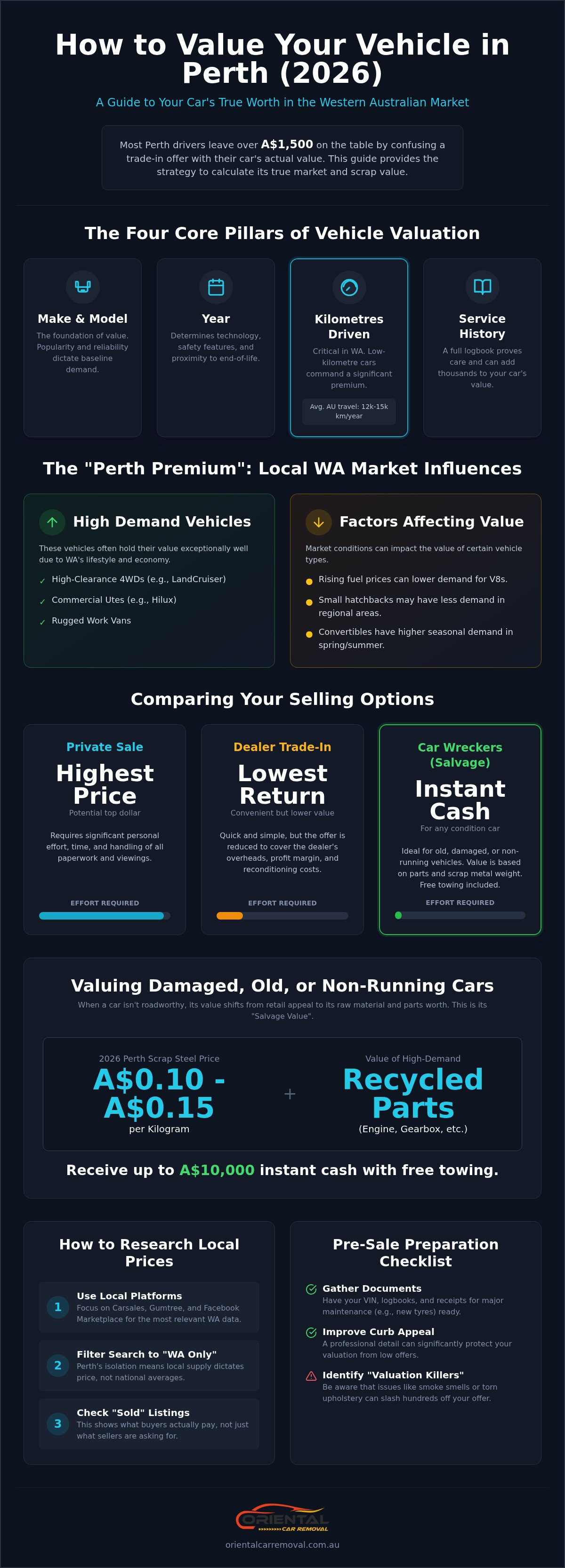
Most Perth drivers leave over A$1,500 on the table because they confuse a dealership’s trade-in offer with their car’s actual worth. It’s a common trap. You spend hours on national websites only to receive a low-ball quote that doesn’t reflect the local Western Australian market. If you want to value your vehicle properly in 2026, you need to look beyond generic data. You need a strategy that accounts for local demand and current salvage rates.

We understand the frustration of trying to find a realistic dollar figure amidst conflicting reports. It feels like a gamble, but it shouldn’t be. This guide gives you the exact process to calculate your car’s true market and scrap value so you never settle for less. We’ll show you how 2026 scrap steel prices, which currently range from A$0.10 to A$0.15 per kg in Perth, impact your local offer. You’ll learn which factors are driving your price up and discover a stress-free way to turn that value into instant cash. We’ll also cover essential 2026 details like DoT transfer fees and the impact of mileage on your final figure.

Why Choose Oriental Car Removal

  • Master the core pillars of vehicle valuation, including why your odometer reading is more critical in the 2026 Perth market than ever before.
  • Learn the specific filters and platforms needed to value your vehicle using real-time Western Australian data rather than national averages.
  • Uncover the formula for calculating salvage value for damaged or old cars based on scrap metal weight and high-demand recycled parts.
  • Follow a simple five-step checklist to prepare your car for a quick sale, from gathering VIN details to identifying minor flaws that affect price.
  • Discover how Oriental Car Removal provides a stress-free path to turn your car’s value into up to A$10,000 instant cash with free towing included.

What Determines Your Vehicle’s Market Value in Perth?

Market value in Western Australia is the estimated price a buyer will pay in the current local climate. When you sit down to value your vehicle, you aren’t just looking at a national average. You are looking at what Perth buyers want today. This figure fluctuates based on supply, demand, and the specific economic conditions of our state.

The foundational car valuation process relies on four core pillars: make, model, year, and the odometer reading. In Australia, the average car travels between 12,000 and 15,000 kilometres per year. If your vehicle sits significantly above this range, expect the market value to drop. Conversely, a low-kilometre car is a prize in the WA second-hand market and can command a significant price bump.

Perth has a unique appetite for specific vehicles. High-clearance 4WDs and commercial Utes often command a “Perth premium” due to our outdoor lifestyle and the massive influence of the mining sector. While a small hatchback might struggle to sell in regional areas, a well-maintained Toyota Hilux or LandCruiser holds its value exceptionally well here. This local demand is a factor that national valuation sites often fail to capture accurately.

You must also distinguish between different valuation types. A private sale usually fetches the highest price but requires the most effort and time. A dealer trade-in is faster but often yields the lowest return because the dealer needs to make a profit on the resale. For vehicles that are damaged, old, or non-running, the salvage or wrecking value becomes the primary metric. Oriental Car Removal specialises in these car wreckers Perth services, focusing on the raw material and part value rather than just the retail appeal.

The Role of Service History and Logbooks

A complete service history can add thousands of dollars to your final valuation. It proves you’ve cared for the car and reduces the risk for the next owner. Missing logbooks create doubt and often lead to lower offers from savvy buyers. If you’ve recently invested in major maintenance, such as a new timing belt or a fresh set of tyres, keep the receipts. These documents act as proof of value that justifies a higher asking price during negotiations. Even for those outside of Perth, using a professional network like My Auto Shop ensures you have the maintenance documentation needed to prove your car’s worth.

Local Market Trends in Western Australia

The WA economy directly impacts car prices. When the mining sector is booming, demand for rugged 4WDs and work vans spikes across the state. Seasonality also plays a role. Convertibles often value higher during a Perth spring than in the middle of a wet winter. Even fuel prices shift the scales. As petrol costs rise, the market value of fuel-efficient small cars often climbs while thirsty V8 SUVs may see a dip in interest.

How to Research and Compare Local Car Prices

To accurately value your vehicle, you must look at what is happening in your own backyard. National averages often lag behind local Perth supply shortages. Start your research on platforms like Carsales, Gumtree, and Facebook Marketplace. These sites dominate the WA market and provide the most relevant data for local sellers.

Always filter your search results to “WA only.” Perth is the most isolated capital city in the world. Shipping a vehicle from the East Coast can cost thousands of dollars, which means local supply dictates our prices. A car that is common in Sydney might be rare in Perth, driving your local valuation higher. Look for “Sold” listings rather than “Asking” prices wherever the platform allows. Asking prices represent what a seller hopes to get, while sold data shows what Perth buyers are actually willing to pay. Use industry tools like RedBook as a baseline. They provide a helpful range, but they don’t account for the specific “Perth premium” on 4WDs or the immediate demand for reliable work utes.

Analysing Private vs Dealer Listings

Private listings represent the “ceiling” of your car’s value. This is the maximum amount you can expect if you are willing to handle the advertising, test drives, and paperwork yourself. Dealer trade-in offers are naturally lower. This gap exists because dealers must account for GST, business overheads, and the cost of reconditioning the vehicle for resale. If you need a quick sale to free up cash, adjusting your expectations toward the trade-in end of the scale is more realistic.

The Importance of Physical Condition

Be objective when you grade your car’s condition. Most owners overestimate their vehicle’s status. An “Excellent” rating is reserved for cars with no visible wear. A “Fair” rating is more common for daily drivers in Perth, accounting for minor shopping centre dings or slight paint fade from the WA sun. Curb appeal matters. Small investments, like a professional detail or fixing a cracked taillight, can significantly protect your valuation. Interior issues like smoke smells or torn upholstery are major valuation killers that can slash hundreds off your final offer. If the research feels overwhelming, you can skip the spreadsheets and sell your car in Perth for an instant, fair offer based on current local data.

Valuing Damaged, Old, or Non-Running Vehicles

If your car is no longer roadworthy, traditional dealerships will likely turn you away. This is where the concept of “Salvage Value” becomes essential. When you value your vehicle for scrap, you aren’t looking at the retail price. You are looking at the sum of its parts and raw materials. In Perth, even a vehicle that hasn’t started in years still holds significant financial worth. You shouldn’t assume a non-runner is worthless just because it won’t pass a pit inspection.

At Oriental Car Removal, we specialise in identifying this hidden value. While a trade-in site might offer nothing for a blown engine or a crushed bumper, we calculate an offer based on the current global demand for recycled metals and high-demand mechanical components. We act as a hassle-fixer for cars that are difficult to sell privately, ensuring you get a fair return regardless of the mechanical condition.

Calculating Scrap Metal Value

Current market rates for metals like steel and aluminium provide the baseline for any junk car valuation. In September 2026, Perth prices for mixed steel typically range from A$0.10 to A$0.15 per kg. This means a standard 1,500 kg sedan has a raw metal value starting around A$150. Heavy vehicles like trucks or large 4WDs often fetch much more due to their significant tare weight. A 2,100 kg SUV, for example, naturally commands a higher scrap price than a small hatchback.

Wreckers distinguish between a “complete” car and a “stripped” shell. A complete vehicle includes the engine, transmission, and catalytic converter, which contains precious metals. If you’ve already removed these parts, the valuation will drop to the basic price for mixed steel. In the current 2026 market, this typically sits between A$100 and A$300 per tonne in the local Perth area. Keeping the car intact is the best way to protect its total salvage value.

Value in Spare Parts

Beyond raw metal, your vehicle’s components can drive the price higher. High-demand brands in Western Australia, particularly Toyota and Nissan, often hold better salvage value. Their parts are constantly needed for repairs in the mining and regional sectors. Components like engines, gearboxes, and undamaged body panels are prized assets that wreckers can refurbish and resell.

Rarity can also work in your favour. If you own an older or less common model, finding replacement parts is difficult for other owners. This makes your “junk” car a goldmine for specialised car wreckers Perth services. We assess these factors to ensure your final offer reflects more than just the weight of the metal. Whether it’s a damaged work ute or a non-running SUV, there is always a way to turn that mechanical failure into a cash injection.

How to Value Your Vehicle in Perth: The 2026 Step-by-Step Guide

5 Steps to Accurately Value Your Vehicle for a Quick Sale

To value your vehicle accurately, you must move beyond guesswork and use a methodical approach. A quick sale depends on a realistic price point that reflects the current Perth market. If you price too high, your car will sit for weeks. Price it too low, and you lose money. Follow these five steps to find the sweet spot.

Step 1: Documenting the Essentials

Start by gathering your vehicle’s Vehicle Identification Number (VIN) and exact build date. This information is usually on the compliance plate in the engine bay or door pillar. You should also perform a PPSR check to confirm there is no outstanding finance. This transparency builds immediate trust with buyers. Trim levels change value significantly; a Toyota LandCruiser Sahara is worth far more than a GXL of the same year. List every aftermarket addition like bull bars, snorkels, or roof racks, as these are highly valued by WA buyers.

Step 2: The “Honest” Condition Report

Conduct a walk-around inspection just like a professional valuer. Check the tyre tread depth and the age of the battery. In Perth, a functioning air conditioning system is a non-negotiable requirement for most buyers. Test every electronic component, from the power windows to the infotainment screen. If the AC is blowing warm air or a window motor is struggling, note it down. You must be honest about these flaws to avoid price haggling later in the process.

Step 3: Getting an Instant Quote

Once you have your report, check local Perth listings for at least three identical models. Subtract the estimated cost of any required repairs or upcoming major services from the average price you find. This gives you a realistic private sale target. However, if you want a guaranteed “floor” price for your car, getting a professional estimate is the fastest solution. Using a service like Cash for cars Perth provides an immediate valuation based on real-time data. To get the most accurate online estimate, take clear photos of the exterior, interior, and any specific damage.

Get an instant cash quote for your vehicle in Perth today

Finally, compare your research with the instant quote. This comparison allows you to decide if the extra effort of a private sale is worth the potential difference in price. Often, the speed and ease of a professional removal service outweigh the stress of managing a private listing.

Turning Value into Cash: The Oriental Car Removal Advantage

Oriental Car Removal simplifies the valuation-to-sale pipeline. You’ve learned how to value your vehicle using local data and scrap metrics. Now you need a reliable way to collect that value without the traditional headaches of the private market. We act as your local hassle-fixer, bridging the gap between a calculated figure and actual cash in your bank account. Our process is designed to be direct, transactional, and highly efficient.

Forget about expensive detailing or mechanical repairs. We buy vehicles exactly as they are, which saves you significant upfront costs and the time-consuming effort of prepping a car for a picky buyer. You don’t need to worry about “tyre-kickers” or no-shows. For premium models, high-demand 4WDs, and commercial trucks, we offer up to A$10,000 instant cash. This is the fastest way to turn an unwanted asset into immediate financial relief.

No-Hassle Removal and Paperwork

We handle the heavy lifting so you don’t have to. Our team manages all necessary DoT paperwork and ownership transfers on your behalf. This ensures that all 2026 transfer requirements are met correctly, protecting you from future liabilities. We provide free car removal from any location, whether it’s your home, your office, or even a mechanical workshop. Choosing a licensed and insured wrecker like Oriental Car Removal is the safest disposal method in Western Australia. It guarantees a transparent transaction and professional service from start to finish.

Serving All of Perth and Beyond

Our mobile team covers the entire Perth metropolitan region and surrounding suburbs. We provide specialised services like Car Removal Rockingham and Joondalup, ensuring no area is out of reach. We bring over 10 years of experience to every valuation, providing a level of local expertise that national sites simply cannot match. Our mobile experts travel to your location to confirm your car’s condition and finalise the payment on the spot. This eliminates the need for you to arrange expensive towing or risk driving an unroadworthy vehicle. It is the most efficient way to turn your car’s value into liquid assets without leaving your driveway.

Ready to Finalise Your Perth Car Sale?

Finding the right price for your car in Western Australia doesn’t have to be a guessing game. By focusing on local Perth demand and current 2026 scrap metal rates, you can accurately value your vehicle and avoid the common traps of low-ball trade-in offers. You now have the tools to distinguish between a retail ceiling and a salvage floor. Whether your car is a high-spec 4WD or a damaged work ute, there is always a buyer ready to pay a fair price.

Oriental Car Removal takes the stress out of the entire process. We accept all makes and models in any condition, from showroom-ready to scrap-ready. We provide free towing across the metropolitan area, covering everywhere from Mandurah to Joondalup. You get instant cash payments on the spot and a professional team that handles all the DoT paperwork for you.

Get an Instant Valuation and Cash Offer Up to A$10,000

Stop letting that unwanted car take up space in your driveway. Turn your vehicle’s value into liquid cash today and enjoy the peace of mind that comes with a fast, professional sale.

Frequently Asked Questions

How do I find the market value of my car for free?

You can find your car’s market value for free by researching local Perth listings on platforms like Gumtree or Facebook Marketplace. Filter your search to Western Australia to ensure the data is relevant to our unique market. For an even faster result, Oriental Car Removal provides a free, no-obligation valuation over the phone or online. This service helps you accurately value your vehicle without the need for paid subscription tools or dealer visits.

Is my car worth more as a trade-in or a private sale?

A private sale typically yields a higher price because you are selling directly to the end user. However, this requires significant time for advertising and meeting buyers. Trade-ins are more convenient but often represent the lowest valuation due to dealer profit margins. Oriental Car Removal offers a superior alternative by providing competitive prices with the speed of a trade-in, ensuring you get a fair deal without the typical marketplace stress.

Does a high odometer reading always mean my car is worth less?

Generally, a high odometer reading reduces a car’s value, but it is not the only factor. In Western Australia, a well-maintained 4WD with 300,000km can still command a premium if it has a full service history. Buyers in Perth often prioritise mechanical reliability over the number on the dash. If you have documented proof of major part replacements, your vehicle will hold its value much better than a neglected low-kilometre alternative.

How much is a non-running or crashed car worth in Perth?

A non-running or crashed car is valued based on its salvage potential and raw scrap metal weight. In the 2026 Perth market, mixed steel prices influence this base figure. While a dealership might offer zero for a vehicle with a blown engine, Oriental Car Removal pays up to $10,000 depending on the make, model, and reusable parts. We specialise in extracting value from vehicles that others consider worthless, providing a fast cash solution for damaged cars.

Do aftermarket modifications like bull bars increase my car’s value?

Do aftermarket modifications like bull bars increase my car’s value?

Yes, specific aftermarket modifications can significantly increase your car’s value in the Perth market. High-quality bull bars, snorkels, and roof racks are in high demand due to the local popularity of off-roading and regional travel. While these additions don’t always return their full original cost, they make your vehicle much more attractive to local buyers. For those who want to boost performance, you can discover ModFilesMarket to find professional chip tuning services that set your vehicle apart. Ensure you mention these extras when you value your vehicle to get the most accurate and highest possible offer.

To prove your vehicle’s value, you should have your registration papers, a complete service logbook, and receipts for any recent major repairs. These documents provide a paper trail of care that justifies a higher price. In Western Australia, you also need a signed Department of Transport (DoT) transfer form to complete a sale. Oriental Car Removal simplifies this process by handling all the necessary ownership paperwork and DoT requirements on your behalf during the sale.

Can I value my car if I have lost the logbooks?

You can still value your car without logbooks, but the offer may be slightly lower. Without a service history, buyers assume the risk of unknown mechanical issues. You can mitigate this by providing recent mechanic invoices or a professional condition report. Oriental Car Removal buys vehicles with or without logbooks. We use our ten years of experience to assess the physical and mechanical state of the car, ensuring you still receive a fair and honest cash offer.

How quickly can I turn my car valuation into cash?

You can turn your valuation into cash instantly when dealing with a professional removal service. While a private sale can take weeks of waiting, Oriental Car Removal offers same-day service across Perth, from Joondalup to Rockingham. Once you accept our offer, we arrive at your location, complete the paperwork, and pay you on the spot. It is the most efficient way to liquidate a vehicle asset without any delays, advertising costs, or hidden fees.

How to Sell a Car with Mechanical Issues in Perth: The 2026 Guide

How to Sell a Car with Mechanical Issues in Perth: The 2026 Guide

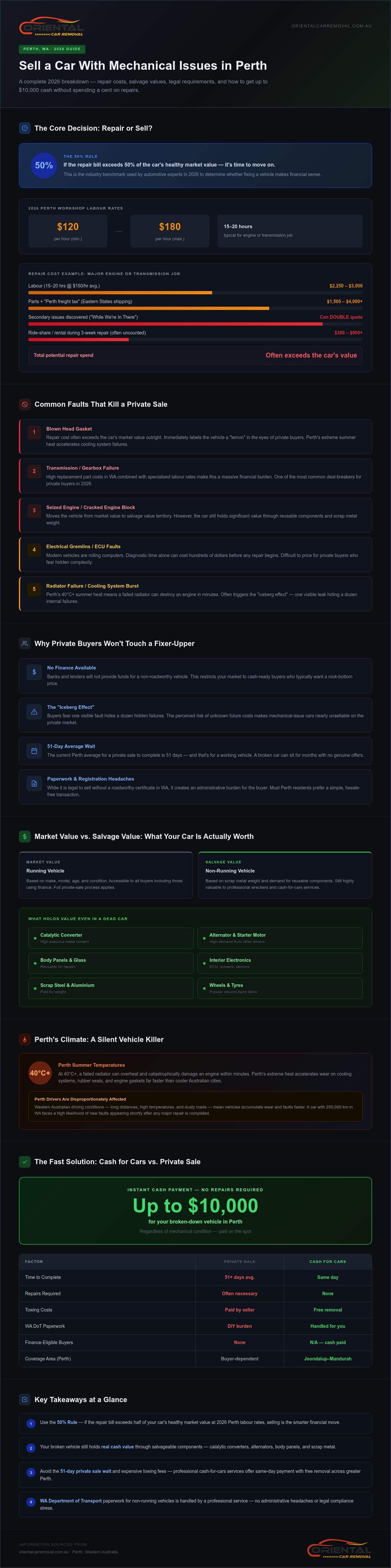
Sinking thousands of dollars into a blown head gasket or a seized transmission just to make your vehicle sellable is often a massive financial trap. In 2026, the rising cost of mechanical labour in Western Australia means that many owners find themselves stuck with a car that costs more to fix than it is actually worth. If you need to sell car with mechanical issues perth, you have likely stared at an eye-watering quote from a local mechanic and wondered if that broken-down ute taking up space in your driveway is worth the headache. It is a stressful situation, especially when you are unsure about the latest WA Department of Transport paperwork for non-running vehicles.

We understand the frustration of a car that won’t start and the pressure of mounting repair bills. This guide promises to show you the most efficient way to turn your broken vehicle into instant cash up to $10,000 without spending a single cent on repairs. You do not have to wait the current 51-day average for a private sale to find a buyer. We will preview the legal disclosure requirements for 2026, explain how to handle your plates, and reveal how to get a fair cash payment on the spot today.

Why Choose Oriental Car Removal

  • Apply the “50% Rule” to determine if repairing your vehicle is a financial win or a costly mistake based on 2026 Perth labour rates.
  • Learn the fastest way to sell car with mechanical issues perth and secure an instant cash payment of up to $10,000.
  • Navigate WA Department of Transport requirements easily by choosing a service that handles the administrative heavy lifting for you.
  • Skip the stress of private listings and expensive towing fees with free car removal available from Joondalup to Mandurah.

Understanding Mechanical Issues and Your Car’s Resale Value

Identifying a major mechanical issue is the first step toward a successful sale. In the automotive industry, these are faults that render a vehicle unsafe or non-functional. Common examples include a seized engine, a slipping transmission, or a cracked engine block. Perth’s harsh climate plays a significant role in these failures. Our scorching summer temperatures often lead to cooling system bursts. When a radiator fails in 40-degree heat, the engine can overheat in minutes; this leads to catastrophic internal damage. If you need to sell car with mechanical issues perth, you are dealing with a vehicle that has transitioned from market value to salvage value.

Market value is what a healthy, running car fetches based on its make and model. Salvage value is different. It is calculated based on the weight of the scrap metal and the demand for reusable components. Your car remains a valuable asset even if it doesn’t start. It contains metals and parts like alternators, starters, or body panels that other Perth drivers need to keep their own cars on the road. We see the potential in every vehicle, regardless of its mechanical state.

Common Faults That Stop a Private Sale

Private buyers usually look for reliability. Certain faults act as immediate deal-breakers. A blown head gasket is a prime example. The repair cost often exceeds the car’s worth, making it a “lemon” in the eyes of a buyer. Many people research what is a lemon car when they realise their purchase has a deep-seated engine fault. Transmission and gearbox failures are equally problematic. The high cost of replacement parts in WA, combined with specialised labour rates, makes these repairs a massive financial burden. Electrical gremlins and ECU faults are often the final straw. Modern cars are rolling computers; when the electronics fail, the diagnostic time alone can cost hundreds of dollars.

Why Traditional Buyers Avoid “Fixer-Uppers”

The risk factor is the biggest hurdle. Private buyers fear hidden costs that might appear after the initial mechanical fault is fixed. They worry about the “iceberg effect” where one visible leak hides a dozen internal failures. Financing is another massive barrier. Most banks and lenders will not provide funds for a vehicle that is not roadworthy. This limits your market to cash-ready buyers who are usually looking for a bottom-dollar bargain. Finally, the registration factor complicates things. While it is legal to sell a car without a roadworthy certificate in WA, it creates an administrative headache for the buyer. Most Perth residents prefer a simple transaction over a project car that requires weeks of mechanical work.

Repair vs. Sell: The 2026 Perth Cost-Benefit Calculation

Deciding whether to fix a broken vehicle or cut your losses is a high-stakes financial choice. Most experts recommend the “50% Rule” as a reliable benchmark. If the estimated repair bill exceeds half of the car’s healthy market value, it is time to move on. In 2026, Perth workshops charge between $120 and $180 per hour for labour. A major engine or transmission job can easily require fifteen to twenty hours of work. When you add the cost of specialised parts, the bill often climbs higher than the vehicle’s actual worth. Stop throwing good money after bad and consider the long-term impact on your bank account.

The high kilometres typical of Western Australian driving also lead to diminishing returns. An older car with 250,000 kilometres on the clock will likely develop a new fault shortly after you fix the current one. You also need to remain compliant with the rules for privately selling a vehicle in WA, which mandate transparency about serious defects. If you choose to sell car with mechanical issues perth, you bypass these legal hurdles and the ongoing repair cycle entirely.

Hidden Costs of Vehicle Repairs in WA

Repairing a car in Perth involves more than just the mechanic’s invoice. Sourcing parts is a major bottleneck. Most components for European or late-model Japanese vehicles are shipped from the Eastern States. This adds a “Perth tax” in the form of high freight costs and significant lead times. You must also avoid the “While We Are in There” trap. Mechanics often discover secondary issues like worn belts or leaking seals once they begin a major teardown. These surprise additions can double your initial quote in a single afternoon. Finally, consider the loss of use. Relying on ride-shares or renting a car while your vehicle sits in a workshop for three weeks is a massive, often uncounted, expense.

Calculating Your Potential Cash Return

Determining the value of a non-runner requires a shift in mindset. Salvage value is the worth of a vehicle based on its remaining functional components and raw materials. Even if the engine is dead, the catalytic converter, body panels, and interior electronics hold significant value for recyclers. If your insurer has already declared your vehicle a total loss, it is worth understanding how to sell a written off car wa owners can navigate legally and profitably before making any decisions. Choosing an immediate cash injection over a growing repair debt provides instant peace of mind. You can get a fast quote and sell car with mechanical issues perth to a professional service that understands the true worth of your vehicle’s parts. This allows you to put that money toward a reliable replacement rather than a bottomless repair pit.

Your Options for Selling a Broken Car in Perth

Choosing the right buyer for a faulty vehicle depends on how much effort you want to invest. You generally have three paths: listing it privately, trading it in at a dealership, or selling it to a professional wrecker. While a healthy car might perform well on the private market, a non-runner changes the dynamic. Dealerships in high-traffic hubs like Osborne Park typically demand “lot-ready” vehicles. If your car has a seized engine or a failed transmission, they have to wholesale it to someone else immediately. Professional car wreckers in Perth operate differently. They see value in individual components and raw materials, which often results in a better offer for a broken vehicle.

Private Sales: The “Tyre Kicker” Headache

Selling a car privately is often a test of patience. You will likely deal with “tyre kickers” who make insulting low-ball offers or fail to show up for scheduled inspections. Listing your car on platforms like Facebook Marketplace or Gumtree requires constant monitoring and message management. There are also significant liability concerns to consider. Even if you are honest about the faults, a buyer might return to complain if a secondary issue appears a week later. You should also stay informed about unlicensed car dealing laws in Western Australia to ensure your sale remains above board. Most private buyers want a vehicle they can drive home, not a project that requires a tilt-tray tow truck.

Dealerships: Why They Usually Say No

Dealerships are built for retail speed. A vehicle with major mechanical issues represents a bottleneck for their service department. Because they cannot sell a broken car on their lot with a warranty, they will offer you a “wholesale price.” This figure is usually the bare minimum, designed to ensure they don’t lose money when they pass the car to a specialist. Towing logistics also complicate the deal. Dealerships rarely offer free pickup for non-runners. You will likely have to pay for a tow truck to get the car to their yard before you even have a firm offer in hand. This upfront cost eats into your potential profit before the deal is even done.

Professional wrecking services offer a far more efficient alternative. They provide an “As-Is” benefit that other buyers cannot match. You don’t need to steam-clean the engine bay, repair the upholstery, or worry about the registration status. When you sell car with mechanical issues perth to a specialist, you are dealing with a buyer who expects the faults. They handle the heavy lifting and the paperwork, allowing you to move on with cash in your pocket and one less problem in your driveway.

How to Sell a Car with Mechanical Issues in Perth: The 2026 Guide

How to Sell Your Non-Running Car in 5 Easy Steps

Selling a vehicle that doesn’t start shouldn’t be a complicated ordeal. By following a methodical process, you can clear your driveway in less than 24 hours. We’ve refined the experience into five straightforward steps to help you sell car with mechanical issues perth without the usual stress. This approach ensures you meet all legal obligations while securing the best possible price for your asset.

  • Step 1: Gather Vehicle Details. Locate your VIN and verify the exact make, model, and year. Be ready to describe the mechanical fault accurately to ensure your quote is firm.
  • Step 2: Get an Instant Quote. Reach out to a local expert to sell car with mechanical issues perth and receive a price offer immediately.
  • Step 3: Prepare for Removal. Clear out all personal items. Don’t forget your E-tags and any paperwork stored in the glove box.
  • Step 4: Handover and Payment. Meet the driver at the agreed time. They will verify the vehicle condition and provide an instant cash payment of up to $10,000.
  • Step 5: Finalise the Paperwork. Complete the necessary WA Department of Transport forms to transfer ownership and end your liability.

WA Legal Requirements and DOT Paperwork

Navigating the administrative side of a car sale is critical for your protection. You must complete a Notice of Disposal form to inform the Department of Transport that you no longer own the vehicle. If the car is being scrapped, you should remove the number plates and return them to a DOT centre. This action allows you to apply for a refund on any remaining registration credit. Handling these steps correctly ensures that the transition of ownership is legally binding and transparent. If your vehicle has been declared a total loss by an insurer, it is also worth reviewing the specific 2026 rules on how to sell a written off car wa regulations require you to follow before disposal.

Preparing Your Vehicle for Removal

A little preparation goes a long way in ensuring a smooth pickup. Check every nook and cranny, including under the seats, inside centre consoles, and throughout the boot. It’s easy to overlook a spare pair of sunglasses or a garage door remote. You should also ensure the tow truck has clear access to the vehicle. Move any obstructions before the driver arrives to allow the tilt-tray to load your car safely. In WA, the seller must lodge a transfer or disposal notice within 7 days to avoid ongoing liability. If you have an older vehicle that has been sitting unused for an extended period, a professional junk car collection perth service can handle the entire removal process, including all the necessary paperwork, without any upfront costs.

car removal

Get Top Cash for Faulty Cars with Oriental Car Removal

Oriental Car Removal is the trusted expert for drivers who need to sell car with mechanical issues perth. We have over 10 years of experience in the Western Australian automotive industry. This local expertise allows us to provide a service that is both professional and incredibly fast. We understand that a broken car is a burden. Our team acts as your dedicated “hassle-fixer,” removing the stress of repair bills and driveway clutter in one simple transaction. You don’t have to worry about the age of your vehicle either. While many buyers ignore pre-2005 models, we buy cars, utes, and 4WDs from any era.

Our “Any Condition” promise is absolute. We accept vehicles with seized engines, blown head gaskets, or total transmission failure. Whether you have a late-model SUV or an old work truck, we see the value in the components and the metal. We provide instant cash payments of up to $10,000 on the spot. You receive a fair price based on the current salvage market without any of the typical haggling found in private sales. Our process is direct, honest, and designed to put money in your pocket today.

Service Areas: From Perth CBD to the Coast

We provide comprehensive coverage across the entire Perth metro area. Our fleet of tow trucks moves daily from Joondalup in the north down to Mandurah in the south. If you need Car Removal Fremantle or help in the southern coastal suburbs, we are just a phone call away. We also maintain a strong presence in northern hubs like Morley and Balcatta. Our drivers are familiar with local industrial centres like Bibra Lake and Cannington, ensuring we can find your location and remove your vehicle without delay. No matter where you are situated in WA, our free towing service remains a core part of the deal.

The Oriental Advantage: More Than Just Scrap

Choosing our Car Wreckers Perth facility means you are opting for a premium recycling service. We don’t just dump your vehicle in a landfill. Our specialised team dismantles every car responsibly, extracting high-quality engine parts and components for reuse. This efficient recycling process is exactly why we can offer higher payouts than standard scrap yards. We maximise the value of every alternator, starter motor, and body panel. Our commitment to the WA community includes a transparent pricing policy with zero hidden fees. The quote we give you is the cash you receive. We handle the heavy lifting, the towing, and the paperwork so you can enjoy total peace of mind.

Turn Your Broken Car into Cash Today

Don’t let a non-runner drain your bank account through endless repair bills or mounting storage fees. You now have the framework to decide between fixing a vehicle or moving on. Remember that the “50% Rule” and high labour rates in WA make selling the most logical choice for many older cars. Choosing to sell car with mechanical issues perth is the fastest way to resolve your vehicle troubles and clear your driveway in one afternoon. You skip the “tyre kicker” headache and the complex dealership trade-in traps.

Oriental Car Removal makes the entire process seamless. As a Licensed WA Motor Vehicle Repairer (MVR), we provide professional service and handle all the Department of Transport paperwork for you. We offer free removal from every Perth suburb and provide instant cash payments of up to $10,000 on the spot. It’s time to stop stressing about your vehicle’s mechanical faults and start planning what you’ll do with the extra cash. Our team is ready to help you move forward without any hidden fees or towing costs.

Get an Instant Cash Quote for Your Broken Car Today

Take the first step toward a hassle-free sale and reclaim your space today. We look forward to providing the relief and professional service you deserve.

Frequently Asked Questions

Can I sell my car in Perth if the engine has completely seized?

Yes, you can sell a car with a completely seized engine to a specialist wrecker immediately. We accept vehicles regardless of the internal engine state, meaning a dead motor won’t stop you from getting a fair price. While private buyers avoid these major faults, we value the car for its remaining parts and scrap metal. You receive an instant cash offer based on the vehicle’s weight and salvageable components rather than its ability to start.

Do I need to pay for the tow truck if my car doesn’t start?

No, you don’t have to pay for towing when you use our service. We provide a complimentary free car removal service across all Perth suburbs for vehicles that are not roadworthy or cannot start. Many owners worry about the high cost of tilt-tray transport, but we handle all logistics at zero cost to you. This ensures you keep the full amount of your cash offer without any deductions for transport or handling.

What paperwork do I need to sell a broken car in Western Australia?

You primarily need your driver’s licence for identification and the vehicle’s proof of ownership to complete the sale. In Western Australia, the most important step is filling out the Notice of Disposal form for the Department of Transport. We assist with all the necessary title documentation on the spot. This ensures the legal transfer is handled correctly, protecting you from any future fines or liabilities once the vehicle leaves your property.

How much cash can I realistically get for a car with a blown head gasket?

The cash amount depends on your car’s make, model, and age, but you can receive an instant payment of up to $10,000. Even with a blown head gasket, your vehicle retains significant value through its body panels, interior parts, and catalytic converter. To sell car with mechanical issues perth effectively, you should get a professional quote that reflects the current market price for recycled auto parts rather than the cost of expensive engine repairs.

Do you buy cars with mechanical issues in Mandurah or Rockingham?

Yes, we provide full coverage for car removal in Mandurah, Rockingham, and all surrounding southern suburbs. Our team travels daily to locations like Port Kennedy, Secret Harbour, and Warnbro to pick up faulty vehicles. Whether your car is stuck in a driveway in Baldivis or a garage in Kwinana, we offer the same fast service and instant cash payments. We make it easy for residents outside the CBD to access professional wrecking services.

What happens to my car after Oriental Car Removal picks it up?

Your vehicle is transported to our licensed wrecking facility for environmentally responsible recycling. We carefully dismantle the car to salvage quality auto parts, such as alternators, starters, and body panels, which help other Perth drivers stay on the road. Any remaining metal is processed as scrap. This methodical approach allows us to extract maximum value from every vehicle, ensuring even a non-runner contributes to a sustainable automotive parts market in Western Australia.

Can I sell a car with mechanical issues if it is currently unregistered?

Yes, you can sell car with mechanical issues perth even if it is currently unregistered or the licence has expired. We regularly purchase cars that have been off the road for months or years. If the car still has number plates, you should remove them and return them to a Department of Transport centre to cancel the registration and claim any potential credit. We handle the pickup and paperwork for unlicensed vehicles, providing a stress-free solution. For vehicles that have been sitting idle for an extended time and accumulated rust or deterioration, our dedicated junk car collection perth service is specifically designed to turn those long-forgotten eyesores into instant cash.

How long does the car removal process take once I accept the quote?

The entire process is designed for speed and often takes less than 24 hours from the moment you accept our quote. We work methodically to arrange a pickup time that suits your schedule, frequently completing the removal on the same day. Our team values your time and ensures the handover is finished in minutes. This efficiency allows you to clear your driveway and receive your cash payment without any unnecessary delays or long waiting periods.