
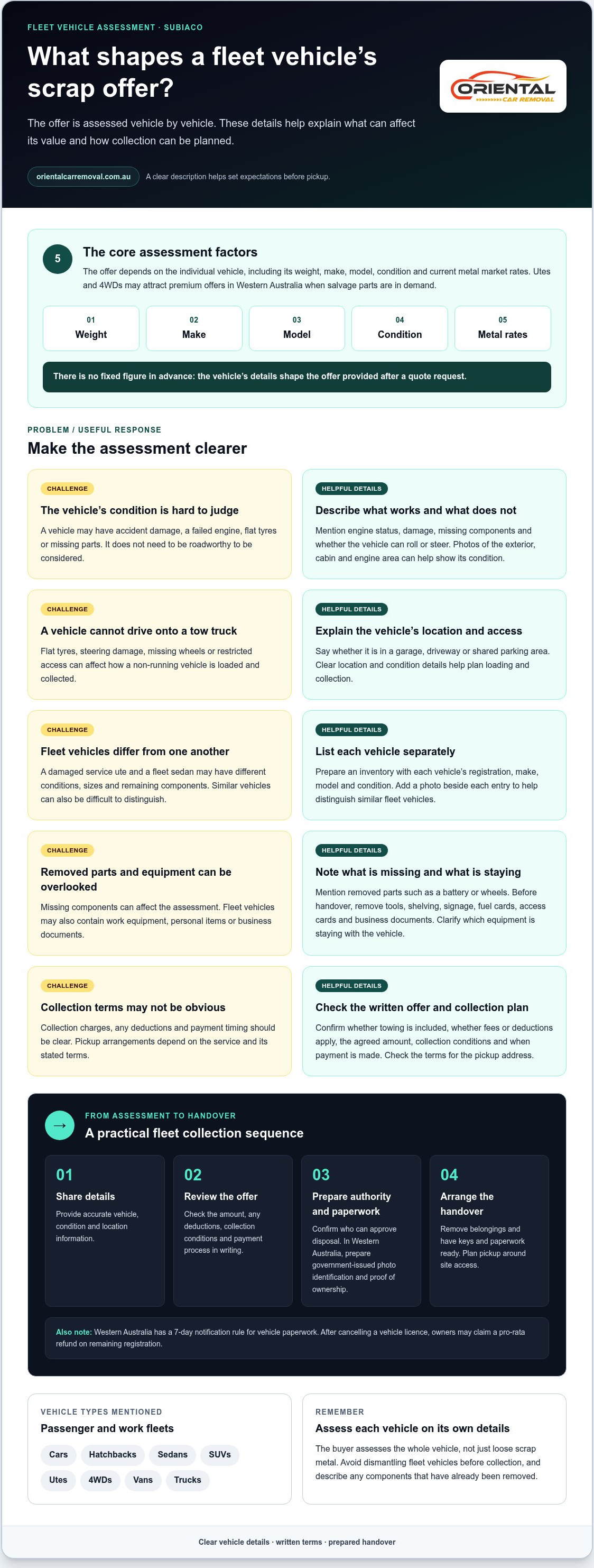
A damaged ute can still carry useful scrap value. For cash for fleet vehicles in Subiaco, the offer depends on the vehicle’s weight, make, model, condition and current metal market rates. Utes and 4WDs can attract premium offers in Western Australia when their salvage parts are in demand.
It’s fair to want a clear idea of what your fleet vehicle is worth before arranging its removal. The value depends on the individual vehicle and is provided after a quote request, with its condition and the factors above shaping the offer. This guide explains which fleet vehicles can be accepted, how scrap offers are assessed, and what to know about free removal and same-day pickup. You’ll also find practical guidance for preparing vehicles and handling the handover, so you can decide on the next step with less guesswork.
Key Takeaways
- Non-running vehicles can still be collected, and free removal can make clearing a fleet vehicle simpler.
- Compare the vehicle’s weight, make, model, condition and missing components to understand what can affect its scrap offer.
- Cars, trucks, 4WDs, vans and utes are among the vehicle types covered, including unwanted fleet vehicles.
- Pickup timing depends on the collection arrangement, so plan the handover around access to the vehicle and site.
- Before disposing of a fleet vehicle, establish who has authority to approve its sale and prepare the ownership details for handover.
Do you offer free car removal for non-running vehicles?
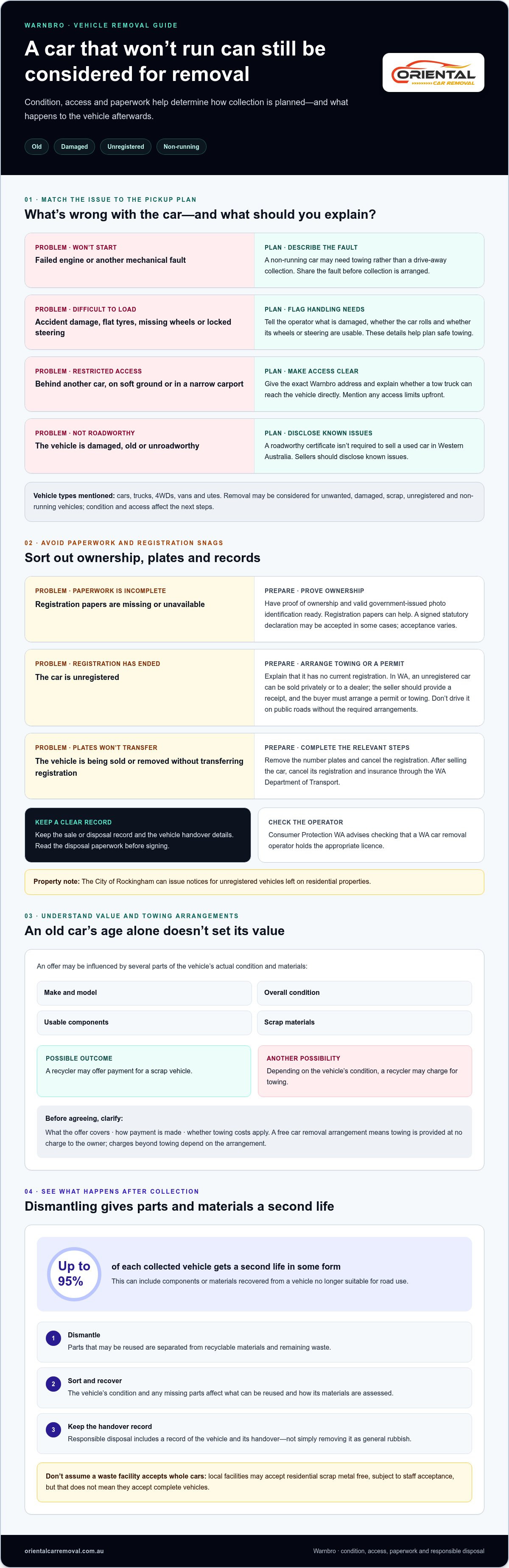
Non-running cars can be collected with free removal. They do not need to start or drive onto a tow truck. When requesting a quote, mention flat tyres, steering damage, missing wheels or restricted access. These details help plan the loading and collection. In Subiaco, describing the vehicle and its location clearly helps Oriental Car Removal assess it and arrange removal.
For a useful quote, share the make, model, approximate age and condition. Add photos of damage and any missing components, then explain whether the car is in a garage, driveway or shared parking area. A vehicle that cannot roll may need different loading arrangements from one with working wheels. Ask for the offer and removal terms in writing, including any deductions and what happens if the condition differs from your description.
Cash offers differ from trade-ins and auctions because they serve different purposes. A trade-in is tied to buying another vehicle, while an auction result depends on bidding and sale terms. Compare the final amount you keep, not just the headline offer, and account for towing, preparation and any sale-related charges.
Before accepting, check whether the written offer includes towing, whether any administration or collection fees apply, and when payment is made. Confirm who can approve disposal of a fleet vehicle, especially if it is leased, financed or company-owned. A friendly conversation is useful, but the written terms should clearly state the agreed amount, collection conditions and payment process.
Prepare the handover paperwork before the truck arrives. In Western Australia, sellers should provide government-issued photo identification and proof of vehicle ownership. The state also has a 7-day notification rule for vehicle paperwork. After cancelling a vehicle licence, owners may claim a pro-rata refund on remaining registration. Remove work equipment, personal items and access cards, then keep a record of the vehicle details and handover.
Subiaco is 4 km from Perth CBD. For a Subiaco collection, free removal means there is no separate collection charge under that arrangement. Nearby coverage and local pickup charges depend on the collection service and its stated terms, so read the quote for the pickup address and any conditions.
Use a straightforward collection sequence: provide accurate vehicle details, review the offer, prepare ownership documents and arrange a pickup time. Before collection, remove belongings and have the keys and paperwork ready. Oriental Car Removal provides free removal for eligible vehicles, making the process practical for a single car or a fleet in Perth.
Accepted vehicle types, including old fleet vehicles
Yes. Oriental Car Removal buys vans, utes, trucks and damaged vehicles, as well as unwanted fleet cars. Age and condition help shape each assessment, so older and non-running vehicles can also be considered. Share the vehicle type, make, model and condition to help the team assess it and plan collection.
Fleet disposals can include passenger cars, work utes, delivery vans, trucks and 4WDs. For example, a business replacing a sedan and a damaged service ute can describe both vehicles together. Provide separate details for each, since their condition, size and remaining components can differ. This gives the buyer a clearer picture of the fleet vehicles being offered.
Make and model details help identify each vehicle. Toyota HiLux, Ford Ranger and Nissan Navara are common ute examples in Western Australia. Provide the exact model and variant if known. For an older fleet car, include its badge, body style and visible damage. Photos of the exterior, cabin and engine area can help show its condition.
A vehicle does not need to be roadworthy to be considered. It may have accident damage, a failed engine, flat tyres or missing parts. Describe its condition accurately, including what is damaged or removed. For a truck with body damage or a van with mechanical faults, note what remains intact and whether it can roll or steer.
Vehicles contain recyclable materials, including steel and aluminium, in their bodies, wheels and other components. Oriental Car Removal assesses the whole vehicle rather than treating it as loose scrap metal. Avoid dismantling fleet vehicles before collection. Mention removed components, such as a battery or wheels, because they can affect the assessment.
Remove work equipment before handover, including tools, shelving, signage, fuel cards and business documents. A fleet van may have fixed storage, while a ute may carry removable toolboxes. Make clear which equipment is staying with the vehicle and which your business is keeping.
For several vehicles, prepare an inventory listing each registration, make, model and condition. Add a photo beside each entry to distinguish similar fleet cars. A clear list also helps an authorised staff member confirm which vehicles the business can dispose of and plan access for collection.
Before arranging removal, match each vehicle’s details to the written offer and collection plan. This is especially useful when damaged vehicles, trucks and passenger cars are being cleared from one site. For practical information about scrap vehicle removal, use the details relevant to the vehicle you’re preparing.
Passenger and light commercial fleet vehicles
In and near Subiaco, vehicle recyclers and car-removal businesses are the usual cash buyers for unwanted fleet vehicles. They may assess passenger cars and light commercial vehicles, including sedans, utes, vans and trucks. Ask whether the buyer handles your vehicle type and collection address before arranging a handover.
Passenger fleets may include sedans, hatchbacks and SUVs used for staff travel or site visits. Light commercial fleets can include delivery vans, work utes and service vehicles. If your business is replacing a damaged van and an older sedan, provide separate details for each. Their conditions and components may differ, so each vehicle is assessed individually.
Oriental Car Removal assesses fleet vehicles individually, considering make, model, condition and components. Include the engine status, accident damage and any missing parts in your description. A fleet manager can list each registration, model and condition in an inventory to keep similar vehicles distinct during the quote process.
Collection can be arranged from a commercial site or residential address within Oriental Car Removal’s service area. At a business depot, identify each vehicle’s parking bay and ensure the tow truck can reach it. For a vehicle at an employee’s home, record the address and arrange access with the person holding the keys. Clear details help the team plan collection.
Commercial vehicle collection also needs site planning. A delivery truck parked behind other vehicles may be harder to access than a ute near the depot entrance. Mention height restrictions, narrow driveways, gates and loading-area access when arranging removal. If several vehicles are being collected, group them in an accessible area where practical.
Removing a whole vehicle differs from collecting loose scrap metal. A fleet vehicle includes its body and remaining components, while detached metal or equipment may need separate handling. Keep tools, shelving and business equipment your organisation intends to retain. Mention any parts already removed, such as wheels or a battery, when describing the vehicle.
Describe a non-running vehicle accurately. State whether its engine starts, whether it rolls, and whether its steering or wheels are damaged. A van with a failed engine but intact wheels, for example, may need different loading arrangements from a collision-damaged ute. Clear information helps Oriental Car Removal plan collection and assess the vehicle fairly.
Before accepting an offer, confirm the vehicle list, collection address, payment method and handover details. The business should also establish who can approve disposal and gather the ownership records. These steps help a fleet manager coordinate vehicles at a depot, office car park or residential address.
Same-day pickup availability
For multiple fleet vehicles, prepare an inventory, receive an offer, then agree on collection and payment arrangements. A Subiaco car removal service can clear a property within 24 hours, while same-day pickup depends on the arranged collection time.
Pickup options
Drop-off may suit a vehicle that can be driven to a site accepting vehicle deliveries. Mobile collection brings a tow truck to your location, which is useful for non-running cars and vehicles parked at a depot. Roll-off containers are for loose scrap and equipment, not intact cars, so keep those materials separate when planning disposal.
For mobile collection, provide the pickup address, vehicle count and access details. Mention a locked gate, narrow driveway or underground car park in Subiaco. This helps Oriental Car Removal plan a safe loading approach. If you are considering drop-off, confirm the receiving site’s process and prepare the ownership paperwork before travelling.
Scheduling and turnaround
Same-day pickup is a timing arrangement, not a fixed promise for every fleet. A Subiaco service can clear a property within 24 hours, but the collection plan still depends on vehicle access, the number of vehicles and the information supplied. Set out those details when arranging a quote.
For a multi-vehicle sale, provide one inventory listing each vehicle’s make, model, condition and location. Oriental Car Removal can review the list, clarify details about damaged or non-running vehicles, and coordinate collection. Ask for the agreed pickup arrangements and payment method to be recorded with the offer.
Keep the collection area accessible. Move cars blocking the tow truck, unlock gates and appoint a staff member to meet the driver. At a Subiaco business site, one contact can identify each vehicle and provide its keys. For residential fleet vehicles, coordinate access with the person holding the vehicle.
Before collection, remove work equipment, personal belongings and company documents. Check each vehicle against the inventory so the correct registration and keys are handed over. If a vehicle cannot roll, explain this when arranging collection. Loading and removal may differ from collection of a driveable car.
Efficient disposal starts with a clear sequence: share vehicle details, review the offer, confirm collection arrangements and prepare the site. A fleet manager can group vehicles near an accessible entrance, as long as this does not disrupt normal site operations. Keep signed handover records with the business’s disposal documents after collection.
If vehicles are at more than one location, list each address and the number of vehicles there. This matters when cars are split between a Subiaco depot and nearby suburbs. Sharing the locations early helps Oriental Car Removal plan collection and lets your business organise staff access.
Scrap value of utes and 4WDs
A ute or 4WD’s scrap offer depends on its weight, make, model and condition. Current metal market rates also affect the assessment. In Western Australia, Toyota HiLux, Ford Ranger and Nissan Navara utes, along with 4WDs, often attract premium offers because salvage parts are in demand. That demand can make a complete vehicle more valuable than one stripped of key components.
Vehicle weight matters because a heavier vehicle contains more recyclable metal. Make and model matter too, since salvage parts demand varies between vehicles. A reliable assessment considers both factors alongside the vehicle’s condition. A heavier 4WD may have a different scrap value from a smaller ute, while a sought-after model may have useful salvage components beyond its metal.
Missing parts can make a substantial difference. Vehicles without critical components such as a catalytic converter, battery or alloy wheels may lose 50% to 100% of their value compared with an intact vehicle. Before requesting an offer, make a list of anything removed or damaged. Include clear photos of the wheels, engine bay and vehicle exterior to help describe its actual state.
Accident damage doesn’t automatically make a ute or 4WD worthless. The extent and location of the damage, remaining components and vehicle weight all shape its assessment. For example, a collision-damaged HiLux with its major components intact differs from one missing its battery and alloy wheels. Describe the accident damage honestly, including whether the vehicle rolls and whether its engine starts.
To understand an offer, share the registration, make, model, condition and any known missing parts. Oriental Car Removal considers each vehicle individually, with condition, weight, make, model and metal market rates affecting its value. The amount is provided after a quote request. Accurate details make the process clearer and help you assess the offer against the vehicle’s actual condition.
Don’t remove components to try to raise a scrap car’s value. A missing catalytic converter, battery or alloy wheels can reduce the offer substantially. Instead, photograph the vehicle as it stands and disclose any parts already removed. For a fleet disposal, record each ute or 4WD separately, because condition and model can vary across the group.
For an instant cash offer, focus on accurate details rather than assumptions about a vehicle’s badge. A Toyota HiLux, Ford Ranger, Nissan Navara or other 4WD may benefit from salvage-parts demand, but its completeness and condition still matter. Clear photos and an honest description give the assessor practical information for a reliable quote.
Oriental Car Removal: Cash for Cars
Oriental Car Removal helps Subiaco businesses dispose of unwanted fleet vehicles through Cash for Cars and Free Car Removal. It also buys trucks, 4WDs and vans, making it a practical option when a fleet includes different vehicle types or conditions.
When you’re ready to clear a vehicle, request an offer from Oriental Car Removal and arrange free collection. Share its make, model, condition and location, then agree on the handover details. For a fleet, describe each vehicle separately so its condition and missing components can be assessed accurately.
Oriental Car Removal also offers Cash for Trucks and Cash for 4WDs and Vans. Contact Oriental Car Removal to discuss your fleet vehicles and collection.
Plan your fleet’s next move
Turn the decision to sell into a clear disposal plan. Identify which vehicles are ready to leave the fleet, who can approve their sale and how the handover fits around daily operations. For cash for fleet vehicles in Subiaco, organised records and a clear decision-maker help keep the process straightforward. When upgrading commercial transport at the same time, organisations sourcing new stock or bespoke modifications can explore global vehicle trading and conversion specialists like Nafaa Cars.
Before proceeding, gather the vehicle details and decide what outcome suits your business. Then share the information with Oriental Car Removal to request an offer and plan collection. This gives your business a practical next step for unwanted fleet vehicles.
When you’re ready, contact Oriental Car Removal with your fleet details to request an offer and organise free removal.
Frequently Asked Questions
How much cash can I get for my scrap car in Subiaco?
Share the make, model and year, and say whether key components remain. Clear photos can show damage or missing parts. For example, mention if the catalytic converter, battery or alloy wheels have been removed. Review the offer for each vehicle before arranging collection.
Do I need to be present when the car is picked up?
Arrange for the seller or an authorised representative to attend the handover. They can identify the vehicle, provide the keys and confirm the correct car is collected. For a company vehicle, choose someone authorised to release it and record the handover against its registration. If access depends on a gate, depot office or parking facility, ensure that person can arrange entry.
Do I need to drain the fuel or oil before you arrive?
No. Don’t drain fuel or oil yourself before collection. Oriental Car Removal handles the vehicle’s de-pollution process. Leave the fluids in place and mention leaks or visible damage when describing the vehicle. For example, point out a damaged fuel tank or oil leak so the collection team can plan safe handling. Remove personal belongings and work equipment separately.
How are funds paid to the seller at settlement?
Oriental Car Removal describes its payment as instant cash. Before handover, match the agreed offer to the vehicle being collected and clarify how payment will be completed. For a business fleet, have the authorised seller record the amount against each vehicle’s registration. Keep that record with the company’s disposal paperwork, particularly if several vehicles are settled during one collection.
How quickly can you pick up an unwanted car?
Same-day pickup is subject to address, vehicle and logistics, and is not guaranteed. Share the car’s location, condition, access restrictions and key availability when arranging collection, and confirm whether same-day pickup is available. A non-running vehicle behind a locked gate may need different planning from a driveable sedan in an open driveway. Agree on a pickup window and ensure someone can provide access when the team arrives.
How quickly can you remove a car from a Subiaco property?
A Subiaco car removal service can clear a property within 24 hours. The collection plan depends on vehicle access and site arrangements. Same-day collection is subject to the address, vehicle and logistics, and isn’t guaranteed. If several cars are parked across different bays, prepare a vehicle list and arrange access to each area. Having a staff contact on site can help identify each car.
What types and sizes of fleet vehicles do Subiaco buyers accept?
Fleet buyers in Subiaco may accept cars, utes, vans, trucks and 4WDs, including damaged or unwanted vehicles. Give the buyer each vehicle’s type, make, model and condition. For larger vehicles, include their location and any access limits, such as a low garage or narrow driveway. A fleet inventory helps distinguish similar vehicles and organise collection across a depot or several addresses.
How much can businesses get for fleet vehicles in Subiaco, and what affects the offer?
For cash for fleet vehicles in Subiaco, Oriental Car Removal assesses each vehicle individually rather than setting one amount for the whole fleet. Weight, make, model, condition, salvage-parts demand and current metal rates can affect value. A damaged ute and a complete passenger car may receive different assessments. Provide a separate description and photos for each vehicle so the offer reflects its condition and components.