Car Salvage Yard Services for Vehicle Sourcing and Recycling

A busy yard isn’t automatically a successful one. Car salvage yard success comes from sourcing suitable vehicles, assessing reusable parts, and managing dismantling, recycling and sales efficiently. In Australia, salvage yards may acquire insurer write-offs or end-of-life vehicles from owners who decide repairs aren’t worthwhile.

Success takes more than finding vehicles. Assess each one, record its details and handle reusable parts carefully. A clear process helps the yard decide what to recover and how to manage the remaining materials.

This guide explains how vehicle purchasing and recycling work, what shapes a yard’s day-to-day performance, and where operators can find opportunities to grow. You’ll also see how owners in Perth can move an unwanted car, truck, 4WD or van into the recycling process without managing the removal themselves.

Accident Car Removal in Perth: Fast Cash with Oriental Car Removal

  • Assess each vehicle’s ownership details, condition and potential for reuse before deciding how to process it.
  • Improve yard performance by tracking inventory, controlling operating costs and reviewing how work moves through the yard.
  • Plan for licensing and environmental obligations by identifying the rules that apply to the yard’s location and activities.
  • Prioritise parts based on condition, demand and the effort needed to inspect, store and sell them.
  • Make online listings easier for buyers to use with clear vehicle details, accurate part descriptions and organised stock records.

Used vehicle purchasing and recycling

How do vehicle write-off and end-of-life car rules differ across Australian states and territories? Write-off status and end-of-life disposal are separate issues, and state or territory rules determine the relevant paperwork and waste duties. In Victoria, the EPA Protection Act 2017 placed obligations on owners of statutory and repairable written-off vehicles to dispose of their industrial waste at a lawful place, effective 1 July 2021.

At intake, record the vehicle’s ownership, title and registration details before accepting it. Then document its make, model and condition in the inventory system. This gives staff a clear starting point for deciding whether to dismantle it, recover reusable components or send the shell for metal recycling. If the yard purchases vehicles as-is and where-is, arrange towing as part of the acquisition process.

Recycling starts with safe fluid handling. Drain and store fuel, oil, coolant and other vehicle fluids for recycling or safe disposal. Then inspect the engine, gearbox, doors, lights and other components for damage and reuse potential. Professional wreckers clean and inspect recovered parts before resale. Buyers can assess each item for rust, cracks or worn edges before purchase.

A U-Pull yard lets customers remove parts themselves; a full-service yard has staff remove them for a fee. Both approaches require clear stock records and safe work practices. Reusing serviceable parts also reduces the resources needed to manufacture replacements.

After removing usable components, separate ferrous and non-ferrous metals from vehicle shells. These materials can go to steel mills or metal recyclers. Keep scrap metal separate from mixed waste, and send fluids and other hazardous materials through appropriate recycling or disposal processes. This makes the final end-of-life stage easier to manage.

A recycler network can help yards direct different materials to suitable recovery channels. For example, a regional yard could coordinate with metal recyclers for shells and specialist processors for fluids. Shared vehicle descriptions and condition records also clarify transfers. A consistent intake checklist helps each partner understand what has been inspected, removed or drained.

For a yard, car salvage yard success depends on treating purchasing and recycling as one controlled workflow. Verify vehicle details, assess reusable components, record inventory, handle fluids safely and separate metals. Each step supports sound decisions and responsible end-of-life vehicle processing.

Industry growth opportunities

Growth starts with making better use of the vehicles and staff already on site. Track which models attract enquiries, which auto parts sell and which stock takes up space without moving. Compare inventory records with completed sales regularly, then use the results to guide future vehicle purchases and dismantling priorities.

A documented yard turnaround shows why workflow matters. The business had eight employees, then reduced to five about four weeks after systems were installed and the yard was cleaned up. After pay for performance was introduced, one salesman left, and the yard operated with four employees within two weeks. This example shows how clear roles and organised processes can affect staffing needs, but it doesn’t prove the same structure suits every yard.

Build on that lesson by reviewing each work stage. Record who handles vehicle intake, inspection, dismantling, cleaning, listing and dispatch. Then identify recurring delays, such as unlabelled components or parts waiting for inspection. Assign responsibility for each step and set a routine for updating inventory. Clear records help car wreckers find stock without searching through the yard.

Online demand can create another growth path. Useful listings identify the part, vehicle make and model, condition, and any visible wear. Add clear photos and update the listing when the part sells. For an engine, for example, describe the item accurately and record its condition rather than relying on a broad “used auto parts” label. Specific details help customers judge whether a listing suits their needs.

Trust also supports repeat business. If a yard offers a warranty on selected car parts, state its terms clearly beside the listing and keep a record of the sale. Don’t imply that every part has identical coverage. Consistent descriptions and straightforward policies reduce confusion and help staff handle enquiries efficiently.

Consider growth beyond the yard’s immediate area, too. A recycler network can provide routes for suitable vehicles, reusable components and scrap materials. Before pursuing a new channel, compare its handling requirements with the yard’s capacity, transport arrangements and stock records. Networks work best when partners receive reliable descriptions and know what has already been inspected.

For car salvage yard success, test improvements in stages. Choose one bottleneck, such as slow parts identification, and introduce a simple tracking process. Review its effect on staff time, stock accuracy and completed sales before expanding the change. The turnaround above moved from eight employees to five, then four. Treat it as a specific example, not a universal staffing target.

What licences and permits are required to operate a car salvage yard in Australia?

There isn’t one permit checklist that fits every Australian salvage yard. The approvals to investigate depend on the site’s location and planned activities. A yard that only stores vehicles has a different operating profile from one that dismantles cars, handles fluids and processes scrap metal. Start by describing each activity, then match it to the relevant local council and state or territory agencies.

Use this sequence to map the approval pathway before committing to a site:

  1. Describe the operation. List vehicle storage, dismantling, parts handling, fluid removal, scrap-metal processing and customer access. Note which activities happen indoors or outdoors.
  2. Check the proposed land use. Give the local council the site address and activity list. Ask how the intended use fits local planning controls, and whether a planning approval or other council permit applies.
  3. Map environmental impacts. Identify likely noise, drainage, waste, fluid storage and emissions concerns. Discuss the actual processes with the state or territory environmental regulator to establish which approvals apply.
  4. Separate vehicle and business processes. Record how vehicles enter the yard, how ownership details are checked, and how waste and recovered materials leave. Then identify any separate registrations or permissions relevant to those activities.
  5. Keep written records. Store council responses, regulator decisions, site plans and operating procedures together. Update the file when the yard adds a new process, such as dismantling trucks or storing fluids.

Environmental duties can be specific to a jurisdiction and vehicle status. According to Victoria’s EPA, the EPA Protection Act 2017 placed obligations on owners of statutory and repairable written-off vehicles to dispose of their industrial waste at a lawful place, effective 1 July 2021. That Victoria-specific rule illustrates why a national operating plan must account for local requirements.

Build the approval file around the yard’s actual workflow. For example, a site that drains fluids needs to explain how it collects and stores them. A yard that separates vehicle shells for scrap metal should describe that process clearly. These details help authorities assess the proposed work rather than relying on a broad label such as “car salvage”.

Before opening, compare every approval with the final site layout and operating plan. Changes to vehicle types, dismantling practices or waste handling can affect the questions authorities need answered. Keep dated records of approvals and correspondence, and assign a staff member to maintain them. This gives the operator a practical basis for managing compliance as the yard develops.

Imlachs operated a 9-acre self-service auto recycling facility. The recycling yard’s salvage sales increased to $25,000 in the first month after the operational changes. A successful recycling yard operator cited by the consultant sold $60,000 per month with three employees and made well over $100k per year.

Which car parts are most profitable to salvage and sell?

There’s no universal list of the most profitable parts. A component’s return depends on its condition, demand, removal effort, storage needs and time to sell. Compare expected sale value with the work required to recover, inspect, clean, store and list each item. Even a sought-after engine can be a poor choice if damage makes its condition difficult to assess.

Start with parts that can be identified clearly and matched to specific vehicle models. Engines, gearboxes, alternators, doors, headlights, mirrors and wheels are practical candidates to assess. Their value to a yard depends on whether each component is intact, whether buyers need it and whether staff can describe it accurately. Check recent enquiries and completed sales against inventory before prioritising a part category.

Use a consistent assessment for each vehicle. For example, note whether an engine turns over, record visible damage and identify the vehicle’s make and model. For a door, record its colour, fittings and visible condition. Clear descriptions help buyers judge compatibility and avoid unnecessary questions. Professional wreckers inspect and clean salvaged parts before resale, while buyers should look for rust, cracks or worn edges.

Build a simple recovery scorecard instead of relying on guesswork. For each component, record:

  • Condition: note damage, wear and any missing fittings.
  • Demand: compare customer enquiries and previous sales for the same model.
  • Handling: assess the time, labour and storage space needed.
  • Sale readiness: record inspection, cleaning, photographs and listing details.

Then compare categories using the same measures. This shows whether a bulky gearbox with uncertain demand deserves space over an intact mirror with a clear model match. Used car parts are generally cheaper than new parts, so accurate identification and condition descriptions help customers assess value without relying on price claims alone.

Keep warranty terms specific to the part and the yard’s actual policy. State what the warranty covers, any limits, and how a buyer can raise an issue. Don’t imply that every component has the same coverage. A clear record linking the part, vehicle and sale makes staff follow-up easier.

Prioritise parts that combine sound condition, identifiable fitment and buyer interest. Review the scorecard as enquiries and sales change. If a component remains unsold, reassess its description, storage burden and demand before recovering more examples. This approach makes dismantling decisions repeatable instead of relying on a guess about which component might sell fastest.

Dismantling works best when recovery decisions reflect the vehicle’s condition and which parts buyers may be able to reuse. Vehicle dismantlers assess vehicles and recover parts for reuse or repurposing. Keep assessment notes, condition details and sale records together to help staff make consistent choices about what to remove and how to describe it. These records also help the yard review which categories merit attention as buyer interest changes.

The recycling yard recorded $42,000 in parts sales in the second month after the operational changes. That result can be considered alongside the yard’s own recovery and sales records when reviewing priorities. Continue comparing handling effort, sale readiness and buyer interest, rather than assuming that every vehicle or part category will produce the same return.

How can an Australian salvage yard sell parts online and attract customers?

Create searchable listings that help buyers identify the right part before enquiring. For each item, include the vehicle make, model, year where known, part name, condition and stock reference. A headlight listing should identify its side and any visible damage. Clear details reduce mismatched enquiries and make stock easier to find.

Use consistent photos for every listing. Show the whole component, its identifying marks and any wear or damage. Photograph an engine from several useful angles, including close-ups of visible cracks, connectors or missing fittings. Keep the background uncluttered and match each image to the correct inventory record. Accurate photos set realistic expectations before a buyer contacts the yard.

Choose sales channels that suit the yard’s customers and stock. A business website can organise parts by make, model and category. Google Business Profile can help local customers find the yard and its contact details. Online marketplaces may reach buyers beyond the local area. Keep listings current on every channel, and remove or mark items unavailable as soon as they sell.

Make every listing easy to act on. Include a clear way to enquire, the stock reference and the details needed to check fitment. Use the same reference in your response, then record the enquiry and its outcome. If several people manage online sales, shared records help prevent duplicate promises about the same part.

Build confidence with accurate condition notes and transparent sale terms. State whether a part has been inspected, cleaned or tested, and describe any known damage. If the yard provides a warranty for a particular item, explain the applicable terms clearly. Don’t imply that all used car parts have the same coverage. Link the sale record to the listing and the part’s stock reference.

Encourage repeat visits with useful, specific updates. A post about a newly dismantled vehicle can identify its make and model, then direct interested buyers to the available components. Share it through the yard’s chosen online channels and keep the matching inventory updated. Avoid advertising parts that have already sold, since stale listings waste staff time and frustrate customers.

Review online enquiries alongside completed sales. Note which vehicle models generate questions, which listings convert, and where buyers stop responding. Use those patterns to improve titles, photos and descriptions. A simple monthly review can help the yard decide what to list first and which channels deserve more attention.

Oriental Car Removal: Cash for Cars

Oriental Car Removal buys unwanted cars, trucks, 4WDs and vans in Perth, WA. If a vehicle has reached the end of its useful life, been damaged in an accident or no longer suits your needs, Cash for Cars offers a practical next step. Free Car Removal is included, so you don’t need to arrange towing yourself.

Oriental Car Removal handles the paperwork, towing and disposal at no charge to the vehicle owner. This can simplify clearing a vehicle when you’d rather not dismantle it or sell parts individually.

Contact Oriental Car Removal to discuss removing your unwanted vehicle.

Turn your next decision into a practical step

For a salvage yard, car salvage yard success comes from disciplined decisions, not simply a larger stockpile. Keep improving how vehicles are assessed, materials are handled and parts are presented to buyers. Choose one process to refine next, then use clear records to see whether the change helps your operation.

If you own an unwanted vehicle rather than run a yard, Oriental Car Removal offers Cash for Cars, Free Car Removal and Cash for Trucks. It’s a straightforward option when you’re ready to move a vehicle on instead of managing its recycling yourself.

Take the next step with a clear plan, and keep building a more organised, responsible vehicle recycling process.

Frequently Asked Questions

What makes a car salvage yard successful in Australia?

In Australia, car salvage yard success depends on sound decisions across purchasing, processing and sales. One practical measure is whether each vehicle generates worthwhile returns after accounting for the work and resources needed to handle it. Compare recovered parts and recyclable materials with the effort spent acquiring, dismantling and storing them. Use those records to adjust purchasing choices, reduce slow-moving stock and focus staff time where it creates value.

How do salvage yards source vehicles and assess their resale value?

Salvage yards may acquire insurer-written-off vehicles after accidents or vehicles their owners decide aren’t worth repairing. To assess resale potential, consider the vehicle’s make, model and condition, then judge which components may be reusable and which materials can be recycled. Damage concentrated at one end, for example, may leave other components intact, while mechanical failure may affect engine value. The decision also depends on likely buyer demand and the work needed to process the vehicle.

How profitable are Australian car salvage yards, and what are typical margins?

Profitability varies with sales, operating costs and stock movement. In one yard turnaround, used-part and warranty sales had a cost of goods of about 35%, monthly expenses were around $20,000, and sales reached $45,000 by the third month; this is a specific example, not a typical margin.

What equipment and facilities does a car salvage yard need?

Plan the yard to support vehicle storage, dismantling, parts inspection and cleaning, safe fluid drainage and storage, and separation of ferrous and non-ferrous metals. Keep clear inventory records and follow safe work practices throughout.

What are the main risks and common reasons salvage yards fail?

Risks include inadequate ownership checks, unsafe fluid handling, overlooked local environmental or licensing obligations, and weak inventory control. Unsold parts can take up valuable space, while delays in inspection, listing or dispatch and uncontrolled operating costs can undermine performance.

Car Wreckers in Success, Perth: Guide for Unwanted Cars

Auto salvage success starts with a clear handover, not a complicated search for a yard. If your car is damaged, unwanted or no longer roadworthy, you may be unsure about towing, paperwork or payment, especially if it won’t start. Whether it has accident damage, has reached the end of its working life or is simply taking up space, you have practical options for moving it on.

Oriental Car Removal buys unwanted vehicles in Success, including cars, trucks, 4WDs, vans and utes. Free vehicle removal means you don’t have to organise transport yourself, and towing, paperwork and disposal are handled at no charge to you. The team has more than ten years of experience helping vehicle owners arrange a straightforward handover.

This guide explains what auto salvage means for you as a vehicle owner, what details to prepare before arranging removal and what to expect during collection. You’ll also find practical steps for handing over a vehicle that can’t be driven, so you can compare your options and prepare with confidence.

Accident Car Removal in Perth: Fast Cash with Oriental Car Removal

  • Auto salvage can be an option for unwanted, damaged or end-of-life vehicles, even if they can’t be driven.
  • Compare collection, private sale and keeping a vehicle for parts by weighing up the time, space and transport each option requires.
  • Have the vehicle’s details and condition ready to make your initial enquiry clear and useful.
  • Before collection, remove personal belongings, explain any access restrictions and gather the keys and available documents.
  • Oriental Car Removal buys unwanted vehicles in Success and handles towing, paperwork and disposal at no charge to the owner.

Auto salvage in Success: what it means for local vehicle owners

Auto salvage gives you a way to move on an unwanted vehicle without restoring it or finding a private buyer. If it’s damaged, unreliable or taking up space, the practical questions are what to do next and how to arrange removal. If you’re searching for auto salvage success, understanding the handover can help you compare collection with repairs, a private sale or keeping the vehicle for parts.

Auto salvage is the process of assessing and collecting an unwanted vehicle, then recovering value from it through reuse or recycling. The vehicle’s condition and details help determine what happens next. Some vehicles may have components or materials that can be recovered, while others may be treated as scrap or end-of-life vehicles. The wider vehicle recycling process can involve recovering usable materials as a vehicle is dismantled and processed.

Salvage is about selling or disposing of the whole vehicle. It isn’t the same as buying used parts or arranging mechanical repairs. Oriental Car Removal buys unwanted vehicles and provides removal, with towing, paperwork and disposal handled at no charge to the owner. If you’re considering car wreckers in Perth, this distinction can help you focus on the option that suits your vehicle and circumstances.

Which vehicles may be suitable for salvage?

Salvage may suit an unwanted, damaged, scrap or end-of-life car. It can also be an option for trucks, 4WDs, vans and utes. The vehicle’s condition and identifying details help establish the appropriate next step. A vehicle that won’t start can still be considered for removal, so being unable to drive it doesn’t automatically rule out salvage.

Why Success owners look for a local option

Arranging a vehicle handover locally can simplify the logistics, particularly if the vehicle isn’t roadworthy. Oriental Car Removal buys unwanted vehicles in Success as part of its Perth service area. Instead of arranging a separate tow, you can organise removal through a local service that handles transport and paperwork as part of the handover.

Before deciding, think about your main priority. If you want to clear space without managing a private sale, salvage collection offers a direct route. If you’re unsure whether the vehicle is worth keeping, gather its basic details and describe its condition accurately. This gives you a clearer basis for discussing the next step without assuming every damaged vehicle will have the same outcome.

For vehicle owners, the key point is simple: salvage is a way to move an unwanted vehicle on, not a promise of repairs or a particular return. Knowing this helps you choose a suitable path and prepare for a clear handover.

How the auto salvage handover works from enquiry to collection

A clear enquiry gives the removal team the information needed to discuss your vehicle and plan the handover. For auto salvage in Success, the process starts with useful details, then moves through the arrangement, preparation and collection. You don’t need to organise a separate tow: Oriental Car Removal handles towing, paperwork and disposal at no charge to the owner.

Follow these steps to keep the process straightforward:

  1. Share your vehicle details. Provide the vehicle type, make, model, year and a clear description of its condition.
  2. Discuss the arrangement. Explain whether it’s unwanted, damaged or scrap, and mention access details that could affect towing.
  3. Prepare for handover. Make the vehicle accessible and gather its keys and any available documents.
  4. Complete collection. The vehicle is collected, with paperwork and disposal handled as part of Oriental Car Removal’s service.

What information helps start the enquiry?

Give the team a useful picture of the vehicle from the outset. Include its type, make, model and year, then describe its general condition and why you’re arranging removal. Mention whether it’s damaged, scrap or simply no longer wanted. If it can’t be driven, say so. Clear details help the team understand the vehicle and discuss an appropriate arrangement.

Access matters too. Explain if the vehicle is parked in a tight space, behind another vehicle or somewhere that could make towing more difficult. Mention narrow driveways, gates or other restrictions, and say whether the vehicle is in a garage or secured area. These practical details help inform collection arrangements. Share them early rather than waiting until the tow truck arrives.

What happens during the handover?

Collection is the physical removal of the vehicle from the agreed location. Paperwork forms part of the handover, while disposal covers what happens to the vehicle after collection. Oriental Car Removal handles towing, paperwork and disposal at no charge to the owner, reducing the separate tasks you need to organise.

Keep the handover details together so you can refer to them when collection is arranged. If the vehicle’s condition or access changes, share an update before collection. For example, let the team know if the car has been moved or a new obstruction blocks the route. Accurate information helps avoid confusion and supports a smoother handover.

Collection arrangements depend on the vehicle and the access details you provide, so discuss the arrangements before making plans around a particular time or process. Once the details are clear, you’ll know what to prepare and what the team will handle. To get started, arrange vehicle removal with Oriental Car Removal.

Compare car wrecking options before deciding what to do

The right choice depends on the vehicle’s condition and how much time you want to spend arranging its next step. A damaged car that won’t start may be difficult to show to buyers, while a vehicle with usable parts might interest someone with the space and knowledge to dismantle it. For auto salvage in Success, compare the practical effort and transport involved, not just the possible outcome.

Use this comparison to weigh up the main options:

  • Salvage collection: Arrange to sell the unwanted vehicle and have it collected. This can suit damaged, scrap or end-of-life vehicles, particularly when you don’t want to organise transport yourself.
  • Private sale: Prepare the vehicle, advertise it, respond to enquiries and arrange viewings. This may suit a vehicle that can be presented to potential buyers and an owner who has time to manage the process.
  • Keeping it for parts: Retain the vehicle and deal with dismantling or selling components separately. This requires space, time and knowledge of the vehicle, as well as a plan for what remains afterwards.

Salvage collection or private sale?

A private sale puts more of the process in your hands. You may need to clean the vehicle, write an advertisement, answer questions and coordinate inspections. If it can’t be driven, consider how a buyer will view or move it. With a salvage service, you arrange the vehicle sale and collection instead. Neither route guarantees a better outcome: the vehicle’s condition, access and your available time all matter.

For example, a roadworthy car that’s easy to show may be simpler to advertise privately. For a non-running or accident-damaged vehicle, collection may be the more practical priority. Oriental Car Removal buys unwanted vehicles and provides removal, with towing handled at no charge to the owner.

When does keeping a vehicle for parts make sense?

Keeping a vehicle for parts may suit an owner with suitable space, knowledge of the vehicle and time to manage dismantling and individual enquiries. It isn’t a hands-off option. Consider where the vehicle will stay, the work involved and how you’ll handle the remaining shell before deciding. Oriental Car Removal buys and removes unwanted vehicles, so you don’t need to make selling individual components part of your own handover.

For broader context on what car wreckers do, explore Oriental Car Removal’s car wreckers in Perth service. This can help clarify how vehicle removal fits into salvage, without confusing it with buying used parts or arranging repairs.

Before choosing, ask yourself what matters most: managing a private sale, having the time and space to deal with parts, or arranging a straightforward vehicle handover. Weigh that against the car’s condition and whether it can be moved easily. The practical option is the one that fits your circumstances, not a promise of a particular return.

Prepare your vehicle in Success for a smoother salvage collection

A little preparation can make vehicle collection easier to organise. Before your auto salvage Success arrangement, focus on three things: clear access, an accurate description of the vehicle and the items you’ll need for handover. You don’t need to get the vehicle running or prepare it for a private sale. The goal is to give the removal team useful information and avoid last-minute surprises.

Use this checklist before collection:

  • Remove personal belongings. Check the cabin, boot, glovebox and storage compartments for items you want to keep.
  • Describe the condition accurately. Mention visible damage, whether the vehicle starts and any missing parts or keys.
  • Explain access. Share where the vehicle is parked and note tight driveways, gates, low clearance or other restrictions.
  • Take photos if helpful. Clear images can make visible damage or a difficult parking position easier to explain.
  • Gather keys and documents. Keep any available vehicle keys and paperwork together for the handover.

Make the vehicle and access details clear

Explain the collection location in practical terms. For example, say whether the vehicle is on a driveway, behind another car or inside a secured area. Point out anything that could restrict access or towing. If it has accident damage, describe what you can see and share photos where useful. Remove personal items before collection, as you may not have another convenient opportunity once the vehicle is handed over.

Be upfront if a key is missing, the vehicle is difficult to reach or its condition has changed since the initial discussion. These details can affect collection arrangements, so sharing them early helps the team plan around the vehicle as it is. A clear description is more useful than trying to make the vehicle sound better or worse than it is.

Gather keys and paperwork without delaying the handover

Set aside the keys you have and any available vehicle documents before the arranged collection. Keep them somewhere easy to find, and let the team know if a key or document is unavailable. This is a practical preparation tip, not a complete statement of Western Australian legal requirements. For a fuller explanation of paperwork, refer to a WA scrap-car paperwork guide.

Before the tow truck arrives, do one final check. Walk around the vehicle, look through the storage areas and confirm the access route is clear. If anything has changed, such as a new obstruction or further damage, provide an update before collection. That small step can prevent confusion at the handover and helps the team understand what to expect at the property.

With personal items removed, access explained and available keys and documents together, you’re better prepared for a smooth collection in Success. Oriental Car Removal handles towing, paperwork and disposal at no charge to the owner.

Arrange auto salvage in Success with Oriental Car Removal

If your vehicle has reached the point where you’re ready to move it on, auto salvage in Success can be a straightforward option. Oriental Car Removal buys unwanted cars, trucks, 4WDs, vans and utes in Success as part of its Perth service area. Start by sharing the vehicle’s details and where it’s parked, including anything that could affect access.

Oriental Car Removal has more than ten years of experience and is a licensed and insured business. Free vehicle removal includes towing, and the business handles paperwork and disposal at no charge to the owner. You don’t need to arrange a separate tow or manage those parts of the handover yourself.

What Oriental Car Removal handles for vehicle owners

Whether your vehicle is unwanted, damaged or at the end of its working life, an accurate description helps make the next step clear. Oriental Car Removal buys cars, trucks, 4WDs, vans and utes. The team handles vehicle collection, towing, paperwork and disposal as part of its service, reducing the tasks you need to coordinate.

Each vehicle is different. Make, model, year and condition help describe what you’re selling. If it’s accident-damaged, missing keys or difficult to access, include those details in your enquiry. Clear information helps the arrangement reflect the vehicle and its collection location without relying on assumptions about timing or offer amount.

Take the next step from Success

To begin, have the vehicle’s basic details ready and describe its condition honestly. Include its location in Success and mention access restrictions, such as a narrow driveway or a blocked parking area. If the vehicle can’t be driven, say so. These details give the team a useful starting point for discussing the arrangement and collection.

Owners looking to sell an unwanted car can also explore cash for cars in Perth. Share the vehicle’s details, explain its condition and provide the collection location. Oriental Car Removal takes care of towing, paperwork and disposal at no charge to you.

Getting started doesn’t require a long list of preparations. Gather the information you have, be upfront about damage or access challenges, and arrange the next step for your vehicle. Oriental Car Removal provides a local option for Success owners who want to clear an unwanted vehicle without organising transport themselves.

Make your next move with confidence

Deciding what to do with an unwanted vehicle is easier when the next step feels manageable. You don’t need every detail worked out before starting. A clear description of the vehicle and its location is enough to begin the conversation and work towards a practical outcome. For auto salvage success, focus on choosing a handover that fits your situation and gets the vehicle off your to-do list.

Oriental Car Removal brings more than ten years of experience serving Perth vehicle owners. The business is licensed and insured, and handles towing and paperwork as part of its removal service. This support can make it easier to arrange the vehicle’s next step.

Share what you know about your vehicle, including its condition and any access challenges. From there, you can discuss the arrangement and decide how to proceed without organising the towing yourself.

Arrange unwanted vehicle removal

Take the next step when you’re ready. A straightforward handover can help you clear space and move on with confidence.

Frequently Asked Questions

Can I sell a car for salvage if it has no keys?

You can enquire about selling a car with no keys. Include that detail when describing the vehicle, along with whether it can be moved and where it’s parked. A missing key may affect how the vehicle is accessed or loaded, so sharing this early helps the team understand the situation. Don’t try to move or start the car yourself if doing so could cause further damage.

Can I arrange auto salvage for a damaged or written-off car in Success?

Yes. Oriental Car Removal buys unwanted and damaged vehicles, including accident-damaged cars. Describe the damage and explain whether the car is accessible for collection. If an insurer or another party has an interest in the vehicle, make sure you’re entitled to sell it before arranging a handover. Oriental Car Removal serves Perth and local areas including Success, Joondalup, Mandurah, Rockingham, Morley, Osborne Park, Karrinyup, Subiaco, Fremantle, Bibra Lake, Beeliar, Naval Base, Orelia, Warnbro, Secret Harbour and Golden Bay.

What information should I provide when requesting an auto salvage quote?

Share the car’s make, model, year and general condition, then note any major damage, missing parts or keys. Be clear about whether it starts and where it’s located. For example, mention if it’s in a garage with limited access or parked behind another vehicle. Photos can help show visible damage. Accurate details give the team a clearer picture of the vehicle and help them discuss the next steps.

Do I need to deliver my unwanted car to a salvage yard in Perth?

No. Oriental Car Removal arranges free vehicle removal and handles towing, so you don’t need to deliver the car to a salvage yard. This can help if it’s unregistered, damaged or won’t start. Share its location and any access issues so collection can account for where it’s parked. Keep the vehicle accessible and remove personal belongings before handover.

Can trucks, 4WDs, vans and utes be sold for salvage?

Yes. Oriental Car Removal buys unwanted trucks, 4WDs, vans and utes, as well as cars. Provide the vehicle type, make, model, year and condition, and explain any damage or difficulty moving it. For larger vehicles, be clear about the collection location and access so the team has useful details to discuss the handover.

What happens to a car after it is collected for salvage?

After collection, the vehicle goes through disposal and recycling processes. Depending on its condition, some components or materials may be recovered for reuse, while the rest is processed as appropriate. Oriental Car Removal handles disposal as part of its service. Outcomes vary from vehicle to vehicle, so don’t assume every car will be dismantled or recycled in exactly the same way.

Can I sell an unwanted car if it is not registered?

An unregistered car can still be discussed for removal. Tell Oriental Car Removal its registration status when you describe the vehicle, and provide accurate ownership and vehicle details for the paperwork. Registration status alone doesn’t establish whether you’re entitled to sell it, so make sure you have the right to hand it over. If you’re unsure about WA paperwork, get guidance before completing the sale.

4WD Wreckers Perth: Sell Your Damaged or Old 4×4 for Cash in 2026

4WD Wreckers Perth: Sell Your Damaged or Old 4x4 for Cash in 2026

That broken-down, blown-engine 4×4 taking up space on your driveway is worth significantly more in salvage than online lowballers want you to believe. If you’ve tried shifting an immobilised four-wheel drive lately, you already know the headache. Casual buyers waste your weekends with insulting offers, while standard tow truck quotes across the Perth metro area quickly eat away at your returns. Dealing with licensed 4wd wreckers perth cuts through that friction entirely, turning an unwanted vehicle into immediate funds without the runaround.

You don’t have to stress over transport logistics or confusing WA Department of Transport plate return rules. In this guide, you’ll discover how Perth 4WD wreckers value salvage vehicles, handle free removals directly from your property, and put cash in your pocket fast without awkward renegotiations at the kerb. Here is your straightforward breakdown of how vehicle evaluations work, what paperwork you need, and how to clear your space today.

Accident Car Removal in Perth: Fast Cash with Oriental Car Removal

  • Understand why specialised 4wd wreckers perth pay significantly higher returns than general scrap operators by valuing heavy-duty mechanical assemblies over simple metal weight.
  • Learn how sustained Western Australian demand for commercial utes and popular off-road models directly drives your salvage payout.
  • Discover how selling directly to a licensed salvage specialist eliminates the need for expensive roadworthy repairs, detailing, or dealing with private tyre-kickers.
  • Master the straightforward checklist for Western Australian Department of Transport paperwork and plate returns to ensure complete legal protection.
  • Find out how to secure upfront payments and arrange complimentary towing across all Perth suburbs, from Joondalup down to Mandurah.

Why Perth 4WD Wreckers Offer Better Returns Than General Auto Scrappers

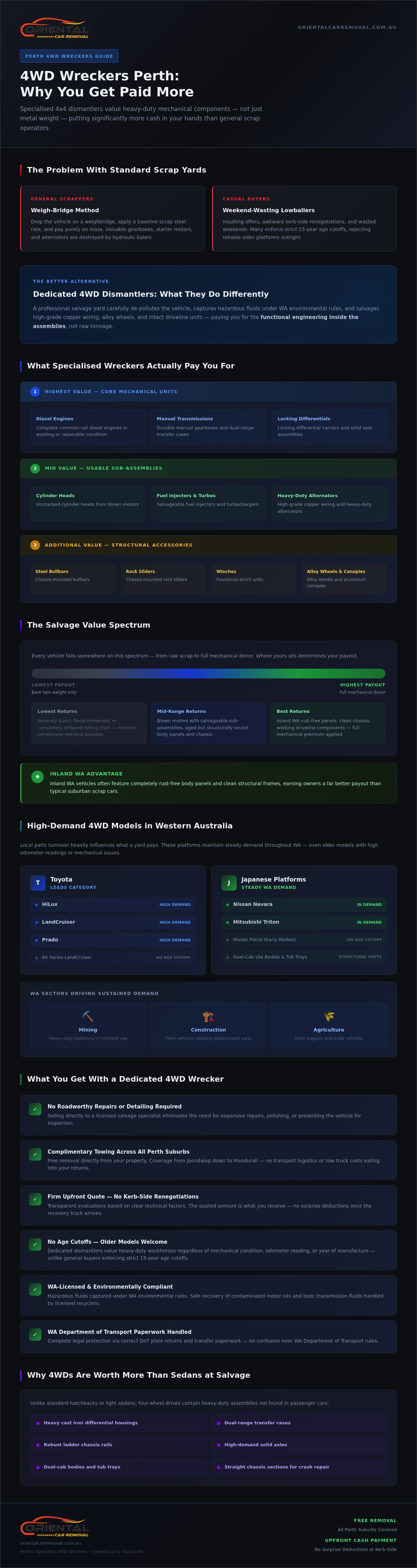
General scrap yards buy metal by weight. They drop your heavy vehicle onto an industrial weighbridge, apply a baseline scrap steel rate, and pay you purely on mass. That formula works against you when dealing with four-wheel drives. Specialised 4wd wreckers perth evaluate recoverable commercial components, not just curb weight. A beaten-up dual-cab or rusted farm wagon contains heavy-duty parts that hold substantial trade value across Western Australia.

Unlike standard hatchbacks or light sedans, four-wheel drives feature heavy cast iron differential housings, dual-range transfer cases, robust ladder chassis rails, and high-demand solid axles. Our local mining, construction, and agricultural sectors run on these platforms. When you choose an experienced 4wd wreckers specialist, you get paid for the functional engineering inside those assemblies, rather than raw scrap metal tonnage.

The Unique Salvage Value of Dual-Cab Utes and 4×4 Wagons

Fleet operators across regional Western Australia regularly need replacement structural components to keep trade vehicles working. Dual-cab bodies, tub trays, and straight chassis sections command strong interest for crash repair jobs across the state. Even an older, non-running bush rig that other yards reject because of age retains genuine utility. Inland WA vehicles often feature completely rust-free body panels and clean structural frames, earning owners a far better payout than typical suburban scrap cars.

Differences Between Metal Scrappers and Dedicated 4×4 Dismantlers

Understanding how different operators handle your vehicle explains the gap in cash offers:

  • General Scrappers: They crush whole vehicles immediately using hydraulic balers, destroying valuable gearboxes, starter motors, and alternators in the process.
  • Dedicated Salvage Yards: A professional wrecking yard carefully de-pollutes the vehicle, captures hazardous fluids under WA environmental rules, and salvages high-grade copper wiring, alloy wheels, and intact driveline units.

Many general car buyers enforce strict 15-year age cutoffs, turning down reliable older platforms like the 80 Series LandCruiser or early Nissan Patrols. Dedicated dismantlers value these heavy-duty workhorses regardless of mechanical condition, odometer reading, or year of manufacture. That specialised dismantling process delivers higher cash payments directly back into your hands.

How Perth Salvage Yards Calculate Your 4WD Cash Payout

Calculating the value of an immobilised 4×4 requires looking well beyond simple curb weight. Unlike passenger cars that rely mostly on sheet metal volume, four-wheel drive payouts reflect mechanical utility, component recovery, and regional demand. Transparent 4wd wreckers perth base their evaluations on clear technical factors, giving you a firm upfront quote without surprise deductions once the recovery truck pulls up to your driveway.

The High-Demand Japanese 4×4 Models in Western Australia

Local parts turnover heavily influences what a yard pays. Commercial workhorses and touring wagons from Japanese manufacturers maintain steady demand throughout Western Australia. Toyota platforms lead this category, with HiLux, LandCruiser, and Prado models yielding consistently strong valuations due to continuous trade and recreational requirements. Similar demand exists across the Nissan Navara and Mitsubishi Triton lineups. If you are dismantling an older off-road touring wagon, review our detailed guide on Used Nissan Patrol Parts Perth to see how specific components hold their worth.

Component Salvage: Engines, Gearboxes, Diffs, and Accessories

The operational condition of your major driveline hardware dictates the top end of an offer:

  • Core Mechanical Units: Complete common-rail diesel engines, durable manual transmissions, and locking differential carriers represent the highest salvage value.
  • Usable Sub-Assemblies: Even blown motors contain salvageable parts like uncracked cylinder heads, fuel injectors, turbochargers, and heavy-duty alternators. Engine control units are also frequently salvaged; if you are configuring replacement electronics or optimising engine performance on a project vehicle, visit Ecuremap to explore custom and original remap files.
  • Structural Accessories: Steel bullbars, chassis-mounted rock sliders, functional winches, and aluminium canopies add immediate recovery appeal.

Scrap Metal Weight vs Mechanical Part Reusability

Every vehicle falls somewhere on a spectrum between intact mechanical donor and raw scrap. A severely burnt, flood-immersed, or completely stripped rolling shell offers minimal component retrieval. In those instances, your quote reflects bare tare weight, sorting high-tensile steel and aluminium under current metal markets. Salvageable vehicles carry an added premium because their individual mechanical assemblies can be reclaimed, cleaned, and reintroduced safely. Under WA environmental regulations, licensed auto recyclers also handle the safe recovery of contaminated motor oils, toxic transmission fluids, refrigerants, and heavy lead-acid batteries.

If you have an unwanted vehicle sitting idle, securing a fast, fair valuation from an established team like Oriental Car Removal is the simplest way to convert that unused metal into cash.

Selling to a 4WD Wrecker vs Private Sale or Dealership Trade-In

Deciding how to offload a tired, broken, or de-registered 4×4 comes down to three main avenues: listing it privately, negotiating a dealership trade-in, or calling a vehicle dismantler. While a pristine, low-kilometre wagon might attract retail buyers, an immobilised or heavily used four-wheel drive presents clear logistical hurdles. Choosing professional 4wd wreckers perth eliminates the financial friction, safety risks, and drawn-out delays typical of traditional selling methods.

Why Private Marketplace Sales for Broken 4x4s Usually Stall

Selling a damaged vehicle privately creates massive administrative headaches. Most private buyers insist on valid road registration, extensive test drives, and roadworthy mechanical condition. If your rig has a blown head gasket, slipping transmission, or cracked chassis rail, marketplace enquiries quickly turn sour. You waste entire weekends fielding lowball messages from tyre-kickers who fail to show up. Worse still, inviting unknown buyers to inspect an immobilised vehicle at your home creates genuine security concerns and leaves you vulnerable to legal disputes over undisclosed defects.

Dealership Reluctance Toward High-Kilometre and Modified 4WDs

Car dealerships operate on fast retail turnaround. They avoid keeping high-kilometre, battle-scarred, or heavily modified trade vehicles on their showroom floors:

  • Automatic Wholesaling: Dealers simply flip older 4x4s to secondary auctions rather than retailing them directly to the public.
  • Severe Reconditioning Deductions: Estimated detailing, mechanical rectification, and statutory warranty costs get deducted straight from your trade-in appraisal.
  • Zero Appetite for Non-Runners: If the vehicle cannot be driven into the dealership under its own power, most sales desks will reject the trade entirely.

Salvage professionals operate on guaranteed cash terms instead. A wrecker buys your 4×4 strictly in “as-is, where-is” condition, accepting the vehicle with all existing mechanical faults and taking on the full disposal risk immediately.

Eliminating Expensive Towing and Heavy Recovery Costs

Moving a stationary 2.5-tonne four-wheel drive across the Perth metropolitan area is remarkably expensive. Standard tilt-tray operators charge hefty hook-up fees and kilometre rates, and those costs quickly spike if the rig sits bogged on grass, lacks functional rolling wheels, or has seized steering. Specialist recyclers solve this logistical bottleneck instantly. Selecting our experienced 4WD wreckers ensures professional recovery vehicles equipped with heavy-duty winches arrive at your property, removing the vehicle at zero expense to you.

4WD Wreckers Perth: Sell Your Damaged or Old 4x4 for Cash in 2026

Preparing Your 4WD for Wrecking: The Western Australia Checklist

Handing over an old four-wheel drive should be an organised, predictable transaction. Completing a few basic preparation steps before the recovery driver reaches your property avoids administrative hold-ups and ensures a smooth collection. Professional 4wd wreckers perth manage the heavy lifting, but completing your end of the Western Australian paperwork and vehicle clearance guarantees total peace of mind.

Department of Transport (DoT) WA Paperwork and Plate Return

Western Australian regulations require formal plate cancellation when a motor vehicle gets dismantled. Remove both number plates from the bullbar and rear tailgate using a standard screwdriver before collection. You must return these plates in person to any Driver and Vehicle Services (DVS) centre or post them directly to the Department of Transport. Handing in plates formally terminates your vehicle licence, allowing you to claim a pro-rata refund on any remaining registration periods. Check our detailed guide on How to Scrap a Car in WA to review complete compliance steps.

Clearing Out Personal Belongings and Aftermarket Accessories

Four-wheel drives accumulate tools and travel gear in out-of-the-way places. Check these key locations before the collection truck arrives:

  • Concealed Compartments: Search under the front seats, inside the centre console, behind the rear bench, and within roof console pockets.
  • Specialist Gear: Detach portable GPS units, handheld UHF transceivers, dash cameras, and expensive recovery tracks that you intend to keep.
  • Tow Gear: Leave standard spare wheels, factory jacks, and wheel braces inside the vehicle so the transport crew can manoeuvre it safely.

Ensuring Safe Property Access for Heavy Tow Vehicles

Salvage tilt-trays need ample space to reverse and position their winching beds. Clear parked family cars, bins, and work trailers from your driveway to provide direct access to the immobilised 4×4. If the vehicle is parked on a suburban lawn or narrow carport, unlock the steering column and inflate flat tyres so the vehicle rolls cleanly onto the steel bed. Even if you have lost the keys or the brakes have seized completely, notify your 4wd wreckers perth specialist beforehand so the driver arrives with heavy-duty wheel skates and recovery winches.

Schedule your free 4WD removal and instant payout today

Why Perth 4WD Owners Rely on Oriental Car Removal

Operating continuously since 2009, Oriental Car Removal has built a trusted reputation as a dependable local solution for offloading broken, accident-damaged, and unwanted four-wheel drives. Instead of forcing you to arrange expensive towing or endure kerbside haggling, we bring a fast, stress-free salvage process directly to your gate. As licensed 4wd wreckers perth, our mobile recovery teams offer immediate payments up to $10,000 for qualifying vehicles, completed on the spot before your rig is loaded.

Comprehensive Perth Metro and Regional Coverage

Distance is never an issue for our recovery fleet. We operate daily across northern hubs like Joondalup, Morley, and Osborne Park, while running constant routes through southern corridors including Fremantle, Rockingham, Bibra Lake, and Mandurah. Our heavy tilt-trays travel to suburban carports, commercial yards, and rural acreage with equal ease. You never pay a single cent for transport, administration, or disposal. Learn more about our complete service reach through our central cash for cars Perth team.

Transparent, Licensed, and Environmentally Responsible Dismantling

Dismantling heavy commercial machinery demands strict adherence to environmental protocols. Oriental Car Removal functions as a fully licensed and insured Western Australian auto recycler. Every vehicle brought to our facility undergoes meticulous de-pollution, capturing motor oils, gearbox lubricants, refrigerants, and battery acids to safeguard vulnerable Perth groundwater catchments. You walk away with complete peace of mind, backed by signed receipts and formal transfer paperwork that release you from future road liability.

Instant Quotes and Fast Same-Day 4WD Collection

Turning an unwanted 4×4 into usable funds takes minutes, not days. Simply contact our dispatch office by phone or fill out our online request form to receive an upfront valuation in under two minutes. We work around your personal commitments and work schedules, offering prompt collection times and guaranteed payouts without last-minute renegotiations. Get your instant cash quote from Oriental Car Removal today!

Clear Your Driveway and Claim Your Cash Today

Leaving an immobilised four-wheel drive to take up valuable space makes little financial sense. Professional 4wd wreckers perth recognise the genuine salvage value locked inside heavy-duty mechanical parts, sparing you from marketplace tyre-kickers and expensive transport costs. With the right team managing the retrieval and disposal paperwork, the entire transaction remains fast, safe, and legally watertight.

Backed by over a decade of trusted Western Australian auto salvage experience, Oriental Car Removal delivers 100% free 4WD towing and recovery across Perth and Mandurah. Enjoy zero hidden deductions and top cash payouts up to $10,000 paid instantly on collection before your vehicle leaves the kerb.

Turn your unwanted 4WD into instant cash today with Oriental Car Removal!

Take control of your property today and let Perth’s local salvage team handle the heavy lifting for you.

Frequently Asked Questions

How much cash can I get for my scrap 4WD in Perth?

Payouts vary based on your vehicle’s make, model, age, and salvageable mechanical parts, reaching up to $10,000 for qualifying 4WDs. Heavy commercial platforms like Toyota LandCruisers and HiLuxes command the highest values due to strong driveline demand across WA. Complete rigs with intact transmissions and running gear yield significantly better returns than stripped shells. We provide a transparent, locked-in quote over the phone before dispatching a recovery truck.

Do I need to pay for 4WD towing or recovery in Perth?

No, you will never pay a cent for 4WD collection or recovery across the Perth metropolitan area. Oriental Car Removal includes complimentary tilt-tray towing as standard with every vehicle purchase. That means zero call-out charges, zero administrative fees, and zero kerbside deductions. Our heavy recovery trucks handle oversized, non-running, or bogged vehicles safely, ensuring the cash figure quoted over the phone is the exact payment delivered to you.

Can I sell my 4WD if the engine is completely blown or seized?

Yes, we buy four-wheel drives with blown, overheated, seized, or missing engines without hesitation. As dedicated 4wd wreckers perth, we assess remaining value across the transfer case, differentials, suspension hardware, interior components, and body panels. Even when an engine block is beyond repair, uncracked cylinder heads, alternators, and turbos retain salvage utility. We winch immobile rigs directly onto our recovery trucks, so operational status is never a barrier.

What paperwork do I need to scrap a 4WD in Western Australia?

You only need a primary photo ID such as an Australian driver’s licence or passport, plus basic proof of ownership. We supply and help you complete the required Western Australian Department of Transport disposal documentation right at your driveway. Our team assists with confirming the Vehicle Identification Number (VIN) digitally. Remember to unbolt your licence plates beforehand so you can return them to a local DVS centre for cancellation.

Do you buy unregistered 4WDs or vehicles without a roadworthy certificate?

Yes, we routinely purchase unregistered vehicles and 4x4s without a roadworthy certificate or inspection pass. Because we buy vehicles for parts recycling and scrap metal recovery rather than showroom resale, current registration is unnecessary. You don’t need to spend thousands fixing oil leaks, steering slack, or cracked windscreens to pass inspection. We take the vehicle exactly as it sits and handle all legal salvage transfer requirements on your behalf.

Which Perth suburbs do your 4WD recovery trucks service?

Our recovery fleet covers the entire Perth metropolitan area, running daily routes from Joondalup down to Mandurah. Key service locations include Morley, Osborne Park, Karrinyup, Subiaco, Fremantle, Bibra Lake, Success, Beeliar, Rockingham, and Warnbro. Whether your immobilised 4×4 is stored in an inner-city garage, a coastal carport, or a semi-rural property, our specialised tilt-tray trucks come directly to your gate without charging any travel fees.

How quickly can you inspect and tow away my 4×4?

We frequently complete inspections, paperwork, and vehicle collection on the very same day you contact our office. Phone assessments take less than two minutes, letting you lock in a guaranteed payout without waiting around. Once accepted, our dispatchers schedule a recovery driver to arrive at a time that suits your schedule. You receive payment immediately before the truck departs, turning your unwanted vehicle into cleared driveway space instantly.

Accident Car Removal Perth: Get Instant Cash and Free Towing for Wrecked Vehicles

Accident Car Removal Perth: Get Instant Cash and Free Towing for Wrecked Vehicles

Imagine standing on the side of the road, staring at your crumpled bonnet while pushy tow truck drivers circle like sharks. It’s a high-pressure moment that nobody wants to face. You’re likely already worrying about mounting storage fees at the panel beaters or how to navigate the confusing WA Department of Transport paperwork. Arranging an accident car removal perth service shouldn’t be another source of stress. We understand that you need a clear, honest way to move on from a wrecked vehicle without the usual headaches or hidden costs.

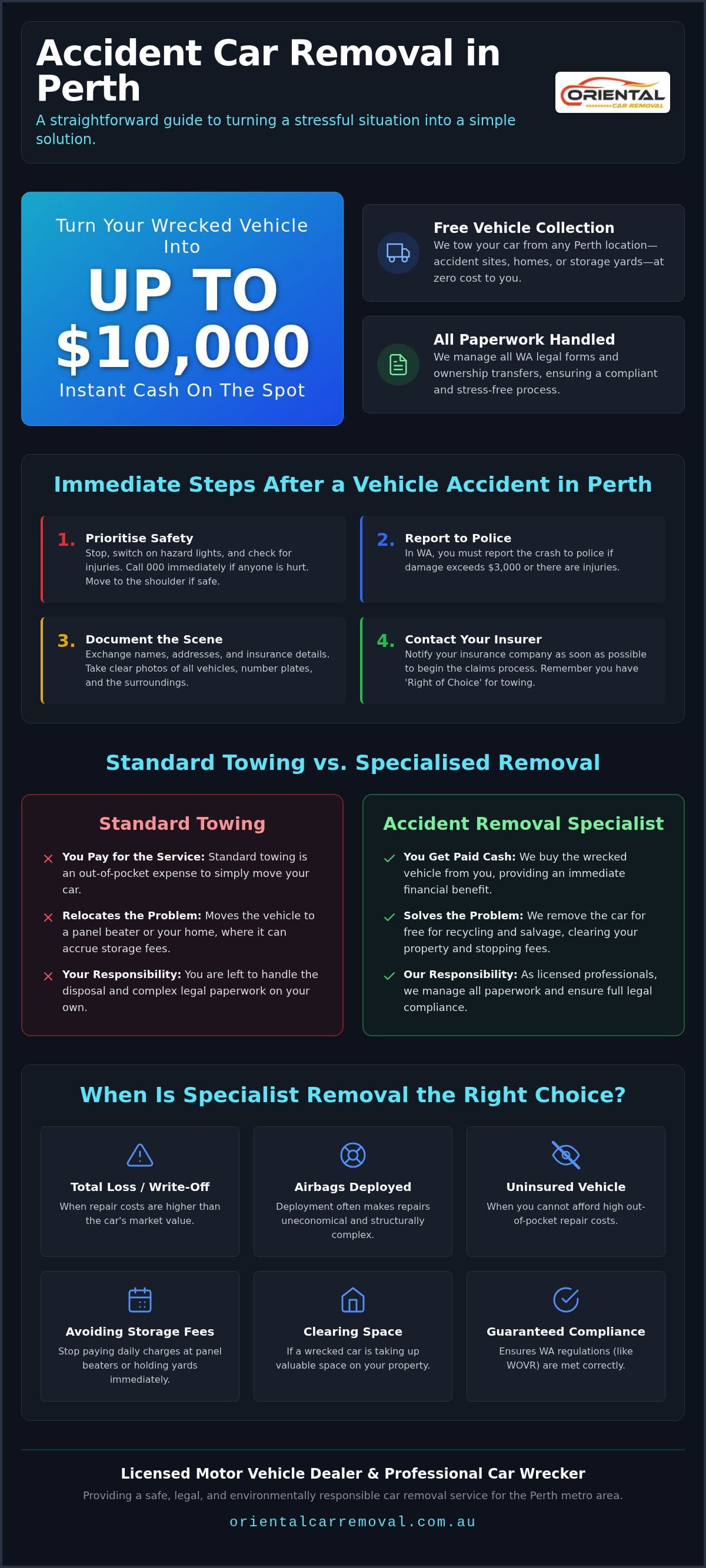
You can turn that smashed car into a financial win today. We’ll show you how to secure up to $10,000 cash on the spot while leaving the difficult logistics to the salvage experts. Our team handles every detail. We provide free towing from any Perth suburb and manage all legal forms professionally on your behalf. This guide walks you through the process of getting a fair salvage price and ensures you meet the latest August 2026 requirements for returning number plates. Discover how to clear your driveway and put money back in your pocket with a simple, transparent process.

Accident Car Removal in Perth: Fast Cash with Oriental Car Removal

  • Secure up to $10,000 cash for your wrecked vehicle with an instant quote based on its specific make and salvage value.
  • Access free accident car removal perth services that collect your vehicle from any location, including accident sites or storage yards, at no cost to you.
  • Learn how to navigate WA legal requirements, including the Written-Off Vehicle Register (WOVR) and the correct process for returning number plates.
  • Follow a step-by-step guide to managing the immediate aftermath of a collision, from ensuring passenger safety to reporting the incident to local authorities.
  • Discover why specialised salvage logistics provide a more efficient and profitable solution than standard towing services for damaged cars.

What is Accident Car Removal and Why is it Different?

Accident car removal is a time-sensitive salvage service for damaged vehicles that simplifies the disposal of non-roadworthy cars. This service differs significantly from standard towing. While a regular tow truck simply relocates your vehicle to a workshop or your home, a professional accident car removal perth specialist buys the car from you directly. This provides an immediate resolution to a stressful situation. You get paid to have the car taken away rather than paying someone to move it.

Speed is critical in these scenarios. Leaving a wrecked car on a Perth nature strip or public road can result in significant council fines. These penalties add up quickly and create unnecessary legal trouble. Acting fast clears the site before complications arise and stops storage fees from accumulating at panel beaters or holding yards. We act as the proactive partner you need to handle the heavy lifting while putting cash in your pocket.

The Role of a Licensed Car Wrecker

Choosing a licensed motor vehicle dealer provides you with essential legal security. A professional wrecking yard operates under strict regulations to ensure vehicles are processed safely and ownership is transferred correctly. We don’t just crush metal; we dismantle vehicles to salvage high-quality components for reuse. This recycling process is why we can offer competitive payouts for wrecked cars. It also ensures environmental safety. Our car wreckers perth team drains hazardous fluids and recycles metals according to WA standards, preventing toxic runoff from entering the local ecosystem.

When to Call an Accident Removal Specialist

Contact a specialist if your vehicle is a total loss or an economic write-off. This occurs when repair quotes are higher than the car’s actual market value. If your smashed vehicle is currently sitting at a panel beater, you might be accruing daily storage fees that eat into your potential insurance payout or savings. Moving it to our facility stops those costs immediately. This service is the right move if:

  • The chassis is twisted or the vehicle is structurally compromised.
  • Airbag deployment has made repairs financially impossible.
  • The car is uninsured and you cannot afford the private repair costs.
  • Your wrecked car is taking up valuable space in your driveway.

We provide a clear path forward. Instead of dealing with the uncertainty of a smashed vehicle, you get a definitive cash offer and free removal from any location in the Perth metro area.

Immediate Steps to Take After a Vehicle Accident in Perth

Safety is your absolute priority in the seconds following a collision. Stop your vehicle immediately and switch on your hazard lights. If it’s safe to do so, move the car to the shoulder of the road to clear traffic. Check yourself and your passengers for injuries. If anyone is hurt, call 000 straight away. In Western Australia, you must report the crash to the WA Police if the estimated damage to all property exceeds $3,000 or if any person involved has suffered an injury. With crash-related costs in WA already exceeding $135 million in the first quarter of 2026, documenting the scene accurately is vital for your future claim.

Once everyone is safe, exchange names, addresses, and insurance details with the other drivers. Don’t admit fault at the scene. Instead, focus on gathering the facts. Organising a professional accident car removal perth service early helps you avoid the high costs of holding yards or council fines for abandoned vehicles.

Safety and Documentation at the Scene

Use your phone to take high-quality photos of all vehicles involved, including number plates and the surrounding road conditions. These images are essential for both insurance assessments and our salvage valuation. Before the tow truck arrives, remove all personal belongings, including sunglasses, house keys, and e-tags. Be wary of ‘tow-truck chasers’ who appear uninvited at accident sites. These operators often charge exorbitant fees to tow your car to their preferred yard. You have the legal right to choose your own provider. Selecting a reliable partner ensures your vehicle is handled by professionals who value your time and property.

Coordinating with Insurance Providers

Contact your insurance company as soon as possible to start the claims process. Many drivers don’t realise they have a ‘Right of Choice’ regarding where their vehicle is taken. If your car is declared a total loss, it will be assessed against the WA legal requirements for written-off vehicles. This determines whether the car is a statutory write-off, which can never be registered again, or a repairable write-off.

If you don’t have comprehensive insurance, the responsibility for moving the wreck falls entirely on you. Leaving a smashed car at a panel beater can result in daily storage fees that quickly reach hundreds of dollars. You can stop these costs immediately by opting for cash for cars perth, which turns your liability into an instant payment. We manage the transition from the accident site to our salvage yard seamlessly, ensuring your legal obligations are met without the stress of extra paperwork.

How We Value Your Wrecked Car: From Scrap to $10,000

Valuation isn’t a guessing game. We look at the make, model, and year of your vehicle alongside the extent of the impact. While a smashed front end might look like a total loss to you, we see the value in the rear panels, transmission, and interior components. Even a non-running wreck has significant value in its recycled components. We use these details to build an offer that reflects the actual market worth of the salvage. This approach ensures you get a fair deal based on real-world demand.

Japanese makes like Toyota and Nissan are particularly valuable in the WA market. These brands have a massive footprint in Perth, which creates a constant demand for high-quality used parts. If you’re selling a Hilux, LandCruiser, or Patrol, you’ll likely receive a higher offer because these components are always in short supply. Our expertise in these specific makes allows us to push our offers closer to that $10,000 limit than general scrap merchants. We understand the specific worth of Japanese engineering and reflect that in every quote.

We also consider the raw material value. Steel prices in Perth currently range from $0.10 to $0.30 per kilogram. While that forms the baseline of any quote, we look deeper. We factor in the weight of copper wiring, aluminium radiators, and the precious metals found in catalytic converters. This multi-layered approach ensures you aren’t just getting a “scrap price” for a vehicle that still has usable parts. It’s about maximising the return on every kilogram of your car.

Salvageable Parts vs. Scrap Metal Value

Perth has a thriving market for second-hand 4WD and truck parts. Commercial vehicles often lead hard lives in the WA outback; therefore, the demand for replacement engines, gearboxes, and suspension components remains high. Our advanced inventory system tracks which parts are moving quickly, allowing us to pay more for vehicles that contain those items. We don’t just weigh your car; we evaluate the condition of every undamaged panel, light assembly, and electronic module. This level of detail is why our accident car removal perth quotes are consistently competitive across the metro area.

The Oriental Cash Guarantee

Transparency is the core of our business. We provide instant quotes over the phone or through our online form based on the information you provide. You won’t face hidden fees for towing or “admin charges” when we arrive. The price we agree on is the price you get in your hand. Our Cash for Cars Perth service is designed to be fast and final. We value your time as much as your vehicle, so we ensure the payment process is settled before the car even leaves your driveway. It’s a straightforward transaction with no surprises.

Accident Car Removal Perth: Get Instant Cash and Free Towing for Wrecked Vehicles

Dealing with the Department of Transport after a crash feels like a second accident. Most drivers find the paperwork overwhelming, especially when they are already managing insurance claims. Legal compliance is essential when arranging an accident car removal perth service. You must ensure the vehicle is correctly recorded on the Written-Off Vehicle Register (WOVR). This protects you from future liability and ensures the car’s history is transparent. We simplify this by providing the necessary disposal forms and guiding you through the transfer of ownership, even if you’ve lost your original registration papers or keys.

Returning your number plates is a critical step. You need to surrender them to a Driver and Vehicle Services (DVS) centre or a regional agent. This act officially cancels the vehicle’s licence. If your plates were destroyed or lost in the collision, you must complete a “Lost – stolen number plates (Form VL14)”. Once the plates are returned, you can apply for a pro-rata refund on any remaining registration fees. This refund is effective from the day you hand the plates in, so acting quickly puts more money back in your pocket. We can assist with the removal of the plates at the time of collection to save you the effort.

The WOVR Process Explained

The WOVR categorises vehicles into two main types. A Statutory Write-Off is a vehicle so badly damaged that it can never be safely repaired. These cars are only good for parts or scrap. A Repairable Write-Off has significant damage but could theoretically be returned to the road after passing a rigorous safety inspection. Correct categorisation is vital for road safety in WA. As a licensed motor vehicle dealer, we assist in notifying the authorities correctly. This ensures your wrecked car is processed according to the latest 2026 safety standards and prevents it from being illegally resold.

Managing Registration and Refunds

You don’t have to lose the money left on your registration. When we collect your vehicle for Scrap Car Removal Perth, we help you organise the one-page form required for vehicle disposal. This document is a straightforward way to notify the DoT that you no longer own the vehicle. We handle the heavy lifting of the physical accident car removal perth while you focus on the administrative side. Even if you’ve misplaced your keys or the car is stuck in a locked holding yard, we have the tools and expertise to retrieve it and finalise the legal transfer seamlessly. If you want a detailed walkthrough of every form and deadline involved, our 2026 step-by-step legal guide to scrapping a car in WA covers the MR9 form, plate returns, and registration refunds in full.

Request your free paperwork assistance and car removal quote today

Why Oriental Car Removal is Perth’s Trusted Accident Specialist

Oriental Car Removal brings over 10 years of dedicated experience to the WA salvage industry. We have built a solid reputation as the go-to “hassle-fixer” for Perth drivers facing the aftermath of a collision. Our team understands the stress of a wrecked vehicle. We prioritise speed and transparency in every transaction. We operate a specialised fleet of tilt-tray tow trucks specifically engineered to handle heavy accident damage. These trucks allow us to safely retrieve vehicles with seized wheels, crumpled frames, or missing axles. We manage the entire process with professional authority. This gives you the peace of mind that your car is in expert hands.

Recycling is a core part of our mission. We are committed to eco-friendly practices that protect the Western Australian environment. When we take a car to our yard, we don’t just crush it. We carefully drain all hazardous fluids, including engine oil, coolant, and brake fluid. We then dispose of them through licensed channels. This proactive approach prevents toxic runoff and ensures that every salvageable part is repurposed. If you want to understand exactly how this process contributes to WA’s circular economy, our guide to eco friendly car disposal Perth explains the full 2026 recycling standards in detail. Our 10-year local reputation is built on this commitment to quality and environmental responsibility.

Perth-Wide Service Coverage

Our reach extends across the entire Perth metro area. We serve clients from Joondalup in the north down to Mandurah in the south. This extensive coverage means we can offer rapid response times to major hubs like Rockingham, Morley, and Fremantle. We maintain a strong local presence in Bibra Lake and Osborne Park. This allows us to coordinate collections efficiently and reach you when you need us most.

Choosing our accident car removal perth service means you never have to worry about the logistics of moving a non-running car. We provide free towing from any location. Whether your vehicle is stuck in a residential driveway, a mechanical workshop, or on a busy roadside, we collect it at no cost to you. We handle the heavy lifting while you focus on moving forward. Our team arrives prepared with the right equipment to ensure a smooth removal process every time. We also offer dedicated scrap truck removal Perth services for commercial vehicles, ensuring heavy-duty trucks and vans are disposed of legally and profitably.

The Easy 3-Step Removal Process

We have refined our service into a methodical, three-step system that values your time. There is no narrative meandering or complex subclauses in our process; just direct results and immediate relief.

  • Step 1: Get a free, no-obligation quote via phone or our website. We use our 10 years of market data to provide a fair, instant valuation for your wrecked vehicle.
  • Step 2: Schedule a pickup time that suits your schedule. We arrive on time and prepared to finalise the deal without delay.
  • Step 3: Get paid instant cash and watch your wreck be towed away for free. We settle the payment on the spot and handle all the legal paperwork for you.

Take the first step toward clearing your driveway and boosting your bank balance. We are the proactive partner you need to handle the logistics and paperwork correctly. Reach out now and experience a stress-free path forward.

Frequently Asked Questions

Is my accident car worth anything if the airbags have deployed?

Yes. Airbag deployment often signals an insurance write-off, but the vehicle still holds significant value in its salvageable parts and scrap metal. We evaluate the car based on the remaining undamaged components such as the engine, transmission, and rear body panels. This ensures you receive a fair cash offer despite the safety system activation. We focus on the recycled worth of the materials to give you the best possible return.

Can you remove a car from an underground car park or a tight driveway?

We certainly can retrieve vehicles from restricted spaces using our specialised fleet of tilt-tray tow trucks. Our experienced drivers regularly navigate narrow Perth driveways and height-restricted underground car parks. If the vehicle has seized wheels or steering damage from the collision, we use recovery dollies and winches to ensure a safe extraction. This prevents any damage to the surrounding property while clearing the site quickly and professionally.

Do I need to be present when you tow the accident car away?

You don’t have to be present for the collection if the access and paperwork are arranged beforehand. Many clients leave the keys and documents with a trusted neighbour or the staff at a panel beating shop. We can verify the vehicle’s condition and process your payment via an instant bank transfer. This flexibility allows you to get on with your day while we handle the heavy lifting of the removal process.

How quickly can you pick up a crashed vehicle in the Perth CBD?

We prioritise rapid response times for any accident car removal perth within the CBD and inner suburbs. Our team can often reach your location within a few hours of you accepting our quote. Acting quickly is essential in high-traffic areas to avoid obstructing the road and attracting expensive council fines. We move fast to clear the wreck and settle your payment so you can put the accident behind you immediately.

What happens if the accident car is still under finance?

You can sell a financed vehicle, but the encumbrance must be cleared with your lender as part of the process. We recommend obtaining a current payout figure from your finance provider first. We can then work with you to settle the outstanding amount directly or provide the necessary documentation to finalise the debt. This ensures the title is clear and the legal ownership transfer meets all Western Australian regulatory requirements.

Do you buy accident-damaged trucks and commercial vans too?

We buy all types of accident-damaged commercial vehicles, including 4WDs, delivery vans, and light trucks. These vehicles are often highly sought after for their heavy-duty Japanese components and high-grade scrap steel. Whether your commercial vehicle has engine failure or structural damage from a crash, we provide a competitive valuation. Our specialised equipment can handle the extra weight and size of trucks to ensure a safe, free removal from any location.

Will I get more cash if I strip some parts off the car myself?

Removing components yourself typically lowers the total cash offer we can provide. A complete vehicle is worth more because it contains a full suite of salvageable parts like the catalytic converter, alternator, and gearbox. Stripping the car also makes it more difficult to tow safely. You get the best financial result and the most efficient service by leaving the vehicle intact and letting our experts handle the dismantling and eco friendly car disposal Perth recycling process.

What documents do I need to show the driver upon pickup?

You must show a valid photo ID, such as your WA driver’s licence, and proof that you own the vehicle. Having the registration papers handy will speed up the accident car removal perth process significantly. If you’ve lost the papers, let us know in advance so we can prepare the alternative statutory declaration forms. Our driver will guide you through the final signatures to ensure the ownership transfer is legally sound and hassle-free.