Cash for Cars Success: Selling a Written-Off Vehicle

Cash for Cars Success: Selling a Written-Off Vehicle

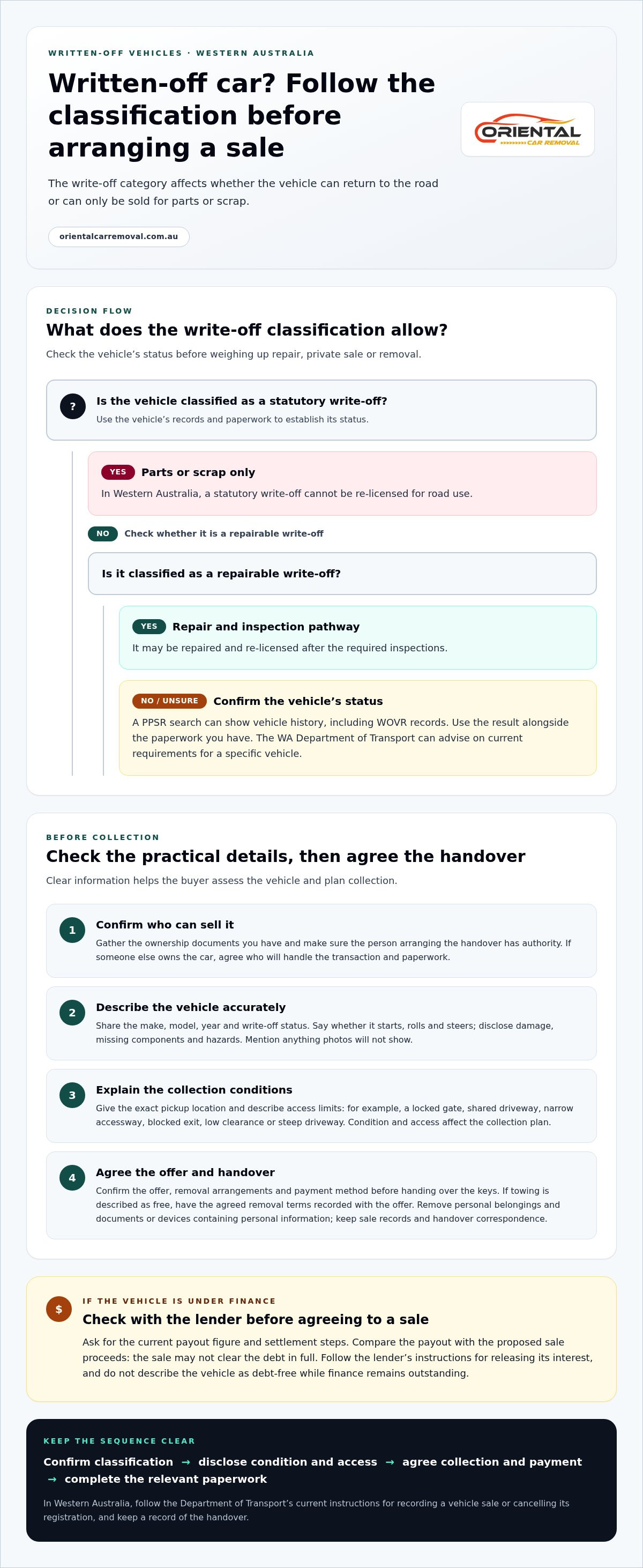
Cash for cars in Success can be an option for a written-off vehicle, but its classification affects what can happen next. In Western Australia, a statutory write-off can only be sold for parts or scrap and can’t be re-licensed for road use. A repairable write-off may be repaired and re-licensed after required inspections.

It’s understandable to want a clear answer before arranging a sale, especially if the car is damaged or hard to move. This guide explains what to prepare and how removal compares with a private sale, including paperwork and payment. If you’re considering cash for cars in Success, these practical steps can help you decide what to do next.

Key Takeaways

  • A written-off vehicle may be sold, but its classification affects whether it can return to the road or be sold only for parts or scrap.
  • Before arranging collection, gather available ownership documents and explain access issues such as a narrow entrance or blocked driveway.
  • Describe whether the vehicle starts, rolls or steers, and disclose known damage, missing parts and hazards when requesting an offer.
  • Before handover, remove personal belongings and information-bearing documents or devices, then confirm the offer, removal details and payment method.
  • Compare removal with a private sale by considering the vehicle’s condition, collection logistics and the paperwork involved.

1. Can I sell a written-off car for cash in Success?

Yes, a written-off car in Success may still be sold for cash, but its write-off classification affects what can happen next. In Western Australia, a statutory write-off can only be sold for parts or scrap and cannot be re-licensed for road use. A repairable write-off may be repaired and re-licensed after the required inspections. Identify the vehicle’s status before arranging a sale, as each category has a different outcome.

A PPSR search can show vehicle history, including WOVR records. Use the result alongside the paperwork you already have, rather than assuming a damaged car has a particular classification. The WA Department of Transport can advise on current requirements for a specific vehicle. This information matters when weighing a private sale against removal or deciding whether repairs are worth pursuing.

Before arranging collection, establish who is authorised to sell the vehicle. Gather the ownership documents you have and make sure the person arranging the handover has authority to do so. If someone else owns the car, agree on who will handle the transaction and paperwork. Clear ownership information helps the buyer arrange collection smoothly.

Access can shape the collection plan as much as visible damage. Tell the buyer if the car is behind a locked gate, in a shared driveway or on a narrow accessway. Mention a second vehicle blocking the exit, low clearance or a steep driveway. For example, a car that rolls but cannot turn through a tight entrance needs a different collection plan from one parked at the kerb.

Describe the vehicle’s condition plainly. Say whether it starts, rolls and steers, then disclose known damage, missing components and hazards. A flat tyre, broken steering or sharp body damage can affect loading arrangements. Don’t rely on photos alone if an important access obstacle or safety issue won’t be visible. Clear details help set practical expectations for collection.

Collection timing and coverage for a Success address depend on the vehicle’s condition, access and agreed arrangements. Set out the exact pickup location and any access limits when discussing timing. If towing is described as free, have the agreed removal terms recorded with the offer, so collection costs aren’t confused with the vehicle payment. The scrap car removal option is relevant when a written-off vehicle is destined for scrap rather than road use.

2. Selling a written-off vehicle for removal

Removal can be a practical option when damage makes a private sale difficult. In Western Australia, a statutory write-off can only be sold for parts or scrap and cannot be re-licensed for road use. A repairable write-off has a different pathway, subject to repairs and required inspections. The classification helps establish whether the vehicle is being sold for road use, parts or scrap.

A vehicle assessment does not guarantee an offer. Share the make, model, year and write-off status, then describe the damage accurately. Explain whether it starts, rolls and steers. Include missing components and any hazards that could affect loading. If the car is partly dismantled, describe what remains rather than relying on its original specifications.

Agree on the practical details before collection. Give the exact pickup location and explain access limits, such as a blocked driveway or restricted vehicle movement. Confirm the offer, removal arrangements and payment method with the buyer before handing over the keys. Remove personal belongings and documents or devices containing personal information. Keep your sale records and handover correspondence.

For a vehicle under finance, contact the lender before agreeing to a sale. Ask for the current payout figure and the steps for settling the loan. Compare that amount with the proposed sale proceeds, as the sale may not clear the debt in full. Follow the lender’s instructions for releasing its interest, and don’t describe the vehicle as debt-free while finance remains outstanding.

In Australia, transfer and registration procedures vary by state. In Western Australia, follow the Department of Transport’s current instructions for recording a vehicle sale or cancelling its registration, and keep a record of the handover. The WA Department of Transport is the relevant point of contact for advice about a specific vehicle’s requirements.

Keep the transaction in a clear sequence: disclose the vehicle’s status, provide accurate condition details, agree on collection and payment, then complete the relevant paperwork. A written-off vehicle may be assessed for removal, but its classification, condition and collection circumstances all matter. If the vehicle is destined for scrap, scrap car removal is one relevant option to consider for the next step.

Oriental Car Removal notes that statutory write-off vehicles cannot be re-registered once classified as statutory write-offs, so confirm the classification before discussing a removal or parts sale.

Vehicle makes, models and conditions accepted

Acceptance depends on the vehicle’s details, condition and intended use. Give the buyer the make, model, year and vehicle type. A small hatchback, commercial ute and four-wheel drive can have different parts, weight and recovery needs. Describe the exact vehicle rather than assuming every make or model will be accepted.

Condition matters just as much as the badge. Explain whether the vehicle starts, rolls and steers. Disclose accident damage, missing components, flat tyres and known hazards. For example, a car that won’t steer may need different loading arrangements from one that drives but has body damage. A clear description helps assess the vehicle and plan collection. Photos can show visible damage, but mention anything they don’t capture.

Buyers may assess vehicles beyond standard passenger cars. Describe whether you have a truck, 4WD, van or ute, and note its condition. If a vehicle is written off, explain its classification and whether it is being sold for parts or scrap. That classification affects the sale pathway.

How does a cash-for-cars buyer compare with a wrecker in Australia? The names alone don’t determine the outcome. Compare the proposed offer, accepted vehicle condition, collection arrangements and payment method. A wrecker may assess a vehicle for parts or scrap, while a buyer’s assessment can depend on its condition and intended destination. Provide the same vehicle details to each buyer for a clearer comparison.

Before accepting an offer, get clear answers about the transaction. Ask what vehicle details informed the offer, whether the amount depends on an inspection, and what happens if its condition differs from your description. Confirm who arranges collection, whether any removal cost applies, and how payment will be made. Agree on these points before handing over the vehicle.

  • Does the offer account for the disclosed damage and missing parts?
  • Is collection included in the agreed arrangement?
  • When and how will payment be made?

Is a particular buyer licensed, reputable and well reviewed? Those points are specific to each business, so a name or offer alone doesn’t establish them. Check relevant licence and insurance details, then read reviews for recurring comments about communication, collection and payment. Treat specific claims as things to verify, not assumptions.

Prepare the details once: vehicle identity, condition, write-off status and collection needs. That makes it easier to compare like with like, whether you’re selling a damaged hatchback or an unwanted work ute. Keep the agreed offer, removal plan and payment method clear before the handover.
Cash for Cars Success: Selling a Written-Off Vehicle

4. Digital sale paperwork and payment

For a car sale in Australia, gather available ownership documents and records showing who can sell the vehicle. In Western Australia, follow Department of Transport instructions for your circumstances. If finance remains, keep relevant lender correspondence with your sale records.

Digital copies can make records easier to organise. Photograph or scan the documents you already have, then check that names and vehicle details are readable. Keep the originals secure until handover. A digital copy helps you retrieve information, but don’t assume it replaces paperwork required for your transaction.

Match every record to the vehicle being sold. Compare the registration details and vehicle identification information on your documents with the car. If a name differs, or another person is arranging the sale, clarify who has authority to act. Share only the information needed to arrange the transaction, and avoid sending sensitive documents through an insecure channel.

Keep the sale terms in writing, whether they arrive by email, text or paper. Record the agreed offer, vehicle description, collection arrangements and payment method. If the buyer changes the offer after inspecting the car, ask for the revised amount and reason in writing before agreeing. This creates a clear record of what both sides accepted.

Confirm how payment will be made before collection. Ask whether it will be cash or an electronic transfer, and agree when payment is due. For a transfer, check your own account for the funds rather than relying only on a screenshot or payment notification. Keep the transaction record with the sale documents.

Before the vehicle leaves, remove personal items and documents or devices containing personal information. Check the glovebox, centre console, boot and storage compartments. Remove saved navigation addresses or paired-device details where possible. Keep your own copy of the agreed terms, payment record and collection confirmation.

A simple digital folder can hold the vehicle documents, written offer, messages and payment confirmation. Use a clear label, such as the vehicle registration, so you can find the record later. Don’t delete the conversation immediately after collection. If a question arises about the agreed amount or pickup, saved messages show the transaction details.

Make the handover a final check, not a rushed exchange. Confirm the vehicle being collected, the agreed payment method and that your personal belongings are out. Keep the records together after the sale. Clear documents and written terms help you track each step, from accepting the offer through payment and collection.

5. Cash offers for unwanted cars in Success

In Success, cash for cars gives owners a way to seek payment for an unwanted vehicle and arrange collection. You provide the car’s details, describe its condition and review the terms before handover. Start by giving a clear picture of the vehicle before comparing an offer.

An offer reflects more than the badge. Make, model, age, condition and usable components all help shape an assessment. A complete car differs from one missing its engine or wheels. Describe specific faults and missing items rather than calling the vehicle simply “old” or “damaged”.

For example, say whether the engine starts, the car rolls and it steers. Mention accident damage, flat tyres, missing keys or parts, and hazards. If it’s written off, state its classification. This information helps the buyer assess the vehicle’s likely destination, such as parts or scrap, and plan collection.

Compare the whole transaction, not just the cash amount. Ask whether the offer includes free collection, what could change it after inspection and how payment will be made. Confirm the terms before agreeing. A higher initial figure may not suit you if the final terms or collection arrangements don’t fit your situation.

A private sale and a removal sale involve different tasks. A private seller prepares an advert, handles enquiries and coordinates viewings. A removal sale centres on assessing the vehicle, agreeing on payment and arranging collection. If the car won’t start, has extensive damage or is difficult to move, compare how each option handles those practical needs.

What does cash for cars in Success involve? It gives owners a way to seek payment for an unwanted vehicle and arrange its removal. Review the offer and collection terms before handing over the car.

Use a short checklist before accepting: provide accurate vehicle details, disclose damage, confirm the amount, agree on collection and verify the payment method. Keep the written offer and transaction messages. If an inspection changes the offer, ask for revised terms before collection proceeds.

For a fair comparison, give each option the same make, model, condition and access details. Then weigh the proposed payment, removal arrangements and steps required from you. This makes it easier to decide whether cash for cars in Success suits an unwanted car that’s no longer practical to drive or sell privately.

Oriental Car Removal: Cash for Cars

Oriental Car Removal offers Cash for Cars and Free Car Removal for unwanted vehicles. If your written-off car is difficult to sell privately, these services offer a practical next step. Share its classification, condition and collection details so the transaction can be assessed clearly.

The business also offers Cash for Trucks and Cash for 4WDs and Vans. Describe the vehicle accurately, including damage or missing parts, before discussing an offer and removal arrangements. Keep the agreed payment method and collection details clear before handover.

For a written-off vehicle in Success, contact Oriental Car Removal to discuss the vehicle and arrange the next steps.

Choose your next step with confidence

Base your decision on what you need next, not just clearing the driveway. If the vehicle may return to road use, compare that pathway with selling it for removal. For a cash-for-cars sale in Success, start with a clear account of the vehicle and the outcome you want. That keeps the conversation focused on a practical choice, not a rushed handover.

Take time to review the terms and choose a route that suits your circumstances. A written-off car can feel like a complicated problem, but clear priorities make the next move easier to manage. You’re ready to proceed when you understand your options and feel comfortable with your decision.

Take it one step at a time. You can move forward with a choice that feels right for you.

Frequently Asked Questions

Can I sell a written-off car for cash in Success?

Yes, a written-off car in Success can be offered for sale, but its classification matters. A statutory write-off is limited to parts or scrap, while a repairable write-off may have a road-use pathway after repairs and required inspections. Share the classification and vehicle details upfront. If ownership is shared, make sure the person arranging the sale has authority to do so.

Can a statutory write-off be sold for removal in Western Australia?

Yes, a statutory write-off can be sold for parts or scrap in Western Australia, but it cannot be re-licensed for road use. Its classification determines the appropriate sale pathway. A PPSR search can show vehicle history, including WOVR records. Keep that result with your available vehicle documents, and describe the car as a statutory write-off when discussing a removal sale.

Can a written-off car be sold for removal in Success?

Yes, a written-off car in Success can be put forward for a removal assessment. Tell the buyer whether it is classified as statutory or repairable, and whether it has missing parts or major damage. For example, a car without wheels needs different loading arrangements from one that can roll. Give the pickup address and describe any access restrictions clearly.

Does a written-off car need to be running for collection?

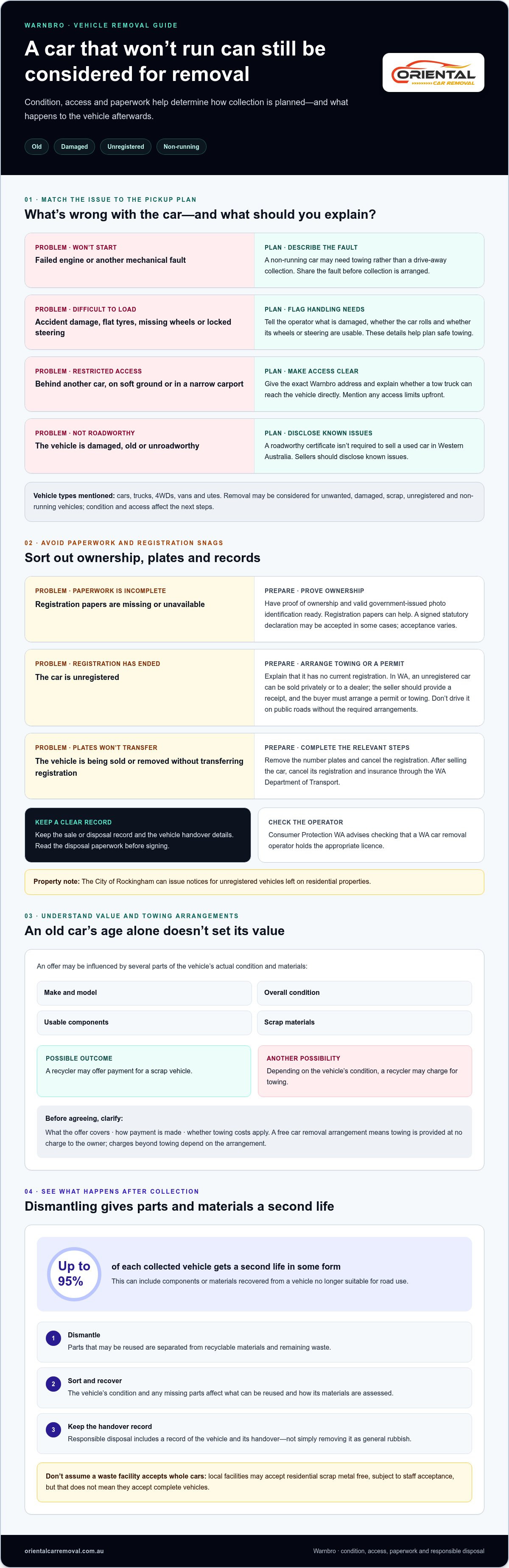
A car can be assessed even if it won’t start. State whether it starts, rolls and steers, and mention issues such as a flat tyre or damaged steering. These details help determine how it can be loaded and moved. If the vehicle is stuck behind another car or inside a tight garage, explain that before agreeing on collection arrangements.

How do you decide what to pay?

An offer depends on the vehicle’s details and condition, rather than one standard amount. Make, model, year, damage, missing components and usable parts can all affect its assessment. A complete car and one missing key components present different salvage possibilities. Provide an accurate description and ask for the offer terms in writing before agreeing to collection.

How much is your salvage car worth?

Your salvage car’s value depends on its specific details, condition and what remains usable. For example, a damaged vehicle with intact components differs from one that has been partly dismantled. Share its make, model, year, write-off status and known faults when requesting an assessment. The price depends on the case and is provided after a quote request.

Is there a fee for the tow?

Oriental Car Removal provides Free Car Removal at no charge to the owner. Before collection, make sure the agreed arrangement covers the vehicle and pickup location you described. Tell the buyer about narrow access, blocked driveways or a car that cannot roll. Clear details help avoid confusion about the collection plan and payment at handover.

Private sale or a vehicle removal buyer?

A private sale means preparing an advert, handling enquiries and arranging viewings, while a removal buyer focuses on assessing the vehicle and collection arrangements. A private listing may suit a roadworthy car with time for prospective buyers to inspect it. For a damaged or immobile vehicle, compare the written offer, removal terms and payment method before choosing your preferred route.

Free Car Collection in Bibra Lake With Payment on Pickup

Free Car Collection in Bibra Lake With Payment on Pickup

Need to get rid of an unwanted vehicle without paying for its removal? Free car collection in Bibra Lake means the vehicle can be picked up at no cost, with payment made when it’s collected. The amount offered depends on the vehicle and its condition.

It’s reasonable to want the details settled before a vehicle leaves your property. Know what happens at pickup, what affects the offer and what information to have ready, without getting caught in a drawn-out process.

This guide explains how collection and payment work, which vehicle details can shape an offer, and how to prepare for handover. You’ll also see how free removal can help with an unwanted, damaged or end-of-life vehicle, and how to arrange collection in Bibra Lake.

Key Takeaways

  • Clarify the agreed payment amount and how payment will be made before the vehicle is collected.
  • Have the vehicle’s make, model, condition and location ready when arranging collection.
  • Free removal can help clear an unwanted vehicle without a separate towing charge.
  • Gather relevant ownership paperwork and vehicle details to make the handover more straightforward.
  • Check the listed contact details and opening hours before arranging the next step.

Payment on pickup

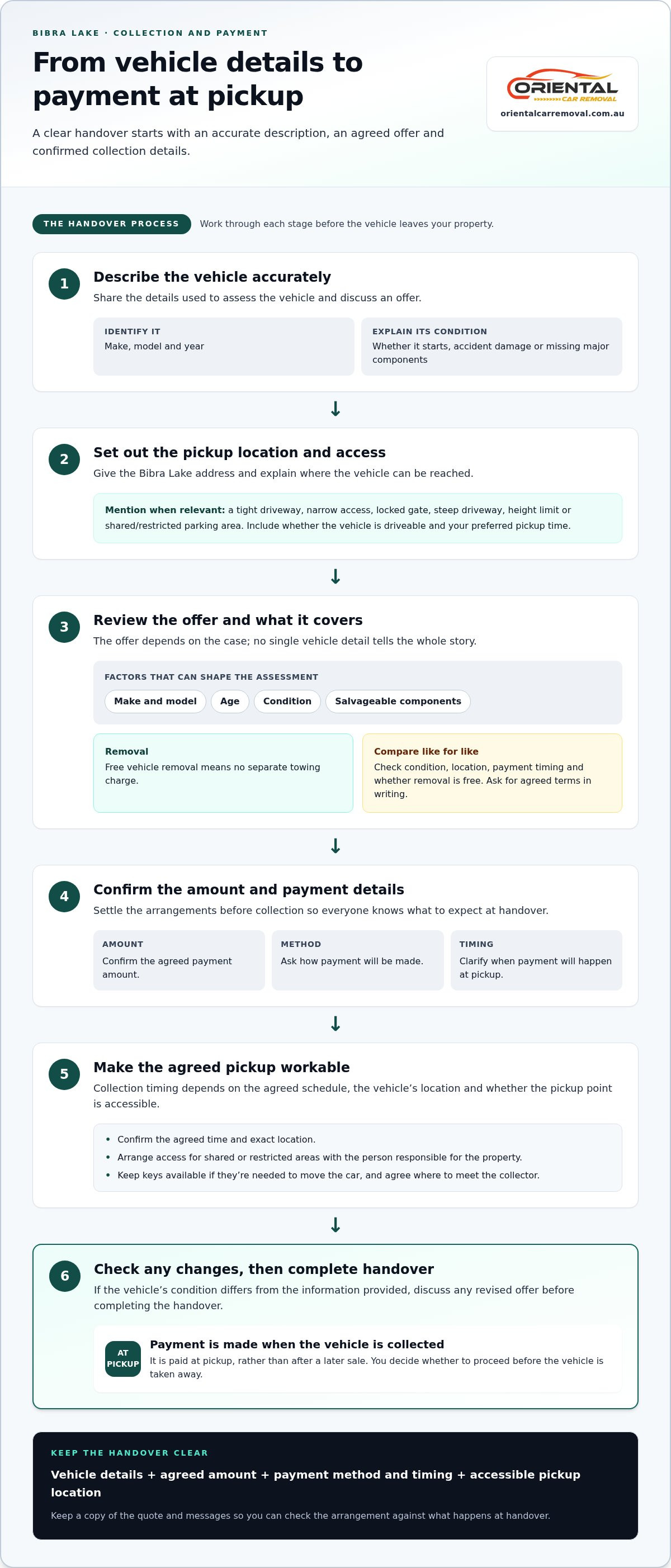
Payment on pickup means the agreed amount is paid when the vehicle is collected, rather than after a later sale. For a Bibra Lake owner, the key step is agreeing on the offer before the vehicle leaves. Make sure the collection and payment details are clear so everyone knows what to expect at handover.

The offer depends on an accurate assessment of the vehicle. Share its make, model, year, condition and location when requesting a quote. For example, say whether it starts, has accident damage or is missing major components. These details help Oriental Car Removal assess the actual vehicle and discuss a relevant offer.

Before collection, confirm the agreed amount and ask for the payment method and timing to be explained plainly. Check that these details match what will happen at pickup. If the vehicle’s condition differs from the information provided, discuss any revised offer before completing the handover. You decide whether to proceed before the vehicle is taken away.

  • Describe the vehicle’s condition accurately, including known damage.
  • Confirm the agreed payment amount before collection.
  • Clarify how and when payment will be made at pickup.
  • Keep the payment arrangement clear before handing over the vehicle.

Payment arrangements can matter as much as the amount. A private sale may involve enquiries, negotiations and coordinating payment with a buyer. With Oriental Car Removal, payment and free vehicle removal are arranged together at the agreed pickup. Consider which process suits your situation, especially if the car is no longer driveable or you want it cleared from your property.

Cash offers depend on factors such as the vehicle’s make, model, age, condition and salvageable components. An unwanted car with usable parts may be assessed differently from a severely damaged vehicle. No single detail tells the whole story; give a complete description to support a relevant offer. The price depends on the case and is given after a quote request.

This gives owners clear points to settle before collection: the vehicle details, the agreed amount and the handover. If you’re arranging free car collection in Bibra Lake, prepare those details first. A straightforward conversation with Oriental Car Removal can help keep pickup and payment aligned.

Contact details and opening hours

A car in Bibra Lake can be collected once a pickup time has been arranged. The timing depends on the agreed schedule, the vehicle’s location and whether the collection point is accessible.

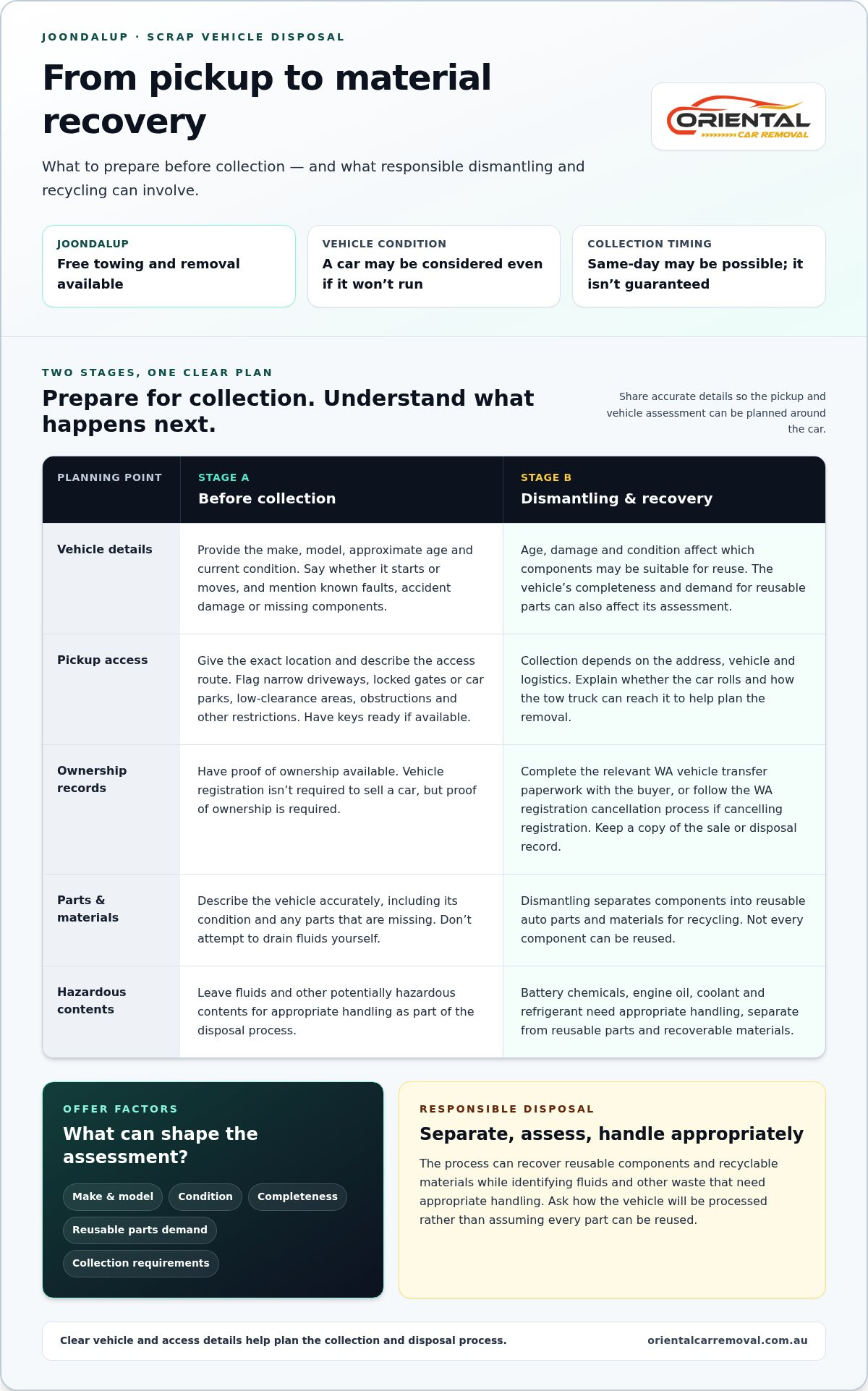
Contact Oriental Car Removal to start arranging collection, then share details that identify the vehicle and pickup location. Include the suburb, street address, make, model and whether the car is driveable. For example, say if it’s parked in a narrow driveway or behind another vehicle. These details help clarify what the pickup involves.

Check the listed opening hours before getting in touch, so you can plan the conversation and any follow-up. Keep the contact page or business details handy while you organise the pickup. If you’re calling, have the vehicle information ready. If you’re using a written contact option, include the same details in your message.

Prepare these details before making contact:

  • Bibra Lake pickup address and the best access point.
  • Vehicle make, model and general condition.
  • Whether the vehicle starts and can move.
  • Your preferred pickup time and a suitable way to respond.

Clear information can reduce avoidable back-and-forth. A car parked on a residential driveway may need different access planning from one in a shared apartment car park. Mention height limits, locked gates or a steep driveway when relevant. For a vehicle at a workplace, identify the correct entrance and where it can be reached.

Opening hours matter when you need to speak with someone or arrange a time. Check the hours shown on the business’s contact information, then make your enquiry during that window. Don’t assume that a listed contact channel is monitored outside those hours. Include a preferred time for a response if you’re leaving a message.

Before finalising pickup, make sure you understand the agreed time, location and what needs to be accessible. If the vehicle is in a shared or restricted area, arrange access with the person responsible for the property. Keep keys available if they’re needed to move the car, and tell the contact person where you’ll meet the collector.

For a straightforward start, use the online contact options and include your Bibra Lake location and vehicle details. That gives the conversation a clear starting point without delaying it to gather basic information later.

There’s no fixed collection speed; pickup can be arranged once a time is agreed. The timing depends on the schedule, the vehicle’s location and whether the collection point is accessible.

Free car removal in Bibra Lake

With Oriental Car Removal, free removal means the vehicle is collected without a separate towing charge. Before agreeing, confirm the vehicle details, payment arrangement and handover steps.

Comparing quotes and checking legitimacy

Compare quotes on the same basis: vehicle condition, collection location, payment timing and whether removal is free. A higher offer may not be better if extra costs reduce the final amount. Ask for the agreed terms in writing, including what happens if the vehicle’s condition differs from your description.

Check that the business provides clear contact details and explains its process plainly. Confirm who is arranging pickup, which vehicle is being collected and how payment will be made. Keep a copy of messages and the quote so you can compare them with the arrangement at handover.

Eligible vehicle types

Collection services can cover cars, trucks, 4WDs, vans and utes. A vehicle may be unwanted, damaged, accident-affected or no longer suitable for regular use. Vehicle type is only one consideration: its condition, completeness and access at the pickup point can also affect the arrangement.

Describe the vehicle accurately before collection. For example, say whether it starts, has accident damage or is missing components. Include its make and model, and explain if it’s parked in a tight driveway. These details help Oriental Car Removal plan for the actual vehicle and its access needs.

Nearby collection areas

For Bibra Lake, ask about the exact pickup address and access conditions when arranging collection. Nearby Perth areas named for vehicle removal include Cockburn, Fremantle and Rockingham. These names provide useful local reference points, but a suburb name alone does not describe the property or access required.

Share the suburb, street and any access instructions together. For example, mention a shared car park, locked gate or narrow driveway. If the vehicle is near a boundary between suburbs, use the street address to avoid confusion. Clear location details help establish where collection needs to take place.

Preparing your car for collection

Before collection, remove personal belongings from the cabin, boot and glovebox. Check under seats and inside door pockets for documents, sunglasses, chargers or other items. Take out child seats, garage remotes and toll tags if they belong to you. Keep the vehicle keys and any paperwork you plan to hand over separate.

Do a final walk-around before the collector arrives. Check the centre console, sun visors and boot for anything left behind. If personal items are stored in a removable accessory, take it with you. Clear access around the vehicle and let the collector know about obstacles, such as another car blocking the driveway.

Free Car Collection in Bibra Lake With Payment on Pickup

Paperwork and required documents

Prepare vehicle and ownership details before handing over a car in Bibra Lake. Keep copies of the collection agreement and payment record with your paperwork.

Have the registration details, make, model and vehicle identification information available if you have them. Registration papers can help identify the vehicle, while proof of ownership can clarify who is authorised to arrange collection. Keep personal identification handy if it’s requested during handover.

Documents that may help organise the transfer include:

  • Vehicle registration papers or registration details.
  • Proof of ownership, such as purchase records.
  • Personal identification for the person arranging collection.
  • Written notes recording the agreed collection and payment terms.

Check that the vehicle details match across your records. For example, compare the registration details with the vehicle’s make and model before collection. If another person is arranging pickup on your behalf, make sure they have the relevant information and understand the agreed handover.

After collection, handle registration cancellation and number-plate return as separate administrative steps. Follow the WA transport authority’s current instructions for cancelling the vehicle’s registration and returning its plates. Keep any confirmation or receipt with your vehicle records.

Don’t leave the plates in the car unless the collection arrangement specifically requires it. Remove them before handover and keep them together so they’re ready for return. If a plate is missing or damaged, note that when contacting the authority and follow its guidance.

At pickup, retain a written record of what was agreed. Include the vehicle description, collection date, payment arrangement and any paperwork transferred. A simple record can help resolve confusion later, especially if the person handing over the car differs from the registered owner.

Before the collector leaves, confirm the vehicle has been collected and keep the payment record. Store these documents alongside your registration details rather than leaving them in the glovebox. If you’re unsure which paperwork applies to your circumstances, follow the relevant WA authority’s instructions for registration and plate return.

What types of vehicles qualify for free car removal in Bibra Lake?

Vehicle type is a useful starting point for arranging removal in Bibra Lake. Cars, trucks, 4WDs, vans and utes can all be considered, including unwanted, damaged or accident-affected vehicles. The vehicle’s condition, completeness and pickup access help shape the arrangement. Give a clear description rather than assuming every vehicle is assessed in the same way.

A passenger car may be an older runabout, a non-running vehicle or a car with accident damage. A ute or van may have different bodywork, load-area or access considerations. Trucks and 4WDs are also distinct vehicle types, so identify them accurately when making an enquiry. Include the make and model if known, and explain whether the vehicle starts or has visible damage.

Useful details to share include:

  • Vehicle type, such as car, truck, 4WD, van or ute.
  • Make and model, if you know them.
  • Whether it starts, moves and has keys.
  • Visible damage, missing parts or accident history.
  • Where it is parked and how a collection vehicle can reach it.

Condition can influence the collection plan. For example, a car that rolls may be easier to position than one with a damaged wheel. A truck in a tight yard may need different access arrangements from a ute parked in an open driveway. Mention these details early, especially if the vehicle is blocked in or stored behind a gate.

Free removal is relevant when you want a vehicle collected without paying a separate removal charge. Removal can cover cars, trucks, 4WDs and vans, while utes are another vehicle type to describe during the enquiry. The vehicle’s condition still matters to the assessment. A damaged car and an intact but unwanted car may be handled differently, so explain what you can see.

Before arranging pickup, make sure your description matches the actual vehicle. If it has been in an accident, describe the affected areas. If it’s missing wheels or major components, mention that too. These details help avoid surprises when the collection team arrives and keep the discussion focused on the vehicle you need removed.

For a car, ute, truck, 4WD or van in Bibra Lake, share its type, condition and pickup access to start the removal process.

Arrange vehicle removal

Oriental Car Removal: Cash for Cars

Oriental Car Removal can help Bibra Lake owners move on from unwanted vehicles through Cash for Cars and Free Car Removal. If you have a truck, 4WD or van instead, its related options include Cash for Trucks and Cash for 4WDs and Vans.

Oriental Car Removal’s services suit owners who want vehicle removal without managing a private sale. Share the vehicle type, condition and collection location to start the conversation. Clear details help frame the next steps around the vehicle you need removed.

Whether you have an unwanted car or a larger vehicle taking up space, contact Oriental Car Removal to discuss free collection and a cash offer.

Take the next step with confidence

If free car collection in Bibra Lake is your next step, choose a time to move the vehicle on and make room for what comes next. A clear plan can help you coordinate access, property arrangements or a change in transport without leaving an unwanted vehicle in the way.

Oriental Car Removal offers Cash for Cars and Free Car Removal for unwanted vehicles, plus Cash for Trucks. Share what vehicle you have and where it’s located to begin discussing the collection. You can then decide whether the proposed arrangement suits your needs before proceeding.

Starting the conversation gives you a practical way to turn a parked vehicle into a clear next step. Share the details, discuss the offer and collection, then choose what works for your situation.

Make your next move when you’re ready. A clear plan starts with one conversation.

Frequently Asked Questions

Who offers free car collection in Bibra Lake, WA?

Oriental Car Removal offers free car collection in Bibra Lake, Western Australia. It buys unwanted vehicles and arranges removal, so owners can discuss both parts of the process together. When enquiring, share the vehicle’s make and model, describe its condition and give the pickup suburb. For example, mention whether the car is at a home or business address in Bibra Lake.

Which car wreckers or scrap yards collect cars for free in Bibra Lake?

Oriental Car Removal provides free removal for unwanted and scrap vehicles. If you need free car collection in Bibra Lake, describe the vehicle and its location when enquiring. Compare the collection terms and handover process, not just the “car wrecker” label. This helps you understand what’s included and how the vehicle will be collected.

Do free car collection services in Bibra Lake pay cash for unwanted cars?

Yes. Oriental Car Removal offers Cash for Cars alongside free car removal. The offer depends on details such as the car’s condition, model and salvageable components. For example, mention whether it runs or has accident damage when requesting an assessment. Discuss the payment arrangement before the vehicle changes hands, so you understand the terms before collection.

What documents are needed when selling or scrapping a car in Western Australia?

Have vehicle and ownership records ready, along with identification for the person arranging the sale. Registration details, make and model can help identify the car. If someone else is handling the handover, prepare information showing their authority to act for the owner. Keep a copy of the sale or collection record after pickup, together with related vehicle paperwork.

Cash for Fleet Vehicles in Subiaco and Scrap Car Prices

Cash for Fleet Vehicles in Subiaco and Scrap Car Prices

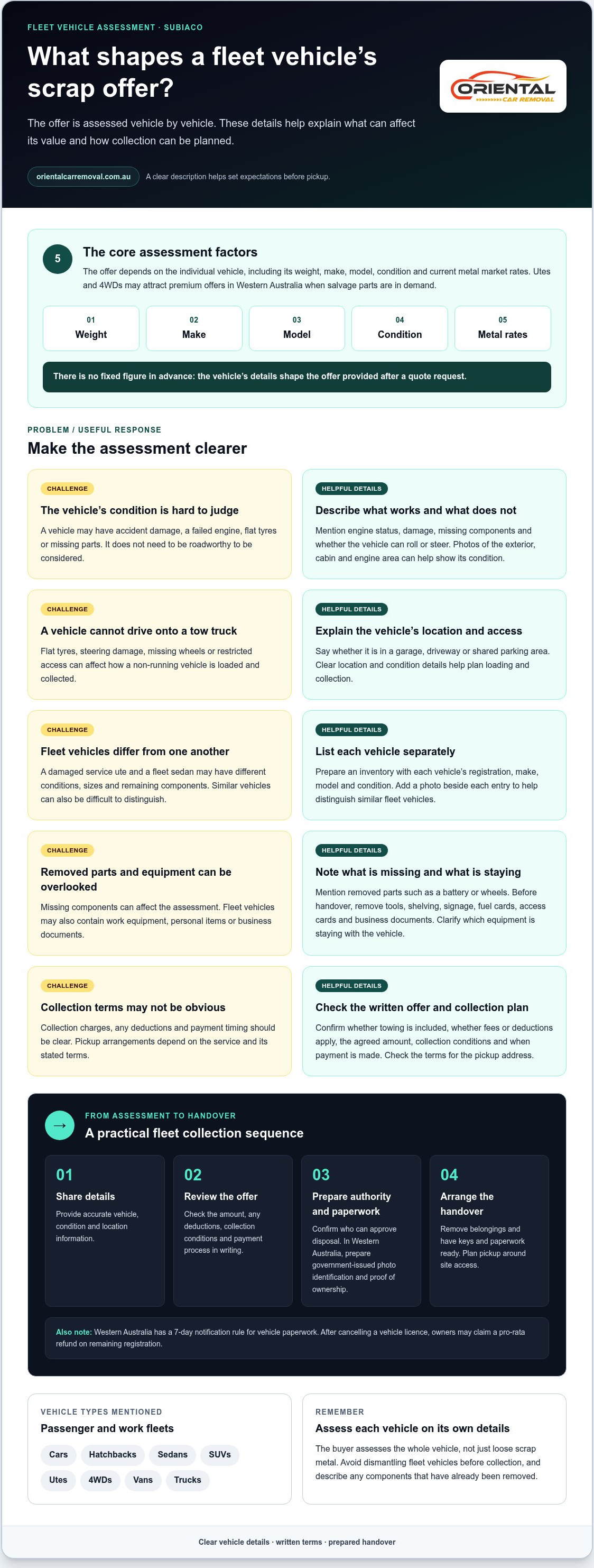
A damaged ute can still carry useful scrap value. For cash for fleet vehicles in Subiaco, the offer depends on the vehicle’s weight, make, model, condition and current metal market rates. Utes and 4WDs can attract premium offers in Western Australia when their salvage parts are in demand.

It’s fair to want a clear idea of what your fleet vehicle is worth before arranging its removal. The value depends on the individual vehicle and is provided after a quote request, with its condition and the factors above shaping the offer. This guide explains which fleet vehicles can be accepted, how scrap offers are assessed, and what to know about free removal and same-day pickup. You’ll also find practical guidance for preparing vehicles and handling the handover, so you can decide on the next step with less guesswork.

Key Takeaways

  • Non-running vehicles can still be collected, and free removal can make clearing a fleet vehicle simpler.
  • Compare the vehicle’s weight, make, model, condition and missing components to understand what can affect its scrap offer.
  • Cars, trucks, 4WDs, vans and utes are among the vehicle types covered, including unwanted fleet vehicles.
  • Pickup timing depends on the collection arrangement, so plan the handover around access to the vehicle and site.
  • Before disposing of a fleet vehicle, establish who has authority to approve its sale and prepare the ownership details for handover.

Do you offer free car removal for non-running vehicles?

Non-running cars can be collected with free removal. They do not need to start or drive onto a tow truck. When requesting a quote, mention flat tyres, steering damage, missing wheels or restricted access. These details help plan the loading and collection. In Subiaco, describing the vehicle and its location clearly helps Oriental Car Removal assess it and arrange removal.

For a useful quote, share the make, model, approximate age and condition. Add photos of damage and any missing components, then explain whether the car is in a garage, driveway or shared parking area. A vehicle that cannot roll may need different loading arrangements from one with working wheels. Ask for the offer and removal terms in writing, including any deductions and what happens if the condition differs from your description.

Cash offers differ from trade-ins and auctions because they serve different purposes. A trade-in is tied to buying another vehicle, while an auction result depends on bidding and sale terms. Compare the final amount you keep, not just the headline offer, and account for towing, preparation and any sale-related charges.

Before accepting, check whether the written offer includes towing, whether any administration or collection fees apply, and when payment is made. Confirm who can approve disposal of a fleet vehicle, especially if it is leased, financed or company-owned. A friendly conversation is useful, but the written terms should clearly state the agreed amount, collection conditions and payment process.

Prepare the handover paperwork before the truck arrives. In Western Australia, sellers should provide government-issued photo identification and proof of vehicle ownership. The state also has a 7-day notification rule for vehicle paperwork. After cancelling a vehicle licence, owners may claim a pro-rata refund on remaining registration. Remove work equipment, personal items and access cards, then keep a record of the vehicle details and handover.

Subiaco is 4 km from Perth CBD. For a Subiaco collection, free removal means there is no separate collection charge under that arrangement. Nearby coverage and local pickup charges depend on the collection service and its stated terms, so read the quote for the pickup address and any conditions.

Use a straightforward collection sequence: provide accurate vehicle details, review the offer, prepare ownership documents and arrange a pickup time. Before collection, remove belongings and have the keys and paperwork ready. Oriental Car Removal provides free removal for eligible vehicles, making the process practical for a single car or a fleet in Perth.

Accepted vehicle types, including old fleet vehicles

Yes. Oriental Car Removal buys vans, utes, trucks and damaged vehicles, as well as unwanted fleet cars. Age and condition help shape each assessment, so older and non-running vehicles can also be considered. Share the vehicle type, make, model and condition to help the team assess it and plan collection.

Fleet disposals can include passenger cars, work utes, delivery vans, trucks and 4WDs. For example, a business replacing a sedan and a damaged service ute can describe both vehicles together. Provide separate details for each, since their condition, size and remaining components can differ. This gives the buyer a clearer picture of the fleet vehicles being offered.

Make and model details help identify each vehicle. Toyota HiLux, Ford Ranger and Nissan Navara are common ute examples in Western Australia. Provide the exact model and variant if known. For an older fleet car, include its badge, body style and visible damage. Photos of the exterior, cabin and engine area can help show its condition.

A vehicle does not need to be roadworthy to be considered. It may have accident damage, a failed engine, flat tyres or missing parts. Describe its condition accurately, including what is damaged or removed. For a truck with body damage or a van with mechanical faults, note what remains intact and whether it can roll or steer.

Vehicles contain recyclable materials, including steel and aluminium, in their bodies, wheels and other components. Oriental Car Removal assesses the whole vehicle rather than treating it as loose scrap metal. Avoid dismantling fleet vehicles before collection. Mention removed components, such as a battery or wheels, because they can affect the assessment.

Remove work equipment before handover, including tools, shelving, signage, fuel cards and business documents. A fleet van may have fixed storage, while a ute may carry removable toolboxes. Make clear which equipment is staying with the vehicle and which your business is keeping.

For several vehicles, prepare an inventory listing each registration, make, model and condition. Add a photo beside each entry to distinguish similar fleet cars. A clear list also helps an authorised staff member confirm which vehicles the business can dispose of and plan access for collection.

Before arranging removal, match each vehicle’s details to the written offer and collection plan. This is especially useful when damaged vehicles, trucks and passenger cars are being cleared from one site. For practical information about scrap vehicle removal, use the details relevant to the vehicle you’re preparing.

Passenger and light commercial fleet vehicles

In and near Subiaco, vehicle recyclers and car-removal businesses are the usual cash buyers for unwanted fleet vehicles. They may assess passenger cars and light commercial vehicles, including sedans, utes, vans and trucks. Ask whether the buyer handles your vehicle type and collection address before arranging a handover.

Passenger fleets may include sedans, hatchbacks and SUVs used for staff travel or site visits. Light commercial fleets can include delivery vans, work utes and service vehicles. If your business is replacing a damaged van and an older sedan, provide separate details for each. Their conditions and components may differ, so each vehicle is assessed individually.

Oriental Car Removal assesses fleet vehicles individually, considering make, model, condition and components. Include the engine status, accident damage and any missing parts in your description. A fleet manager can list each registration, model and condition in an inventory to keep similar vehicles distinct during the quote process.

Collection can be arranged from a commercial site or residential address within Oriental Car Removal’s service area. At a business depot, identify each vehicle’s parking bay and ensure the tow truck can reach it. For a vehicle at an employee’s home, record the address and arrange access with the person holding the keys. Clear details help the team plan collection.

Commercial vehicle collection also needs site planning. A delivery truck parked behind other vehicles may be harder to access than a ute near the depot entrance. Mention height restrictions, narrow driveways, gates and loading-area access when arranging removal. If several vehicles are being collected, group them in an accessible area where practical.

Removing a whole vehicle differs from collecting loose scrap metal. A fleet vehicle includes its body and remaining components, while detached metal or equipment may need separate handling. Keep tools, shelving and business equipment your organisation intends to retain. Mention any parts already removed, such as wheels or a battery, when describing the vehicle.

Describe a non-running vehicle accurately. State whether its engine starts, whether it rolls, and whether its steering or wheels are damaged. A van with a failed engine but intact wheels, for example, may need different loading arrangements from a collision-damaged ute. Clear information helps Oriental Car Removal plan collection and assess the vehicle fairly.

Before accepting an offer, confirm the vehicle list, collection address, payment method and handover details. The business should also establish who can approve disposal and gather the ownership records. These steps help a fleet manager coordinate vehicles at a depot, office car park or residential address.

Cash for Fleet Vehicles in Subiaco and Scrap Car Prices

Same-day pickup availability

For multiple fleet vehicles, prepare an inventory, receive an offer, then agree on collection and payment arrangements. A Subiaco car removal service can clear a property within 24 hours, while same-day pickup depends on the arranged collection time.

Pickup options

Drop-off may suit a vehicle that can be driven to a site accepting vehicle deliveries. Mobile collection brings a tow truck to your location, which is useful for non-running cars and vehicles parked at a depot. Roll-off containers are for loose scrap and equipment, not intact cars, so keep those materials separate when planning disposal.

For mobile collection, provide the pickup address, vehicle count and access details. Mention a locked gate, narrow driveway or underground car park in Subiaco. This helps Oriental Car Removal plan a safe loading approach. If you are considering drop-off, confirm the receiving site’s process and prepare the ownership paperwork before travelling.

Scheduling and turnaround

Same-day pickup is a timing arrangement, not a fixed promise for every fleet. A Subiaco service can clear a property within 24 hours, but the collection plan still depends on vehicle access, the number of vehicles and the information supplied. Set out those details when arranging a quote.

For a multi-vehicle sale, provide one inventory listing each vehicle’s make, model, condition and location. Oriental Car Removal can review the list, clarify details about damaged or non-running vehicles, and coordinate collection. Ask for the agreed pickup arrangements and payment method to be recorded with the offer.

Keep the collection area accessible. Move cars blocking the tow truck, unlock gates and appoint a staff member to meet the driver. At a Subiaco business site, one contact can identify each vehicle and provide its keys. For residential fleet vehicles, coordinate access with the person holding the vehicle.

Before collection, remove work equipment, personal belongings and company documents. Check each vehicle against the inventory so the correct registration and keys are handed over. If a vehicle cannot roll, explain this when arranging collection. Loading and removal may differ from collection of a driveable car.

Efficient disposal starts with a clear sequence: share vehicle details, review the offer, confirm collection arrangements and prepare the site. A fleet manager can group vehicles near an accessible entrance, as long as this does not disrupt normal site operations. Keep signed handover records with the business’s disposal documents after collection.

If vehicles are at more than one location, list each address and the number of vehicles there. This matters when cars are split between a Subiaco depot and nearby suburbs. Sharing the locations early helps Oriental Car Removal plan collection and lets your business organise staff access.

Scrap value of utes and 4WDs

A ute or 4WD’s scrap offer depends on its weight, make, model and condition. Current metal market rates also affect the assessment. In Western Australia, Toyota HiLux, Ford Ranger and Nissan Navara utes, along with 4WDs, often attract premium offers because salvage parts are in demand. That demand can make a complete vehicle more valuable than one stripped of key components.

Vehicle weight matters because a heavier vehicle contains more recyclable metal. Make and model matter too, since salvage parts demand varies between vehicles. A reliable assessment considers both factors alongside the vehicle’s condition. A heavier 4WD may have a different scrap value from a smaller ute, while a sought-after model may have useful salvage components beyond its metal.

Missing parts can make a substantial difference. Vehicles without critical components such as a catalytic converter, battery or alloy wheels may lose 50% to 100% of their value compared with an intact vehicle. Before requesting an offer, make a list of anything removed or damaged. Include clear photos of the wheels, engine bay and vehicle exterior to help describe its actual state.

Accident damage doesn’t automatically make a ute or 4WD worthless. The extent and location of the damage, remaining components and vehicle weight all shape its assessment. For example, a collision-damaged HiLux with its major components intact differs from one missing its battery and alloy wheels. Describe the accident damage honestly, including whether the vehicle rolls and whether its engine starts.

To understand an offer, share the registration, make, model, condition and any known missing parts. Oriental Car Removal considers each vehicle individually, with condition, weight, make, model and metal market rates affecting its value. The amount is provided after a quote request. Accurate details make the process clearer and help you assess the offer against the vehicle’s actual condition.

Don’t remove components to try to raise a scrap car’s value. A missing catalytic converter, battery or alloy wheels can reduce the offer substantially. Instead, photograph the vehicle as it stands and disclose any parts already removed. For a fleet disposal, record each ute or 4WD separately, because condition and model can vary across the group.

For an instant cash offer, focus on accurate details rather than assumptions about a vehicle’s badge. A Toyota HiLux, Ford Ranger, Nissan Navara or other 4WD may benefit from salvage-parts demand, but its completeness and condition still matter. Clear photos and an honest description give the assessor practical information for a reliable quote.

Oriental Car Removal: Cash for Cars

Oriental Car Removal helps Subiaco businesses dispose of unwanted fleet vehicles through Cash for Cars and Free Car Removal. It also buys trucks, 4WDs and vans, making it a practical option when a fleet includes different vehicle types or conditions.

When you’re ready to clear a vehicle, request an offer from Oriental Car Removal and arrange free collection. Share its make, model, condition and location, then agree on the handover details. For a fleet, describe each vehicle separately so its condition and missing components can be assessed accurately.

Oriental Car Removal also offers Cash for Trucks and Cash for 4WDs and Vans. Contact Oriental Car Removal to discuss your fleet vehicles and collection.

Plan your fleet’s next move

Turn the decision to sell into a clear disposal plan. Identify which vehicles are ready to leave the fleet, who can approve their sale and how the handover fits around daily operations. For cash for fleet vehicles in Subiaco, organised records and a clear decision-maker help keep the process straightforward. When upgrading commercial transport at the same time, organisations sourcing new stock or bespoke modifications can explore global vehicle trading and conversion specialists like Nafaa Cars.

Before proceeding, gather the vehicle details and decide what outcome suits your business. Then share the information with Oriental Car Removal to request an offer and plan collection. This gives your business a practical next step for unwanted fleet vehicles.

When you’re ready, contact Oriental Car Removal with your fleet details to request an offer and organise free removal.

Frequently Asked Questions

How much cash can I get for my scrap car in Subiaco?

Share the make, model and year, and say whether key components remain. Clear photos can show damage or missing parts. For example, mention if the catalytic converter, battery or alloy wheels have been removed. Review the offer for each vehicle before arranging collection.

Do I need to be present when the car is picked up?

Arrange for the seller or an authorised representative to attend the handover. They can identify the vehicle, provide the keys and confirm the correct car is collected. For a company vehicle, choose someone authorised to release it and record the handover against its registration. If access depends on a gate, depot office or parking facility, ensure that person can arrange entry.

Do I need to drain the fuel or oil before you arrive?

No. Don’t drain fuel or oil yourself before collection. Oriental Car Removal handles the vehicle’s de-pollution process. Leave the fluids in place and mention leaks or visible damage when describing the vehicle. For example, point out a damaged fuel tank or oil leak so the collection team can plan safe handling. Remove personal belongings and work equipment separately.

How are funds paid to the seller at settlement?

Oriental Car Removal describes its payment as instant cash. Before handover, match the agreed offer to the vehicle being collected and clarify how payment will be completed. For a business fleet, have the authorised seller record the amount against each vehicle’s registration. Keep that record with the company’s disposal paperwork, particularly if several vehicles are settled during one collection.

How quickly can you pick up an unwanted car?

Same-day pickup is subject to address, vehicle and logistics, and is not guaranteed. Share the car’s location, condition, access restrictions and key availability when arranging collection, and confirm whether same-day pickup is available. A non-running vehicle behind a locked gate may need different planning from a driveable sedan in an open driveway. Agree on a pickup window and ensure someone can provide access when the team arrives.

How quickly can you remove a car from a Subiaco property?

A Subiaco car removal service can clear a property within 24 hours. The collection plan depends on vehicle access and site arrangements. Same-day collection is subject to the address, vehicle and logistics, and isn’t guaranteed. If several cars are parked across different bays, prepare a vehicle list and arrange access to each area. Having a staff contact on site can help identify each car.

What types and sizes of fleet vehicles do Subiaco buyers accept?

Fleet buyers in Subiaco may accept cars, utes, vans, trucks and 4WDs, including damaged or unwanted vehicles. Give the buyer each vehicle’s type, make, model and condition. For larger vehicles, include their location and any access limits, such as a low garage or narrow driveway. A fleet inventory helps distinguish similar vehicles and organise collection across a depot or several addresses.

How much can businesses get for fleet vehicles in Subiaco, and what affects the offer?

For cash for fleet vehicles in Subiaco, Oriental Car Removal assesses each vehicle individually rather than setting one amount for the whole fleet. Weight, make, model, condition, salvage-parts demand and current metal rates can affect value. A damaged ute and a complete passenger car may receive different assessments. Provide a separate description and photos for each vehicle so the offer reflects its condition and components.

Car Recycling in Australia: How Old Cars Become Materials

Car Recycling in Australia: How Old Cars Become Materials

An old car doesn’t go straight from the driveway to the scrap pile. In the car recycling process in Australia, a damaged or non-running vehicle is assessed, depolluted and stripped of reusable parts before its shell is crushed or shredded. Magnets and other sorting methods then separate metals from non-metal materials for further processing.

It’s natural to wonder what happens to the fuel, oil, battery and other materials inside a vehicle after collection. This guide explains how recyclers handle them, which parts may be reused, and how steel, aluminium and other materials are sorted and recovered.

You’ll also learn why depollution comes before crushing, what happens to materials that can’t be recycled, and how recycling can reduce waste and demand for raw materials. Each stage has a purpose, from making the vehicle safer to dismantle to directing recovered materials towards their next use.

Key Takeaways

  • Damaged and non-running vehicles can still enter the recycling process; condition, age and market value help determine how they’re assessed.
  • Depollution comes before crushing: fluids, batteries and other hazardous materials are removed for safe handling.
  • After shredding, magnets and other sorting methods separate metals from plastics, glass and other materials.
  • Recovered steel, aluminium and copper can be sent for further recycling, while some leftover material may require disposal.
  • The International Organization for Standardization identifies ISO 14001 as an environmental management system certification relevant to car recyclers.

Car recycling options for damaged and non-running vehicles

Damaged, unregistered and non-running vehicles can still be assessed for recycling. Australian disposal rules vary by state and territory, while the National Policy on the Disposal of End-of-Life Vehicles provides national guidelines for safe, responsible disposal.

Collecting and transporting vehicles

Collection is the step where an end-of-life vehicle is moved from its current location to a recycling facility. It matters because a car that won’t start, has accident damage or cannot be driven needs suitable transport rather than a road journey.

Before collection, describe the vehicle’s condition and location accurately, including whether it rolls and whether access is clear. This helps plan loading and transport. Cars, vans, trucks and commercial vehicles can be considered for recycling in any condition, so major damage or a failed engine doesn’t automatically rule them out.

At the facility, vehicles are logged and assessed for hazardous materials and reusable components. For a business fleet, record each vehicle’s identifying details and collection status. A separate record for every vehicle helps match transport, assessment and disposal paperwork across the fleet.

Assessing end-of-life vehicles

Assessment reviews a vehicle’s condition, age and market value to establish its recycling value. These factors matter because a damaged vehicle can still contain components or metals worth recovering.

Assessors review the vehicle as a whole, then identify reusable components and recoverable materials. For example, an accident-damaged vehicle may have a badly affected body but retain components suitable for reuse. A vehicle with extensive damage and fewer usable components may be valued mainly for its recyclable materials.

Some recycling services base payment on vehicle weight, while others consider condition, age and market value. That’s why two vehicles of similar size can receive different assessments. For fleet disposal, assess vehicles individually rather than treating them as identical, especially when their condition and models differ.

Preparing vehicles and paperwork for disposal

Preparation means gathering ownership records, clearing the vehicle and organising disposal documents before collection. Missing paperwork or personal belongings can complicate the handover.

Gather registration and ownership documents, along with records relating to any outstanding loan or lease. For fleet vehicles, organise paperwork by vehicle so each disposal can be matched to its records. Remove personal belongings, registration documents and insurance documents before collection.

Check for outstanding vehicle fees, such as parking tickets or tolls, and settle them where required. Notify the relevant transport authority about the disposal to avoid registration complications. Keep a record of the handover and vehicle details for your files. These steps create a clear trail from collection to disposal.

Rules for dismantling and recycling

Vehicle dismantling and recycling are shaped by state and territory rules, alongside national disposal guidance. Requirements can differ depending on where the vehicle is stored, treated and disposed of.

The National Policy on the Disposal of End-of-Life Vehicles sets guidelines for safe and responsible disposal in Australia. Each state and territory has its own regulations for vehicle disposal and recycling, which may cover waste storage, treatment and disposal. Don’t assume one state’s process applies everywhere.

Responsible handling also includes checking how a recycler manages environmental impacts. The International Organization for Standardization identifies ISO 14001 as an environmental management system certification relevant to car recyclers. It relates to environmental management, rather than replacing the applicable state or territory rules. Together, these considerations help frame a sound disposal process.

Separating shredded materials with magnets and other sorting methods

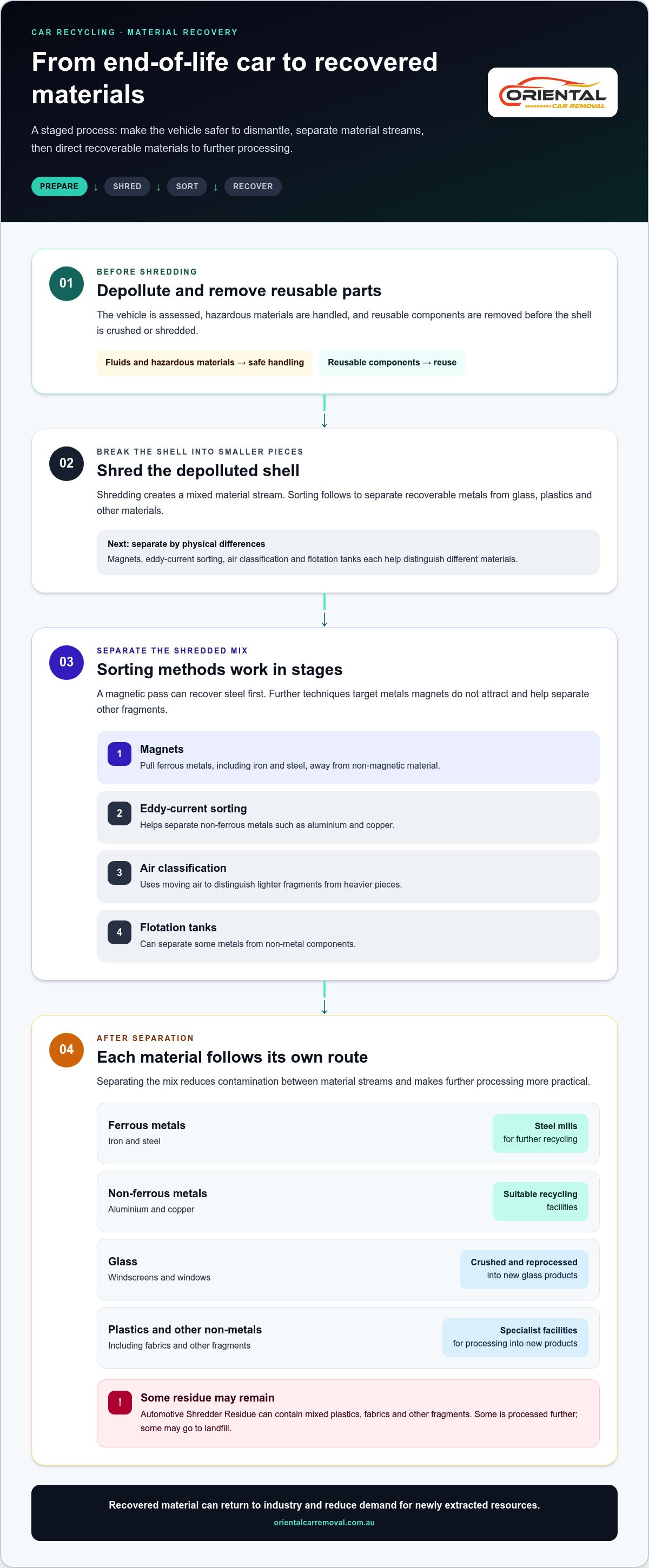
After reusable components are removed and the shell is depolluted, shredding breaks it into smaller pieces. Sorting then separates recoverable metals from glass, plastics and other materials.

Sorting shredded materials

Sorting separates the shredded mix by using physical differences between materials. This matters because steel, aluminium, copper and non-metal materials need different recovery and processing routes.

Magnets pull ferrous metals, including iron and steel, away from non-magnetic material. Eddy-current sorting helps separate non-ferrous metals such as aluminium and copper. Air classification uses moving air to distinguish lighter fragments from heavier pieces, while flotation tanks can separate some metals from non-metal components.

These methods work in stages. A magnetic pass can recover steel first, followed by techniques that target metals magnets don’t attract. The remaining mix may contain glass, plastics and fabrics. Separating it reduces contamination between material streams and makes further processing more practical.

Each recovered stream has a different next step. Ferrous metal can go to steel mills, while aluminium and copper are sent to suitable recycling facilities. Windscreens and windows can be crushed and reprocessed into new glass products. Plastics and other non-metal materials may go to specialist facilities for processing into new products.

Not all residue is easy or economical to recover. Automotive Shredder Residue can contain mixed plastics, fabrics and other fragments. Some residue is processed further, while some may go to landfill. Sorting helps recover usable materials before the remaining waste is handled.

Processing materials for reuse

Processing prepares recovered metal and non-metal materials for use in manufacturing. Recycling can return materials to industry and reduce demand for newly extracted resources.

Once separated, metal streams are prepared for their respective recycling facilities. Recovered steel can be used again, while aluminium and copper follow separate recovery routes. Glass and plastics also need suitable processing before they can become feedstock for new products.

Depollution supports material recovery by keeping hazardous substances out of the shredder and sorted streams. Fluids, batteries and other hazardous components are removed and handled separately before crushing. This helps prevent pollutants from entering the surrounding environment and keeps recoverable materials from becoming contaminated.

For example, drained oil should not mix with metal fragments intended for processing. A removed battery follows a separate recycling or disposal route, while cleaned steel can be directed towards metal recovery. Separating these items at the right stage makes later sorting clearer and reduces avoidable pollution.

Recovering metals also reduces reliance on virgin materials that require mining. Recycled metal can re-enter manufacturing, including vehicle production, while recovered glass and plastics may be processed into other products. Materials that are no longer suitable for recovery remain a disposal challenge, so careful separation matters from depollution through to final sorting.

Removal and handling of oils, fuels, batteries and coolants

Before a vehicle is crushed or dismantled, recyclers remove fluids and hazardous components. This depollution stage limits leaks and keeps substances such as oil, fuel and battery acid out of the processing area.

Oils, coolant, brake fluid and windscreen wash are drained and stored separately. Engine oil is collected for controlled disposal and further processing for reuse. Remaining petrol or diesel can be pumped from the tank and filtered to remove contaminants before further use. Keeping each fluid separate helps prevent spills and avoids mixing substances with different handling needs.

Batteries are removed for safe recycling or disposal, including recovery of lead from conventional car batteries. Airbags also need separate handling before dismantling because they contain explosive components. Refrigerants and battery acid are other hazardous materials that require careful removal and storage. Hybrid and electric vehicles need an additional stage: technicians safely disconnect and remove high-voltage batteries before dismantling continues.

Parts with reuse value are removed before the remaining vehicle shell is processed. Engines, transmissions, panels and lights may be cleaned and tested for resale or reuse. Functional components can serve another purpose and supply parts for consumer use instead of being treated as scrap metal. The vehicle’s condition and each component’s usability affect what can be recovered.

For car recyclers and vehicle recycling programs in each Australian state and territory, start with the relevant government environment or transport authority’s vehicle disposal guidance. State and territory rules differ, so use local guidance to understand disposal requirements and find suitable operators in your area.

In Australia, responsible vehicle disposal separates hazardous substances from reusable components and recyclable materials. Fluids are drained before crushing, batteries and airbags are handled separately, and salvageable parts are assessed for reuse. The order matters: removing contaminants first helps protect recovery and reduces the risk of pollution from leaks during processing.

As an owner, you don’t need to drain fluids or remove hazardous parts at home. Leave that work to the recycling process. Instead, remove personal belongings and paperwork, and give accurate details about the vehicle’s condition. A non-running car, damaged truck or unwanted van can still be collected for recycling, with suitable components recovered before its shell is processed.

These stages connect recycling with manufacturing. Reusable engines or panels may return to service, while recovered metals follow separate recycling routes. Materials that cannot be reused or recycled are handled as residual waste. The aim is to recover useful parts and materials while keeping hazardous fluids and components out of those streams.

Car Recycling in Australia: How Old Cars Become Materials

Environmental and economic benefits of car recycling

Recycling end-of-life vehicles recovers useful materials and reduces waste sent to landfill. In Australia, the benefit depends on what dismantlers recover and how they handle the remaining residue.

Environmental benefits and challenges

Vehicle recycling recovers usable materials from vehicles no longer suitable for the road. Responsible dismantling can reduce landfill waste and demand for natural resources.

End-of-life motor vehicles account for approximately 1.36 million tonnes of waste in Australia. The industry currently recovers approximately 70% of this waste. That recovery keeps valuable materials in use, but also leaves a substantial amount requiring further treatment or disposal.

Some materials are difficult or too expensive to separate after shredding. Automotive shredder residue can include mixed plastics and fabrics, and some of it goes to landfill. Thousands of tonnes of non-metal materials from end-of-life vehicles are sent to landfill in Australia annually. Better separation helps, but recycling does not eliminate every waste stream.

Resource and economic benefits

Resource benefits come from returning recovered materials to manufacturing rather than relying solely on newly extracted resources. Mining and processing virgin materials require energy and affect the environment.

Steel recovered from vehicles can be recycled repeatedly without losing strength. Aluminium and copper also have recovery routes, while reusable components can serve another purpose. These materials support manufacturing and consumer use, extending a vehicle’s value beyond its time on the road.

Recycling metal uses about 74% less energy than making metal. That energy saving supports more efficient production and reduces reliance on resource extraction. Recovered steel, for example, can feed into steel production rather than requiring all-new ore.

There are limits. Mixed materials can be costly to separate, and residue that cannot be recovered still needs responsible disposal. Environmental and economic value therefore depends on every stage: dismantling, sorting, material recovery and handling what remains. Effective recycling keeps more valuable resources circulating while recognising that some waste still reaches landfill.

Recycling ferrous and non-ferrous metals

After dismantling and sorting, metal streams are sent to suitable facilities for recovery. Ferrous metals contain iron, while non-ferrous metals include aluminium and copper. Separating them helps each material enter the right recycling process.

Reusable parts include engines, transmissions, lights and catalytic converters. Components in working condition may be cleaned, tested or refurbished for reuse. Steel, aluminium, copper, glass and plastics are processed as materials rather than resold as vehicle parts.

Steel is a major recovery stream. Around 80-90% of the weight of scrapped cars in Australia is recycled, and about 65% of a car’s weight is metal. Recovered steel can be recycled repeatedly without losing strength, making it valuable feedstock for steel mills and manufacturing.

Aluminium and copper follow separate routes because they are non-ferrous metals. Eddy-current sorting can separate them from shredded material, allowing each stream to go to an appropriate recycling facility. Australia exports recovered metal, particularly to Asia, connecting local vehicle recycling with wider manufacturing markets.

Glass and plastics also need separate processing. Windscreens and windows can be crushed and reprocessed into new glass products. Plastics and other non-metal materials can be sent to specialist facilities for processing. Mixed residue is harder to recover, so some material may still require disposal.

Scrap metal values can change as metal rates and market demand shift. The amount and type of material recovered, along with the vehicle’s make, model and condition, affect its potential value. This helps explain why two vehicles of similar size may yield different amounts of recoverable metal.

Recycling ferrous and non-ferrous metals reduces reliance on virgin materials that require mining. Producing steel from recycled metal uses less energy than mining and processing new ore. This can also reduce pollution associated with extracting and processing raw materials. However, the benefit depends on safe dismantling, effective separation and responsible handling of leftover material.

For an unwanted vehicle, arrange scrap car removal

Oriental Car Removal: Cash for Cars

Oriental Car Removal helps Perth owners move on from unwanted vehicles with Cash for Cars and Free Car Removal. It’s a practical next step when a car is damaged, no longer running or ready for recycling, and arranging collection is the main hurdle.

The service also covers Cash for Trucks and Cash for 4WDs and Vans. Oriental Car Removal handles towing and disposal at no charge to the owner, helping simplify the handover. Have your vehicle details and ownership paperwork ready so the disposal can be organised clearly.

If you’re ready to discuss an unwanted vehicle, contact Oriental Car Removal.

Make your next vehicle decision easier

Understanding the car recycling process in Australia can help you decide what to do with a vehicle that’s reached the end of its road life. Turn that decision into a clear handover plan: gather the ownership paperwork, remove personal belongings and arrange collection for a vehicle that can no longer serve you.

Oriental Car Removal offers Cash for Cars, Free Car Removal and Cash for Trucks. These services suit owners ready to move on from an unwanted car or truck without managing the removal themselves. Having the vehicle details and paperwork ready helps make the conversation straightforward.

A vehicle’s final journey can be the start of its materials being recovered for another use. When you’re ready, take the next step and arrange a simple handover with Oriental Car Removal.

You’re ready to move forward with a practical plan for your vehicle.

Frequently Asked Questions

The Process of Car Recycling: What Happens to Your Old Car?

Your old car is assessed, made safe for dismantling, then separated into reusable components and recyclable materials. For example, a working engine may be removed for reuse, while the remaining shell is processed for metal recovery. The exact route depends on the vehicle’s condition and which components remain usable. Materials that cannot be recovered are handled as residual waste.

What are the steps in the car recycling process in Australia?

Australia’s car recycling process generally moves through collection, facility assessment, depollution, parts recovery, shell processing and material sorting. A recycler first records the vehicle and examines its condition. Fluids and hazardous components are removed before dismantling or crushing. Reusable components are separated, then the shell is shredded and its materials sorted. The order matters: depollution must happen before crushing to limit leaks and contamination.

How are end-of-life vehicles collected and transported in Australia?

Vehicles are collected and transported to a recycling facility for logging and assessment. A car that won’t start or has accident damage can still be collected, but its condition affects how it can be loaded and moved. Tell the recycler whether it rolls, where it is parked and whether access is restricted. For fleet vehicles, keep a separate collection record for each one.

How are fluids, batteries, airbags and other hazardous materials removed safely?

Recyclers depollute a vehicle before crushing by draining fluids and removing hazardous components. Oil, fuel, coolant and brake fluid are kept separate for controlled handling, recycling or disposal. Batteries and airbags are removed separately, and hybrid or electric vehicles need high-voltage systems made safe before dismantling. Don’t attempt to drain fluids or remove airbags yourself; leaving these tasks to trained dismantlers helps prevent spills and injury.

Do vehicle owners need to cancel registration or return number plates when scrapping a car in Australia?

Notify the relevant transport authority when disposing of a vehicle, and follow your state or territory’s instructions for registration cancellation and number plates. The process differs across Australia, so don’t assume the same plate-return steps apply everywhere. Keep the handover details and vehicle identification information together when lodging disposal paperwork. This helps you maintain a clear record and avoid later registration complications.

How much can you get for a scrap car in Australia, and what affects the price?

A scrap car’s value depends on its condition, age, market value, weight and recoverable components. The make and model can also affect the value of reusable parts and metal. A complete vehicle with usable components may be assessed differently from a stripped or heavily damaged shell. The price depends on the case and is given after a quote request, based on the vehicle and its recoverable value.

How can I choose a licensed and reputable car recycler in Australia?

Choose a licensed operator and look for clear information about vehicle assessment, depollution and disposal records. Ask how the operator handles hazardous materials and what paperwork records the handover. ISO 14001 is an environmental management system certification relevant to car recyclers, according to the International Organization for Standardization. It can inform your assessment of environmental management, but it does not replace checking the applicable state or territory requirements.

What documents and proof of ownership are needed to recycle a car in Australia?

Have proof of ownership ready, along with the vehicle’s registration and title documents. If the vehicle is subject to an outstanding loan or lease, gather the related paperwork too. For a company fleet, organise documents by vehicle and keep each vehicle’s identification details with its disposal record. Remove registration and insurance documents from the car before collection, and retain your handover records for reference.

Licensed Car Wreckers for Scrap Car Disposal in Joondalup

Licensed Car Wreckers for Scrap Car Disposal in Joondalup

Saturday access can shape the whole car-removal plan. In Joondalup, scrap-car disposal can include free vehicle removal and towing, and old cars that no longer run may still be bought for scrap. Choosing licensed car wreckers in Joondalup also means looking beyond collection to what happens during dismantling and recycling.

An unwanted vehicle can be a headache, especially when it won’t start or you can’t arrange a weekday pickup. This guide explains what to consider when looking for licensed car wreckers in Joondalup, including Saturday collection, selling a non-running car and responsible scrap disposal. You’ll also learn how dismantling and recycling fit into the process and which vehicle details can affect an offer. Use these practical steps to plan your next move.

Key Takeaways

  • Understand what vehicle dismantling and recycling can involve, from preparing a car for collection to separating reusable materials.
  • Use the northern Perth pickup section to plan collection around your location and preferred timing, including Saturday availability.
  • Learn what can affect a cash offer for a non-running car, and what vehicle details to have ready when arranging a quote.
  • See how free removal can simplify disposal when an unwanted vehicle can’t be driven.
  • Review the practical steps for scrap-car disposal, including ownership details and what to consider before the vehicle is collected.

Vehicle dismantling and recycling

Vehicle disposal can involve collection, dismantling and recovery of materials from cars in different conditions. Before arranging removal, find out what happens to the vehicle and prepare the ownership paperwork needed for the sale.

Vehicle Dismantling and Material Recovery

Dismantling separates a vehicle into components, reusable auto parts and materials for recycling. A responsible process also identifies hazardous contents, such as battery chemicals, engine oil, coolant and refrigerant, for appropriate handling. Ask how the vehicle will be processed, rather than assuming every component can be reused. For a 4WD, compare the vehicle’s condition and reusable components with 4WD wrecking options.

A responsible dismantling process separates reusable parts and recoverable materials from fluids and other waste. Vehicle age, damage and condition affect which components may be suitable for reuse. Avoid attempting to drain fluids yourself; these materials need appropriate handling.

Vehicle Collection and Towing

Oriental Car Removal buys unwanted vehicles and provides free towing and removal in Joondalup. Same-day collection may be possible, subject to address, vehicle and logistics, and is not guaranteed. When arranging pickup, describe the access route and say whether the vehicle is obstructed. A narrow driveway or locked car park can affect how the tow truck reaches it.

Have the keys and proof of ownership ready, if available. If the vehicle is at a workplace, apartment complex or roadside location, explain its exact position and any access restrictions. These details help plan the removal and avoid delays at pickup.

Vehicles Accepted for Sale

Oriental Car Removal buys unwanted, scrap and accident-damaged vehicles across different makes and models. A car doesn’t have to be roadworthy or running to be considered. When requesting an assessment, share the make, model, approximate age and known faults. Mention missing components or significant damage too, as these details can affect the vehicle’s value.

What documents are needed to sell or scrap a car in Western Australia? Have proof of ownership available. Vehicle registration isn’t required to sell a car, but proof of ownership is required. Keep a record of the sale and vehicle details for your files.

Offers for Unwanted and Damaged Vehicles

Cash offers are available for unwanted, scrap and damaged vehicles. The make, model, condition, completeness and demand for reusable components can affect the assessment. Give an accurate description, including any accident damage and whether the car starts. This helps ensure the offer reflects the vehicle presented at collection.

How do I transfer vehicle ownership or cancel registration when scrapping a car in WA? Complete the relevant WA vehicle transfer paperwork with the buyer, or follow the WA registration cancellation process if the registration is being cancelled. Keep a copy of the sale or disposal record. Licensed car wreckers in Joondalup can assess and buy your vehicle, then arrange towing, dismantling and recycling as part of the disposal process.

Pickup service areas in northern Perth

Collection coverage depends on the pickup address, vehicle access and the type of vehicle. In Joondalup, removal and towing are available, with same-day removal advertised locally.

Joondalup and nearby pickup planning

For a local collection, start with the exact Joondalup pickup address. If the vehicle is elsewhere in northern Perth, provide the suburb and location so the collection can be planned. A home driveway, apartment car park, workplace or roadside spot can each present different access needs.

Share the vehicle’s location, whether it rolls, and any access restrictions. A car parked behind a locked gate, for example, needs a different plan from one on an open driveway. Clear details help organise pickup without assuming every northern suburb has identical arrangements.

Access, timing and vehicle type

Pickup planning involves more than the suburb. The tow truck needs a workable route to the vehicle, and a non-running car may need different handling from one that rolls. Describe tight turns, low-clearance parking or blocked access before agreeing on a collection time.

Same-day removal is advertised for Joondalup, while timing still needs to fit the vehicle’s location and access. A truck or 4WD may also require a suitable collection arrangement. Giving the make, model and condition helps define the job before the tow vehicle arrives.

Licensing and service assurances

The phrase “licensed car wreckers in Joondalup” raises two separate questions: whether the business is licensed and whether it can collect from your location. A licence claim alone doesn’t explain what removal includes. Look for clear information about pickup, towing, vehicle assessment and disposal.

Keep the agreed collection address, vehicle description and payment terms together in writing. Clear details about free towing and collection in Joondalup are more useful than a broad promise of service across Perth. Oriental Car Removal is licensed, insured and authorised to operate as a car wrecker in WA.

Experience and service area details

Wrecking experience matters in practical ways: recognising vehicle types, assessing damage and planning safe access for collection. Cars, vans, trucks and 4WDs differ in size and condition, so accurate details help shape the removal plan. The vehicle’s make and model can also help identify its category before pickup.

For a northern Perth address outside Joondalup, provide the suburb and the vehicle’s exact position. This keeps service-area information specific instead of relying on a broad regional label. You can review Perth car removal details alongside the practical pickup information before planning disposal.

Do you buy old cars that no longer run in Joondalup?

Yes. Oriental Car Removal buys scrap cars in Joondalup that no longer run. A failed engine doesn’t automatically rule out a purchase. The vehicle’s condition, parts and collection requirements help shape its assessment.

Car Valuation and Offers

Start with the basics: provide the make, model, approximate age and current condition. Explain whether the car starts or moves, whether it has accident damage and whether components are missing. A complete car with engine trouble, for example, may be assessed differently from a stripped vehicle with panel damage.

The buyer weighs the vehicle’s condition and potential for reuse or recycling. Be accurate about faults, including a flat battery, damaged wheels or a seized engine. These details help establish a cash offer that reflects the car being collected, rather than an assumed roadworthy vehicle.

When comparing offers, use the same vehicle details and compare what each offer includes, such as pickup and towing, not just the amount. Before handover, make sure the cash-for-cars purchase clearly states which vehicle is covered, the agreed amount and the collection arrangements.

Cash Offers and Payment Methods

Cash offers are available for unwanted and scrap cars in Joondalup, including vehicles that won’t start. The phrase “instant cash” refers to payment timing, so separate that from the vehicle’s valuation. The amount depends on factors such as condition, completeness, make and model, and whether the car can be accessed for pickup.

Agree on the payment amount and method before the vehicle leaves. Keep a written record of the offer and vehicle details. This gives both sides a clear reference if the condition at collection differs from the description.

A non-running car still needs a practical collection plan. Tell the buyer whether it can roll, steer and brake, and describe its exact position. A car in a narrow driveway or shared parking area may need different towing arrangements from one parked on an open verge.

Before accepting an offer, review the full transaction. Confirm which vehicle it covers, how towing is handled and when payment is made. Describe collision damage, affected panels and missing parts. Clear details help prevent a mismatch between the initial assessment and the vehicle presented at pickup.

For an unwanted car, prepare the keys and proof of ownership for handover. Keep your own record of the sale and payment. This straightforward process also applies when the vehicle is scrap or cannot be driven.

Licensed Car Wreckers for Scrap Car Disposal in Joondalup

Environmental practices and materials recovery

Responsible vehicle disposal separates reusable parts from fluids and materials that need careful handling. A clear process makes scrap removal more convenient and helps reduce avoidable waste.

Licensing and Environmental Compliance

Licensing and environmental handling are separate considerations. Check that the business clearly describes its vehicle dismantling and disposal process, including how fluids and materials are handled. A broad statement that a car is recycled gives less useful information than a clear account of the process.

For example, an engine may contain oil and coolant, while an air-conditioning system can contain refrigerant. These materials need appropriate handling during dismantling. Ask how they are separated from metal and other components and managed afterward.

Clear communication matters at handover. Make sure you understand the collection and disposal steps, and retain your sale or removal records. These give you a practical reference for the vehicle’s destination and the agreed process.

Responsible Vehicle Disposal

Responsible disposal starts with assessing the vehicle for reusable components, such as mirrors, doors or an intact alternator. Parts suitable for reuse can be separated from damaged items, while steel and other recoverable materials can be sorted for recycling.

Different waste streams need separate handling. Batteries, tyres, oils and coolant should not be mixed with general scrap metal. Keeping them apart helps prevent leaks and supports more controlled handling. A damaged car may also need a different dismantling approach from one with intact components.

Not every part is suitable for repair or reuse. Rusted panels, cracked lights and contaminated materials may need another disposal route. The vehicle’s condition determines what can be recovered, so a responsible process distinguishes reusable parts from waste rather than promising that everything will be reused.

Before arranging removal, note any visible leaks, damaged battery or loose parts. Share these details so the collection plan reflects the car’s condition. Keep the keys and proof of ownership separate from components intended for dismantling.

A high cash offer doesn’t explain how a vehicle will be recycled. Consider the offer separately from the disposal process: convenient pickup can save time, but it doesn’t show how fluids or scrap materials are handled. Clear information about sorting, recovery and waste management gives you a better understanding of the vehicle’s end-of-life process.

Unwanted and scrap car disposal in Joondalup

An unwanted car doesn’t need to be roadworthy to be considered for disposal. Oriental Car Removal provides free removal and towing in Joondalup for vehicles that are damaged, scrap or simply no longer needed.

First decide whether you want to sell the vehicle for reuse, dismantling or scrap. Its make, model, completeness and condition help shape the offer and collection plan. A car with a failed engine may still have recoverable components, while a badly damaged vehicle may be assessed mainly for its materials.

Prepare accurate details before arranging collection. Note whether the car starts, rolls or steers, and describe visible damage, missing parts and its location. A car in a tight apartment car park, for example, may need a different plan from one on an open driveway. Clear information helps avoid a mismatch between the vehicle described and the one collected.

Proof of ownership is required to sell a car in Joondalup, while vehicle registration is not required. Keep ownership evidence available and record the buyer’s details and agreed sale terms. Registration paperwork is separate from proof of ownership, so keep relevant vehicle documents together until the disposal steps are complete.

Before handover, remove personal belongings from the cabin, boot and glovebox. Check under the seats and in door pockets for items such as mail, toll tags or garage remotes. Only remove number plates as part of the relevant registration process; removing them does not prove that ownership has changed.

Free car removal makes disposal simpler when a scrap car won’t start or is too damaged to drive safely. Confirm the pickup address, access conditions and vehicle state when arranging collection. Keep the keys ready if available, and point out hazards such as leaking fluids or unstable components.

Choosing licensed car wreckers in Joondalup also means understanding what happens after collection. Ask for a clear outline of dismantling and material recovery. Clarify the cash offer, towing and paperwork separately, since each affects a different part of the handover. A clear process gives you a record of the sale and a definite next step for the unwanted vehicle.

Arrange scrap car removal

Oriental Car Removal: Cash for Cars

When you’re ready to dispose of an unwanted vehicle, Oriental Car Removal offers Cash for Cars and Free Car Removal. The service is designed for owners who want to sell a vehicle and have it collected without arranging repairs or keeping it parked.

For larger vehicles, Oriental Car Removal also offers Cash for Trucks and Cash for 4WDs and Vans. Share the vehicle type, make, model and condition when discussing your options. Details such as whether it runs and where it’s parked help clarify the collection arrangement.

If you’re in Joondalup and want to move ahead with a vehicle sale or removal, contact Oriental Car Removal to discuss your car.

Make your next move with confidence

Disposing of an unwanted vehicle can clear space and remove a task from your list. Decide what matters most: a straightforward sale, collection, or a useful next step for a vehicle you no longer need. Having the make, model, condition and pickup location ready helps you explain what you need.

For Joondalup vehicle owners, choosing licensed car wreckers in Joondalup is part of making an informed disposal decision. Oriental Car Removal offers Cash for Cars, Free Car Removal and Cash for Trucks. Consider which service fits your vehicle, then contact the company to arrange the next step.

A clear plan can make moving on from an unwanted vehicle feel manageable. Take it one practical step at a time.

Frequently Asked Questions

Are you open on Saturdays?

If Saturday is the only day that suits, mention this when arranging collection and provide the vehicle’s location and condition. Saturday collection depends on the address, vehicle and logistics, so confirm availability when you arrange pickup. A car in a shared apartment garage, for example, may need access arrangements as well as towing. Agree on the details before handover so you know when the vehicle needs to be accessible.

Do I need to be present for the car removal?

Arrange for someone to make the vehicle and handover details accessible. If you can’t attend, a representative can meet the tow operator and manage the handover. Tell them where the keys and ownership documents are, and explain restrictions such as a locked gate or apartment parking rules. Make sure they understand the agreed vehicle and collection details.

How Does It Work?

Share the car’s make, model, condition and pickup suburb to start the sale process. Oriental Car Removal uses these details to assess the vehicle and make an offer. If you accept, prepare the keys and proof of ownership for handover. The company handles towing and paperwork as part of its vehicle-buying service. Keep a record of the agreed sale details for your files.

How it works?

Prepare a clear description of the vehicle before arranging removal. Note whether it starts, whether keys are available and where it’s parked. Agree on the offer and collection plan, then remove personal belongings from the cabin and boot. At handover, make sure the vehicle matches the description provided and retain a record of the transaction for your files.

Which car wreckers are licensed to operate in Joondalup, Western Australia?

Oriental Car Removal is licensed, insured and authorised to operate as a car wrecker in Western Australia. If you’re looking for licensed car wreckers in Joondalup, compare the business name on the paperwork with the name you arranged the sale with. Keep copies of the sale and collection documents to identify which business handled the vehicle and its handover.

How can I verify a car wrecker’s licence in WA?

Ask for the wrecker’s legal business name and relevant licence details, then compare them with the sale paperwork. Make sure the details relate to the business handling your vehicle, not only a trading name or unrelated entity. Keep written information with your records and review the paperwork provided for the vehicle purchase and collection.

What happens to vehicles and hazardous materials at licensed car wreckers in WA?

Vehicles can be assessed for reusable components, recyclable materials and waste requiring separate handling. Batteries, oils and coolant should be kept apart from recoverable metal during dismantling. Hybrid vehicles may contain high-voltage batteries that require specialist handling. Ask how different materials are separated and managed after collection.

What should I check before choosing a car wrecker in Joondalup?

Before choosing licensed car wreckers in Joondalup, make sure the business name, written offer and collection details match your understanding. Clarify which vehicle the offer covers, how towing is arranged and what paperwork is handled at handover. Disclose damage, missing keys and restricted access beforehand. A secured apartment garage, for example, needs an access plan as well as a towing arrangement.

Get Rid of an Old Car in Warnbro, Including Non-Runners

Get Rid of an Old Car in Warnbro, Including Non-Runners

Old cars don’t need to run to be considered for removal in Warnbro. If you need to get rid of an old car in Warnbro, a damaged, unregistered or unroadworthy vehicle may still be collected.

It’s reasonable to want clear answers before arranging a pickup, especially when a car can’t be driven and is taking up space. Start by describing its condition, location and your authority to dispose of it.

This guide explains which old and non-running vehicles may be accepted, what details to have ready and how collection, dismantling and recycling work. You’ll also learn what affects a vehicle’s value and which ownership and registration steps to handle, so you can choose the next step with less hassle.

Key Takeaways

  • Old, damaged and non-running vehicles may still be candidates for removal; condition and access affect the next steps.
  • Have proof of ownership, photo identification and any available registration papers ready when arranging a vehicle’s disposal.
  • Share the vehicle’s type, condition and exact location so removal can be planned around access and towing needs.
  • Find out how dismantling separates reusable materials from waste, and what happens to the vehicle after collection.
  • Review the registration and number-plate steps that apply when an unregistered vehicle is sold or removed.

Accepted vehicle types and conditions

In Warnbro, removal can suit more than a running car. Unwanted cars, trucks, 4WDs, vans and utes are relevant vehicle types, while damage, age or mechanical failure can affect how they’re collected. For example, a car with a failed engine may need towing rather than a drive-away collection.

Condition matters for access and handling, but a vehicle doesn’t need to be roadworthy to be sold. In Western Australia, a roadworthy certificate isn’t required to sell a used car; sellers should disclose known issues. Tell the removal operator if the vehicle has accident damage, missing wheels, flat tyres or a locked steering wheel. These details help plan safe towing from a driveway, garage or roadside location.

Collection planning also depends on where the vehicle sits. Give the exact Warnbro address and explain whether a tow truck can reach the car directly. A vehicle parked behind another car, on soft ground or inside a narrow carport may need a different loading approach. Nearby suburbs can be discussed as part of the removal request, with location and access details supplied upfront.

Ownership paperwork is separate from the car’s condition. Have proof of ownership and valid government-issued photo identification ready. Registration papers can help show ownership. If they’re lost, a signed statutory declaration may be accepted in some cases, though acceptance varies. A driver’s licence, registration papers and signed disposal notice are also listed as paperwork sellers need when selling a car in WA.

  • Registered car: Keep the registration papers available and confirm who is authorised to sign.
  • Unregistered car: Explain that it has no current registration before towing is arranged.
  • Damaged or non-running car: Describe the damage and whether the wheels, steering and access are clear.
  • Missing papers: Prepare proof of ownership and photo ID, plus a statutory declaration if relevant.

A free car removal arrangement means towing is provided at no charge to the owner. To reduce paperwork and ownership risks, use accurate vehicle details, keep a record of the disposal and complete the registration steps that apply. Charges beyond towing depend on the arrangement, so read the disposal paperwork before signing.

If the number plates aren’t being transferred, remove them and cancel the registration. After selling the car, cancel its registration and insurance through the WA Department of Transport.

Do you buy old or non-running cars in Warnbro?

Unwanted, damaged and non-running cars can be considered for removal in Warnbro. The vehicle’s condition, access and paperwork help determine the towing arrangements and its potential value for recycling.

Offers for unwanted and damaged cars

Cash offers may apply to old, unwanted, scrap, damaged or unregistered cars. Age alone doesn’t determine a car’s value. Its make, model, condition, usable components and scrap materials can all influence an offer. Provide accurate details so the vehicle can be assessed on its actual condition.

A recycler may offer payment for a scrap vehicle or charge for towing, depending on its condition. Similar vehicle removal services operate worldwide; for instance, providers such as sellyourjunkcarsatlanta.com assess scrap and damaged vehicles based on salvageable parts and metal value. Before agreeing, clarify what the offer covers, how payment is made and whether towing costs apply. Keep the written sale or disposal record with your paperwork.

Removing non-running vehicles

A car that won’t start can be collected by towing rather than driven away. Describe issues such as accident damage, a failed engine, flat tyres or missing wheels. Explain whether the car is in a driveway, behind another vehicle or difficult to reach. These details help plan safe loading and avoid delays at pickup.

For an inspection, make the vehicle accessible and remove personal belongings before collection. If the car is scrap, its condition still matters: missing components and the vehicle’s overall state can affect its assessment. A clear description helps set realistic expectations before the tow truck arrives.

Unregistered cars and council rules

An unregistered car can still be sold privately or to a dealer in Western Australia. The seller should provide a receipt, and the buyer must arrange a permit or towing. If registration isn’t being transferred, remove the number plates and cancel the registration. Don’t drive an unregistered vehicle on public roads without the required arrangements.

The City of Rockingham can issue notices for unregistered vehicles left on residential properties. If an unwanted car is sitting on your property, arrange its removal rather than letting the issue continue. Keep a record of the sale or disposal and the vehicle handover.

Before proceeding, check that the removal operator holds the appropriate licence; Consumer Protection WA advises checking an operator’s licence. For a practical next step, review the details involved in unwanted car removal and prepare the vehicle’s condition, location and ownership paperwork.

Responsible vehicle dismantling and recycling

For a complete old car near Warnbro, arrange collection through a vehicle removal or recycling service. Local waste facilities may accept residential scrap metal free, subject to staff acceptance, but this does not mean they accept whole vehicles.

Vehicles accepted for recycling

Cars, trucks, 4WDs, vans and utes can enter the vehicle recycling process, including vehicles that are damaged or no longer roadworthy. The vehicle’s condition affects what can be reused and how it must be moved. Describe missing parts, accident damage and whether it rolls, so the recycler can plan collection and assess its materials.

After collection, dismantling separates parts that may be reused from recyclable materials and remaining waste. Up to 95% of each collected vehicle gets a second life in some form. That can include components or materials recovered from a vehicle that is no longer suitable for road use.

Responsible vehicle disposal

Responsible disposal means more than removing a car from a driveway. A recycler dismantles it and sorts materials, rather than treating the whole vehicle as general rubbish. Tell the operator about the car’s condition and any parts already removed. Keep the disposal paperwork, including a record of the vehicle and its handover.

Consumer Protection WA advises checking a WA car removal operator’s licence. This helps you assess who will handle the vehicle before collection. For a non-roadworthy car, use towing rather than driving it to a disposal site. The Department of Transport’s current guidance can also help with disposal and registration steps.

Licensed facilities handle scrap metal drop-offs, subject to staff acceptance, but a complete vehicle requires a dedicated removal service. Oriental Car Removal can assist with proper assessment and towing when you need to get rid of old car Warnbro residents often rely on.

For a whole car near Warnbro, a vehicle removal service is the practical route. A landfill drop-off is for accepted materials, such as scrap metal, not a complete vehicle. Keep these options separate when deciding how to dispose of an old car.

  • Whole vehicle: Arrange towing and vehicle recycling.
  • Scrap metal: Local facilities accept residential drop-offs, subject to staff acceptance.
  • Non-roadworthy car: Share its condition and location before collection.

These steps clarify what happens after removal and help direct each vehicle or material to the appropriate disposal route.

Get Rid of an Old Car in Warnbro, Including Non-Runners

Information needed to arrange removal

Good details make a removal booking easier to plan. Share the vehicle’s type, condition and Warnbro location, especially if access is restricted.

Booking and quotation details

Start with the make, model and vehicle type, then describe its condition. Say whether the engine starts, the car rolls or accident damage affects loading. Include the exact pickup address and any narrow driveway, gate or access issue. These details help assess the vehicle and plan suitable towing.

A quote depends on the vehicle’s condition, useful components and access for collection. Provide accurate information before accepting an offer, and clarify what the quote includes. Ask how payment will be made and what paperwork records the handover. For car removal arrangements, clear details help align the quote with the vehicle being collected.

Steps to arrange removal

Use a simple sequence: describe the vehicle, provide its location, discuss the quote, then agree on collection arrangements. Mention whether it’s registered or unregistered. Tell the operator if the car is blocked in, parked on soft ground or missing wheels. These details affect towing and the collection plan.

Before pickup, remove personal belongings and gather ownership paperwork. A seller or authorised person needs to be present for about 10 to 15 minutes at pickup. Use that time to complete the handover and sign the disposal paperwork. Keep a copy or record for your own files.

For a non-running car, explain the problem rather than simply calling it “broken”. A failed engine, flat tyres or accident damage can each change how the vehicle is loaded. State whether the tow truck can reach the car directly. If it’s parked behind another vehicle, clear the path where possible before collection.

Free car removal means towing is provided at no charge to the owner. Confirm the removal arrangements and read the paperwork for the agreed terms. The vehicle’s condition and pickup access affect the collection plan, while its materials and usable components influence any offer.

An unregistered vehicle can still be sold in Western Australia. Provide a receipt and arrange a permit or towing rather than driving it on public roads. If registration isn’t transferred, remove the number plates and cancel the registration. Keep the disposal record with your other vehicle paperwork.

  • Vehicle details: Type, condition, engine status and missing components.
  • Collection details: Warnbro address, driveway access and obstacles.
  • Handover details: Proof of ownership, identification and authorised signatory.
  • Registration details: Registration status, plates and transfer plans.

These details give the removal process a clear starting point and help prevent avoidable collection problems.

Service coverage around Warnbro

Warnbro is roughly 45 kilometres south of Perth’s CBD. That distance makes the exact pickup address and vehicle access important details when planning removal.

A booking should identify whether the car is in Warnbro, Rockingham or Port Kennedy. Naming the suburb helps distinguish locations, but the street address tells the driver where to go. Include the driveway entrance, parking position and any gate or access restriction. A car behind other vehicles needs a different collection plan from one parked beside the kerb.

Distance alone doesn’t describe the job. A non-running vehicle needs towing, while a car with a working engine may be easier to load. Mechanical damage, missing wheels and limited access can change the equipment and handling required. Share these details early so the booking reflects the vehicle and pickup site.

Use this simple booking checklist for Warnbro and nearby areas:

  • Suburb and street address: Give the full pickup location, not just “near Rockingham”.
  • Vehicle condition: State whether it starts, rolls and has visible accident damage.
  • Access: Mention steep driveways, narrow lanes, locked gates or blocked parking.
  • Registration: Say whether the vehicle is registered or unregistered.

These details also distinguish vehicle collection from scrap-metal disposal. A whole car needs a vehicle removal arrangement; individual scrap metal follows different acceptance rules. For a vehicle at a Warnbro home, describe the complete car and its access rather than treating it as a general waste drop-off.

Registration steps remain relevant after collection. If the number plates aren’t being transferred, remove them and cancel the registration. The WA Department of Transport is the authority for registration processes. Keep the disposal paperwork with the vehicle details so you can track the handover and complete the relevant administration.

Before confirming a booking, make sure the quoted arrangement reflects your location and the vehicle’s condition. Check that it identifies the right car, pickup address, towing plan and paperwork. If access changes, such as another vehicle blocking the driveway, update the booking details before collection. Clear information helps keep the process straightforward across Warnbro and surrounding Perth suburbs.

Millar Road Landfill Facility in Baldivis accepts residential scrap metal, subject to staff acceptance. This option is for accepted material, not whole-car collection. Choose the route that matches what you’re disposing of: an intact vehicle needs removal, while separated scrap metal may be suitable for the facility.

Oriental Car Removal: Cash for Cars

Oriental Car Removal buys unwanted cars in Warnbro, including vehicles that are damaged or no longer running. Its Cash for Cars service includes Free Car Removal, so you can discuss the vehicle’s condition and collection arrangements together.

For larger unwanted vehicles, the business also offers Cash for Trucks and Cash for 4WDs and Vans. Share the vehicle type, condition and pickup location when arranging a quote. Clear details help establish the right removal plan and paperwork for handover.

If your old vehicle is ready to go, contact Oriental Car Removal or visit orientalcarremoval.com.au.

Make your next move with confidence

To get rid of an old car in Warnbro, make the handover clear and organised. Gather your ownership paperwork and note anything that could affect access, such as a blocked driveway or a car that won’t start. These details give you a practical starting point for arranging collection.

Oriental Car Removal offers Cash for Cars, Free Car Removal and Cash for Trucks. Share your vehicle’s type, condition and pickup location when making an enquiry. Clear information helps keep the discussion specific to your vehicle. Read the agreed disposal paperwork before signing.

A straightforward conversation can help you decide on your next step and prepare for collection. When you’re ready, arrange removal rather than leaving an unwanted vehicle unused.

Contact Oriental Car Removal to discuss your vehicle and arrange a clear handover.

Frequently Asked Questions

Can trucks, 4WDs, and damaged cars be removed too?

Yes. Oriental Car Removal handles unwanted cars, trucks, 4WDs and vans, including damaged vehicles. A ute with accident damage or a truck that won’t start can still be discussed for removal. Describe its condition and whether it can roll or steer. That helps plan collection and towing around the vehicle’s size, damage and position, rather than assuming it can be driven away.

Car Recycling Perth: What Happens to Your Old Car?

A recycler assesses and dismantles an old car, separating reusable components and recyclable materials from waste. For example, a dismantler may remove usable parts before sorting the remaining metal. The vehicle’s condition affects what can be recovered. Recycling is different from leaving a car at a general waste facility, so arrange vehicle removal for a complete car.

How are vehicle fluids, batteries, and other components handled?

Responsible dismantling separates batteries and vehicle fluids from the metal shell before materials are processed. These items need different handling from scrap metal and reusable components. Parts such as a battery, engine or radiator shouldn’t be treated as ordinary household rubbish. A vehicle recycler sorts each material stream for suitable recovery or disposal, reducing the chance that mixed vehicle waste is sent through one route.

How quickly can you pick up my car in Warnbro?

Pickup timing depends on the booking, Warnbro address, vehicle condition and tow truck access. A car in a clear driveway is simpler to collect than one blocked behind other vehicles or unable to roll. Share those details when arranging removal and agree on a collection time. Same-day pickup is subject to address, vehicle and logistics, and isn’t guaranteed.

I Just Want to Get Rid of My Car – What Are My Options?

To get rid of an old car in Warnbro, you can sell it privately or arrange removal for recycling. A running vehicle may suit a private sale or dealership trade-in—dealerships such as autosalenewport.com provide an example of how used-car buyers assess roadworthy stock—whereas a damaged or scrap car may be more practical to have towed. For an unregistered vehicle, arrange towing rather than driving it on public roads. Keep a record of the sale or disposal and complete the relevant registration steps.

Which car wreckers offer free vehicle removal in Warnbro or nearby suburbs?

Oriental Car Removal offers Free Car Removal in Warnbro. Its service covers unwanted vehicles, with towing arranged as part of removal at no charge to the owner. Give the pickup suburb and exact address, then describe the car’s condition and access. This helps establish a collection plan for locations such as Warnbro, Rockingham or Secret Harbour without assuming the vehicle can be driven.

How much do car wreckers pay for old, damaged, or scrap cars in Warnbro?

The offer depends on the vehicle’s make, model, condition, reusable components and scrap materials. An old car with valuable components may be assessed differently from a heavily damaged vehicle missing parts. The price depends on the case and is given after a quote request. Share accurate details about damage and condition so the offer reflects the vehicle being assessed.

What documents are needed to sell or scrap a car in Western Australia?

Prepare proof of ownership, valid photo identification and any available registration papers. Registration documents can help show that you own the vehicle. Keep a receipt or contract for the sale and have the disposal paperwork completed at handover. A driver’s licence and signed disposal notice may also be needed when selling a car. If someone else signs, they should be authorised to act for the owner.

Heavy Vehicle Wreckers in Naval Base for Business Removal

Heavy Vehicle Wreckers in Naval Base for Business Removal

Yes, a business can arrange removal for more than one unwanted work vehicle by listing each vehicle’s type, make, model, year and condition, along with the collection location and access details. Heavy vehicle wreckers in Naval Base may suit when the vehicles no longer have a defined job and the business wants a direct handover.

It’s practical to weigh removal against keeping a vehicle for upcoming work or managing a private sale. A private sale takes time for advertising, enquiries and handover, while a vehicle that still has a clear role may be worth keeping. Naval Base is about 28 kilometres south of Perth CBD, so location and access matter when planning a collection.

This guide explains when heavy vehicle wreckers in Naval Base may be useful, what details to prepare for a damaged or non-running truck, and how to plan collection. It also covers nearby areas and the next step for Perth businesses ready to clear unwanted vehicles.

Key Takeaways

  • Removal may suit when a work vehicle no longer has a defined role; keeping it can make sense if upcoming jobs still need it.
  • For each truck, note its type, make, model, year, general condition, visible damage and running issues.
  • Share the collection location and access details so the pickup can be planned around the vehicle and site.
  • Naval Base is approximately 28 kilometres south of Perth CBD, and most addresses are reached within 30-40 minutes.
  • For a business clearing more than one vehicle, organise the details for each one before arranging collection.

When commercial vehicle removal may suit a Naval Base business

Removal may suit a Naval Base business when a truck, bus or other commercial vehicle is no longer needed and a direct handover is preferable. Keeping it may make more sense if upcoming work still requires it.

Heavy commercial vehicle removal

Heavy vehicle removal means arranging collection for trucks and buses a business no longer needs. List each vehicle separately, including its type, make, model, year and condition. Note visible damage, whether it runs and the collection location. For a fleet, this gives the enquiry a clear record of each vehicle instead of one general description.

Commercial vehicle wrecking

Truck wrecking means the vehicle is assessed for removal and dismantling rather than kept in service. Compare operators by looking at their relevant licences, experience with the vehicle type, collection arrangements, written terms and paperwork process. Ask for the agreed scope in writing, including what happens to the vehicle after handover. For mixed fleets that include 4WDs, the 4WD wreckers information covers that separate vehicle category.

Selling a truck or bus for wrecking

To sell a truck or bus for wrecking in Naval Base, prepare its make, model, year, condition and location, and describe damage or running issues accurately. Have photo identification and proof of ownership ready. WA registration papers in the seller’s name are usual, and a statutory declaration may be used if the papers are lost. Agree on the handover and complete the disposal notice together.

For an unregistered heavy vehicle in WA, organise proof of ownership and record the handover with the receiving operator. The seller and provider can complete a disposal notice together, removing the seller’s liability for the vehicle from that point onward. Keep your copy of the paperwork with the business vehicle records.

Before choosing a wrecker, compare the written offer, collection method, paperwork and stated vehicle handling. Check that the operator can manage the specific truck or bus, especially if it is damaged or cannot move under its own power. Parts availability varies, so ask about a specific component using the vehicle’s make, model and year.

Removal is worth considering when storage, an unused vehicle or a difficult private sale is taking staff time without serving a work need. A private sale may suit a business with time to advertise, answer enquiries and manage the handover. If the vehicle still has a clear role in upcoming jobs, retaining it may be more practical.

Arranging removal for non-running or damaged trucks

A truck does not need to start or move under its own power for a removal enquiry. Describe its condition clearly so the collection team understands what vehicle is involved and what access arrangements may matter.

Start with details that identify the truck: vehicle type, make, model and year. Then describe whether it starts, moves or steers, and note any obvious damage. “Doesn’t run” is less useful than explaining, for example, that the engine will not start but the truck can still roll. State what you have observed.

For visible damage, describe the affected area and whether it affects the truck’s position or access. A damaged front end, flat tyre or truck parked close to a wall each presents a different collection situation. Photos can show the vehicle’s current condition and surrounding space, but do not replace a clear written description.

Include the exact collection location and practical access details. Note whether the truck is in a yard, behind a gate or among other fleet vehicles. Mention narrow driveways, low clearances, soft ground or other site features that could affect access. At a workplace, identify the entrance and the person who can direct the driver.

Use this enquiry checklist for each damaged or non-running truck:

  • Vehicle type, make, model and year.
  • General condition, visible damage and known running issues.
  • Whether it can start, roll and be steered.
  • Collection address and site access details.
  • Photos showing the truck and its surroundings.

For more than one vehicle, prepare a separate description for each. A fleet list can match each truck to its condition, location and images. This helps avoid confusion when one truck runs and another is immobile, or when vehicles are in different parts of a site.

Before agreeing to collection, make sure the description matches the truck on site. If its condition changes, such as a tyre issue or additional damage, update the details. Keep vehicle records and handover paperwork together so the business can track which truck was collected and when.

If you’re arranging removal for a truck that won’t run, the truck wreckers information can help you take the next step.

Service coverage around Naval Base and nearby suburbs

Collection planning starts with the vehicle’s exact location, not just the suburb name. Naval Base is approximately 28 kilometres south of Perth CBD, and most Naval Base addresses are reached within 30-40 minutes by the car-removal service. For a truck or business fleet, the site address and access conditions help shape practical arrangements.

Nearby business locations may include Kwinana, Henderson, Wattleup and Hope Valley. Give the complete street address, suburb and site entrance for each vehicle. A Naval Base warehouse, an industrial yard in Kwinana and a roadside location near Henderson can have very different access requirements, even when they are close to one another.

Use this location checklist when preparing a collection enquiry:

  • Write the street address and suburb for every truck.
  • Name the gate, yard entrance or loading area used for vehicle access.
  • Describe nearby obstacles, such as parked fleet vehicles or restricted turning space.
  • Explain whether the truck is inside a secured site or positioned on the street.
  • Identify a site contact who can direct the driver to the vehicle.

Access details are especially important for non-running trucks. A tow vehicle needs a workable approach and enough room to position near the truck. A vehicle parked behind other equipment may need a different collection plan from one beside an open entrance. State the truck’s condition and location together so both can be considered.

For businesses operating across Naval Base and Kwinana, group vehicles by suburb before arranging collection. A list showing each truck’s address, condition and access notes makes separate locations easier to distinguish. It also helps prevent a driver being directed to the wrong depot or gate.

Do not treat a nearby suburb as interchangeable with Naval Base. A business in Rockingham or Port Kennedy should provide its own address rather than relying on a Naval Base travel estimate. That estimate applies to most Naval Base addresses, not every location across the wider region.

Before the agreed collection time, prepare the site for the access route. Move equipment only where safe and practical, and make sure the named contact knows which truck is being collected. For a multi-site fleet, keep each location’s vehicle details together. Clear addresses and access notes help match the right truck to the right site.

Heavy Vehicle Wreckers in Naval Base for Business Removal

Collection arrangements

Plan a truck collection around three details: the address, the vehicle’s condition and safe access. For a Naval Base business, clear instructions help identify the correct vehicle and site and prepare for collection without confusion.

Start with the full street address and suburb, then identify the entrance the driver should use. A large industrial site may have separate staff, delivery and loading gates. Name the correct gate and give a simple direction from there, such as “turn left after the warehouse”. If the truck is parked in a yard, describe where it is among nearby vehicles or equipment.

Access information should be specific to the truck, not just the property. Explain whether it is parked on firm ground, inside a shed or behind other fleet vehicles. Note tight turns, low overhead structures, locked gates or narrow driveways. These details help identify possible obstacles before collection is organised.

Make a concise collection record for each vehicle. Include:

  • The vehicle’s type, make, model and year.
  • Whether it starts, rolls or can be steered.
  • Visible damage that could affect access or movement.
  • The exact collection address and entry point.
  • A site contact who can identify the truck on arrival.

For several vehicles at one depot, label each record clearly. For example, “truck beside the eastern workshop” is more useful than “truck in the yard” when a site holds multiple vehicles. If vehicles are at different Naval Base locations, keep a separate address and access note for each. This reduces the chance of a driver being directed to the wrong vehicle.

Prepare the collection area before the agreed time. Move loose equipment only where safe, and keep the route to the truck clear. If the vehicle is blocked in, explain what is preventing access instead of describing it only as non-running. A truck that cannot start may still be accessible; one boxed in by machinery presents a different issue.

Keep the handover straightforward. Have the relevant vehicle and ownership documents ready, identify the person authorised to represent the business, and record which vehicle leaves the site. If the condition or access changes after arrangements are made, update the collection details. Accurate notes help keep the address, truck and handover aligned.

A commercial vehicle removal enquiry should include the collection location and relevant access details. Keep them with the vehicle record so the collection team understands where the truck is and how to reach it. If access instructions change, provide the updated information before collection.

Oriental Car Removal ensures its driver arrives promptly with a heavy-duty tow truck and all necessary paperwork for vehicle collection. Having the site contact ready to identify the truck and provide the prepared ownership documents can support a smooth and clear handover at the collection point when dealing with heavy vehicle wreckers Naval Base services.

Truck wreckers and dismantlers serving Naval Base and Kwinana

For a business in Naval Base or Kwinana, the right truck wrecker depends on the vehicle and collection site. A damaged rigid truck, bus and prime mover each have different dimensions, conditions and access needs. Describe the vehicle accurately before comparing removal arrangements.

Truck dismantling involves assessing a vehicle for reusable components and materials, then separating it for disposal or recovery. This differs from repairing a truck for continued use, where heavy-duty towing and repair services like JTT Towing and Storage focus on restoring viable commercial vehicles. If the vehicle no longer suits business needs, consider whether a direct handover is preferable to advertising it privately and managing buyer enquiries.

Use these points to compare written removal arrangements for a truck or bus:

  • Does the operator handle the vehicle type and its stated condition?
  • Are the collection location and access instructions recorded clearly?
  • Does the written offer describe the handover and vehicle destination?
  • Are ownership documents and disposal paperwork addressed?
  • Is the agreed collection process clear for every vehicle in a fleet?

Ask for the proposed process in writing. This lets a business compare what each arrangement covers, including collection, handover and paperwork. Keep the vehicle description consistent in the enquiry and written terms. For example, distinguish a bus that starts from a truck that cannot move instead of describing both simply as unwanted vehicles.

Parts availability is separate from vehicle removal. A dismantler’s stock depends on the vehicles processed and the components retained. If you need a particular item, identify the truck’s make, model, year and component. Do not assume a nearby dismantler has a matching part simply because it handles trucks.

For a fleet across Naval Base and Kwinana, prepare a separate record for each truck. Include its location, condition and intended handover. A truck at a Kwinana depot may have different access constraints from a bus at a Naval Base site. Separate records help prevent mix-ups during collection and paperwork.

Before proceeding, make sure the person arranging the handover can represent the business and provide ownership documents. Record which vehicle was collected and retain the completed paperwork with business records. These steps create a clear record from the initial enquiry through to handover.

If you’re ready to arrange truck removal, start your vehicle removal enquiry.

Treat that advertised amount as a point to clarify, not as confirmed payment for a particular truck or bus. Ask whether the offer applies to the vehicle described and request the terms in writing. Keep the vehicle details and collection location consistent when seeking or comparing offers.

Before accepting, check the payment offered for the specific vehicle and how it relates to the proposed handover. Confirm that collection arrangements, vehicle identification and paperwork are clear, and keep the written offer with the completed handover records. For a vehicle at a Naval Base site, state its condition and access details accurately. A clear written comparison helps distinguish an advertised maximum from the amount and arrangements offered for your vehicle.

Oriental Car Removal: Cash for Cars

Oriental Car Removal is a practical next step when a business wants to clear an unwanted truck, car, 4WD or van. Its Cash for Trucks service suits businesses considering a handover, while Free Car Removal helps with unwanted vehicles that need collection.

Prepare the vehicle’s type, make, model, year, condition and collection address before making an enquiry. For a truck that will not run, include visible damage and access details so collection can be planned around its condition. Keep ownership documents ready for handover.

Contact Oriental Car Removal to discuss removing an unwanted business vehicle.

Make your next vehicle handover straightforward

Choosing heavy vehicle wreckers in Naval Base is one part of clearing an unwanted work vehicle. Next, decide who will manage the handover and what details your business needs on record. A clear decision can help your team move on from a vehicle that no longer fits its work plans.

Oriental Car Removal offers Cash for Cars, Free Car Removal and Cash for Trucks. These services may suit businesses looking to remove an unwanted vehicle rather than keep it on site. Share the vehicle details and collection address to begin.

Choose the option that fits the vehicle and your business needs. A practical handover can free up space and help keep your next steps organised.

Take the next step when you are ready and make room for what your business needs next.

Frequently Asked Questions

Can a business arrange removal for more than one unwanted work vehicle?

Yes, a business can arrange removal for multiple unwanted vehicles. Keep a separate record for each one, including its fleet number or another internal identifier. This helps match handover documents to the correct vehicle, particularly when several trucks share a depot. If vehicles belong to different business entities, have the relevant representative manage each handover and file the records with that entity’s documents.

Commercial vehicle removal in Naval Base: when is it the practical option?

Removal can be practical when a commercial vehicle no longer supports current or upcoming work and has no clear business purpose. For example, a damaged truck taking up space at a Naval Base depot may be ready for handover rather than a private sale. Compare the time needed to advertise and manage buyer enquiries with the value of keeping the vehicle for planned jobs.

Where can I find heavy vehicle wreckers near Naval Base WA?

Oriental Car Removal serves Naval Base as part of its Perth-area vehicle removal service. Businesses looking for heavy vehicle wreckers in Naval Base can enquire about removing an unwanted truck and provide its location, condition and vehicle details. The business also serves nearby areas such as Kwinana and Rockingham. Share the suburb and site address so the collection can be considered for the correct location.

What heavy vehicles do wreckers near Naval Base accept?

Oriental Car Removal buys trucks, including unwanted, damaged and non-running vehicles. Its vehicle purchases also cover cars, 4WDs, vans and utes. A business should describe the truck accurately, including its make, model, year and condition, so the enquiry concerns the actual vehicle. Don’t assume a bus or a specialised heavy vehicle is included in the same category as trucks; identify it clearly in your enquiry.

Do truck wreckers offer free vehicle collection near Naval Base?

Yes, Oriental Car Removal provides free removal for vehicles, including trucks. Oriental Car Removal offers a complimentary free removal service. For a business arranging a truck handover near Naval Base, include the collection address and the vehicle’s condition in the enquiry. This helps make the arrangements specific to the truck and site, rather than relying on a general fleet description.